

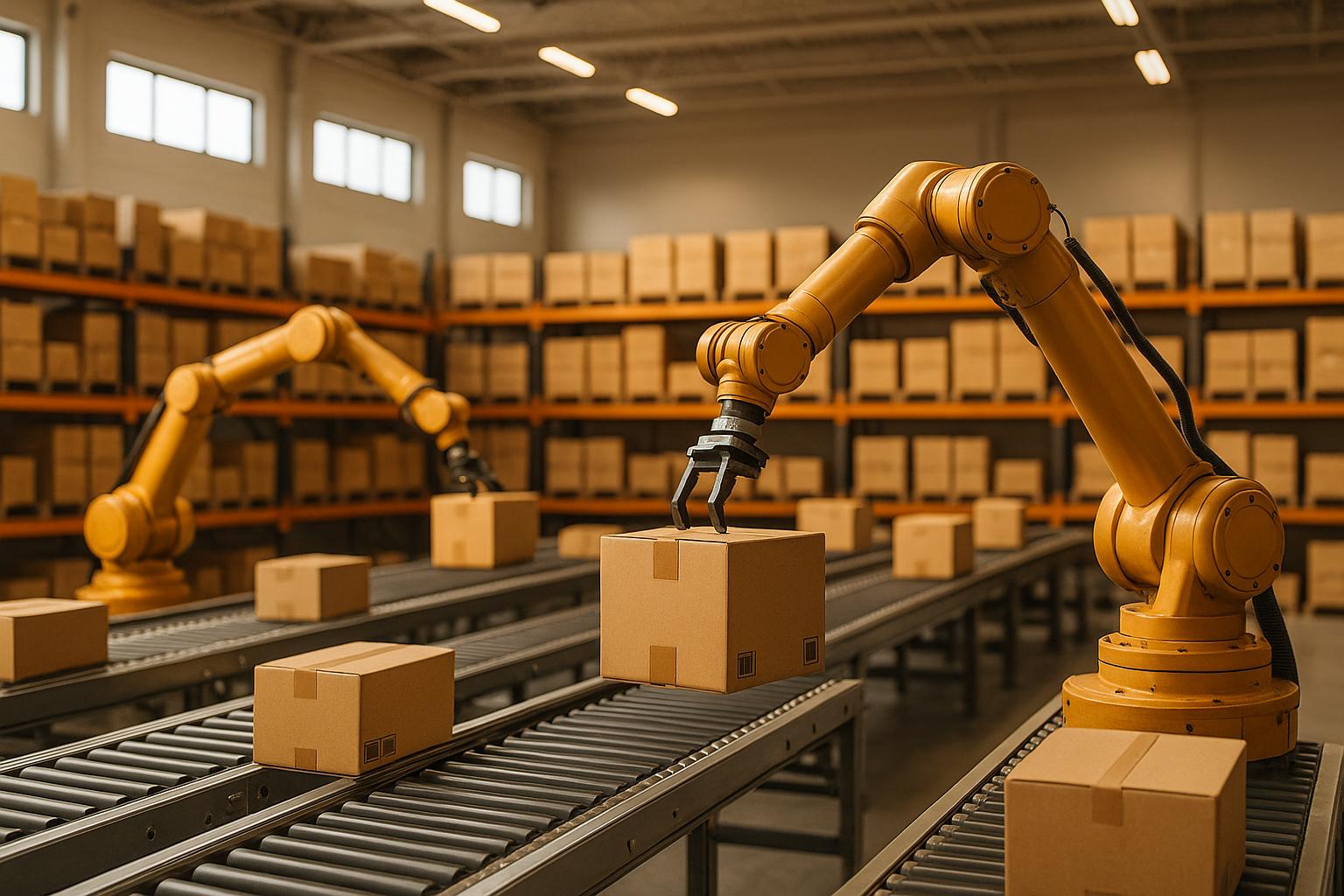
Automation is reshaping eCommerce fulfillment by addressing critical challenges like rising costs, labor shortages, and growing customer expectations for speed and accuracy. Here’s how automation transforms fulfillment:
- Faster Order Processing: Automated systems reduce order processing times from days to hours, improving efficiency and handling high volumes without extra staff.
- Improved Accuracy: Automation minimizes errors, with technologies like barcode scanning and robotics achieving over 99.9% precision.
- Real-Time Inventory Management: Up-to-the-minute inventory tracking reduces stockouts, overstock, and lost sales while optimizing stock allocation.
- Lower Labor Costs: Automation cuts labor expenses by up to 50% and enables 24/7 operations, boosting productivity.
- Better Warehouse Space Usage: Vertical storage solutions and automated systems reclaim up to 90% of floor space, maximizing efficiency.
- Scalability: Automation handles demand spikes like holiday seasons efficiently, with flexible systems like Robots-as-a-Service (RaaS).
- Safer Workplaces: Automated systems take over hazardous tasks, reducing injuries and creating healthier work environments.
Automation is no longer optional for eCommerce businesses aiming to stay competitive. While initial costs can be high, financing options like revenue-based funding from providers such as Onramp Funds make automation more accessible. By improving speed, accuracy, and cost-efficiency, automation helps businesses meet customer expectations and scale effectively.
World’s most advanced robotic warehouse (AI automation)
1. Faster Order Processing
When customers hit "buy now", they expect their orders to move through your system quickly and efficiently. Automation turns what could be a slow, manual process into a well-oiled operation that handles more orders in less time.
Automated picking systems take the tedious task of workers walking through aisles out of the equation. By using robotics and intelligent routing, these systems optimize picking paths and speed up product retrieval.
With automation, order processing times shrink drastically - from days to just a few hours [6]. This is possible because automated systems simultaneously manage tasks like order entry, inventory checks, route optimization, and even generating shipping labels [6].
Companies like AccuformNMC and Standard Electric have seen impressive results, reporting 100% data extraction accuracy and processing speeds that increased by up to 88% [6]. This efficiency allows businesses to handle high volumes of orders without hiring extra staff, cutting costs while keeping customers happy.
Intelligent order routing is another game-changer. Automated systems quickly analyze factors like inventory levels, warehouse locations, and delivery timelines to decide the best fulfillment center for each order [3]. This eliminates the delays caused by manual decision-making, ensuring smoother operations.
Automation also takes care of shipping labels, packing slips, and customs paperwork in an instant, moving orders seamlessly from confirmation to shipping [4].
For businesses dealing with returns, automation significantly reduces processing times - from minutes to just seconds - saving as much as 1,700 hours annually [3]. For example, Native Shoes revamped its return process and now handles up to 50,000 returns per year without increasing labor costs.
In a market where 63% of consumers expect three-day delivery as the norm [5], speed is critical. Automation not only meets these expectations but also ensures accuracy and reduces errors throughout the fulfillment process, giving businesses a competitive edge.
2. Fewer Errors and Better Accuracy
After speed, accuracy becomes the next big priority. When humans handle order processing manually, mistakes are almost unavoidable. In fact, manual processes are responsible for about 80% of errors in warehousing operations [8], which can lead to profit losses and strained customer relationships.
Automation changes the game by delivering near-perfect precision. Robots follow programmed instructions with over 99.9% consistency [7], removing risks tied to human fatigue, distractions, or simple errors. This level of accuracy is essential, as the ideal range for order accuracy is between 96% and 98%; falling below 95% can put a business at a serious disadvantage [9].
A great example comes from 2025, when a retailer adopted automated barcode scanning and real-time inventory tracking. This move reduced errors by 40% and shortened fulfillment times by 30%, leading to happier customers and lower operational costs [8].
The backbone of this accuracy lies in technologies like barcode scanning and RFID systems, which provide real-time inventory updates [2]. With machine learning, these systems can even spot and address anomalies before they become problems [7].
Automated packing systems also play a key role, ensuring items are packaged consistently, shipping labels are accurate, and the right products are sent out [2]. This eliminates common mistakes like sending the wrong size, color, or quantity.
3. Real-Time Inventory Management
Real-time inventory management takes the speed and precision of automation to the next level. By providing an up-to-the-minute view of stock across warehouses, stores, and fulfillment centers, it eliminates the guesswork that often leads to costly errors. This continuous, unified visibility reshapes how eCommerce businesses operate, ensuring they stay ahead in a competitive market [10].
The numbers speak for themselves. Nearly 45% of supply chain executives have flagged real-time inventory visibility as a "significant issue" [11]. Meanwhile, 46% of shoppers check product availability online before heading to a store [12]. When businesses fail to meet these expectations, they risk losing sales. Real-time inventory management bridges this gap, offering a level of precision that drives measurable improvements across key metrics.
Take Amazon, for example. In December 2024, they introduced Proteus, a robot capable of lifting nearly 900 pounds and working up to 20 hours a day. Integrated with Amazon's warehouse management system, Proteus provides real-time tracking of inventory and worker activities, ensuring daily goals are met with remarkable accuracy.
The benefits of automated inventory systems are clear. They’ve been shown to cut stockouts by 37%, reduce overstock by 29%, improve customer satisfaction by 24%, and lower lost sales by 31% [13]. One grocery chain, for instance, used RFID-based tracking to reduce perishables stockouts by 30%. Similarly, an e-retailer slashed stockouts on best-selling products by 40% using predictive analytics [13].
By consolidating inventory data into a single source and using sales patterns and forecasts to guide decisions, businesses can allocate stock intelligently and ensure product availability [10].
"When you order the right quantity of goods and place it where it needs to be, the 'cleaner' your inventory picture and decisions will be." - John Appert, Chief Supply Chain Officer, Standvast Fulfillment [11]
This streamlined approach not only optimizes stock replenishment but also reduces carrying costs, ensuring products are available when and where they’re needed. It’s a system built for efficiency, preparing businesses to tackle the challenges and opportunities that come with further automation.
4. Lower Labor Costs and Higher Productivity
Labor costs make up a hefty portion of fulfillment expenses for eCommerce businesses, typically ranging between 20–30% of total operational costs [16]. Automation offers a practical solution by reducing the need for manual labor while significantly increasing output. In fact, automation can slash labor costs by 50% and improve accuracy by 20% [16].
The productivity boost from automation is undeniable. Take PAC Worldwide’s PACjacket® machine as an example - it churns out 15–20 bags per minute, compared to just 3 bags produced manually. That’s a staggering 400–500% increase in efficiency [15].
Manual order processing can cost businesses more than $10 per order [16]. By redesigning workflows and optimizing layouts, one project increased order volume by 40% without needing additional staff, cutting per-order labor costs by 15% [16]. Similarly, implementing Shopify’s Warehouse Management System led to a 30% reduction in labor costs through smarter automation [16].
Automated systems also bring the advantage of running 24/7. Unlike human workers who require breaks and shifts, these systems operate continuously, allowing businesses to process orders around the clock. This constant availability means higher throughput without a proportional rise in labor expenses [14].
Automation doesn’t just cut costs - it scales operations effortlessly. Businesses can handle growing order volumes, manage multiple sales channels, and navigate peak shopping seasons without the added expense of hiring and training temporary staff [14]. Automated systems eliminate the need for seasonal recruitment, onboarding, and training, which are often costly and time-consuming. Plus, employees supported by automation report feeling less stressed and fatigued, leading to higher retention rates and reduced hiring costs [1].
In addition to automation, cross-training employees has proven to be an effective strategy. Warehouses that train staff to take on multiple roles during busy periods have seen efficiency rise by 20% [16]. This flexibility allows teams to meet shifting demands without increasing headcount.
By leveraging automation and strategic workforce management, companies can grow revenue without significantly increasing their largest operational expense. This approach creates a clear path to greater profitability.
While initial investments in automation can be high, strategic financing options can ease the burden. For instance, Onramp Funds (https://onrampfunds.com) provides equity-free financing tailored specifically for eCommerce businesses, helping them adopt automation without straining cash flow. These systems not only deliver cost savings but also enhance speed and precision, ensuring businesses remain competitive and efficient.
5. Better Warehouse Space Usage
Warehouse space doesn’t come cheap, so it’s crucial to make every square foot count. One way to achieve this is by using vertical storage solutions. By storing inventory upward instead of outward, these systems can reclaim up to 90% of your floor space - a game-changer for facilities where space is tight[17]. This need for efficiency has fueled the rise of smart storage systems.
At the heart of this shift are Automated Storage and Retrieval Systems (AS/RS). These systems take care of placing and retrieving loads, dramatically increasing storage density. Compared to traditional shelving, AS/RS can save up to 85% of floor space[20].
To meet specific operational needs, specialized automated systems offer tailored solutions. For example:
- Vertical Lift Modules (VLMs): These use a central extractor to retrieve trays from two vertical columns, making them ideal for handling heavier loads and making use of high ceilings.
- Vertical Carousels: Operating like a Ferris wheel, these systems rotate to bring items directly to operators, making them perfect for quick retrieval of smaller products. Some systems, like EffiMat, can deliver performance that’s up to four times better than traditional VLMs[17][19].
Beyond space-saving, automated vertical systems also make warehouses safer. They reduce clutter, eliminate overloaded racks, and minimize trip hazards, creating a cleaner and more organized workspace[21]. Workers can then focus on higher-value tasks, while the systems handle the heavy lifting and precise inventory placement.
Here’s a quick look at how different AS/RS solutions compare:
These vertical storage systems can be customized to handle different payloads, heights, and sizes, and they integrate smoothly into existing workflows[18].
"ASRS solutions have been the backbone of efficient warehouse operations worldwide for decades. With over 140,000 Kardex Remstar installations globally, any modern warehouse that hasn't embraced automation is falling behind." – Cal Bowers, Senior Director of New Business - North America, Kardex Remstar[20]
When choosing an AS/RS solution, businesses should weigh both storage density and throughput needs. Often, the best approach combines multiple automation technologies to suit varying inventory profiles and handling requirements. This strategy ensures maximum space use and overall efficiency[22].
For eCommerce operations, the upfront cost of these systems might seem steep. However, the long-term benefits - like lower real estate expenses, improved efficiency, and scalability - usually outweigh the initial investment. Financing options, such as those from Onramp Funds, can help businesses implement these systems without straining their cash flow.
Making better use of warehouse space not only cuts costs but also boosts fulfillment capabilities, tying into the broader advantages of automation discussed earlier.
sbb-itb-d7b5115
6. Better Scalability and Flexibility
When your eCommerce business faces sudden demand spikes during peak seasons, automation can be a game-changer. Instead of scrambling to hire temporary staff or find extra warehouse space, automated systems let you scale up efficiently. This builds on earlier improvements in speed and accuracy, ensuring your operations stay smooth even during high-demand periods.
Many businesses are already using automation and planning to expand further, especially as the global eCommerce fulfillment service market is expected to grow from $124.8 billion in 2024 to over $272 billion by 2030[1].
One smart option is the Robots-as-a-Service (RaaS) model, which allows businesses to add extra capacity during busy times without committing to year-round equipment costs.
But it’s not just about adding more machines. Advanced automation systems can adjust in real time, managing different order types and shifting tasks seamlessly[23]. By designing flexibility into your system from the beginning, you can keep operations running smoothly, no matter how chaotic peak seasons get.
Modular automation systems take this adaptability further. They integrate easily with platforms like Shopify, Amazon, and WooCommerce, while allowing you to add or adjust features as your business grows. For example, when Zappos introduced automated sorting systems in 2012, they cut down warehouse shipping times significantly, boosting customer satisfaction in the process[24].
The key is scaling smartly. Automation enables your business to handle a surge in small-item orders just as effectively as bulk shipments, all while maintaining accuracy and speed.
To make scalable automation more accessible, businesses can explore financing options like those offered by Onramp Funds, helping to fund these critical investments.
Want to see if your operation is ready for scalable automation? Simulate a 30% increase in order volume and walk through your fulfillment process to spot bottlenecks[23]. Cross-train your team to cover multiple stations, and set up temporary scan-and-sort areas to support your workflow during busy times. Agile systems like these can help your business thrive, ensuring faster and more profitable order handling even during peak demand. These scalable solutions work hand-in-hand with broader automation strategies, creating a strong and reliable fulfillment process.
7. Safer Workplace Conditions
In 2020, there were 24,900 reported incidents in warehousing that led to time off work due to injuries, with the majority involving sprains, strains, or tears, and around 1,500 cases resulting in fractures. By 2021, the injury rates in the industry were more than twice the national average[26][25].
Automation has stepped in to address these challenges by taking over hazardous tasks like heavy lifting, climbing ladders, and working in extreme temperatures. This shift not only reduces risks but also allows workers to focus on more strategic roles[25]. Additionally, automated systems help minimize repetitive strain and fatigue, creating a healthier and more efficient work environment. These safety improvements align with automation's other advantages, such as increased speed, precision, and cost savings.
Since 2012, Amazon has been at the forefront of integrating robotics to improve warehouse safety. Their Sequoia system handles mobile shelf transport, while ergonomic automated picking stations reduce physical strain. The Sparrow system, powered by computer vision and AI, identifies, selects, and sorts items into bins, leaving employees to handle the final packaging steps[27].
"Warehouse employees benefit from improved health and safety conditions while also being spared the most repetitive and strenuous tasks." - DHL[25]
In 2025, TGW Logistics partnered with Leroy Merlin, a French retailer specializing in home improvement and gardening, to create a cutting-edge fulfillment center. The center featured the FlashPick solution, which included warehouse robots for order picking, automated depalletizing stations, and ergonomic workstations. These advancements not only reduced physical strain but also attracted more female employees and improved retention rates[25].
The financial upside of safer workplaces is hard to ignore. According to OSHA, workplace safety programs yield an average return of $5 for every $1 invested[28]. With work-related injuries costing employers nearly $1 billion each week in direct workers' compensation expenses, automation offers a clear financial advantage[28].
Smart automation also improves warehouse layouts, reduces the reliance on forklifts, and minimizes manual handling, allowing workers to take on higher-level responsibilities[7][27].
For businesses concerned about the upfront costs of automation, financing options can make these safety upgrades more accessible. Companies like Onramp Funds provide solutions to help eCommerce businesses invest in safety-focused automation. By combining improved working conditions, lower injury costs, and increased productivity, automation presents a strong case for transforming warehouse operations - both for employees and the bottom line.
Funding Automation with eCommerce Financing
As eCommerce businesses look to the advantages of automation, finding affordable financing becomes a critical piece of the puzzle. The upfront costs of automation tools - like warehouse robotics, automated sorting systems, and inventory management software - can be steep, often putting a strain on cash flow. This is where revenue-based financing steps in, offering a more flexible repayment approach tied directly to sales performance.
Unlike traditional bank loans that demand extensive paperwork, collateral, and fixed monthly payments, revenue-based financing adjusts repayments based on how well your sales are performing. When sales are strong, you pay more; during slower periods, you pay less. This flexibility is particularly helpful for eCommerce businesses facing seasonal fluctuations or rolling out automation projects that gradually enhance efficiency.
Onramp Funds provides equity-free financing designed specifically for automating fulfillment operations. By connecting your store to Onramp's secure platform, you can receive tailored funding offers and access capital within 24 hours. This quick turnaround is invaluable when you need to implement automation solutions to solve fulfillment challenges or seize growth opportunities.
"Onramp offered the perfect solution with revenue-based financing to secure the capital we needed to invest in inventory and pay it back at a reasonable time frame once we made sales. The process was quick, easy, and the support was great." - Jeremy, Founder and Owner of Kindfolk Yoga
Onramp's financial structure is straightforward and predictable. They charge a flat fee, typically between 2% and 8% of the funded amount, and repayments are based on a percentage of daily sales, sometimes as low as 1%. With no monthly minimums or fixed payments, the repayment schedule adapts naturally to your cash flow. This kind of flexibility is crucial, especially during the adjustment phase of new automation projects. For instance, implementing a warehouse management system might initially slow operations as your team adjusts, but with revenue-based financing, your repayments decrease in line with your sales during this period.
Onramp's customers have seen impressive results - on average, businesses experience a 60% revenue increase after securing funding, and 75% of customers return for additional financing[29].
"Onramp has simplified cash flow by automating everything: easy to request, set it and forget it payments - quick and fast!" - Torrie V., Founder and Owner of Torrie's Natural
Revenue-based financing can cover up to 100% of automation project costs, from hardware like robotics to soft costs such as software updates, implementation services, and consulting fees[30]. This comprehensive coverage allows businesses to allocate cash to other strategic priorities, such as hiring talent or stocking emergency inventory.
The global market for revenue-based financing is growing rapidly, projected to reach $42.3 billion by 2027, with a compound annual growth rate of 61.8% from 2020 to 2027[31]. This growth highlights the increasing demand for financing models that align with the fast-paced and dynamic nature of eCommerce.
Automation Benefits and Challenges
Implementing automation in eCommerce fulfillment offers significant advantages, but it also comes with its fair share of hurdles. Understanding both sides is crucial for making informed decisions about when and how to embrace automation.
Automation can increase productivity by 20–25%, with some picking operations becoming 2–3 times more efficient, while also reducing labor costs by up to 30% [35][1]. Lower error rates are another major plus, especially since each picking mistake can cost anywhere from $10 to $250 [33]. Automation also supports scalability, a critical factor as 79% of consumers now expect same-day shipping [1]. These benefits align with improvements in speed, accuracy, and space optimization, but the challenges of automation require careful consideration.
On the flip side, the costs of automation can be steep. Industrial robots range from $50,000 to $150,000 each, mobile robots cost between $30,000 and $100,000, and turnkey systems can exceed $500,000. Maintenance fees, which typically add 15–20% of the original system cost, further contribute to ongoing expenses [35].
Integration challenges also pose significant obstacles. Dan Coll from Fulfillment IQ highlights the difficulties:
"Once we delve into the actual implementation, the anticipated smooth integration with existing systems often falls short, uncovering gaps that were not initially apparent." [34]
Managing multiple vendors adds another layer of complexity. Ninaad Acharya, Founder & CEO of Fulfillment IQ, explains:
"Dealing with a multitude of vendors to solve a single integration issue without centralized monitoring brings to light the complex, often chaotic nature of introducing robotics into legacy systems." [34]
Adapting the workforce is yet another challenge. Training costs typically range from $5,000 to $10,000 per employee, and businesses must develop strategies to ensure employees can work alongside automated systems effectively [35]. Additionally, a lack of expertise in robotics and automation can slow down implementation [32].
The table below highlights the key benefits and challenges of automation:
A phased approach can help businesses navigate these challenges. Start by automating high-impact areas, conduct detailed cost-benefit analyses, and explore financing options that align with your cash flow. It’s also wise to budget an additional 10–15% for unexpected costs, as custom automation projects can run 20–30% higher than standard systems [35].
While the road to automation has its challenges, the rewards often outweigh the risks. Beyond measurable gains in productivity, automation can lead to more streamlined operations and a more adaptable work environment.
Conclusion
Automation has reshaped eCommerce fulfillment, turning it from a necessary expense into a powerful advantage. The strategies we've covered show how automation enhances customer satisfaction and streamlines operations, impacting every stage of the fulfillment process. Industry leaders' performance metrics make these benefits hard to ignore.
The numbers speak for themselves. Around 54% of companies have already brought automation into their warehouse operations, while nearly 87% of decision-makers are either planning or scaling up their efforts to handle increasing demand [1]. With the global eCommerce market expected to grow at an annual rate of 18.9% from 2024 to 2030, and 67% of customers willing to switch brands over delayed or inaccurate orders [36], automation is no longer optional. It's essential for meeting customer expectations and staying ahead in a competitive landscape.
Success in this area starts with careful planning. Pinpoint repetitive, error-prone tasks and implement scalable automation tools to streamline your processes. Whether you're dealing with hundreds or thousands of orders daily, automation can scale with your needs without adding unnecessary costs or complications.
For businesses ready to take the leap, funding options are within reach. Onramp Funds offers equity-free, revenue-based financing tailored to eCommerce operations. This ensures you can invest in advanced automation technologies while maintaining flexibility - repayments adjust based on your sales performance, helping you protect your cash flow.
The real challenge isn't deciding whether to automate but choosing and implementing the right solutions quickly. Companies that move now will set the standard for the future, while those who hesitate risk being left behind in a market that's only becoming more automated.
Customers expect faster, more accurate service. From speed to precision, the automation strategies we've discussed don't just enhance your operations - they give you a competitive edge and position your business for lasting success.
FAQs
How does automation improve customer satisfaction and ensure accurate eCommerce order fulfillment?
Automation transforms the way businesses handle customer orders, making the entire process more efficient and reliable. By speeding up order processing and reducing the chance of human errors, it ensures that inventory data stays accurate. This means faster deliveries and fewer mistakes, allowing businesses to consistently meet - or even exceed - customer expectations.
It doesn’t stop there. Automation also enhances order tracking, giving customers real-time updates on their purchases. This level of transparency builds trust and confidence, creating a smoother shopping experience and cutting down on issues like returns or complaints.
What financial factors should eCommerce businesses consider when adopting automation, and how can they manage these costs efficiently?
When implementing automation, businesses need to account for several key expenses: initial costs for purchasing and setting up the technology, regular maintenance fees, and potential long-term savings from reduced labor needs and fewer mistakes.
To handle these costs wisely, consider starting small by automating critical areas first. This approach can help deliver a quicker return on investment (ROI). Additionally, businesses might look into flexible financing options, such as revenue-based funding, which can help manage upfront costs without giving up equity. Prioritize scalable solutions that can expand alongside your business to ensure you get the most value in the long run.
What steps can eCommerce businesses take to identify which parts of their fulfillment process should be automated?
To figure out which parts of your eCommerce fulfillment process could benefit most from automation, take a close look at your existing workflows. Focus on areas like inventory management, order processing, picking and packing, shipping, and returns handling. Pay attention to tasks that are repetitive, spots where delays often occur, or steps where manual efforts tend to slow things down.
Consider key factors such as order volume, processing speed, and error rates to identify where automation could make the biggest difference. Keeping an eye on performance metrics and gathering input from your team regularly can also uncover ways to streamline operations and boost overall efficiency.
Related Blog Posts
Onramp Funds
Funding built around your sales
Connect your store and see what you qualify for. Repay as a percentage of sales, with no personal credit check.
Funding in as little as 24 hours.
