


Managing cash flow while scaling your eCommerce business can be tough, especially when buying inventory in bulk. Paying suppliers upfront ties up money for weeks or months before you see sales, creating financial pressure. Traditional loans with fixed monthly payments don't always align with fluctuating sales, making it harder to cover expenses or seize bulk order discounts.
Here's how to address these challenges:
- Revenue-based financing: Repayments adjust based on daily sales, easing cash flow during slow periods.
- Short-term loans: Fixed repayment schedules offer predictability but require steady cash flow.
- Bulk purchase discounts: Access to funding helps secure discounts of 10%-30%, boosting profit margins.
- Quick funding options: Platforms like Onramp Funds provide capital within 24-48 hours, linking approvals to sales data instead of credit scores.
Using these financing methods, you can stock up for busy seasons, secure supplier discounts, and manage repayments in line with your sales cycles.
Inventory Financing: Cash Without Selling a Thing
sbb-itb-d7b5115
Funding Options for Large Inventory Purchases
Expanding your inventory requires smart financing that aligns with your sales cycles and revenue flow. Below, we break down funding options that not only secure the capital you need but also offer repayment structures designed to match your business operations.
Revenue-Based Financing with Onramp Funds
Onramp Funds provides a flexible, equity-free financing option where repayment adjusts based on your daily sales. Instead of fixed monthly payments, a percentage of your sales is used for repayment - making it easier to manage during slow periods and busier seasons. Approval and funding can happen in as little as 24 to 48 hours by linking your store data from platforms like Amazon, Shopify, or Walmart Marketplace [1][2]. This funding method prioritizes your sales performance and growth trends over traditional credit scores, and personal guarantees are often not required.
One example: A fashion retailer used this type of financing to fund a large Amazon holiday order. With up to 100% of inventory costs covered, they secured bulk discounts and achieved 40% quarterly growth. Repayments were tied directly to sales after fulfillment [2].
Costs are straightforward, with fees ranging from 2% to 8%, ensuring transparency and avoiding hidden charges. This structure helps maintain cash flow while maximizing the efficiency of your capital.
Short-Term Loans for Inventory Purchases
For businesses that prefer fixed repayment schedules, short-term loans are another option. These loans provide an upfront lump sum and typically come with repayment periods of three to 12 months. They often require inventory collateral and have fixed monthly payments [3]. While interest rates are generally higher than traditional bank loans, approval is faster - sometimes within days instead of weeks [5].
This option is ideal for established sellers who can accurately predict cash flow and value the stability of predictable monthly payments. Even if sales fluctuate, the fixed payment structure ensures consistency, making financial planning more straightforward.
Using Funding to Access Bulk Purchase Discounts
Having capital ready can unlock bulk purchase discounts ranging from 10% to 30% [2][3].
For example, purchasing 6,000 t-shirts at $3 each could drop the unit cost to $2.10 with a bulk discount, saving $5,400 overall.
These savings directly enhance profit margins, potentially increasing them by 20% to 40% after sales. Additionally, early funding access allows you to secure manufacturing slots, reducing the risk of delays or stock shortages during peak seasons. Financing can cover anywhere from 50% to 100% of your inventory costs [2], helping you streamline operations and boost profitability.
How to Get Inventory Financing from Onramp Funds
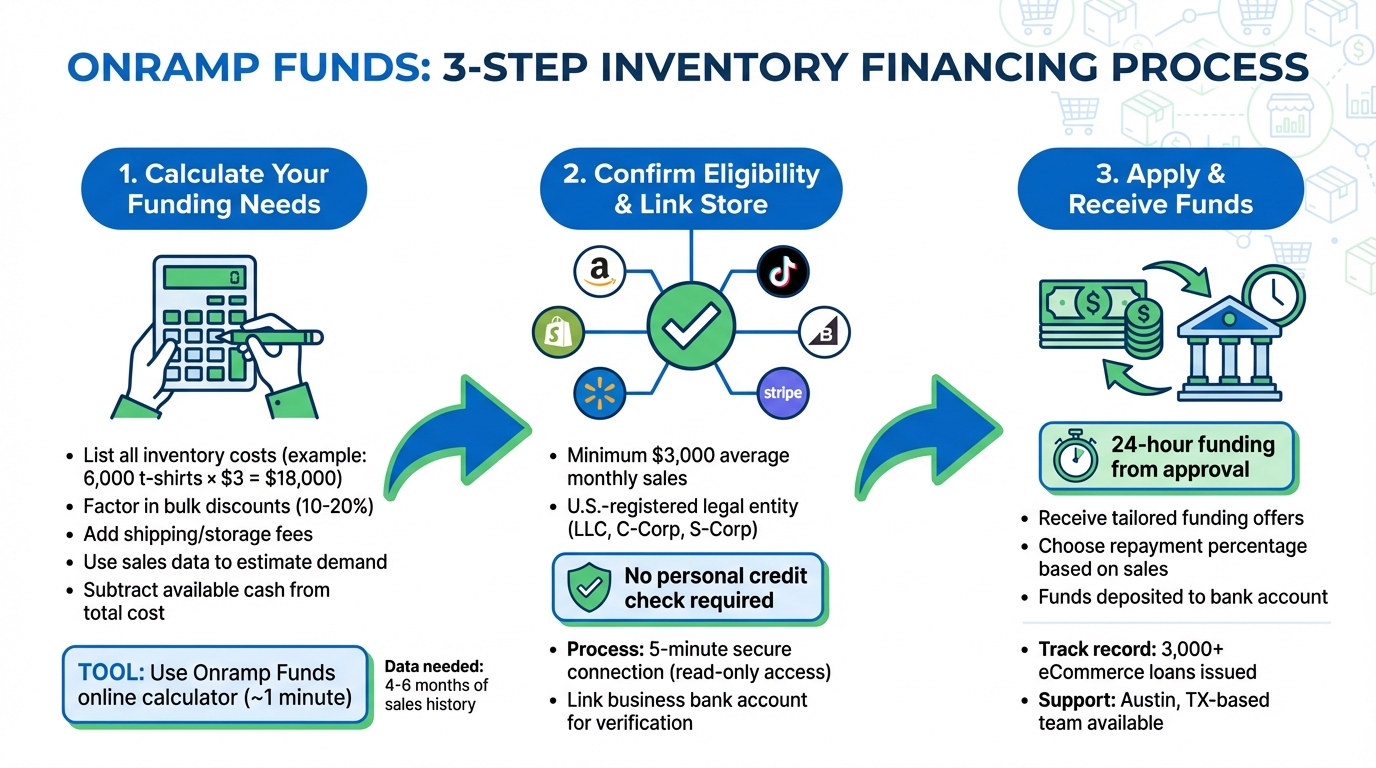
Step 1: Figure Out How Much Funding You Need
Start by listing all your inventory costs. For example, buying 6,000 t-shirts at $3 each adds up to $18,000. Don’t forget to factor in bulk discounts (usually 10%–20%) and shipping or storage fees. Then, use your sales data - like selling 1,000 units per month for six months - to estimate future demand. Subtract your available cash reserves from the total inventory cost to determine how much financing you’ll need. For instance, if your inventory costs $25,000 after discounts, but you only have $10,000 available, you’ll need $15,000 in funding.
To simplify this process, try Onramp Funds' online funding calculator. It gives you an estimate in just about a minute based on your average monthly revenue. Use sales data from the past four to six months for conservative forecasting, helping you avoid overstocking or running out of inventory.
Step 2: Confirm Eligibility and Link Your Store
To qualify for funding, your business must meet two basic requirements: a minimum of $10,000 in average monthly sales and a U.S.-registered legal entity (like an LLC, Single-Member LLC, C-Corp, or S-Corp). Once you meet these criteria, securely connect your eCommerce platform - whether it’s Amazon, Shopify, Walmart Marketplace, TikTok Shop, WooCommerce, BigCommerce, Squarespace, Shopline, or Stripe. This step takes about five minutes and only provides Onramp Funds with read-only access to verify your revenue. Plus, there’s no personal credit check involved [6].
Next, link your business bank account. This direct connection eliminates the need for traditional paperwork, speeding up the approval process by analyzing your sales and cash flow.
Step 3: Apply and Receive Funds in 24 Hours
Once your store and bank account are linked, you’ll receive tailored funding offers from Onramp Funds. Each offer includes a repayment percentage tied to your sales, giving you the flexibility to pick a plan that fits your cash flow. After choosing an offer, funds are typically deposited into your bank account within 24 hours of final approval - sometimes even faster [6].
"Applied, got our offer, and had cash in our bank account within 24 hours. Their Austin, TX based team was very professional and helped me deploy the cash to effectively grow our business", said Nick James, CEO of Rockless Table [6].
Onramp Funds’ Austin-based team is ready to assist you every step of the way. With over 3,000 eCommerce loans already issued, the process is designed to be quick and hassle-free. Once funded, you can immediately place your inventory order and set up repayment schedules that align with your sales patterns.
Setting Up Repayment Schedules That Match Your Sales
Automatic Repayments Based on Your Sales Volume
Onramp Funds offers a repayment system based on a fixed percentage of your daily sales, rather than a rigid monthly payment plan. Here's how it works: if your daily sales hit $2,000 and your repayment rate is 10%, $200 is automatically deducted. If sales drop to $500 the following week, the payment adjusts to $50. This is all made possible through API integrations that connect directly to your eCommerce platform, tracking settled sales and automatically withdrawing the agreed percentage.
This revenue-based repayment model is designed to adapt to your business's actual performance. For example, if your sales slow down due to seasonal shifts, inventory delays, or unexpected market changes, your repayment amount decreases accordingly. This flexibility means you won't be stuck trying to cover a $5,000 fixed payment during a week when your sales only total $2,000. By adjusting with your sales volume, this approach aligns repayment schedules with your business's natural ebb and flow.
Planning for High and Low Sales Seasons
Tailoring repayments to your sales patterns can help protect your cash flow, especially during seasonal highs and lows. Knowing your store's typical revenue trends allows you to estimate how quickly you'll repay your funding. For instance, if 40% of your annual revenue comes in Q4 (October to December), you'll naturally repay more during those months and less during slower periods, like the summer.
With Onramp Funds, the repayment structure includes a fixed fee that is disclosed upfront. This provides clarity from the get-go. For example, if you receive $50,000 with a 6% fee, you'll repay $53,000 in total - whether it takes three months or six. During high-sales months, you'll repay faster, freeing up capital sooner. Conversely, during slower periods, smaller daily payments help preserve cash for critical needs like advertising and inventory restocking. This ensures financing stays aligned with your sales, keeping your business on track for growth.
To make the most of this system, review your historical sales data from the past 12–24 months. Platforms like Shopify or Amazon can provide reports to identify your strongest and weakest months. A good rule of thumb is to keep your repayment rate between 15% and 20% of daily sales. This leaves enough cash on hand to cover operational expenses, even during your busiest times when repayment amounts may be higher.
Reducing Financial Risk When Buying Inventory
Use Past Sales Data for Accurate Forecasting
Your past sales data is a goldmine for understanding inventory trends and planning future purchases. By analyzing a full year of sales, you can spot patterns like peak months, top-selling products, and how quickly inventory moves. This information forms the backbone of accurate demand forecasting.
To fine-tune your forecasts, calculate your inventory turnover (units sold ÷ average inventory). Businesses that forecast demand within a 5% margin of error often unlock over 20% of working capital by avoiding the pitfalls of overstocking and stockouts[7]. When planning significant purchases, use this formula: (Average Daily Sales × Lead Time) + Safety Stock. For items that sell quickly, aim to keep safety stock at 10–20% of your expected demand.
If you're considering financing, having a clear forecast is crucial. For example, if you anticipate selling 1,000 units monthly and want six months of stock on hand, you'll need around 6,000 units. Don’t forget to account for your supplier's lead time when planning your cash flow, ensuring your inventory arrives before stocks run low. Precise forecasting not only prevents tying up resources in excess inventory but also keeps financial risks manageable, especially when it comes to repayment schedules.
Track Inventory Turnover and Adjust Future Orders
Keeping an eye on how quickly your products sell is key to smarter ordering. By tracking metrics like Weeks-Of-Cover (inventory ÷ average weekly sales), you can predict when stock will run out. Pair this with your sell-through rate (units sold ÷ units received) to identify which products are thriving and which might be taking up valuable shelf space.
Prioritize restocking your highest-margin products - the top 20% of your SKUs - and use Gross Profit Return on Inventory (GPROI) to measure how well your inventory investments are paying off. GPROI is calculated as gross profit ÷ average inventory cost. Businesses that leverage tools like data dashboards often reduce stockouts by 12% while freeing up cash that would otherwise be stuck in slow-moving inventory[7]. By focusing on products with proven turnover rates, you’ll not only align inventory with sales but also ensure repayment schedules fit comfortably within your cash flow.
How Onramp Funds Aligns Financing with Expected Revenue
Onramp Funds takes the guesswork out of financing by tying funding directly to your real-time sales data. Unlike traditional lenders that focus on credit scores or existing debts, Onramp evaluates your historical sales, seasonal trends, and growth patterns. This approach ensures that your funding aligns with your projected sales, reducing the risk of overextending your finances.
Repayment is also designed with flexibility in mind. Payments adjust based on your daily sales - when sales are strong, repayments increase; during slower periods, they scale down. This dynamic system safeguards your cash flow during lean times while still keeping you on track with repayments. By syncing repayment terms with your actual sales cycles, Onramp helps you maintain financial stability while fueling sustainable business growth.
Conclusion
Large inventory financing can help maintain financial stability without the stress of rigid repayment schedules. Revenue-based financing from Onramp Funds takes this idea a step further by tying repayments directly to your daily sales. When sales are strong, repayments increase; during slower periods, they decrease. This approach ensures you can manage cash flow effectively while still taking advantage of opportunities to stock up on inventory.
Onramp Funds makes the process fast and straightforward, which is a game-changer for eCommerce sellers. Funding can be available in as little as 24 hours, and eligibility is determined by real-time sales data - not personal credit scores. This means you avoid the lengthy approval timelines that come with traditional banks. As Onramp Funds explains: "Traditional banks don't typically lend to eCommerce sellers since they fundamentally don't understand how they work." [4] By focusing on your actual business performance, Onramp offers financing that aligns with your growth goals.
This model helps businesses grow without sacrificing ownership. It allows you to take advantage of bulk discounts, handle seasonal demand, and scale efficiently. Plus, the automatic repayment system - based on a percentage of sales - means you’re not locked into fixed monthly payments that could strain your budget during slower months. Tying financing to your sales performance keeps your cash flow healthy while driving growth.
FAQs
How do I choose a safe funding amount for a bulk inventory purchase?
To determine a secure funding amount, start by evaluating your sales forecasts, cash flow, and inventory requirements. Accurate predictions are key to avoiding overfunding, which can result in unnecessary interest expenses and strain your cash flow.
Pinpoint your inventory financing gap by considering factors like sales trends, seasonal demand, and supplier payment terms. Historical sales data and metrics such as Days Inventory Outstanding (DIO) can guide you in identifying an amount that fits seamlessly with your business cycle.
What repayment percentage won’t choke my cash flow?
When choosing a repayment plan, it's wise to aim for a percentage that won't put too much pressure on your cash flow. Generally, this falls between 10% to 20% of your sales, depending on the type of financing. Flexible options, such as revenue-based financing, make this easier by adjusting payments according to your sales volume. For instance, dedicating about 10% of your monthly sales to repayments can help you keep cash flow steady, even during slower months.
How fast can I repay if my sales spike or dip?
With revenue-based financing from Onramp Funds, your repayment scales with your sales. During high-sales periods, payments rise, while during slower months, they decrease - making it easier to manage cash flow. Additionally, seasonal financing options are tailored to match your peak and off-season cycles. This means faster repayments during busy times and smaller payments when business slows down. This approach ensures your repayment schedule stays in sync with your business performance.
Related Blog Posts
Onramp Funds
Funding built around your sales
Connect your store and see what you qualify for. Repay as a percentage of sales, with no personal credit check.
Funding in as little as 24 hours.
