


Struggling to decide between funding marketing or inventory? Here's the bottom line:
- Early-stage businesses: Prioritize inventory to validate demand and avoid stockouts. Without products, marketing efforts are wasted.
- Growth-stage businesses: Focus on marketing to scale and acquire customers, but ensure inventory can meet demand.
- Key metrics to guide decisions:
- Marketing ROI: Return on Ad Spend (ROAS) and customer acquisition costs (CAC).
- Inventory ROI: Gross Margin Return on Investment (GMROI) and inventory turnover.
Quick tips for allocation:
- Low stock, high demand: Allocate 80–100% to inventory.
- High stock, slow sales: Focus 80–100% on marketing.
- Balanced operations: Split funds 50/50 between inventory and marketing.
Use demand forecasting to align funding with sales cycles. For peak seasons, prioritize inventory. During slow periods, ramp up marketing to maintain momentum.
Marketing vs. Finance: Who Really Drives Business Growth?
sbb-itb-d7b5115
How Your Business Stage Affects Funding Priorities
The stage your business is in plays a big role in determining where you should focus your funding. Early-stage sellers need to prioritize inventory to prove demand, while growth-stage sellers should channel their funds into marketing to scale effectively.
Early-Stage Businesses: Focus on Inventory
For early-stage businesses, securing inventory is a top priority. Without products to sell, even the best marketing efforts won’t matter. This stage is all about testing customer response and confirming demand. Start small - beta testing and limited launches can help you gauge interest without overcommitting resources.
Keep a close eye on lead times. Knowing how long it takes to source materials and restock can help you avoid stockouts, which would waste any money spent on marketing. A SWOT analysis can be a helpful tool to identify production bottlenecks or gaps in inventory. Address these issues before ramping up customer acquisition efforts.
The risks at this stage are real - only 44% of Kickstarter projects reach their funding goals, highlighting the challenge of validating your product idea[1][3]. Once you’ve proven demand and established a product-market fit, your funding priorities will naturally evolve.
Growth-Stage Businesses: Focus on Marketing
Once your business has consistent revenue and a proven market fit, it’s time to focus on marketing. This is where you can expand your customer base and explore new revenue streams. For instance, DAVAN Strategic used external funding to ramp up marketing efforts, which helped them grow from $73,000 in their first year to over $5 million by year three[2].
"Cash is trash, cash flow is king"[2].
To make the most of your marketing investments, track key metrics like ROAS (Return on Ad Spend) and ACOS (Advertising Cost of Sale) to ensure campaigns are profitable. AI-powered demand forecasting can also help you manage inventory levels more efficiently, freeing up cash for marketing instead of tying it up in excess stock. Negotiating supplier terms, such as paying a 30% deposit and the rest upon shipment, can also improve cash flow for marketing[2].
As Matthew Shearer, SVP at eCapital, explains:
"The brands that scale fastest are not always the ones with the best products. They're the ones with the most liquidity at the right moment"[4].
ROI Analysis: Comparing Marketing and Inventory Returns
To make smarter funding decisions, it's essential to weigh the ROI of marketing against inventory. By crunching the numbers for both, you can pinpoint where your money will work harder for your business.
Calculating Marketing ROI
Marketing ROI measures how much revenue you generate for every dollar spent on acquiring customers. The formula is simple: (Revenue - Marketing Spend) / Marketing Spend. For example, if a $5,000 Google Ads campaign brings in $40,000 in revenue, the ROI is ($40,000 - $5,000) ÷ $5,000 = 7, or 700% [6][8].
Here's what the data says:
- Businesses typically earn $8 for every $1 spent on Google Ads [9].
- Email marketing outshines other channels, delivering $36–$44 for every $1 spent [9].
Trevin Shirey, VP of Marketing at WebFX, emphasizes the long-term value of SEO:
"When it comes to which marketing channels produce the best ROI, SEO dominates. It's a long-term strategy built for driving long-term revenue." [9]
SEO alone can contribute to over 40% of total revenue for many businesses [9].
Calculating Inventory ROI
Inventory ROI, often expressed as Gross Margin Return on Investment (GMROI), shows how much gross profit is earned for every dollar spent on inventory. The formula for GMROI is Gross Profit ÷ Average Inventory Cost. For instance, $20,000 in inventory generating $60,000 in gross profit results in a GMROI of 3.0 [7].
Key benchmarks and insights:
- A GMROI above 2.5 is generally considered strong [7].
- Glossier, a beauty brand, achieves a GMROI exceeding 4.0 by focusing on high-margin products and efficient inventory management [7].
- Inventory Turnover, another critical metric, is calculated as COGS ÷ Average Inventory. Healthy turnover for eCommerce typically ranges from 4 to 8 times per year [7].
- Amazon sets a high bar with an average inventory turnover of 8.5 times annually, showcasing operational excellence [7].
Sahil Agrawal from Qubit Capital highlights the importance of GMROI:
"A healthy GMROI demonstrates efficient inventory investment and profit maximization. Investors typically look for a GMROI greater than 2.5." [7]
It's also crucial to monitor Days Inventory Outstanding (DIO). Keeping your DIO between 30–60 days ensures cash isn't tied up in unsold stock [7]. For example, ASOS improved its cash flow and investor confidence by cutting its DIO from 120 days to around 45 [7]. Be mindful that holding inventory can cost 20–30% of its value annually due to storage, insurance, and potential obsolescence [7]. On the flip side, frequent stockouts can lead to an average revenue loss of 12% per year [7].
Marketing vs. Inventory ROI Comparison Table
| Feature | Marketing ROI | Inventory ROI (GMROI) |
|---|---|---|
| Primary Focus | Customer Acquisition & Spend Efficiency | Asset Utilization & Capital Efficiency |
| Key Metric | ROAS (Return on Ad Spend) / CAC | Inventory Turnover / GMROI |
| Formula | (Revenue - Spend) / Spend | Gross Profit / Avg. Inventory Cost |
| Healthy Benchmark | Varies (e.g., 8:1 for Google Ads) | > 2.5 |
| Risk of Underfunding | Stagnant growth, low brand awareness | Stockouts, lost customers, 12% revenue hit |
| Risk of Overfunding | Diminishing returns, high CAC | High carrying costs (20–30%), dead stock |
Putting It All Together
When deciding where to allocate funds, use these insights:
- High inventory turnover (above 8)? Invest in more inventory to avoid stockouts [7].
- Low turnover (below 4)? Focus on marketing to move existing stock [7].
- If stockout rates exceed 3%, prioritize inventory investments to avoid losing sales [7].
Using Demand Forecasting to Balance Your Budget
Demand forecasting transforms budget management into a proactive strategy. By analyzing past sales data, these tools help predict future demand, aligning your capital with actual inventory needs. This minimizes the risks of overstocking or understocking, keeping your operations smooth and cost-effective [5].
Timing plays a major role here. During peak sales seasons, your priority shifts to inventory - you need enough stock to meet demand. On the flip side, slower periods call for ramped-up marketing efforts to attract new customers and drive traffic. As CrediLinq explains:
"Preparations for Prime Day and TikTok Deals For You Day sales campaigns start ramping up in March. You need cash well in advance to cover creators, video production, and media spend. Waiting on revenue means you miss your window." [11]
By combining financing with real-time inventory tracking, you can better align your cash flow with supply chain demands. This integration ensures that funding decisions for inventory and marketing are in sync with your growth objectives, helping you stay ahead of the curve.
Peak Sales Periods: Fund Inventory First
When demand spikes, inventory takes center stage. Having sufficient stock during these periods is critical - stockouts can lead to lost revenue and damage customer trust. Qubit Capital highlights this:
"Inventory financing plays a vital role during high-demand periods, ensuring businesses can meet market needs without delays or stock shortages." [5]
For instance, a fashion retailer leveraged purchase order financing to fulfill a large holiday order from Amazon. This move enabled the company to achieve 40% quarterly growth by meeting seasonal demand without straining cash reserves [5]. Use your demand forecasts to plan inventory purchases ahead of time. Typically, inventory financing covers 50% to 80% of the appraised inventory value [5][12].
Slow Sales Periods: Increase Marketing Spend
During slower seasons, the focus shifts to marketing. These periods are ideal for experimenting with new customer acquisition strategies, such as YouTube ads, influencer collaborations, or emerging platforms. It’s also a good time to maintain algorithm momentum on platforms like Meta and Google [11].
Cutting back on marketing during these times can hurt momentum, leading to higher costs when demand picks up again. Instead, focus on growing your customer base and driving traffic that’s likely to convert later.
In 2017, Shopfront founder Andrew Romeo used recurring revenue financing from CrediLinq to expand from pharmaceuticals into consumer retail. Rather than putting all the funds into direct ad spend, the company invested in market research, team growth, and audience testing. This strategy paid off, as Shopfront landed a major retail client and boosted projected revenue by over 20% within months [11].
Keep an eye on metrics like Return on Ad Spend (ROAS) and customer acquisition costs (CAC) to ensure your marketing investments are paying off. These efforts not only drive growth but also support liquidity and long-term sustainability.
When to Fund Marketing vs. Inventory: Decision Framework
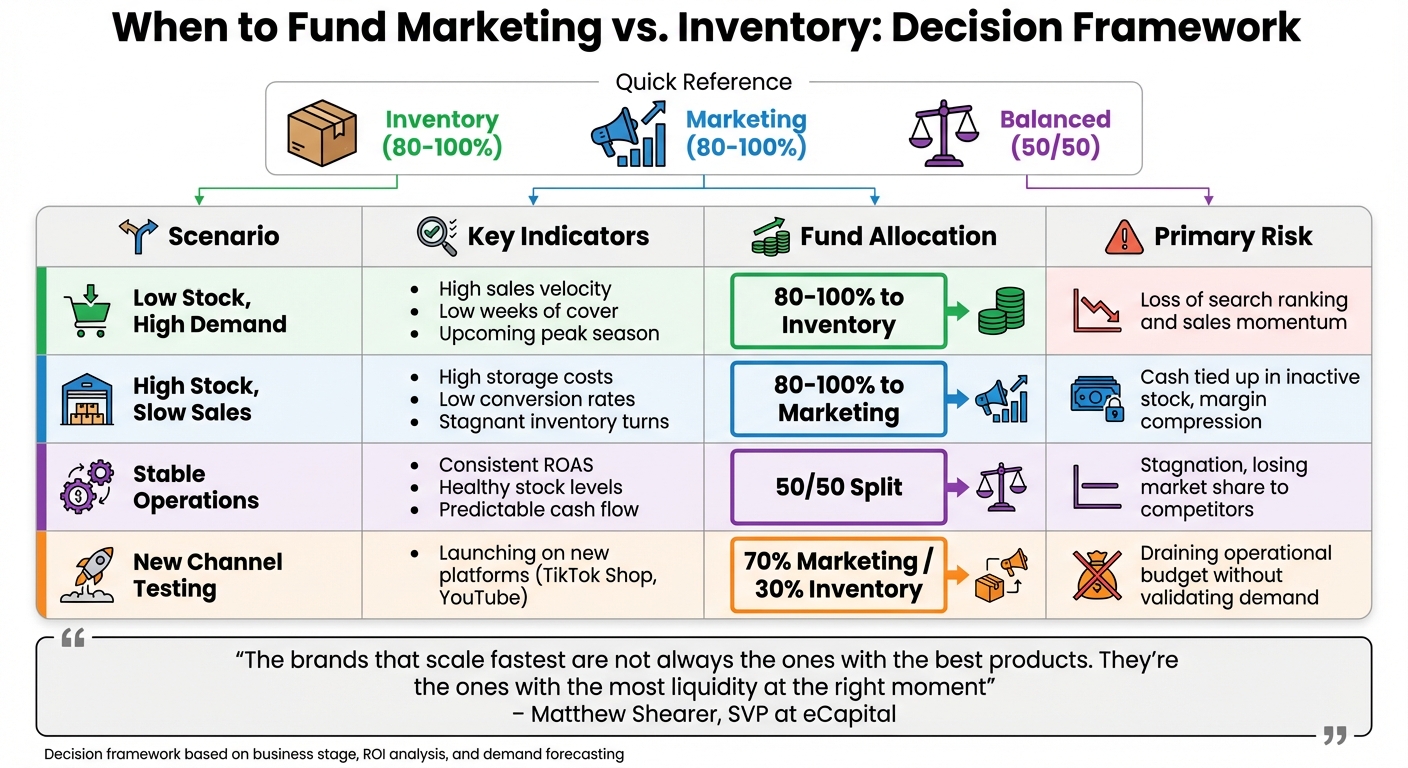
Using insights from ROI analysis and demand forecasting, this framework helps you decide how to allocate funds effectively. Your decision should hinge on factors like stock levels, sales trends, and cash flow predictability. As eCapital puts it:
"The brands that scale fastest are not always the ones with the best products. They're the ones with the most liquidity at the right moment" [4].
Low Stock, High Demand: Prioritize Inventory
When sales are booming but inventory is running low, your top priority should be replenishing stock. Running out of inventory can lead to what eCapital describes as an "inventory death spiral." This happens when you lose search rankings on platforms like Amazon, sales velocity drops, and your advertising efforts become less effective [4]. This scenario often arises ahead of peak seasons or when a product unexpectedly gains traction.
In this case, allocate 80–100% of funds to inventory. Metrics like days of cover (how long your current stock will last) and sales velocity can help you spot this situation early [4]. Neglecting inventory risks losing your search rankings and sales momentum [4].
High Stock, Slow Sales: Focus on Marketing
If you find yourself with high inventory but slow-moving sales, shift your focus to marketing. Excess inventory ties up cash and racks up storage costs, which can quickly erode your margins. This is the time to ramp up product visibility with targeted advertising and promotional campaigns [4][10].
In this scenario, allocate 80–100% of funds to proven marketing channels with strong ROAS. Stick to platforms where you've already seen success instead of venturing into untested areas. The danger here is leaving cash tied up in stagnant inventory while storage fees pile up and products risk becoming outdated [4].
Stable Operations: Balance Inventory and Marketing
For businesses with steady revenue, healthy margins, and consistent stock levels, a balanced approach works best. Split your funds roughly 50/50 between inventory and marketing to maintain growth and avoid bottlenecks. Use ROI analysis to fine-tune this split, focusing on whichever area currently offers better returns. The risk with this strategy is missing out on growth opportunities or losing market share to competitors who are more aggressive [13].
The matrix below provides a clear guide for funding decisions across different scenarios:
Funding Decision Matrix
| Scenario | Key Indicators | Allocation | Primary Risk of Poor Allocation |
|---|---|---|---|
| Low Stock, High Demand | High sales velocity; low weeks of cover; upcoming peak season | 80–100% Inventory | Loss of search ranking and sales momentum [4] |
| High Stock, Slow Sales | High storage costs; low conversion rates; stagnant inventory turns | 80–100% Marketing | Cash tied up in inactive stock; margin compression [4] |
| Stable Operations | Consistent ROAS; healthy stock levels; predictable cash flow | 50/50 Split | Stagnation; losing market share to aggressive competitors [13] |
| New Channel Testing | Launching on new platforms (e.g., TikTok Shop, YouTube) | 70% Marketing / 30% Inventory | Draining operational budget without validating demand [13] |
How Onramp Funds Supports Marketing and Inventory Needs
Securing the right funding is just the beginning - you also need capital that fits seamlessly into the fast-paced world of eCommerce. Traditional bank loans often miss the mark for online sellers who need quick, adaptable financing to match their sales cycles. According to a 2025 Federal Reserve report, 59% of small employer firms sought financing within a 12-month window, underscoring the consistent need for accessible funding [12].
Onramp Funds steps in with customized capital solutions designed to address both marketing efforts and inventory requirements.
Quick Access to Funds for eCommerce Sellers
Onramp Funds provides funding within 24 hours for sellers operating on popular platforms like Amazon, Shopify, TikTok Shop, Walmart Marketplace, and WooCommerce. This speed is crucial during moments like unexpected stock shortages or limited-time marketing opportunities. By integrating directly with your store, the platform uses real-time sales data to determine funding capacity - no lengthy paperwork required.
Flexible Revenue-Based Repayment
Onramp Funds offers a revenue-based repayment model that adjusts automatically to your sales performance. When sales are high, repayments increase; when sales slow, payments decrease accordingly. This approach ensures steady cash flow during seasonal spikes or slowdowns. With the revenue-based financing market projected to grow to $178.3 billion by 2033, the demand for this type of funding is clear [5]. Onramp Funds keeps fees transparent, charging a fixed rate between 2–8%, with no hidden surprises.
Accessible for Businesses with $10,000+ Monthly Sales
Onramp Funds caters to small-to-medium eCommerce businesses generating at least $10,000 in monthly sales. This low threshold means you don’t need years of operating history or perfect credit to qualify. Instead, the platform uses data-driven underwriting, evaluating factors like SKU-level sales velocity and marketplace signals rather than traditional credit scores [4]. This specialized inventory financing allows you to preserve cash for impactful marketing campaigns while ensuring you have the stock needed to meet customer demand [4][12]. By aligning funding with your sales data, Onramp Funds helps you manage your eCommerce operations effectively.
Conclusion
Deciding whether to allocate funds to inventory or marketing depends on your business stage, return on investment (ROI) analysis, and demand forecasting. For businesses in a growth phase, investing in marketing can drive customer acquisition and boost revenue. Start by reviewing your ROI metrics to guide your allocation choices.
Use ROI analysis to weigh the returns from marketing and inventory. For marketing, track metrics like sales growth and customer retention. For inventory, consider how well you prevent stock-outs and take advantage of bulk discounts. Comparing these returns side by side gives you a clearer picture of where your funds will have the most impact.
Demand forecasting also plays a key role. Plan to fund inventory ahead of busy sales periods, like Q4, to meet increased customer demand. During slower months, shift focus to marketing efforts that maintain momentum. This strategy helps you manage the cash conversion cycle effectively, balancing upfront supplier payments with revenue that typically comes in 30–60 days later [3].
FAQs
What numbers tell me to fund inventory vs marketing?
Deciding whether to allocate funds to inventory or marketing comes down to understanding a few key metrics: demand forecasts, sales cycles, and cash flow. For instance, if you're anticipating a surge in demand that requires additional stock, inventory should take precedence. On the other hand, if you're seeing strong revenue growth and a high return on ad spend (ROAS), it might make more sense to channel funds into marketing efforts. Carefully analyzing these figures will help you align your funding decisions with your business objectives and drive profitability.
How much cash should I keep aside before increasing ad spend?
Before ramping up your ad spend, make sure you’ve set aside enough cash to cover your operating expenses and inventory needs. The amount you’ll need depends on factors like your sales cycle and demand forecast. Since every business has different cash flow dynamics and scales, it’s essential to plan thoughtfully to keep your finances stable while expanding your marketing efforts.
How do I forecast demand if I don’t have much sales history?
If you don’t have a long sales history to rely on, you can still forecast demand by digging into past sales data, current market trends, and industry benchmarks. Pay attention to metrics like Days Inventory Outstanding (DIO), Days Payables Outstanding (DPO), and Days Sales Outstanding (DSO) - these can help you identify potential bottlenecks in your operations. Additionally, factoring in seasonal trends and aligning with industry standards can provide valuable insights to predict future demand. This approach can guide critical decisions related to inventory levels, marketing strategies, and overall operational planning.
Related Blog Posts
Onramp Funds
Funding built around your sales
Connect your store and see what you qualify for. Repay as a percentage of sales, with no personal credit check.
Funding in as little as 24 hours.
