

Running your Walmart Marketplace business without a growth plan can leave you stuck reacting to problems like stockouts, cash flow issues, and missed sales opportunities. If you're relying on past revenue to fund inventory or scrambling to meet demand during peak seasons, it’s time to rethink your approach. Planned growth helps you prepare for future demand, avoid costly mistakes, and scale efficiently.
Key Takeaways:
- Reactive Growth Issues: Stockouts, manual processes, financial strain, and missed opportunities.
- Planned Growth Benefits: Use data to forecast demand, streamline fulfillment with Walmart Fulfillment Services (WFS), and secure funding to stay ahead.
- When to Switch: Watch for signs like frequent stockouts, financial instability, or operational bottlenecks. Review performance metrics like on-time delivery and order defect rates to assess readiness.
- How to Implement: Use Walmart’s dashboards to forecast demand, adopt WFS for scalable fulfillment, and manage cash flow with financing options like Walmart Marketplace Capital.
Switching to planned growth isn’t about waiting until you’re overwhelmed - it’s about preparing before issues arise. Walmart’s tools and services make it easier to stay competitive and grow your business steadily.
How to Grow Walmart Marketplace Sales in 2025
sbb-itb-d7b5115
Reactive vs. Planned Growth: What's the Difference?
How you approach growth can determine whether you're constantly scrambling to keep up or building a business that scales smoothly. For Walmart sellers, the choice between reactive and planned growth leads to very different operational and financial outcomes. Let’s break down these two approaches and their impact.
What Reactive Growth Looks Like
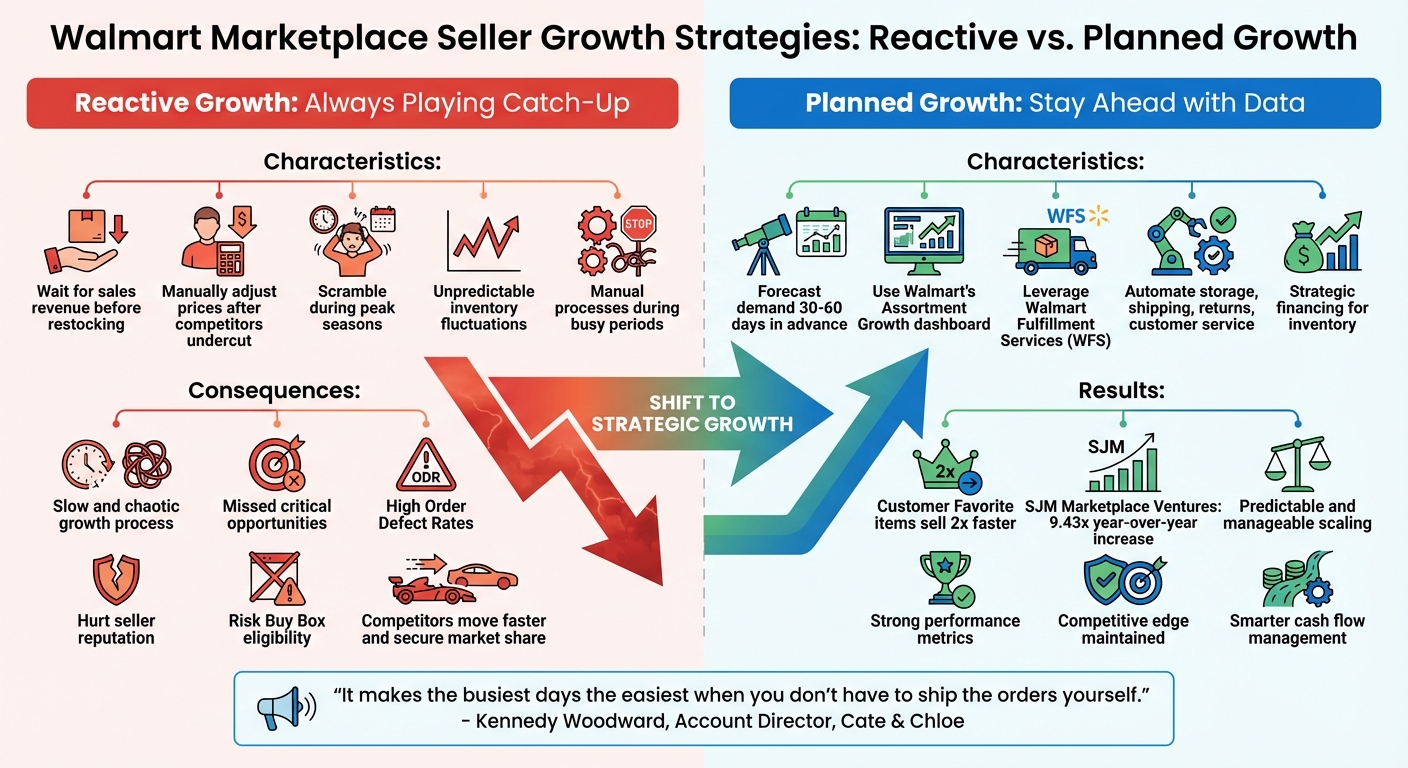
Reactive growth is all about responding to what’s already happened. You wait for sales revenue to roll in before restocking inventory. You manually adjust prices after noticing competitors undercutting you. When peak seasons hit, you scramble to fulfill orders because you didn’t anticipate the surge in demand. This often leads to unpredictable inventory fluctuations and stockouts on high-demand products - right when customers are ready to buy. Add manual processes during these busy periods, and your operations become even more strained.
This approach creates a slow and chaotic growth process that caps how fast your business can expand [1]. By relying solely on available cash, you miss critical opportunities to stock up before demand spikes. Financially, this puts you at a disadvantage, as competitors with access to strategic financing can move faster, secure market share, and leave you behind [1]. Operationally, reactive sellers often face account health issues, from high Order Defect Rates caused by cancellations to inventory inaccuracies. These issues can hurt your seller reputation and even jeopardize your Buy Box eligibility [6].
On the other hand, a planned approach doesn’t just avoid these pitfalls - it turns them into opportunities for growth.
Why Planned Growth Works Better
Planned growth is all about using data to stay ahead. Instead of reacting to past sales, you forecast demand 30–60 days in advance [6]. Walmart’s Assortment Growth dashboard, for example, identifies "Customer Favorite" items that are in high demand. These recommended products can sell up to 2x faster than non-recommended ones [5].
Operationally, the difference is night and day. Sellers focused on planned growth often leverage Walmart Fulfillment Services (WFS), which automates storage, shipping, returns, and customer service. This shift makes scaling predictable and manageable. Take SJM Marketplace Ventures as an example: after switching to WFS between February 2022 and January 2023, they achieved a 9.43x year-over-year increase in their WFS-supported assortment. This freed up their team to focus on growing the business instead of packing and shipping orders [3].
"It makes the busiest days the easiest when you don't have to ship the orders yourself." - Kennedy Woodward, Account Director, Cate & Chloe [3]
Planned growth also means smarter cash flow management. Programs like Walmart Marketplace Capital provide upfront funding for inventory and marketing, enabling you to act on opportunities immediately instead of waiting for revenue to accumulate [1]. With this strategy, you can align inventory levels with seasonality and pricing trends [5][2]. The result? A business that scales quickly, maintains strong performance metrics, and protects its competitive edge. By replacing reactive habits with planned strategies, you can leverage Walmart’s tools to achieve steady, predictable growth.
When to Make the Switch to Planned Growth
Switching to planned growth isn’t about hitting a specific revenue target - it’s about recognizing when your operations and finances are under strain. The key is to spot growth constraints early and evaluate your performance metrics. Many Walmart sellers wait too long, thinking they need to grow bigger first. But often, the best time to make the shift is when you’re still managing growth, not drowning in it.
Spotting Growth Bottlenecks
When your operations can’t keep up with increasing demand, it’s time to rethink your strategy. Common signs include frequent stockouts or overstocking, both of which indicate your inventory management isn’t aligned with demand. If you’re relying on labor-intensive manual packaging during busy periods, that’s another clear bottleneck that will only get worse as you scale.
Take Cate & Chloe, for example. They resolved their peak season bottlenecks by switching to bulk processing, which streamlined their operations. Financial instability is another red flag. If you’re constantly waiting for sales revenue to buy new inventory, you’re operating in a risky “austerity” mode, leaving room for better-funded competitors to pull ahead [1]. ESI, a consumer electronics distributor, faced similar challenges with limited warehouse space and staff for handling large, fragile items. By outsourcing inventory prep and fulfillment to Walmart Fulfillment Services (WFS), they moved from reactive packaging to bulk handling. The result? Triple-digit growth and the ability to expand their product range [3].
Operational challenges like delayed fulfillment during Q4, packaging errors, or difficulty maintaining 2-day shipping speeds are strong indicators that your current approach isn’t sustainable [6][7]. Miko, for instance, identified fulfillment and visibility as their main hurdles. By addressing these issues through WFS, they achieved a staggering 1,573% GMV increase [3]. Recognizing these bottlenecks early allows you to assess whether your growth strategy can scale effectively.
Checking Your Walmart Performance Metrics
Your performance metrics provide a clear picture of whether your current operations can handle planned growth. Start by reviewing your Seller Performance Standards in Seller Center. Struggling to meet the minimum benchmarks - 90% on-time delivery, a 2% or lower cancellation rate, and a 99% valid tracking rate - is a sign that your reactive processes are falling short [9].
The next step is aiming for Pro Seller status, which requires even higher standards: 95% on-time delivery, a 1.5% or lower cancellation rate, a 75% content quality score, and a 50% shipping speed score [10]. Walmart recalculates Pro Seller eligibility twice a month, on the 5th and 20th, giving you regular checkpoints to track your progress.
Pay attention to your Order Defect Rate (ODR), which includes issues like cancellations and refunds. A high ODR points to operational instability that will only worsen as you scale [7][6]. Use Walmart’s Success Hub to identify underperforming items - whether due to poor conversion, uncompetitive pricing, or low inventory levels [4]. The Assortment Growth dashboard can also highlight high-demand products missing from your catalog, which often sell up to twice as fast as others [5].
Ultimately, clean operations, consistent revenue, and disciplined inventory management are what both lenders and Walmart value when evaluating your growth readiness [7]. If your metrics show steady, repeatable sales rather than unpredictable spikes, you’re likely ready to transition from reactive to planned growth.
How to Implement Planned Growth on Walmart Marketplace
Shifting from reactive to planned growth on Walmart Marketplace requires setting up systems that can handle demand forecasting, scalable fulfillment, and effective cash flow management. Here’s how you can use Walmart's tools and strategies to achieve this.
Using Walmart's Data and Analytics Tools
Walmart offers a range of dashboards to help sellers plan inventory and identify growth opportunities. The Assortment Growth Dashboard is a key tool that uses customer demand data to suggest high-priority items for your catalog. These recommendations update every two weeks and highlight "Customer Favorite" items, which can sell up to twice as fast as others [2][5]. Regularly checking and acting on these suggestions can give you a competitive edge.
The Assortment Explorer is another resource, letting you dive into new product categories, analyze in-demand brands, and track trends in seasonality and pricing on a weekly or monthly basis [2]. Meanwhile, the Analytics Dashboard provides detailed sales reports, including Account Sales, Item Sales, and Sales By Department. Use the "Compare" feature to analyze performance over different time frames and spot growth opportunities or declines [11]. Sales data on this dashboard updates almost hourly, giving you near real-time insights [8].
For those using Walmart Fulfillment Services (WFS), the WFS Inventory Insights tool offers a "Suggested Units" metric. This prediction is based on factors like past sales, seasonality, listing quality, and pricing [13]. Additionally, the Item Conversion Report helps identify seller-fulfilled items that could perform better if switched to WFS, ranking them by their potential sales and GMV over the next 30 days [12]. The Inventory Health report further supports planning by providing 1–4 week and 5–8 week sales forecasts, helping you align stock levels with expected demand [13].
Setting Up a Fulfillment System That Scales
A scalable fulfillment system is crucial for long-term success. Statistics show that 66% of top Walmart sellers use WFS, and items fulfilled through WFS often see a 50% boost in GMV, thanks to the "Fulfilled by Walmart" and "2-day shipping" tags [14][3]. WFS covers the entire logistics process, from storage and shipping to customer service, with no signup or subscription fees - just a fixed storage fee and fulfillment pricing based on item size and weight [14].
To get started with WFS, Walmart suggests enrolling your best-performing and premium brands, starting with at least 50 items [14]. The Item Conversion Report can guide you in prioritizing which products to transition. For peak seasons, it’s wise to send inventory to WFS warehouses well before Q4, as processing times can extend from 2 to 10 business days during the holidays [14][3]. Sellers who prepare their entire catalog for WFS ahead of the holiday rush often manage peak demand more effectively without the hassle of manual packing.
For products requiring complex logistics, WFS supports Multi-Box fulfillment at no extra cost beyond standard fees. Additionally, the Walmart Preferred Carrier Program offers discounted FedEx rates for small parcel and LTL shipments. The Inventory Transfer Service can also help you efficiently distribute stock across WFS warehouses [14][3].
Managing Cash Flow and Inventory Planning
To stay ahead, align your inventory spending with demand forecasts rather than past revenue. Use the Assortment Growth Dashboard to identify trending items and review seasonal pricing patterns for smarter purchasing decisions [2]. Keep an eye on "Days of Supply" in the Seller Center or Walmart Seller app. WFS flags inventory with less than 28 days of supply as "At risk", while anything exceeding 28 days is marked "In stock" [15].
If cash flow becomes a bottleneck, consider financing options like Onramp Funds. This service provides revenue-based financing tailored for eCommerce sellers, with repayments tied to a percentage of your sales. This flexible approach ensures you can scale inventory and marketing during peak periods without straining cash flow during slower months. Onramp Funds integrates directly with Walmart Marketplace, offering fast funding (within 24 hours) and repayment terms that adjust based on your sales performance.
Make it a habit to revisit the Assortment Growth Dashboard every two weeks. Use the "Items saved by me for acquisition" filter in the Workspace tab to manage and prioritize new product additions [2]. Maintaining a cash buffer allows you to seize high-demand opportunities immediately, setting you apart from sellers who struggle with stockouts and missed chances. This proactive strategy is key to scaling effectively on Walmart Marketplace.
Tracking Your Growth with Key Performance Metrics
Setting Your Growth KPIs
Once you've put your growth strategies into action, it's crucial to track key metrics to measure progress. Focus on GMV (Gross Merchandise Value), Units Sold, Total Orders, and Average Unit Retail (AUR) to get a clear picture of performance [11].
For Walmart Fulfillment Services (WFS) users, GMV Penetration is a key indicator of success. It shows the percentage of sales coming from WFS items compared to seller-fulfilled products, helping you gauge your Buy Box wins. The Item Conversion Report is another valuable tool - it ranks your seller-fulfilled products based on the potential sales lift if they were moved to WFS [12].
Keeping an eye on inventory health is equally important. Metrics like the Sell-Through Rate help you avoid stockouts and storage fees. A rate of 1.5 or higher is considered "Excellent", while anything below 0.75 could signal a problem [13]. Pay attention to Days of Supply to spot items with less than 28 days of inventory, and monitor Aged Units (items stored for over 365 days), as these can tie up cash and lead to extra fees [13].
Operational standards are another cornerstone of success. To achieve Pro Seller status, you'll need to meet these benchmarks:
- On-Time Delivery Rate: ≥95%
- Cancellation Rate: ≤1.5%
- Seller Response Rate: ≥95% [10]
Starting in spring 2026, Walmart will also evaluate:
- Negative Feedback Rate: Target ≤2%
- Return Rate: Target ≤6%
- Item Not Received Rate: Target ≤2% [9]
Lastly, maintaining a Content Quality Score of 80% or higher can make a noticeable difference in your sales [12].
Adjusting Your Strategy Based on Data
The Analytics dashboard is your go-to tool for spotting trends and making adjustments. Use the "Compare" feature to evaluate GMV, Units Sold, and AUR across different periods [11]. If you see a drop in performance, filter the data by Brand, Category, or Fulfillment Type to identify where improvements are needed.
For inventory issues, a Sell-Through Rate below 0.75 suggests it's time to adjust pricing, run promotions, or clear out aged inventory to free up cash and storage space [13]. If your Listing Quality Score falls below 80%, visit the Growth Opportunities tab in Analytics to improve titles, descriptions, and images [12]. A low GMV Penetration might mean you're missing out - converting high-performing seller-fulfilled items to WFS could help [12].
The WFS overview page offers tailored recommendations, such as restocking out-of-stock items or switching high-potential products to WFS [16]. Also, keep an eye on Unpublished Units - inventory in fulfillment centers that isn't live on Walmart.com due to pricing or trust issues. Addressing these can help recover lost revenue [13]. The Suggested Units metric, which considers past sales, seasonality, and pricing, can guide your replenishment decisions [13].
For real-time updates, the Walmart Seller app's Sales Tracker refreshes hourly, giving you up-to-date GMV and order data [17]. Make it a habit to review this data weekly, take action on dashboard recommendations, and align your inventory with demand to stay ahead.
Conclusion
Switching to a planned growth strategy can transform your Walmart business into a scalable and efficient operation by tapping into data-driven forecasting, smarter inventory planning, and Walmart Fulfillment Services. This method not only helps avoid resource-draining bottlenecks but also creates new opportunities for growth.
Sellers using Walmart Fulfillment Services see an average 50% boost in Gross Merchandise Volume (GMV) for items tagged as "Walmart Fulfilled" and benefit from fulfillment costs that are roughly 15% lower than those of major competitors [19][20]. With over 430 million visits to Walmart.com every month and a carefully curated group of more than 200,000 active sellers (compared to over 2 million on Amazon), the platform offers a uniquely focused marketplace [21][22][23].
"Everything we're building - from smarter tools to expanded fulfillment and global reach - is designed to accelerate seller growth and empower sellers to serve customers while driving their businesses forward."
– Manish Joneja, Senior Vice President, Walmart U.S. Marketplace and Walmart Fulfillment Services [19]
This vision highlights the importance of making data-driven decisions at every step. Planned growth involves using tools like your Analytics dashboard to identify trends early, leveraging Capital by Walmart for quick inventory expansion, and optimizing your listings for AI-driven discovery tools like Sparky and Google Gemini [18][20]. With global e-commerce sales rising 22% in Q1 of fiscal year 2026 [21], Walmart's platform is expanding, and sellers who prepare strategically can claim a larger slice of this growth.
Assess your current performance against these benchmarks. If frequent stockouts or cash flow issues are holding you back, now is the time to act. Walmart provides the tools, data, and financing you need to succeed - put them to work without delay.
FAQs
How do I know it’s time to switch to planned growth?
When your merchandising decisions start moving faster than your ability to plan, it’s a clear sign that it’s time to embrace a more strategic growth approach. Other indicators include constantly reacting to market shifts without a defined strategy or having at least six months of sales data available. This data can be a powerful tool for forecasting, seasonal planning, and securing scalable financing. Taking a planned growth approach allows you to stay ahead of opportunities and build a foundation for long-term success.
Which Walmart dashboards should I check first for forecasting?
The Assortment Growth Dashboard and the Pricing Insights Dashboard are powerful tools to guide your decision-making. These dashboards provide detailed data on product assortment and pricing performance, giving you the insights needed to make smarter forecasting choices.
How can I fund inventory earlier without hurting cash flow?
Inventory financing lets you tap into working capital by using your existing inventory as collateral. This method helps you unlock cash that's otherwise tied up in stock, keeping your business liquid. In many cases, you can access funds within 24 hours, with repayment terms that adjust based on your sales. This flexibility can be a lifesaver during slower seasons, easing cash flow challenges. All you need to do is connect your sales data, apply, and secure the funds you need to restock inventory without interruptions.
Related Blog Posts
Onramp Funds
Funding built around your sales
Connect your store and see what you qualify for. Repay as a percentage of sales, with no personal credit check.
Funding in as little as 24 hours.
