

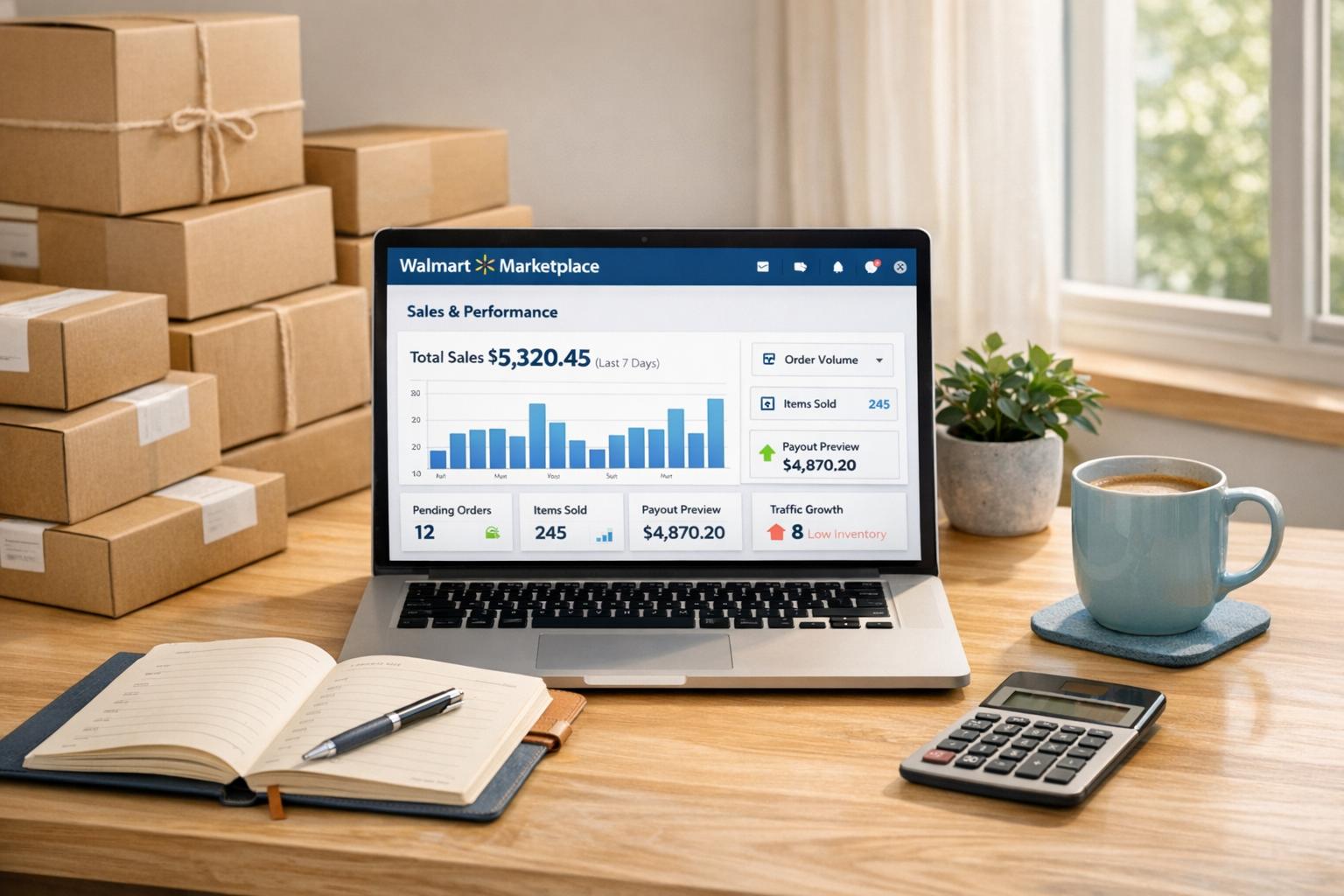
Working capital is the financial lifeline of your Walmart Marketplace business. It’s the difference between your current assets (like cash, inventory, and pending payouts) and liabilities (supplier bills, taxes, and short-term debts). A healthy working capital ensures you can pay suppliers, restock inventory, and handle unexpected costs while waiting for Walmart's two-week payout cycle.
Key Points for Walmart Sellers:
- Working capital ratio: Aim for 1.2–2.0. Below 1.0 signals risks in covering short-term obligations.
- Challenges: Walmart's payout delays can strain cash flow, especially during high-demand seasons.
- Solutions: Tools like Walmart Marketplace Capital or services like Onramp Funds provide faster access to funds, helping bridge gaps between expenses and payouts.
Managing working capital effectively allows you to maintain inventory, meet customer demand, and grow your business without disruptions.
Working capital solutions tailored to your business
What Working Capital Means for Walmart Sellers
Working capital is essentially the financial buffer between what you own and what you owe. For Walmart Marketplace sellers, your current assets include your cash reserves, inventory stored at Walmart Fulfillment Services (WFS) or in your own warehouse, and any pending payouts from Walmart. On the flip side, your current liabilities cover things like supplier invoices, sales tax obligations, employee wages, and short-term debts like Walmart Marketplace Capital installments [6].
Here’s the challenge: there’s often a time gap between when you pay for inventory and when you actually receive revenue from sales. Walmart’s two-week payout cycle means you’re waiting for funds even though your products have already been sold and delivered [3]. This timing mismatch makes working capital essential - it helps you keep your business running while waiting for your earnings to come through.
A healthy working capital ratio, which is calculated by dividing your current assets by your current liabilities, typically falls between 1.2 and 2.0 [6]. If your ratio dips below 1.0, it’s a red flag that you might not have enough liquidity to cover your short-term obligations. For Walmart sellers, this means keeping a close eye not just on your cash balance, but also on the value of your unsold inventory and the funds tied up in pending payouts. Understanding this dynamic is key to managing your business effectively.
| Working Capital Component | Examples for Walmart Sellers |
|---|---|
| Current Assets | Cash in bank, Inventory at WFS or private warehouse, Pending Walmart payouts (Accounts Receivable) |
| Current Liabilities | Supplier invoices (Accounts Payable), Walmart Marketplace Capital installments, Sales tax payable, Short-term loan interest |
Why eCommerce Businesses Need Working Capital
For eCommerce sellers, working capital isn’t just another line on the balance sheet - it’s the fuel that powers your Walmart operations. It ensures you can replenish inventory, experiment with new products, and maintain your sales momentum, even while waiting for payouts. This is especially important for keeping your search rankings and sales velocity strong on Walmart Marketplace. Plus, having adequate working capital allows you to expand your product catalog without waiting for months to accumulate revenue organically [1][5].
The two-week payout delay can strain cash flow, particularly when your suppliers operate on net-30 payment terms or shorter [3]. Without enough working capital, you could miss out on bulk purchase discounts, lose leverage in supplier negotiations, or even face stockouts during high-demand periods. And with Walmart Marketplace growing from 91,000 sellers in 2021 to over 150,000 by 2023, the competition is tougher than ever [5]. Sellers with strong working capital can move faster, test new products more aggressively, and scale their operations, while others are left waiting for their next payout. This financial cushion also helps you navigate slower sales periods without resorting to personal savings [1].
Real Examples of Working Capital for Walmart Sellers
Let’s look at how this plays out in real-world scenarios. Take the holiday season, for example. Many retailers generate 20% of their annual sales during the four weeks between Thanksgiving and Christmas [5]. For some, this figure can climb as high as 70% of yearly revenue concentrated in November and December [6]. To meet this demand, you’ll need to invest in extra inventory, hire temporary staff, and ramp up marketing - all before the sales revenue actually lands in your account.
Imagine placing a large inventory order in September, with payment due in October. Your holiday sales might not generate cash until mid-to-late November due to payout delays. Meanwhile, you’ll likely need to restock in early December to avoid running out of popular items during the final holiday rush. Without sufficient working capital to cover those early expenses, you could miss out on the most lucrative selling period of the year [5].
This same principle applies year-round. If you sell an item on December 1st but don’t get paid until December 15th, you still need funds to cover those 14 days of operating expenses, supplier payments, and potential restocking costs. While some sellers may qualify for Walmart’s "Faster Payout" option to receive funds the next day, this feature isn’t available to everyone [3]. For most sellers, working capital is what keeps the wheels turning smoothly between payout cycles.
How to Calculate Your Working Capital as a Walmart Seller
Working Capital Calculation Formula
To figure out your working capital, use this simple formula: Current Assets – Current Liabilities.
Your current assets include:
- Cash in your bank account
- The value of your inventory (whether it's stored in a Walmart Fulfillment Services warehouse or your own facility)
- Pending payouts from Walmart sales
On the other hand, your current liabilities consist of short-term obligations like:
- Supplier invoices
- Sales tax dues
- Outstanding balances to 3PL providers
- Marketing service fees
- Repayment obligations from programs like Walmart Marketplace Capital [1][3]
Keep in mind that Walmart operates on a two-week payout cycle, so pending payouts should be treated as receivables. While they count as part of your current assets, you can’t actually spend them until they’re deposited into your account [7].
Walmart-Specific Factors to Include
Walmart has unique timing and fee structures that can influence your working capital calculations. Start by checking the "Payment Information" section in your Seller Center to determine your settlement cycle cut-off time. Missing this cut-off - for instance, by submitting a shipment notice late - could delay your payment by up to 14 days [7].
When calculating your figures, remember that Walmart deducts several fees and costs before sending payouts. These include:
- Referral fees
- WFS storage and fulfillment fees
- Customer refunds and order adjustments
- Outstanding negative balances from previous cycles [7]
Make sure to account for WFS stocking and fulfillment fees in your liabilities [3]. Additionally, if you’ve used Walmart Marketplace Capital, repayment installments will be automatically deducted from your future sales. If your sales don’t cover the repayment, Walmart may withdraw the funds directly from your connected bank account [1].
For sellers who qualify, Walmart offers a "Faster Payout" feature. This allows you to convert receivables into cash more quickly [3]. If you’re eligible, this can significantly boost your current assets by giving you faster access to funds. Check your Seller Center to see if you qualify - this feature can be a game-changer for improving your working capital without turning to external financing.
Common Cash Flow Problems for Walmart Marketplace Sellers

How Delayed Walmart Payouts Affect Cash Flow
Walmart's standard 14-day payout cycle can create a frustrating gap between the time you ship orders and when you actually receive payment [3][7]. For new sellers, this wait can stretch even longer - up to about 28 days - due to a rolling hold period [7]. Meanwhile, you're still responsible for covering supplier costs, storage fees, and other expenses, all before seeing a dime from your sales.
If you miss the settlement cut-off, your payout gets pushed to the next cycle [7]. On top of that, performance issues like high return rates or chargebacks can lead to further payment suspensions [7]. These delays can leave you scrambling, causing inventory shortages and missed sales opportunities - while your competitors swoop in to fill the gap [1]. To ease the strain, check your Seller Center to see if you qualify for the Faster Payout feature, which can release funds as soon as the next day [3]. However, these delays often create a ripple effect, complicating inventory management and seasonal planning.
Restocking Inventory During High-Demand Periods
Delayed payouts aren't the only issue. Restocking your inventory during high-demand periods can drain your cash reserves even further. Buying inventory upfront ties up your available capital long before the revenue from those sales starts rolling in. If you wait for funds to build up, competitors may seize the opportunity to grab market share while you're stuck on the sidelines [1].
Relying on traditional loans isn't always a quick fix - they often involve lengthy approval processes that can take weeks [4]. Business credit cards, while faster, come with high interest rates and late fees that can worsen your cash flow struggles [4]. The real challenge here is finding funding options that are both fast and flexible, without locking you into rigid repayment terms.
How Seasonal Sales Affect Your Finances
The holiday season might bring in more revenue, but it also demands a hefty upfront investment in inventory before you see any returns [1]. These high upfront costs, paired with fixed repayment schedules based on past sales, can leave you in a tough spot if current sales take a dip.
For example, Walmart Marketplace Capital uses historical sales data to calculate repayments. If your current revenue doesn't match up, Walmart may still withdraw the scheduled payments directly from your bank account - even if your sales can't cover it [1]. To navigate these challenges, use the Catalog Dashboard in your Seller Center. This tool can help you spot trending products and seasonal patterns, giving you a clearer idea of when to ramp up or scale back your inventory investments [1].
sbb-itb-d7b5115
Ways to Improve Working Capital and Cash Flow
Leverage Walmart Tools to Track Inventory Performance
In the Financial Settings section of your Walmart Seller Center, the Capital tab provides access to funding offers. Pair this with the Grow Your Catalog Dashboard, which highlights trending products and customer behavior insights based on real-time data [10]. This tool helps you pinpoint which SKUs deserve more investment.
Keep an eye on inventory reports to identify slow-moving products and reallocate funds to faster-selling items. This strategy not only frees up cash tied to unsold stock but also ensures your inventory aligns with repayment plans, helping to maintain a steady cash flow.
Align Repayments with Sales Trends
Flexible repayment models, like sales-based repayment plans, adjust according to your revenue. For example, Walmart Marketplace Capital offers Merchant Cash Advances where repayments are set as a percentage of your sales. This means payments increase during high-revenue months and decrease during slower periods [9][8].
This approach prevents cash flow issues caused by fixed loan payments during sales slumps. Sellers can explore these options under the Capital tab in Seller Center, with notifications sent via email and the platform itself [9]. For those dealing with seasonal sales cycles, a line of credit offers additional flexibility - you only pay interest on the amount you use [9]. By reinvesting saved capital into high-performing products, you can further enhance your financial position.
Prioritize High-Performing Products
Concentrating your inventory budget on top-selling products can significantly improve cash flow. Typically, 20% of your products drive 80% of your sales, so focusing on these items reduces carrying costs and accelerates cash turnover.
The Grow Your Catalog Dashboard provides actionable insights on your product performance in real time [10]. Prioritizing these high-performing SKUs not only boosts revenue but also strengthens your bargaining power with suppliers. Larger, more consistent purchases of bestsellers can often lead to better pricing, further improving your profitability and working capital management.
How Onramp Funds Helps Walmart Sellers Access Working Capital


When Walmart's delayed payouts put a strain on your cash flow, getting funding quickly can make all the difference. Onramp Funds offers a fast and efficient solution by linking directly to your Walmart store, analyzing real-time sales data, and providing funds within 24 hours [2]. This quick turnaround is especially helpful when you're trying to restock top-selling products or take advantage of seasonal opportunities. Here's how Onramp Funds' revenue-based financing can help keep your business running smoothly.
How Revenue-Based Financing Works
Onramp's revenue-based financing is designed to be flexible, syncing your repayments with your sales. Repayments are about 1% per sales cycle, adjusting to your business performance - lowering when sales dip and increasing when sales rise. There’s no need for equity, collateral, or worrying about compounding interest [2][1].
The fees range between 0.5% and 4% of sales, with an estimated APR equivalent of 11.9% to 19.9%, depending on the terms of your funding [2]. Most advances are repaid within 90 days [2]. As Onramp Funds' founder Eric Youngstrom puts it:
"Our mission is to ensure sellers have the capital they need to keep product in stock and their customers happy. We're here to make that happen." [2]
A major plus for sellers operating on multiple platforms is that Onramp evaluates your performance across all connected channels - Walmart, Amazon, Shopify, and others - providing a more comprehensive picture of your business [1][4].
Comparing Funding Options
| Feature | Merchant Cash Advance | Line of Credit | Onramp Revenue-Based Financing |
|---|---|---|---|
| Assessment Basis | Anticipated future sales | Credit, collateral, business assets [1] | Real-time sales across all channels [1][2] |
| Repayment Terms | Fixed daily/weekly deductions | Fixed monthly payments [5] | Flexible; 1% of sales volume [1][2] |
| Speed of Funding | Varies | Slow; extensive paperwork [2] | Within 24 hours [2] |
| Cash Flow Impact | High during slow periods | High; payments due regardless of sales [4] | Minimal; payments adjust with sales [1] |
| Cost Structure | Factor rates (approx. 10% fee) [5] | Interest rates | Flat fees (0.5%–4%) [2] |
Understanding your options is key, but it’s equally important to know who qualifies for Onramp Funds and what benefits you can expect.
Who Can Qualify and What You’ll Gain
To qualify for Onramp's funding, your business must be based in the U.S. and have generated at least $10,000 in sales over the past 30 days [2]. Onramp integrates with platforms like Walmart Marketplace, Amazon, Shopify, BigCommerce, WooCommerce, Squarespace, and SHOPLINE [2]. By analyzing your performance across all these channels, Onramp creates a funding offer that reflects your overall business activity.
The process is simple: sign up, connect your Walmart store and any other platforms you use, receive a pre-qualified cash offer based on your data, and access the funds within 24 hours [2]. By factoring in sales from multiple channels, Onramp ensures your funding offer is based on your total business performance, not just one platform [1][5].
Conclusion
Managing working capital effectively is what sets successful Walmart sellers apart from those bogged down by cash flow issues. It ensures you can restock inventory quickly and keep growing, even when payout delays occur. Having enough liquidity means you're better equipped to navigate delayed payouts, seize new opportunities, and keep your business running smoothly without being held back by slow revenue cycles.
Addressing these challenges, Onramp Funds offers a solution tailored to sellers. Their repayment system aligns with your sales - typically just 1% per cycle - while evaluating your performance across multiple channels. With transparent fees ranging from 0.5% to 4%, you can expect predictable costs without the headaches of compounding interest or rigid monthly payment plans that traditional lenders often impose [2].
Speed matters, and Onramp delivers. Funds are made available within 24 hours, allowing you to restock quickly to meet peak demand and bridge the gap between Walmart's payout schedule and your operational needs [2]. Plus, with a $10,000 monthly sales minimum, there's no need for collateral or personal credit checks [2].
FAQs
How can Walmart Marketplace sellers manage cash flow during the two-week payout cycle?
Managing cash flow during Walmart's two-week payout cycle can feel tricky, but there are smart ways to keep your business on track. One option is to take advantage of Walmart’s early-payout feature, which lets you access your funds sooner. Another approach is securing a working capital advance specifically designed for Marketplace sellers, giving you some breathing room. You might also consider negotiating longer payment terms with your suppliers to help bridge the gap.
Using credit wisely can also make a big difference. Tools like credit cards or lines of credit can cover key expenses, such as restocking inventory or paying for shipping, while you wait for your payouts. By combining these strategies, you can keep your finances steady and stay focused on growing your business.
What are the best funding options for Walmart Marketplace sellers to manage cash flow challenges?
Walmart Marketplace sellers dealing with cash flow issues have several funding options to explore. For instance, Walmart Marketplace Capital offers cash advances with repayments tied to sales, while programs like Capital by Walmart and Capital for WFS provide additional financial support. Sellers can also consider inventory financing solutions designed specifically for eCommerce businesses. Another option is revenue-based financing from providers like Onramp Funds, which helps maintain steady operations and fuel business growth.
These funding options can be especially helpful in tackling challenges such as delayed payouts, replenishing inventory, or handling seasonal demand spikes. By tapping into these resources, Walmart sellers can maintain financial stability and position their businesses for growth.
Why is working capital important for growing your Walmart Marketplace business?
Working capital plays a crucial role for Walmart Marketplace sellers, as it ensures you have the cash flow required to keep your business running smoothly. It helps cover daily operations, restock inventory, and seize opportunities to grow, such as investing in advertising. Without enough working capital, you might face issues like stockouts, delayed order fulfillment, or missed chances to expand your business.
Having sufficient working capital also prepares you to tackle challenges like delayed payouts, seasonal demand surges, or unexpected expenses. This financial cushion not only keeps you competitive but also helps you meet customer expectations, giving you the stability to focus on scaling your business.
Related Blog Posts
Onramp Funds
Funding built around your sales
Connect your store and see what you qualify for. Repay as a percentage of sales, with no personal credit check.
Funding in as little as 24 hours.
