


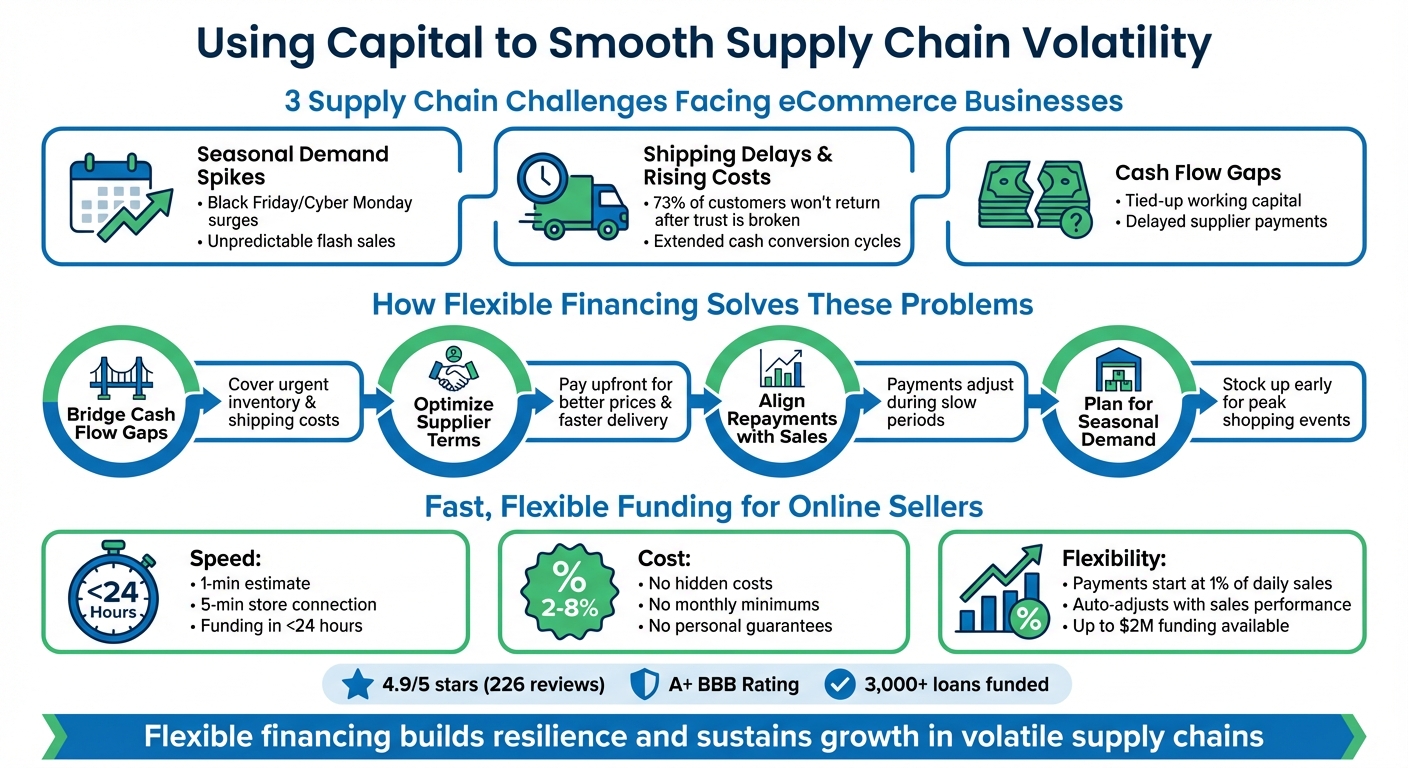
Supply chain disruptions can cripple eCommerce businesses, especially SMBs. From seasonal demand spikes to shipping delays and cash flow issues, these challenges often lead to lost sales, stockouts, and strained supplier relationships. The solution? Access to flexible funding.
Here’s how financing can help:
- Bridge cash flow gaps: Cover urgent inventory needs or rising shipping costs without depleting reserves.
- Optimize supplier terms: Pay upfront to negotiate better prices and faster delivery.
- Align repayments with sales: Revenue-based financing adjusts payments during slow periods.
- Plan for seasonal demand: Stock up early to avoid missing out on peak shopping events.
Onramp Funds offers fast, tailored funding for online sellers, with approvals in under 24 hours, transparent flat fees (2-8%), and repayment tied to sales performance. This approach ensures you can maintain operations, improve supplier relationships, and meet customer expectations, even during disruptions.
Key takeaway: Flexible financing isn't just about solving immediate problems - it’s about building resilience and sustaining growth in a volatile supply chain environment.
How To Fund Your Ecommerce Business For Cheap (Or Even Free)
sbb-itb-d7b5115
Supply Chain Volatility in eCommerce
eCommerce businesses grapple with three key challenges: unpredictable seasonal demand, shipping delays coupled with rising costs, and cash flow issues. These hurdles disrupt inventory management and customer satisfaction, requiring thoughtful financial strategies to keep operations on track.
Seasonal Demand Changes
Peak shopping events like Black Friday, Cyber Monday, and the holiday season often bring overwhelming demand surges. These spikes can stretch warehouse operations and fulfillment systems to their limits. Add in flash sales and shifting trends, and forecasting becomes even trickier, making it harder to allocate resources effectively.
Jessica Stoller, the Director of Supply Chain and Operations at Arrae, shared her experience during the 2025 Black Friday/Cyber Monday period. By using an integrated third-party logistics platform, she successfully navigated the high-volume challenges without delays. As she put it:
"On Black Friday I woke up with a smile on my face because I knew our orders were going out smoothly. This BFCM has been incredible for us." [1]
However, excess inventory poses its own problems, such as increased storage costs and reduced access to growth capital.
Shipping Delays and Cost Increases
Shipping delays, often caused by carrier limitations and last-mile delivery bottlenecks, have become a major pain point. These delays can stretch the cash conversion cycle, leaving businesses waiting longer to collect revenue while still needing to pay suppliers. Late deliveries often lead to stockouts, lost sales, and damage to a company’s reputation. In fact, 73% of customers are less likely to spend with a company they don’t trust. [4]
Rising logistics and material costs only add to the pressure. Sudden cost increases can drain cash reserves, leaving businesses with less money for essential operations like payroll and marketing. To combat these issues, Ancestral Supplements restructured their fulfillment strategy by distributing inventory across a national network. This approach ensured faster deliveries and reduced shipping costs. Jay Stephens, Director of Operations at Ancestral Supplements, highlighted the impact:
"ShipBob has been a great advantage for our brand. We have been able to save $4.11 per order on shipping since switching our fulfillment to ShipBob and distributing inventory throughout the country to place it closer to customers." [1]
Cash Flow Problems from Supply Chain Disruptions
Beyond delays and rising costs, cash flow issues create additional strain. Unexpected disruptions often force businesses to pay higher spot rates for expedited shipping or stockpile extra inventory, tying up valuable working capital. These liquidity challenges can lead to delayed supplier payments or pulling funds away from growth opportunities.
Small-to-medium enterprises are particularly vulnerable, as they often operate with tight margins. Inflation, rising material costs, and shifting tariffs can quickly eat into profits. Delayed payments to suppliers can also weaken future negotiating power, creating a cycle that’s tough to escape without external financial support.
How Onramp Funds Helps with Supply Chain Disruptions
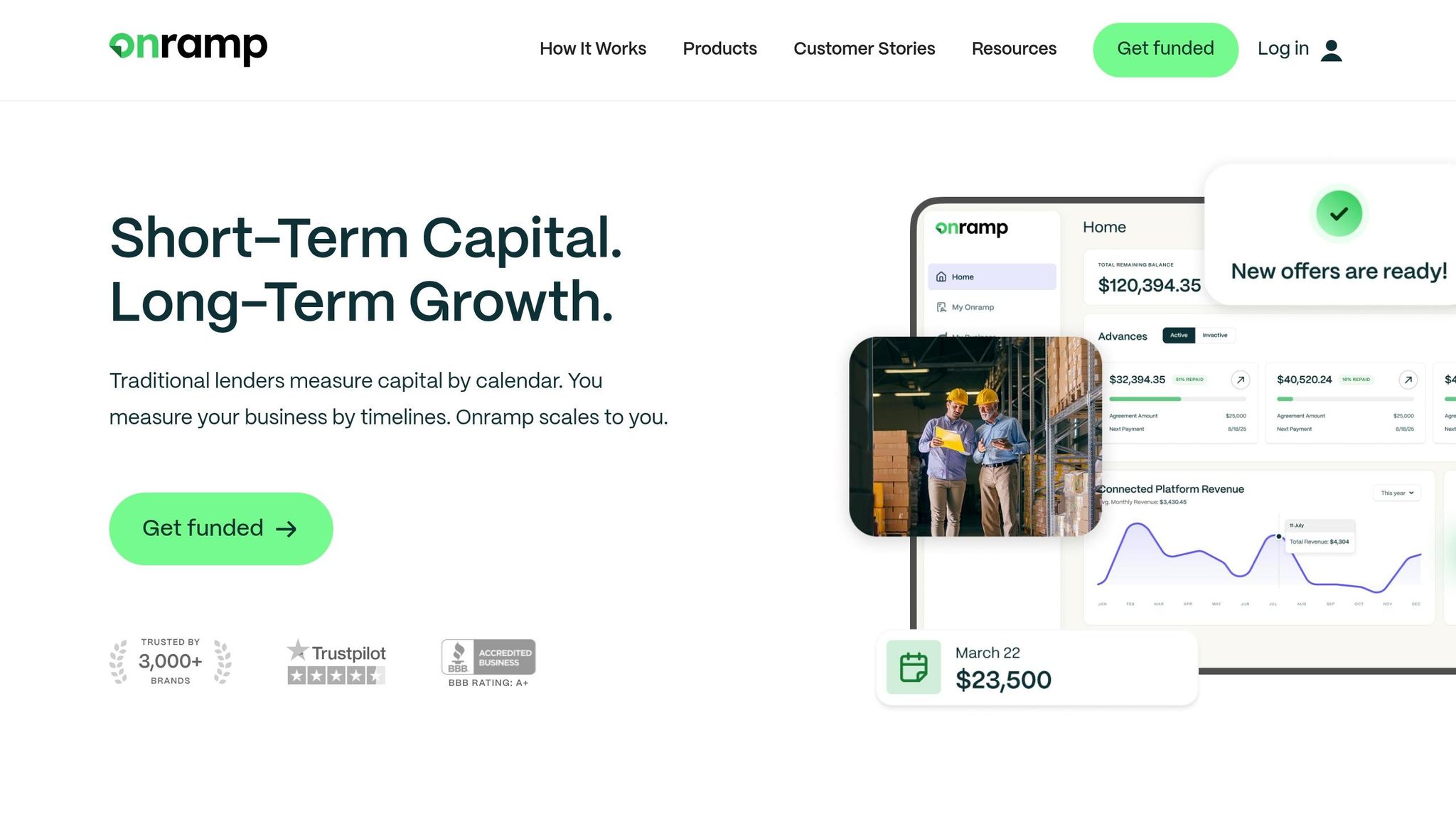
When supply chain hiccups arise, eCommerce businesses often need quick access to flexible funding. Onramp Funds steps in with financing solutions tailored specifically for online sellers, leveraging data to make the process efficient and effective.
24-Hour Funding for Urgent Needs
Onramp Funds offers capital in under 24 hours through a simple, three-step process: a 1-minute estimate, a 5-minute secure connection to your store, and funding delivery within a day [3][5]. Instead of relying on personal credit scores, Onramp evaluates your business's real-time performance data - like sales history, cash flow, and debt positions - using read-only access [3][5].
Nick James, CEO of Rockless Table, shared his experience with Onramp's speed:
Applied, got our offer, and had cash in our bank account within 24 hours. Their Austin-based team was professional and helped me deploy the cash to effectively grow our business [3].
This fast funding can be a game-changer when unexpected shipping costs or urgent inventory needs arise. Onramp supports sellers on platforms like Amazon, Shopify, Walmart, TikTok Shop, WooCommerce, BigCommerce, Squarespace, and SHOPLINE [3][6]. Plus, the repayment structure is designed to grow alongside your business.
Revenue-Based Repayment That Adjusts with Sales
Onramp uses a revenue-based repayment model that aligns with your sales. This means payments are only made when your business generates revenue [3][5]. During slower periods, payments decrease automatically. When sales pick up, payments scale proportionally. This approach helps businesses avoid the strain of fixed monthly payments, especially during uncertain times caused by supply chain issues.
Jeremy, Founder and Owner of Kindfolk Yoga, noted how this model worked for his business:
Onramp offered the perfect solution with revenue-based financing to secure the capital we needed to invest in inventory and pay it back at a reasonable time frame once we made sales [3].
With payment rates starting as low as 1% of daily sales, businesses can maintain cash flow flexibility when it matters most [7][8]. Transparent fee structures further simplify managing finances during unpredictable periods.
Fixed Fee Structure with No Hidden Costs
Onramp Funds pairs its fast funding and flexible repayment with a flat fee model. Fees range from 2% to 8% of the funded amount, and the total repayment amount is disclosed upfront - no surprises, no hidden costs [7][8]. Unlike loans with compounding interest, this fixed-fee structure ensures businesses can clearly calculate their costs. There are also no monthly minimums for variable plans, no personal guarantees, and no hidden mark-ups [7][8].
Adam B., from The Full Spectrum Company, appreciated the transparency:
Onramp's process is straightforward and easy to navigate. I had funds in my account within a day of final approval [3].
With funding options up to $2 million, a 4.9/5 star rating from 226 reviews, and an A+ rating from the Better Business Bureau, Onramp Funds has already supported over 3,000 eCommerce loans [3][7]. It’s a trusted partner for businesses navigating supply chain challenges and looking to grow.
How to Use Financing to Manage Supply Chain Volatility
Funding Seasonal Inventory Purchases
Financing can help bridge the timing gap between paying suppliers early and receiving revenue from customers. This allows you to stock up on inventory ahead of peak times, like Black Friday, or during unexpected demand surges, without draining your cash reserves. With the right capital, you can also buy in bulk, often securing discounts of 20% or more, while avoiding stockouts that could hurt your business [2].
Revenue-based financing offers flexibility by adjusting repayments based on your sales. If revenue drops after a busy season, your repayment amounts decrease, easing the financial strain of fixed monthly payments.
This type of funding doesn't just cover inventory - it also helps improve supplier terms and simplifies the funding process.
Improving Supplier Terms with Capital
Having access to quick capital can strengthen your position in supplier negotiations. When you can pay upfront or agree to shorter payment terms, suppliers may offer better pricing, faster delivery, or even priority fulfillment. A great example of this is United Legwear's $20 million Supply Chain Finance program launched in March 2026 with eCapital. Alan B. Mandell, the company’s SVP and Group Financial Controller, shared how this initiative standardized payment terms, introduced early-payment options, and unlocked over $12 million in working capital. This helped the company improve cash flow visibility and build stronger supplier relationships during a challenging time for global supply chains [9].
"It's improved our cash flow visibility, strengthened supplier relationships, and helped us build a more resilient global supply chain."
– Alan B. Mandell, SVP and Group Financial Controller, United Legwear
To optimize supplier terms, negotiate for better payment conditions on critical supplies that typically strain your cash flow. Finalize payment terms before agreeing on purchase prices, and aim for terms that are more flexible than what you might immediately need. This approach leaves room for compromise.
In addition to better terms, capital can integrate directly with eCommerce platforms, making cash flow management more efficient.
Using Platform Integrations to Streamline Funding
Onramp Funds offers seamless integration with leading eCommerce platforms like Amazon, Shopify, Walmart Marketplace, TikTok Shop, WooCommerce, BigCommerce, Squarespace, and SHOPLINE. These integrations simplify the funding process by providing real-time performance data through secure, read-only access. Payments automatically align with your revenue, adjusting when sales fluctuate. This reduces the risk of over-leveraging during slower periods and eliminates the need for manual tracking - a major advantage when unexpected shipping expenses or sudden inventory opportunities arise.
Tracking Results and Building Long-Term Stability
Metrics to Monitor Supply Chain Performance
To understand how financing impacts your supply chain, you need to measure specific metrics that shed light on operational improvements. One key metric is the Perfect Order Rate, which tracks the percentage of orders delivered on time, complete, undamaged, and error-free. This metric reflects whether your investment is maintaining product availability and meeting delivery expectations. Calculate it by dividing perfect orders by total orders, then multiplying by 100.
Another critical metric is the Stockout Rate, which indicates how often sales are lost due to insufficient inventory. A high stockout rate highlights the need for better capital allocation to inventory. Parisa Sadrzadeh, Senior Vice President of Omnichannel Fulfillment at Flexport, explains the importance of this:
Operations is critical to building brand trust and loyalty with consumers. If your products are constantly out of stock, you'll lose sales and customers [10].
You should also monitor Gross Margin Return on Investment (GMROI), which measures the profit generated for every dollar invested in inventory. This helps assess whether bulk purchasing or logistics improvements are effectively lowering your per-unit costs. Additionally, track your Cash-to-Cash Cycle Time, which calculates how quickly you’re converting investments into cash flow. This is done by adding Days Inventory Outstanding and Days Sales Outstanding, then subtracting Days Payable Outstanding. The shorter this cycle, the faster you can reinvest in your business.
By analyzing these metrics, you can refine your financing strategies to strengthen your supply chain.
Growing Your Business with Onramp Funds
These metrics not only guide operational decisions but also support long-term growth strategies. For instance, businesses can leverage Onramp Funds to finance their growth intelligently. Onramp’s revenue-based financing adjusts repayment amounts based on your actual sales performance. During slower periods - like post-peak seasons - your payments decrease automatically, helping maintain cash flow while scaling operations.
As your business expands, integrations with platforms like Amazon, Shopify, Walmart Marketplace, and TikTok Shop provide real-time performance data. This ensures that funding aligns with sales activity. When entering new marketplaces, it’s essential to consider reserve policies, where funds may be held for 14 days or longer. Financing can bridge this gap, ensuring supplier payments aren’t disrupted. Onramp’s fixed fee structure (ranging from 2-8%) also makes it easier to predict costs for inventory purchases, marketing efforts, or expanding into new channels [11].
Conclusion
Supply chain challenges like seasonal demand shifts, shipping delays, and cash flow gaps can wreak havoc on operations. These issues often lead to stockouts, lost sales, and strained relationships with suppliers when capital isn't handled wisely. The key is finding flexible financing options that align with your business needs, especially during unpredictable times.
Onramp Funds offers a solution with 24-hour funding, designed to bridge gaps caused by delayed shipments or unexpected inventory demands. Their revenue-based repayment model automatically adjusts payments based on your actual sales, helping you maintain cash flow during slower periods while keeping inventory levels steady. Plus, their clear fee structure makes it easy to anticipate costs. This approach not only meets immediate financial needs but also positions your business for stronger supplier negotiations and smarter inventory planning.
Successful businesses take a proactive approach to managing capital rather than reacting to problems as they arise. By using financing tools integrated with platforms like Amazon, Shopify, and Walmart Marketplace, you can align funding with real-time sales data. This allows you to secure bulk discounts, improve supplier terms, and maintain the product availability your customers depend on.
FAQs
How much funding do I need for inventory and shipping surprises?
The amount of funding your business requires hinges on factors like inventory costs, supply chain risks, and cash flow needs. It's crucial to ensure you have enough capital to navigate unexpected challenges, such as delays, seasonal fluctuations in demand, or rising expenses. Depending on the scale of your operations, this could range from a few thousand dollars to several hundred thousand.
Will revenue-based repayment hurt my cash flow during slow weeks?
Revenue-based repayment offers flexibility by adjusting payments according to your revenue. During slower weeks, this approach can impact cash flow, but it’s designed to scale with your income. This alignment helps maintain liquidity, making payments more manageable even when sales dip.
What metrics should I track to prove financing improved my supply chain?
Tracking metrics like Days Inventory Outstanding (DIO) can reveal how efficiently your inventory is managed, while Days Payables Outstanding (DPO) sheds light on the timing of payments to suppliers. Meanwhile, Days Sales Outstanding (DSO) helps you understand how quickly your business collects payments from customers. Together, these indicators provide valuable insights into how financial decisions influence the performance and stability of your supply chain.
Related Blog Posts
Onramp Funds
Funding built around your sales
Connect your store and see what you qualify for. Repay as a percentage of sales, with no personal credit check.
Funding in as little as 24 hours.
