

AI is transforming how eCommerce businesses manage inventory, cash flow, and funding. By analyzing real-time data and external signals, AI improves demand forecasting accuracy by up to 80%, reduces inventory levels by 20–30%, and cuts logistics costs by 20%. It also helps businesses optimize cash flow and plan capital needs with precision.
Key Takeaways:
- Inventory Management: AI predicts demand at the SKU level, reducing stockouts by 65% and excess inventory.
- Cash Flow Forecasting: AI systems analyze real-time data to project cash inflows and outflows, improving liquidity by up to 30%.
- Capital Planning: AI links inventory and cash flow forecasts to funding needs, ensuring businesses invest in high-demand, high-margin products.
AI-powered tools are accessible to businesses of all sizes, integrating seamlessly with platforms like Shopify and Amazon. By combining AI insights with flexible financing options, like revenue-based funding, businesses can act quickly to meet demand and scale efficiently.
AI Inventory Management: Predict Demand, Prevent Stockouts
Using AI for Inventory Forecasting
AI is reshaping inventory management by diving deep into SKU-level sales data to establish baselines for seasonal trends and demand surges [2][9]. With machine learning tools like neural networks and decision trees, businesses can identify complex, non-linear patterns that traditional spreadsheets simply miss [2][10]. This detailed level of analysis goes beyond broad category-level forecasts, delivering daily, SKU-specific predictions that mirror actual customer behavior [2][7]. These insights set the stage for smarter demand forecasting, on-the-fly adjustments, and automated reordering processes.
Predicting Demand with Machine Learning
Machine learning models analyze sales data across multiple platforms - like Amazon, Shopify, and TikTok Shop - to create a unified and accurate picture [7][10]. This approach has been shown to improve forecasting accuracy significantly, from 60% to 80%, ensuring businesses maintain the right stock levels [1]. For instance, Kimai, an online jewelry brand, used Prediko's AI to synchronize data from three Shopify stores. The result? Delivery times dropped by 43%, and production costs were trimmed by 11% [10]. While historical data lays the groundwork, real-time inputs take these predictions to the next level.
Adding Real-Time Data and External Factors
"Demand sensing" technology brings real-time external signals - like social media trends, weather patterns, and competitor pricing - into the mix [8][7]. By Q1 2025, 98% of companies had adopted AI in their supply chains to optimize inventory management [7]. These systems constantly update and retrain as fresh data comes in, enabling dynamic adjustments instead of relying on outdated assumptions [1][7]. Adding layers like promotional calendars and ad spend data can further help avoid stockouts [2].
Automating Reorders with Dynamic Safety Stock
AI replaces outdated static safety stock models with dynamic safety stock, which adapts to changes in lead times, supplier reliability, and demand fluctuations [1][9]. Instead of sticking to fixed reorder points, AI-powered systems set triggers that account for variable supplier lead times and current market dynamics [1][11]. For example, Asia's largest spice company turned to ConverSight's Athena AI to shift from manual forecasting to real-time predictions that factor in seasonality and buying behaviors. This transition improved forecasting accuracy by 30% and cut inventory waste from expired products by 20% [9]. As noted by McKinsey:
"AI can reduce overall inventory levels by 20-30%, freeing up cash and reducing the need for last-minute markdowns" [1].
AI-Powered Cash Flow Forecasting
Managing cash flow manually can be a major stumbling block for businesses, with 82% of failures linked to poor cash flow management [12]. AI is transforming this process, replacing reactive guesswork with proactive, data-driven planning. By pulling real-time data from ERP systems, CRM tools, and eCommerce platforms like Shopify and Amazon, AI creates a dynamic and accurate view of cash flow [12][3]. Predictive models can even flag early or late payments based on payer behavior, giving businesses the chance to act before cash flow issues arise [12]. For instance, Long Short-Term Memory (LSTM) networks deliver 92% accuracy in forecasts, outperforming ARIMA models at 85% [4]. These systems also incorporate external factors - like inflation, interest rates, commodity prices, and geopolitical trends - into their forecasts, enabling businesses to make well-informed decisions even as conditions shift [4]. This level of insight lays the groundwork for deeper revenue and liquidity analyses.
Using Predictive Analytics for Revenue Trends
AI's ability to analyze historical and real-time sales data has proven transformative for companies like King's Hawaiian, which used DataRobot's Cash Flow Forecasting App to reduce interest expenses by over 20% [12]. Automated "what-if" simulations, such as assessing the impact of currency devaluations or supply chain disruptions, help businesses identify and mitigate liquidity risks [3]. This strategic approach can unlock up to 30% of working capital within weeks, optimizing how payables and receivables are managed [6].
Accounting for Seasonal and Promotional Changes
AI goes beyond tracking revenue trends by adapting forecasts to seasonal and promotional shifts. Events like Black Friday or holiday shopping surges often overwhelm static models, but AI handles these fluctuations with ease. By analyzing promotional calendars, ad spend, and marketing signals, AI predicts the "lift" from campaigns even before they begin [2]. This demand sensing technology boosts forecast accuracy by 20–50%, far surpassing traditional methods [1]. A great example is LegalOn, which used AI to identify viral TikTok trends and unseasonable weather patterns, forecasting a 47% demand increase for specific products. CEO Daniel Lewis highlighted the advantage:
"Our AI system detected viral TikTok trends and unseasonable weather patterns that spreadsheets failed to identify" [6].
This insight helped the company avoid $2 million in dead stock and cut stockout-related lost sales by 32% [6].
Connecting with eCommerce Platforms for Automated Insights
AI tools seamlessly integrate with platforms like Shopify and Amazon, offering businesses a unified view of their financial health [3][2][4]. These tools continuously sync data to analyze accounts receivable, accounts payable, and sales trends, enabling businesses to predict cash inflows and outflows 30, 60, or 90 days in advance [2][4]. By incorporating marketing data - such as ad spend - AI can also forecast revenue spikes from promotions, ensuring businesses are prepared with the necessary capital during demand surges [2][1]. These automated insights not only streamline financial planning but also enhance operational efficiency, helping businesses allocate resources wisely and maintain liquidity. Alberto Hernandez-Martinez, Executive Director at J.P. Morgan, emphasized:
"AI-driven cash flow forecasting puts us in a new era of corporate treasury function. Advanced machine learning, real-time analysis and sophisticated simulations enable organizations to achieve levels of accuracy and strategic insight that were previously unimaginable" [3].
Forecasting Capital Needs with AI
Connecting Inventory and Cash Flow to Funding Requirements
AI is reshaping how eCommerce businesses pinpoint funding needs by directly linking inventory forecasts to cash flow projections. By analyzing real-time data - like site traffic, promotional calendars, and social media trends - AI provides precise insights into when and how much funding is required [6]. The earlier discussions about inventory cycles and revenue timing tie seamlessly into this process, creating a well-rounded framework for capital planning.
When cash flow is tight, AI focuses on high-performing, high-margin SKUs, ensuring every dollar invested yields maximum returns [2]. By integrating data from platforms like Shopify, marketing tools, and ERP systems, businesses gain a clear, comprehensive view of their capital requirements. This approach highlights funding needs tied specifically to inventory purchases and cash flow gaps [2][1]. It eliminates guesswork, reducing the risks of over-borrowing - which can lead to unnecessary fees - or under-borrowing, which might limit growth opportunities. With this level of precision, businesses can confidently plan for growth and manage potential risks.
Scenario Modeling for Growth and Risk Management
AI shines when it comes to modeling "what-if" scenarios, helping businesses allocate resources wisely. Whether you're launching a new product or entering a new market, AI combines internal data - like sales history, inventory levels, and supplier lead times - with external factors such as inflation, interest rates, and consumer confidence [4][3]. Even for products with limited sales data, AI uses attributes from similar products and early traffic trends to project realistic demand curves [2].
This scenario modeling also plays a key role in risk management. For example, AI can simulate disruptions like currency fluctuations, customer defaults, or supply chain delays, showing how each scenario affects cash flow [3]. Tools like natural language processing (NLP) analyze news, social media, and geopolitical trends to predict demand shifts before they hit your bottom line [4][3]. These capabilities can cut forecasting errors by up to 50% compared to traditional spreadsheet-based methods [3].
Revenue-Based Financing with Onramp Funds
AI-driven forecasts also pave the way for flexible financing options like revenue-based financing. Onramp Funds uses these forecasts to provide sales-driven financing specifically designed for eCommerce businesses. Instead of rigid monthly payments, this model adjusts repayments based on a percentage of your sales, making it easier to manage cash flow during slower periods. By aligning financing with AI-driven insights, this approach ensures that funding evolves with your business’s actual performance.
sbb-itb-d7b5115
How to Implement AI Forecasting
Preparing and Cleaning Your Data
When it comes to accurate forecasting, everything starts with solid data management. Begin by pulling together data from various sources like CRM systems, ERP platforms, web analytics, and marketing tools into one unified system [1][6].
After consolidating your data, the next step is to clean and organize it. This means eliminating duplicate entries, correcting anomalies (like negative inventory counts or nonsensical dates), and ensuring that every product has proper attribute tagging. For instance, each SKU should include details like category, size, color, and seasonality. Why is this so important? Because even the most advanced AI systems can’t deliver reliable forecasts if the data it’s working with is messy or incomplete [9][13].
Choosing and Integrating AI Platforms
The right AI platform can make or break your forecasting efforts. Look for tools that provide SKU-level granularity and multi-horizon forecasts, giving you both detailed and long-term visibility [2][5]. These platforms should align with the dynamic forecasting techniques we’ve already discussed.
Focus on platforms that offer explainability and override options. It’s not enough for an AI system to generate a forecast - you need to understand why it made certain predictions. Plus, having the ability to override AI recommendations lets you account for business insights that the model might not catch [2]. Some platforms go a step further by offering actionable alerts, such as automated purchase order suggestions or warnings about shrinking margins [2][11]. To keep the AI on track with your goals, set guardrails upfront - like limiting price deviations or establishing minimum margin thresholds.
Training Models and Testing Results
Once your AI platform is up and running, it’s time to train and test your models. Start small with low-risk applications, such as cart recommendations, and scale up gradually [5][9]. For products with short lifecycles or brand-new items, consider adding human expertise to complement AI forecasts. Regular testing and oversight are essential to maintain accuracy, especially when external events - like supply chain disruptions or new regulations - impact your data [7].
"Success with AI in inventory management isn't just about the technology – it's about implementation strategy. The key is to start slow with a pilot project and then iterate from there to build a full-fledged product." - Hardik Chawla, Senior Product Manager - Technical at Amazon SCOT [13]
Use A/B testing to evaluate how AI-driven strategies stack up against manual ones [6]. Incorporate scenario simulations to prepare for unexpected situations - like a supplier going offline for 10 days or a sudden spike in demand during a holiday season [13]. Keep an eye on your production models for signs of "drift" or performance issues. For example, if conversion rates drop even though the model’s accuracy remains high, it could mean the AI has veered away from your business priorities [5].
Measuring the Impact of AI Forecasting
Once you've implemented AI forecasting, it's crucial to evaluate its performance by focusing on real-time, actionable metrics.
Key Metrics for Evaluating Forecasting Performance
To assess the success of your AI forecasting, start by tracking Mean Absolute Percentage Error (MAPE). This metric provides a straightforward way to measure accuracy and is particularly useful for explaining results to finance teams [7]. Another important metric is Forecast Value-Added (FVA), which helps you determine whether your AI model delivers better accuracy compared to baseline predictions or manual adjustments [7].
In addition to accuracy, keep an eye on Days of Supply (DOS). A high DOS combined with no stockouts could signal that capital is unnecessarily tied up in inventory [7]. Similarly, monitor your Inventory Turnover Ratio, which is calculated by dividing the Cost of Goods Sold by Average Inventory [14]. This ratio highlights how effectively you’re converting inventory into sales.
To fully understand the impact, compare these metrics between traditional forecasting methods and AI-powered approaches. This comparison will highlight the performance improvements AI brings.
Comparing Traditional and AI Forecasting Methods
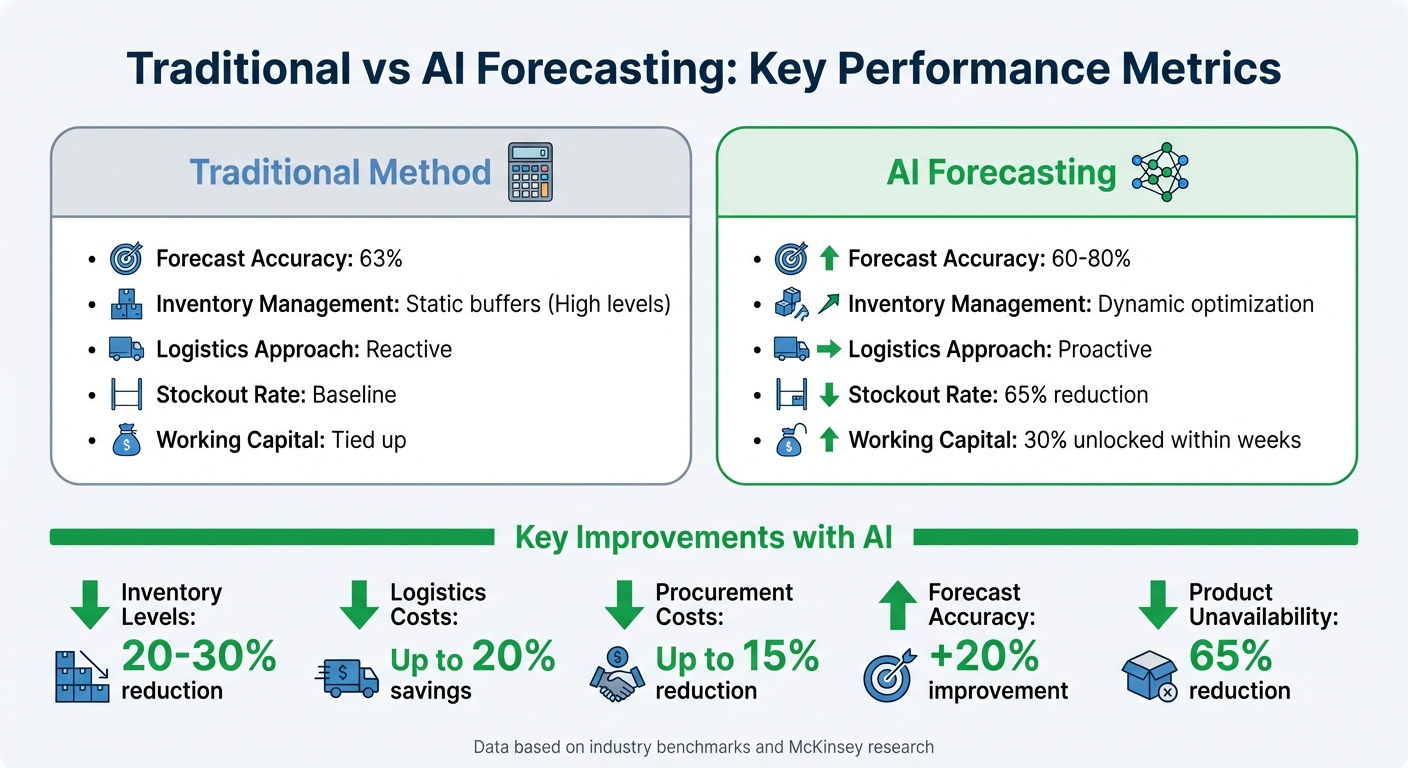
The difference between traditional methods and AI-powered forecasting is striking. Traditional retail inventory accuracy hovers around 63%, while AI can boost forecast accuracy to between 60% and 80% [1]. Companies leveraging AI have reported significant benefits, such as reducing inventory levels by 20% to 30%, cutting logistics costs by up to 20%, and lowering procurement costs by up to 15% [1].
AI models can also unlock up to 30% of working capital within weeks by optimizing payables and receivables in real time [6].
Monitoring and Updating Your Models
Tracking performance metrics is just the beginning. To maintain and improve forecasting accuracy, it's essential to continuously update your AI models. Regularly retrain models as new data - such as sales, returns, and inventory figures - becomes available [7][16]. This ongoing oversight is critical for sustaining the benefits of AI forecasting.
By Q1 2025, 98% of companies had integrated AI into their supply chains. However, over 40% of these businesses reported challenges in managing risks tied to AI inaccuracies [7][16]. To mitigate such risks, set up real-time dashboards to monitor SKU-level performance and catch potential issues before they escalate [9]. Frequent data audits are also necessary to ensure input quality, as the precision of your AI models depends heavily on clean, reliable data [4][15].
For a balanced approach, consider the Human-AI Framework recommended by MIT Sloan. Use AI for products with stable demand, involve experts for new product launches, and override forecasts when external events - like port closures or regulatory changes - disrupt the data [7].
"AI models continually learn and retrain themselves as new data becomes available." - Shopify Staff [7]
Conclusion: Growing Your Business with AI Forecasting and Onramp Funds
Key Takeaways for eCommerce Business Owners
AI forecasting takes the guesswork out of inventory management. By analyzing past sales, current trends, and external factors, businesses can see 20% to 30% reductions in inventory levels, experience up to 65% fewer stockouts, and cut logistics costs by 20% [1]. These savings not only free up capital but also ensure your products are available exactly when your customers need them.
To get started, focus on clean, reliable data and test AI forecasting with a single product category before expanding. Pay close attention to SKU-level forecasts and consider returns, especially in categories with high return rates like apparel. Unified AI forecasts bring merchandising, finance, and logistics teams together, enabling faster, data-driven decisions. However, to fully harness these insights, pairing them with flexible funding is critical for driving growth.
Partnering with Onramp Funds for Flexible Financing
AI tells you what to stock and when to stock it, but having the funds to act on those insights is just as important. Onramp Funds provides up to 25% of your projected monthly revenue with repayments tied to your sales performance [17]. This model adjusts naturally to your business, offering a more flexible alternative to traditional financing.
"Our customers pay less than 1% of GMV as a fee to borrow up to 25% of their expected monthly revenue. Unlike banks and credit cards, we do not charge APR fees or require minimum monthly payments." - Eric Youngstrom, Founder and CEO, Onramp [17]
When AI highlights high-demand, high-margin products that require additional investment, Onramp ensures you have the funds to act quickly - without giving up equity or waiting on lengthy bank approvals. Even if marketplaces like Amazon hold your payouts, Onramp aligns its collections with your cash flow, so you maintain liquidity [17]. Together, AI forecasting and Onramp’s flexible financing create a growth strategy that evolves with your business needs and opportunities.
FAQs
How can AI improve demand forecasting for eCommerce businesses?
AI is reshaping demand forecasting by moving away from outdated manual methods and introducing machine learning models that can process massive amounts of data while adapting to new inputs in real time. These models draw insights from a mix of historical sales data, current inventory levels, social media activity, weather patterns, and promotional schedules. By analyzing this diverse range of information, AI uncovers patterns and connections that traditional methods often overlook.
The result? More precise forecasts that enable eCommerce businesses to adapt swiftly to market changes, prevent stockouts, and cut down on excess inventory. In fact, retailers using AI have seen up to a 15% boost in forecast accuracy, along with noticeable reductions in inventory costs. Armed with AI-driven insights, companies can make sharper decisions, improve cash flow, and lay the groundwork for steady growth.
What are the advantages of using AI for managing cash flow in eCommerce?
AI-driven cash flow management gives eCommerce businesses a precise, up-to-the-minute view of their financial standing. By analyzing live transaction data, past trends, and external factors like inflation or interest rates, AI delivers highly accurate cash flow predictions. Unlike traditional methods, these forecasts are constantly updated, providing businesses with a dynamic and forward-looking picture of their liquidity.
The advantages are clear. Improved forecasting accuracy helps businesses better manage working capital by aligning receivables, payables, and inventory more effectively. AI also empowers finance teams to run "what-if" scenarios - like preparing for seasonal demand surges or navigating supply chain disruptions - helping to sidestep potential cash flow problems. On top of that, automating data analysis reduces manual work and errors, allowing teams to focus on strategic priorities. These benefits combine to enhance decision-making, lower costs, and drive growth for online retailers.
How does AI help businesses forecast capital needs?
AI is transforming the way businesses forecast their capital needs. By analyzing data such as sales trends, seasonal fluctuations, and operational costs, it delivers highly accurate predictions. With machine learning, AI can project future revenue, inventory demands, and expenses more efficiently than traditional forecasting methods. This helps businesses spot potential cash flow gaps early and prepare accordingly.
Through precise forecasting, AI provides insights into how much cash is required for tasks like purchasing inventory, paying suppliers, or managing seasonal demand spikes. It also enables businesses to run dynamic "what-if" scenarios, simulating how changes in demand or pricing could affect cash flow. Armed with this information, businesses can make smarter decisions, avoid running out of stock, and handle financing needs with greater ease.
Related Blog Posts
Onramp Funds
Funding built around your sales
Connect your store and see what you qualify for. Repay as a percentage of sales, with no personal credit check.
Funding in as little as 24 hours.
