

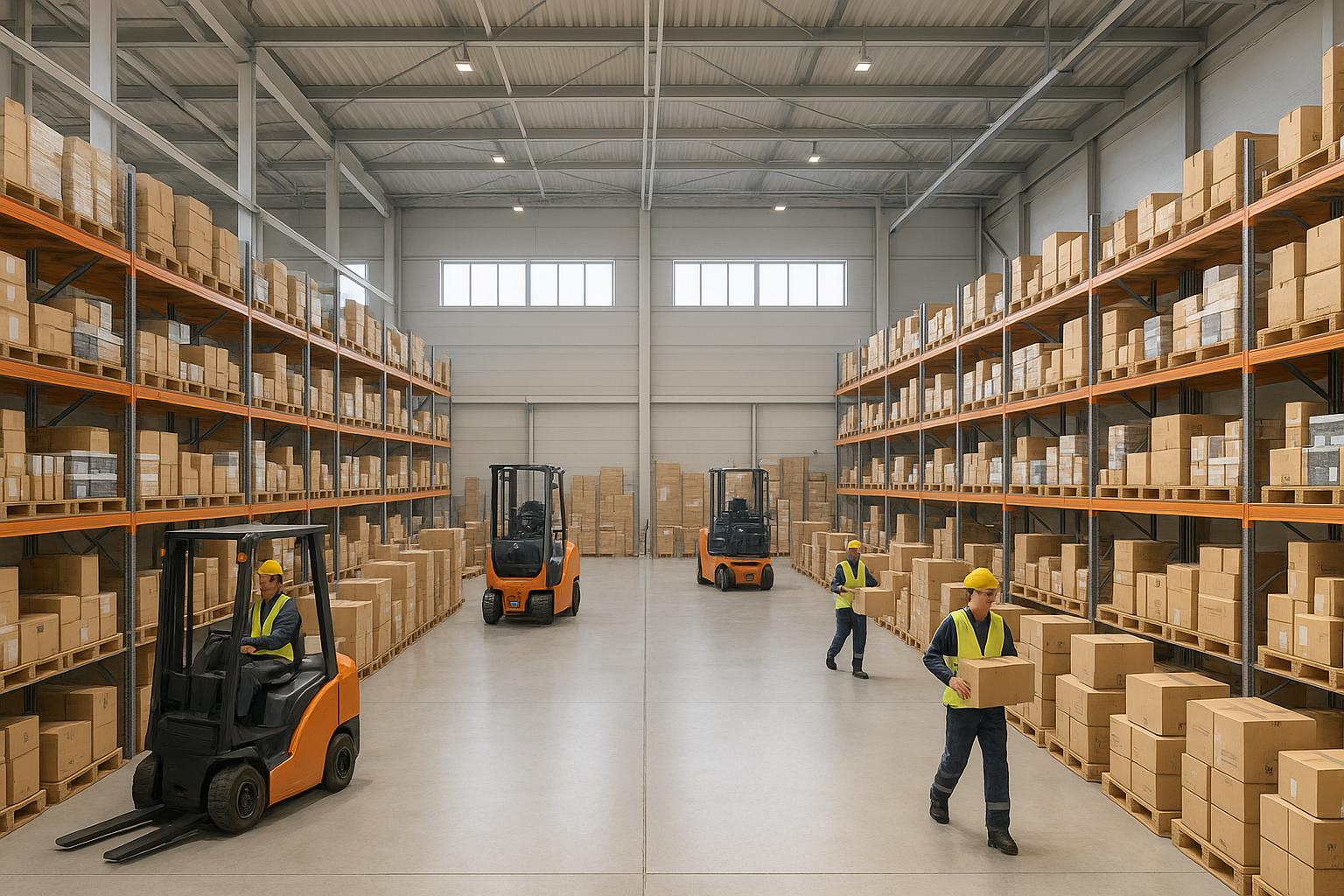
Your warehouse layout directly impacts order fulfillment speed, inventory management, and customer satisfaction. For eCommerce, where individual orders and fast delivery dominate, efficient design is critical to reduce costs, errors, and delays. Here’s a quick breakdown:
- Why It Matters: A good layout reduces travel time, improves storage efficiency, and supports scalability for peak seasons.
- Key Challenges: High return rates (up to 1 in 3 orders), space constraints (85.6% of warehouse space is typically used), and safety risks.
- Core Principles:
- Maximize space with vertical storage and dynamic shelving.
- Optimize workflow by placing high-demand items near packing zones and using technology like WMS and barcode systems.
- Prioritize safety with clear pathways, proper lighting, and designated zones for tasks.
- Common Layouts:
- U-Shaped: Efficient for medium-sized operations with shared docks but risks congestion.
- I-Shaped: Ideal for linear, high-volume tasks but lacks flexibility.
- L-Shaped: Flexible for mixed products but requires careful planning.
Key Takeaway: A well-planned warehouse layout boosts efficiency, reduces costs, and improves customer experience. Investing in automation and leveraging financing options like revenue-based funding can make these upgrades manageable.
Designing an Efficient Warehouse Layout for eCommerce, Assembly and Distribution with Shipedge
Core Principles of Effective Warehouse Layout Design
Designing an efficient warehouse layout for eCommerce revolves around three key principles that drive productivity and streamline operations. These principles are essential for creating a functional and scalable warehouse, regardless of its size or the type of products it handles.
Space Utilization and Accessibility
Making the most of available space without compromising accessibility is a cornerstone of warehouse efficiency. By optimizing how space is used, you can increase storage capacity by 20–30% without the need for physical expansion [4].
Vertical racking systems are particularly effective, offering up to a 40% boost in storage capacity [5]. Mezzanines and modular shelving systems also help maximize space by creating additional storage levels while keeping items within reach. Dynamic shelving systems, which can be adjusted based on inventory needs, improve storage flexibility and can enhance space usage by 20–40% [4].
Aisle width is another critical factor. Wider aisles improve accessibility and safety but reduce overall storage capacity, so finding the right balance is essential. Placing high-density shelving in areas for slower-moving inventory and positioning fast-moving products closer to packing stations can further streamline operations and speed up order fulfillment.
Ultimately, a well-optimized layout doesn’t just save space - it also improves how materials flow through the warehouse.
Optimizing Workflow and Material Flow
Smooth material flow is vital for faster order processing and cost savings. Ensuring that products move efficiently across all stages of the operation reduces delays and bottlenecks.
Start by placing high-demand items near packing zones to cut down on travel time. Clearly marked pathways for both pedestrians and equipment can minimize hazards and improve overall efficiency.
Integrating technology is another game-changer. Warehouse Management Systems (WMS) provide real-time inventory tracking and can boost productivity by as much as 40% [6]. Tools like barcode scanners and RFID systems reduce picking errors and speed up inventory management. On top of that, incentive programs for staff can increase productivity by 15–30% [6].
Regularly reviewing material flow helps identify problem areas and ensures that operations remain efficient, keeping order cycle times short and fulfillment processes smooth.
Safety and Compliance Requirements
While optimizing space and workflow is important, prioritizing worker safety and meeting compliance standards is non-negotiable. With an injury rate of 5.5 per 100 full-time workers [7], safety must be at the forefront of warehouse design.
OSHA guidelines provide a comprehensive framework for creating a safe workplace. This includes everything from personal protective equipment to emergency plans. Proper lighting, clear signage, and adequate spacing between work zones and storage areas are crucial elements of a safe warehouse.
Forklift safety is a major concern, given that forklift accidents result in 100 fatalities and 95,000 injuries each year [8]. Designated forklift lanes, operator certifications, and regular maintenance checks can significantly reduce these risks.
Loading dock areas also present unique hazards, accounting for nearly 25% of warehouse injuries [7]. Using proper dock levelers, safety restraints, and clear communication protocols between drivers and staff can enhance safety in these high-risk zones.
| Common Warehouse Injuries | Percentage |
|---|---|
| Soreness, pain | 20% |
| Fractures | 19% |
| Bruises, contusions | 14% |
| Cuts, lacerations, punctures | 9% |
| Multiple traumatic injuries | 5% |
| Amputations | 1% |
Ergonomic improvements, like adjustable workstations and mechanical aids, can help reduce musculoskeletal disorders and improve long-term productivity. Training programs are equally important - comprehensive safety training has been shown to lower the likelihood of accidents by up to 70% [7].
Emergency preparedness is another critical component. Clearly marked evacuation routes, accessible fire safety equipment, and first aid stations should all be part of the warehouse design. Regular safety inspections and adherence to standards like the Hazard Communication Standard (29 CFR 1910.1200) ensure that even areas handling hazardous materials remain safe and compliant.
Common Warehouse Layout Types for eCommerce
Picking the right warehouse layout can significantly impact how efficiently your warehouse operates and how well it supports your business goals. For eCommerce, three main layout types are commonly used, each tailored to specific operational needs. Let’s break down these layouts and what makes them work.
U-Shaped Layout
The U-shaped layout organizes receiving and shipping areas on the same side of the warehouse, creating a natural flow: goods come in, move through storage, and return to the shipping area nearby [9]. This setup makes the most of dock space, as shared dock doors can be used for both receiving and shipping. It also supports cross-docking, which helps reduce handling time and costs. For medium-sized operations, this layout is a practical choice. It even boosts security by having a single point of entry and exit, simplifying access control [9]. Plus, it’s great for managing returns, a big deal in eCommerce.
But it’s not perfect. The central hub can get congested when receiving and shipping overlap, and it’s not the best option for very large warehouses. Expansion can also be tricky with this design [10]. Despite these limitations, the U-shaped layout shines when efficient communication between teams is key, or when handling returns is a priority.
I-Shaped Layout
The I-shaped layout keeps things straightforward. Goods enter at one end, move through storage, and exit at the opposite end [10]. This linear design is easy to navigate and works well for high-volume operations focused on simple pick, pack, and ship tasks. Smaller warehouses or zoned areas benefit from this layout’s simplicity, making it a good fit for businesses with a steady flow of orders and minimal product complexity [10].
However, it’s not ideal for larger spaces or operations that deal with a wide variety of products. Long travel distances can slow things down, and the linear design doesn’t adapt well to processes requiring backtracking or more complex workflows [11]. If your operation is all about efficiency and straightforward inventory movement, though, this layout could be a perfect match.
L-Shaped Layout
The L-shaped layout forms a right angle, with one leg typically handling receiving and shipping and the other dedicated to storage [11]. This configuration offers more flexibility than the I-shaped layout, making it easier to organize different functions. It also makes good use of corner space and can shorten travel distances between key areas [11]. For warehouses managing mixed product types or requiring separate storage and shipping zones, this layout is worth considering. It’s also a solid option for businesses engaged in cross-docking [2].
That said, careful planning is essential. Poorly designed picking paths can lead to inefficiencies, and this layout usually takes up more floor space than the others [12][13]. If zones are not thoughtfully planned, operations can become disorganized. Still, with proper planning, the L-shaped layout can be a versatile solution.
| Layout Type | Best For | Key Advantage | Main Challenge |
|---|---|---|---|
| U-Shaped | Medium-sized operations with returns | Shared dock resources and cross-docking | Potential central hub congestion |
| I-Shaped | High-volume, linear operations | Simple navigation and sequential flow | Limited flexibility for complex processes |
| L-Shaped | Mixed product types and cross-docking | Versatile space utilization | Requires careful path planning |
When choosing a layout, think about your product mix, order volume, available space, and future growth. The right design will set the stage for smoother operations and long-term success [10].
sbb-itb-d7b5115
Step-by-Step Guide to Designing an Efficient Warehouse Layout
Designing an efficient warehouse layout isn’t just about arranging shelves and workstations - it’s about creating a space that meets your business needs, streamlines operations, and prepares you for future growth. This step-by-step guide will walk you through the process of optimizing your warehouse for maximum efficiency, especially in the fast-paced world of eCommerce.
Analyze Your Business Requirements
Before diving into design, take a step back and evaluate your warehouse’s core functions. As The Materialogic Team explains:
"Good warehouse planning starts with the simple question: 'How much warehouse space do I need?'" [14]
Calculate Your Space Needs
Start by determining how much space you’ll need for pallets, cartons, and other inventory. Make sure to account for cubic footage and explore shelving systems that take advantage of vertical storage [14][15]. Don’t forget to allocate dedicated areas for essential functions like receiving, storage, shipping, returns processing, and even future growth. Keep in mind that eCommerce returns require significant space for reverse logistics.
Identify Necessary Equipment
Your equipment list should include storage systems, handling tools, and inventory management technology tailored to your specific operations [14][15]. For example, a high-volume operation might prioritize automated picking systems, while a business handling diverse product types may need more flexible storage solutions.
Spot Automation Opportunities
Look for repetitive tasks that automation can simplify. Even basic tools like barcode scanners can reduce errors and speed up workflows [14][15]. The Materialogic Team emphasizes the need for adaptability:
"E-commerce warehouses must be flexible than ever in order to meet the customers' expectations and rising demand." [14]
Understand Your Order Patterns
Dive into your sales data to identify trends like peak seasons, product velocity, and order frequency [16]. eCommerce warehouses often handle high volumes of individual orders with fewer items per order [1]. This data should guide the design of your picking areas and overall workflow.
Once you’ve nailed down your space and equipment requirements, it’s time to plan your zones and streamline the workflow.
Plan Zones and Workflow
Organizing your warehouse into well-defined zones is key to efficiency. Grouping fast-moving items closer to picking and shipping areas can save time and reduce unnecessary movement. Disk.com highlighted this strategy in January 2024, noting that placing best-selling products near dispatch areas can significantly speed up processing [17].
Define and Organize Zones
Clearly outline areas for receiving, storage, packing, and shipping to ensure smooth transitions between tasks. Buffer zones in high-traffic areas can help prevent bottlenecks [5].
Maximize Storage Density
Make the most of your space by using tall shelving units and stackable bins [17]. Organize inventory based on demand frequency, size, and handling needs. For example, store heavy items at waist level to reduce strain on workers, while lightweight, frequently accessed items should be kept in easily reachable spots.
Adopt Dynamic Zoning
Instead of sticking to fixed zones, consider creating areas that can adapt to changing inventory needs. This flexibility allows you to adjust based on current demand [17].
With your zones and storage sorted, the next step is to integrate technology and automation.
Add Automation and Technology
Incorporating technology into your warehouse layout can simplify operations and prepare your business for growth [18].
Start with a Warehouse Management System (WMS)
Choose a cloud-based WMS that supports automation tools and offers features like real-time inventory tracking and optimized pick paths [18]. Before implementing, centralize and clean your data to ensure accuracy.
Use Real-Time Tracking
Implement tools like RFID or barcode scanners to track inventory in real time [22]. Amazon, for instance, uses automated barcode systems to assign unique identifiers to incoming products and shelves, streamlining pick routes [21].
Automate Routine Tasks
Free up labor by automating repetitive processes like cycle counting and inventory audits [18]. You can also enhance receiving and picking workflows with directed putaway systems. Some companies even use drones for inventory counts, allowing for real-time discrepancy reporting [18].
Plan for Advanced Automation
As your operations grow, consider more advanced solutions. Nike’s distribution center in Japan uses robots that deliver products directly to workers, enabling same-day delivery [21]. Similarly, IKEA employs automated storage and retrieval systems (AS/RS) with cranes and conveyors capable of handling 600 pallets per hour [21].
Prepare Your Infrastructure
Ensure your facility is ready for automation by checking for adequate space, level floors, and sufficient electrical capacity [19]. Your WMS should integrate seamlessly with automation systems to avoid downtime [19].
The warehouse automation market is projected to grow from $24.09 billion to $42.25 billion by 2034, with an annual growth rate of 15.1% [20]. Yet, as of 2024, only 20% of North American warehouses have incorporated automation [18], making this an opportunity to gain a competitive edge.
Funding Solutions for Warehouse Layout Optimization
A well-thought-out warehouse layout can significantly boost efficiency, but implementing these changes often requires a solid financial plan. While optimizing your warehouse demands an upfront investment, the potential returns make it a worthwhile endeavor. By understanding your funding options and planning strategically, you can make these improvements without disrupting operations, keeping pace with the demands of today's fast-moving eCommerce world.
Investing in Warehouse Layout Redesign
The cost of redesigning a warehouse layout can vary widely depending on the size and complexity of your facility. For mid-sized warehouses, budgets typically range from $500,000 to $1 million for comprehensive improvements. On a broader scale, warehouse budgets can extend from $100,000 to several million dollars, depending on the scope of the project [11].
Key Investment Areas
When planning your budget, several expense categories need attention:
- Personnel Costs: These often represent the largest share of the budget. Expenses may include training new hires, retention bonuses, and managing potential productivity dips during the transition [24].
- Material Handling Equipment: Items like pallet racks, shelving, conveyors, and lift trucks are major investments. Assess what can be reused from your current setup and account for disassembly and reinstallation costs [24].
- Infrastructure Enhancements: Budget for facility upgrades such as RF communication devices, security systems, office equipment, and other necessary modifications [24].
The ROI of a Better Layout
A well-optimized layout can yield significant savings. For instance, it reduces operating costs, which average $7.91 per square foot [3], and minimizes product damage - a common issue in inefficient setups. Around 7–10% of packages arrive damaged, and this directly impacts customer satisfaction. In fact, 58% of consumers say receiving damaged goods negatively affects their perception of the shipper [28].
Planning Your Funding Strategy
Investing in automation is becoming increasingly critical, with logistics and fulfillment automation projected to account for over a third of capital spending [25]. To manage costs effectively, consider options like negotiating flexible lease terms to align with seasonal cash flow or partnering with third-party logistics (3PL) providers to offset infrastructure expenses [23]. By understanding your costs and potential returns, you can explore more tailored financing options to ease the financial burden.
How Onramp Funds Can Help

Traditional funding methods often fall short for eCommerce businesses aiming to optimize warehouse operations. Bank loans involve lengthy approval processes and strict credit requirements, while equity financing means giving up ownership. Onramp Funds offers a refreshing alternative through revenue-based financing designed specifically for eCommerce needs.
Fast and Equity-Free Funding
Onramp Funds provides quick access to financing - funds are available in less than 24 hours - without requiring you to give up equity in your business [26]. Instead of using traditional credit checks, they evaluate real-time sales data from platforms like Amazon, Shopify, BigCommerce, WooCommerce, Squarespace, and Walmart Marketplace [27]. To qualify, your business must be legally based in the U.S. and maintain at least $10,000 in average monthly sales [26].
Flexible Repayment Based on Sales
Unlike traditional loans with fixed monthly payments, Onramp Funds adjusts repayment based on your sales performance. Payments are automatically calculated as a percentage of revenue, allowing you to pay more during busy seasons and less during slower periods [26].
Jeremy, the founder of Kindfolk Yoga, shared his experience:
"Onramp offered the perfect solution with revenue-based financing to secure the capital we needed to invest in inventory and pay it back at a reasonable time frame once we made sales. The process was quick, easy, and the support was great." [26]
Transparent Pricing and Personalized Support
Onramp Funds has an "Excellent" Trustpilot rating, based on 205 reviews, with customers praising their Austin-based support team and straightforward process [26]. Their fee structure ranges from 2–8%, with no hidden costs, making financial planning simpler [26].
Torrie V., founder of Torrie's Natural, highlighted the convenience:
"Onramp has simplified cash flow by automating everything: easy to request, set it and forget it payments – quick and fast!" [26]
Empowering Your Growth
Revenue-based funding is particularly suited for warehouse optimization projects. It aligns repayment with your sales performance, enabling you to invest in storage systems, automation tools, and infrastructure upgrades without draining working capital. Plus, Onramp Funds integrates with major eCommerce platforms, ensuring they understand the unique challenges of online retailers.
Conclusion: Key Takeaways for eCommerce Warehouse Layout Design
Designing a warehouse layout isn't just about organizing space - it’s about setting the stage for smoother operations, lower costs, and better profits. In fact, optimizing your warehouse layout can increase storage capacity by 20–30% while also improving productivity and reducing expenses by similar percentages[4]. With the average U.S. warehouse operating at $7.91 per square foot, these gains can have a big impact on your bottom line[3].
The layout principles and strategies discussed here provide a roadmap for operational success. Whether you opt for a U-shaped layout for speed, an I-shaped design for high-volume needs, or an L-shaped configuration to maximize storage, your choice should be based on your business’s unique demands. Scalability is also key - your layout should grow with your business, ensuring it remains effective as your needs evolve[3][4].
Safety is another cornerstone of effective warehouse design. Features like clearly marked exits, proper lighting, and good ventilation not only protect employees and inventory but also improve processing times and order accuracy. These details play a vital role in keeping customers happy and loyal, especially in today’s competitive markets[4][29].
Of course, funding these improvements can be a challenge, but it doesn’t have to be a roadblock. Flexible financing options, such as revenue-based funding from companies like Onramp Funds, allow you to invest in upgrades like automation tools and storage systems while aligning repayments with your sales performance. This approach helps maintain healthy cash flow during the transition.
Ultimately, your warehouse should be a dynamic asset that grows with your business. Regularly reviewing and tweaking your layout based on performance data ensures it continues to deliver value, keeping your operations efficient and your customers satisfied as your eCommerce business expands.
FAQs
What’s the best way to design a warehouse layout for my eCommerce business?
When creating the perfect warehouse layout for your eCommerce business, it’s crucial to start by evaluating your specific needs. Think about aspects like how much storage space you need, the flow of products through the warehouse, and how orders are fulfilled. The goal is to design a space that reduces unnecessary movement, makes the most of available space, and keeps traffic - both workers and equipment - flowing smoothly.
Layouts like U-shaped or L-shaped designs are popular choices because they often improve workflow efficiency. Experimenting with different setups and tweaking them to fit your operations can lead to the best results. Also, plan for growth - your layout should be flexible enough to handle increased demand during busy seasons without disrupting operations.
What should I consider when adding automation to my warehouse layout?
When adding automation to your warehouse layout, there are a few critical elements to consider to make the transition as seamless as possible. Start by evaluating labor costs and availability in your region. If you're dealing with labor shortages or high wages, automation can be a game-changer in filling those gaps or reducing expenses.
Next, take a close look at your warehouse design. Automated systems like robotics or conveyor belts need layouts that allow for smooth movement and efficient use of space. Adjusting your design to fit these systems is key to maximizing their potential.
You'll also need a strong IT infrastructure in place. Automation thrives on technology and data integration, so a reliable system to support these processes is non-negotiable. On top of that, rethink your workflows to align with automation. Focus on eliminating bottlenecks and streamlining processes to make everything run more efficiently.
One of the biggest perks of automation is its ability to reduce human error. By automating repetitive tasks, you can boost accuracy and speed, which translates to smoother operations overall. With thoughtful planning around these factors, you'll be setting the stage for improved productivity and the ability to grow your eCommerce business.
How can revenue-based financing support the costs of improving my warehouse layout?
Revenue-based financing provides a flexible funding option for improving your warehouse layout - whether that means optimizing space, streamlining workflows, or upgrading equipment. Instead of demanding a hefty upfront payment, this method ties repayments to your revenue, making it easier to manage finances during growth phases.
For eCommerce businesses, this means you can make essential upgrades without straining your cash flow, allowing you to scale operations effectively while aligning repayments with your sales performance.
Related Blog Posts
Onramp Funds
Funding built around your sales
Connect your store and see what you qualify for. Repay as a percentage of sales, with no personal credit check.
Funding in as little as 24 hours.
