


Running a Shopify store often means juggling upfront costs like inventory, marketing, and platform fees while dealing with irregular revenue. Transparent financing can help bridge these cash flow gaps with clear terms and flexible repayment options tailored to your sales performance. Here's what you need to know:
- Revenue-based financing: Repay a fixed percentage of daily sales, adjusting during slow or busy periods.
- Term loans: Fixed repayment schedules with interest rates, but less flexible during revenue dips.
- Merchant cash advances: Lump sums repaid as a percentage of sales, often with fixed fees.
- Platform-integrated financing: Shopify Capital offers loans and advances directly within the Shopify dashboard.
Transparent providers ensure no hidden fees, upfront disclosure of costs, and repayment terms that align with your business's cash flow. For example, Onramp Funds offers revenue-based financing with fixed fees and automatic sales-based payments, helping sellers manage cash flow without surprises.
Key takeaway: Choose financing options with clear costs, flexible repayment tied to sales, and no hidden fees to support your store's growth.
How to get Revenue-based Financing for your Shopify Store?

Financing Options for Shopify Sellers
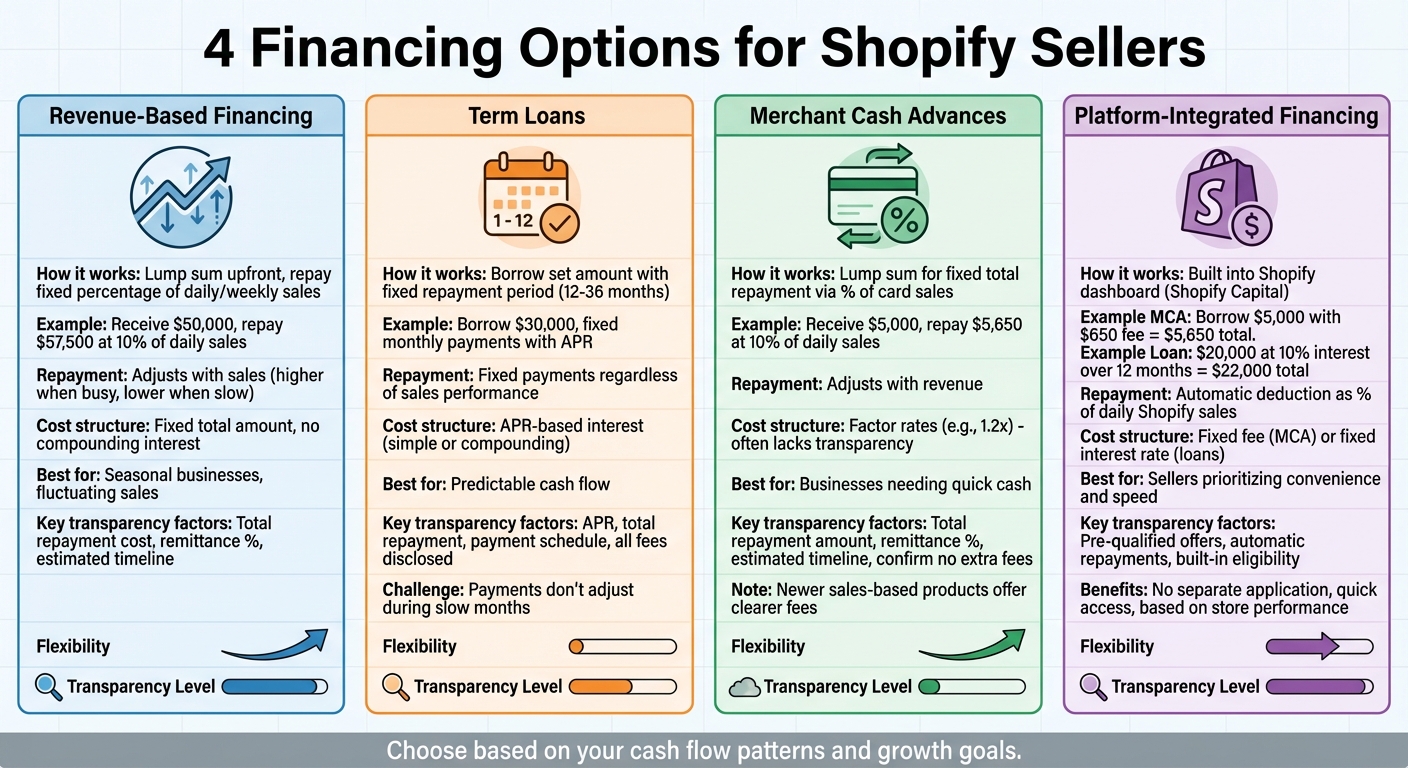
Shopify sellers have four main financing models to consider, each with its own set of costs and repayment structures. Choosing the right one depends on your store’s cash flow patterns and growth goals. Here’s an overview to help you understand the options and make a decision that aligns with your business needs.
Revenue-Based Financing
Revenue-based financing (RBF) provides a lump sum upfront, which you repay by allocating a fixed percentage of your daily or weekly sales. For instance, you might receive $50,000 and agree to repay $57,500 by remitting 10% of your daily sales. The total repayment amount is fixed, with no compounding interest or hidden fees, so you know exactly what you owe. Payments rise when sales are strong and decrease during slower periods, making this option particularly appealing for businesses with seasonal revenue or fluctuating sales. Brands that rely heavily on inventory or marketing often benefit from this flexibility. Transparent RBF providers will clearly outline the total repayment cost, remittance percentage, and estimated repayment timeline based on your sales history, helping you plan for how this financing will impact your cash flow.
Term Loans
Term loans involve borrowing a set amount - say, $30,000 - with a fixed repayment period, typically ranging from 12 to 36 months. These loans come with interest rates expressed as an APR and require fixed monthly payments, regardless of how your sales perform. While the structure is straightforward, transparency can sometimes be a concern. Key details to watch for include whether the interest is simple or compounding, how daily interest accrues, and whether there are hidden fees like origination charges or penalties for late or early payments. For Shopify sellers, the main challenge with term loans is that fixed payments don’t adjust during slow months, which can strain cash flow compared to sales-based options. A reliable term loan provider will disclose the APR, total repayment amount, payment schedule, and all fees upfront, allowing you to compare offers accurately.
Merchant Cash Advances and Sales-Based Products
A merchant cash advance (MCA) gives you a lump sum in exchange for a fixed total repayment collected as a percentage of future card or platform sales. For example, you might receive $5,000 and agree to repay $5,650 by remitting 10% of your daily Shopify Payments sales. This structure adjusts to your revenue, which can be helpful during slow periods. However, traditional MCAs often lack transparency, as they use factor rates (e.g., 1.2x the advance) instead of clear interest rates. Newer sales-based products improve on this model by offering one simple fee and greater clarity. A transparent provider will detail the total repayment amount, remittance percentage, estimated repayment timeline based on sales, and confirm there are no extra fees, so you can see how much of your revenue will go toward repayments each month.
Platform-Integrated Financing
Platform-integrated financing is embedded directly within your eCommerce platform. For Shopify users, this typically means Shopify Capital, which offers both merchant cash advances and loans to eligible U.S. sellers. Pre-qualified offers appear in your Shopify dashboard, and funds are deposited directly into your business account after you select an amount. Repayments are automatically deducted as a percentage of your daily Shopify sales. For merchant cash advances, Shopify Capital charges a fixed fee upfront (e.g., borrow $5,000 with a $650 fee, repaying $5,650 total). For loans, they use fixed interest rates (e.g., a $20,000 loan at 10% interest over 12 months, totaling $22,000 repayment). While this option is convenient - there’s no separate application process or external integrations - the total cost can sometimes be higher than bank loans or specialized lenders. However, the speed, built-in eligibility assessments based on store performance, and automatic sales-based repayments make it an attractive choice for many Shopify sellers, especially those who value simplicity and quick access to funds.
How to Evaluate Transparency in Financing Offers
Building on the basics of transparent financing, here's a guide to critically assessing financing offers.
Understanding Cost and Fee Structures
When evaluating financing, focus on three key figures: the funding amount (e.g., $25,000), the total repayment amount (e.g., $31,250), and the cost expressed as a percentage or APR-equivalent. These numbers make it easy to determine the true cost - in this case, you're paying $6,250 for $25,000 in funding, which translates to a 25% total cost.
Look for offers that clearly state "no hidden fees" in their terms. Reputable providers typically use a single service fee or fixed fee model and disclose all charges upfront. Avoid offers that rely on vague terms or factor rates without showing the actual dollar amounts you'll owe.
This straightforward structure sets the stage for evaluating repayment flexibility.
Repayment Flexibility and Predictability
Transparent financing adjusts repayments based on your sales performance. For instance, if payments are tied to a percentage of daily or weekly sales, they increase when sales are strong and decrease during slower periods. This approach helps protect your cash flow and minimizes the risk of missed payments.
Verify the exact deduction percentage, payment schedule, and whether early repayment penalties apply. Ask questions like: "What happens if my sales drop significantly?" or "Can I pay off early without extra fees?" Transparent lenders should provide these answers in writing and often highlight features like zero prepayment penalties.
Identifying Hidden Fees
Once you've reviewed cost structures and repayment terms, it’s time to check for hidden fees. These might include application fees, processing or origination fees, disbursement fees, servicing or account maintenance fees, and late payment charges. Such fees are often buried in the fine print rather than prominently disclosed.
Request a detailed breakdown of all fees in writing. Ask directly: "Are there any application, processing, disbursement, servicing, or prepayment fees?"
To verify transparency, carefully review the fee section of the loan agreement, test the provider’s online dashboard to confirm it clearly displays your current balance and total obligation, and compare the offer to at least one other transparent option. If any fee seems unclear or isn’t explicitly listed, consider it a red flag and ask for clarification. Truly transparent providers will state upfront that they charge no hidden fees and will ensure all costs are visible at the time of approval.
sbb-itb-d7b5115
Using Onramp Funds for Transparent Financing
How Onramp Funds Supports Shopify Sellers
Onramp Funds provides equity-free, revenue-based financing designed specifically for Shopify sellers. This straightforward approach aligns with the clear terms mentioned earlier. By integrating directly with your Shopify store, Onramp analyzes your sales history and cash flow to offer funding options that match your business needs. Unlike traditional lenders that focus on personal credit checks, Onramp bases its decisions on your store’s actual performance, ensuring your business track record takes center stage.
Once you connect your Shopify store, you’ll receive tailored offers with fixed fees clearly disclosed right from the start. There are no application fees, no origination charges, and no penalties for early repayment. Payments are automatically deducted as a percentage of your daily sales, making them flexible. When sales are high, you pay more; when sales slow down, payments adjust accordingly, helping you maintain steady cash flow.
Transparent Pricing and Flexible Repayment
Onramp prioritizes upfront pricing to eliminate surprises. Each funding offer clearly outlines the amount you’ll receive, the total repayment, and the fixed fee. For instance, if you’re advanced $5,000 with a fixed fee of $650, your total repayment is $5,650 - no matter how quickly you pay it back. This level of predictability means you can confidently plan for expenses like inventory restocking or marketing campaigns.
"Onramp offered the perfect solution with revenue-based financing to secure the capital we needed to invest in inventory and pay it back at a reasonable time frame once we made sales."
– Jeremy, Founder and Owner of Kindfolk Yoga
Repayment terms are tied to your sales performance, typically ranging from 2–8% of daily revenue depending on the offer. One customer shared their experience:
"Onramp has simplified cash flow by automating everything: easy to request, automated payments - quick and fast!"
– Torrie V., Founder and Owner of Torrie's Natural
Next, let’s look at how you can quickly start using Onramp Funds.
Getting Started with Onramp Funds
Getting funding through Onramp is simple and efficient:
- Share basic details about your business to get an initial funding estimate.
- Connect your Shopify store with read-only access to ensure your data stays secure.
- Link your bank account to qualify and view customized funding offers.
Once you accept an offer, funds are typically deposited within 24 hours. To qualify, your business needs to generate at least $10,000 in average monthly sales and be a registered U.S. entity (such as an LLC, C-Corp, or S-Corp). There’s no minimum time in business required, making Onramp accessible even to newer Shopify sellers with growing sales. The Austin-based team is ready to assist you every step of the way, helping you make the most of your funding for inventory, marketing, or other operational needs.
Conclusion: Why Transparent Financing Matters for Shopify Sellers
Running a Shopify store comes with its fair share of challenges - managing inventory costs, allocating marketing budgets, and dealing with fluctuating cash flow, all while navigating a competitive market. Transparent financing can make a world of difference by removing uncertainties from funding decisions. When you know exactly what you'll owe upfront, you can invest in growing your business without the fear of hidden fees cutting into your profits.
Revenue-based financing offers a repayment model that adjusts with your sales. This means during slower periods, your payments decrease, and during busier times, they increase. This flexibility helps maintain financial stability while giving you the breathing room to scale your operations effectively[2][3].
Another benefit of transparent financing is the clarity in fee structures, which helps prevent overextending your resources. Providers that evaluate your store’s sales history and cash flow needs - rather than relying solely on personal credit - can offer terms tailored to your business. For example, platforms like Onramp Funds ensure you don’t take on more debt than your store can handle, all while keeping you in control and avoiding equity loss.
The results speak for themselves. Shopify sellers who use clear, revenue-based financing have reported over 20% revenue growth by reinvesting funds into inventory and marketing at the right time[3]. With over 3,000 eCommerce loans already funded and customers seeing a 73% revenue increase within 180 days of funding, the impact of straightforward financing is undeniable[1].
When exploring financing options, prioritize partners who provide full transparency. Look for features like fixed fees, no prepayment penalties, and repayment terms that align with your sales. Your business deserves financing that’s simple, clear, and built to support your growth.
FAQs
What advantages does revenue-based financing offer Shopify sellers?
Revenue-based financing offers Shopify sellers a repayment method that adapts to their sales performance, easing the burden of fixed monthly payments. This approach is especially helpful during periods of slower sales, as it allows for better cash flow management.
One of the biggest advantages is how quickly sellers can access funds - sometimes in as little as 24 hours - all without sacrificing equity. Since repayments are directly linked to revenue, this financing option provides a smart way to scale operations, invest in inventory, or ramp up marketing efforts without stretching finances too thin.
How does financing work with Shopify and my store?
Financing connects seamlessly with your Shopify store by analyzing your sales history and cash flow to create a funding offer tailored specifically to your business. The best part? It skips personal credit checks and focuses entirely on how your store is performing.
Once approved, you’ll have access to flexible funding options, with funds often landing in your bank account within just a few hours. Repayments are automatically taken as a percentage of your sales, helping you manage your cash flow without unnecessary pressure.
How can I ensure a financing offer is truly transparent?
When evaluating a financing offer, it's crucial to prioritize clear and upfront information about fees, interest rates, and repayment terms. Steer clear of deals that include hidden charges or ambiguous conditions. Make sure the repayment terms are adaptable and aligned with your sales performance. Also, verify that there are no penalties for paying off the balance early. A transparent offer ensures you’re always aware of what you owe and when you need to pay it.
Related Blog Posts
Onramp Funds
Funding built around your sales
Connect your store and see what you qualify for. Repay as a percentage of sales, with no personal credit check.
Funding in as little as 24 hours.
