


eCommerce brands that grow sustainably think of capital as infrastructure, not a quick fix. This means maintaining a steady financial foundation to cover essentials like inventory, marketing, and operations. Instead of scrambling for loans or falling into debt cycles, these businesses rely on structured, long-term capital strategies to ensure stability and resilience.
Key takeaways from this approach include:
- Capital as a baseline resource: Treat funds like a permanent part of your operations, similar to your warehouse or tech systems.
- Avoid reactive financing: Stop relying on emergency loans or personal credit cards.
- Focus on cash flow: Use metrics like the Cash Conversion Cycle (CCC) to optimize how quickly you turn investments into revenue.
- Flexible financing: Options like revenue-based funding adjust repayments to your sales, ensuring cash flow stability during slower periods.
This mindset helps eCommerce brands handle challenges like supplier delays, rising costs, or seasonal fluctuations without disrupting growth. Platforms like Onramp Funds provide tailored solutions, offering fast, equity-free financing tied to your sales performance. By building a strong capital foundation, you can focus on scaling your business with confidence.
eCommerce Funding Secrets Every Seller Should Know
Financial Fundamentals for eCommerce Capital Management
Before treating capital as infrastructure, it's crucial to grasp the financial mechanics behind it. A solid understanding of these basics is key to making smarter decisions about inventory, marketing, and funding. Let’s dive into the core metrics and cost distinctions that can guide efficient capital use in eCommerce.
Working Capital and the Cash Conversion Cycle
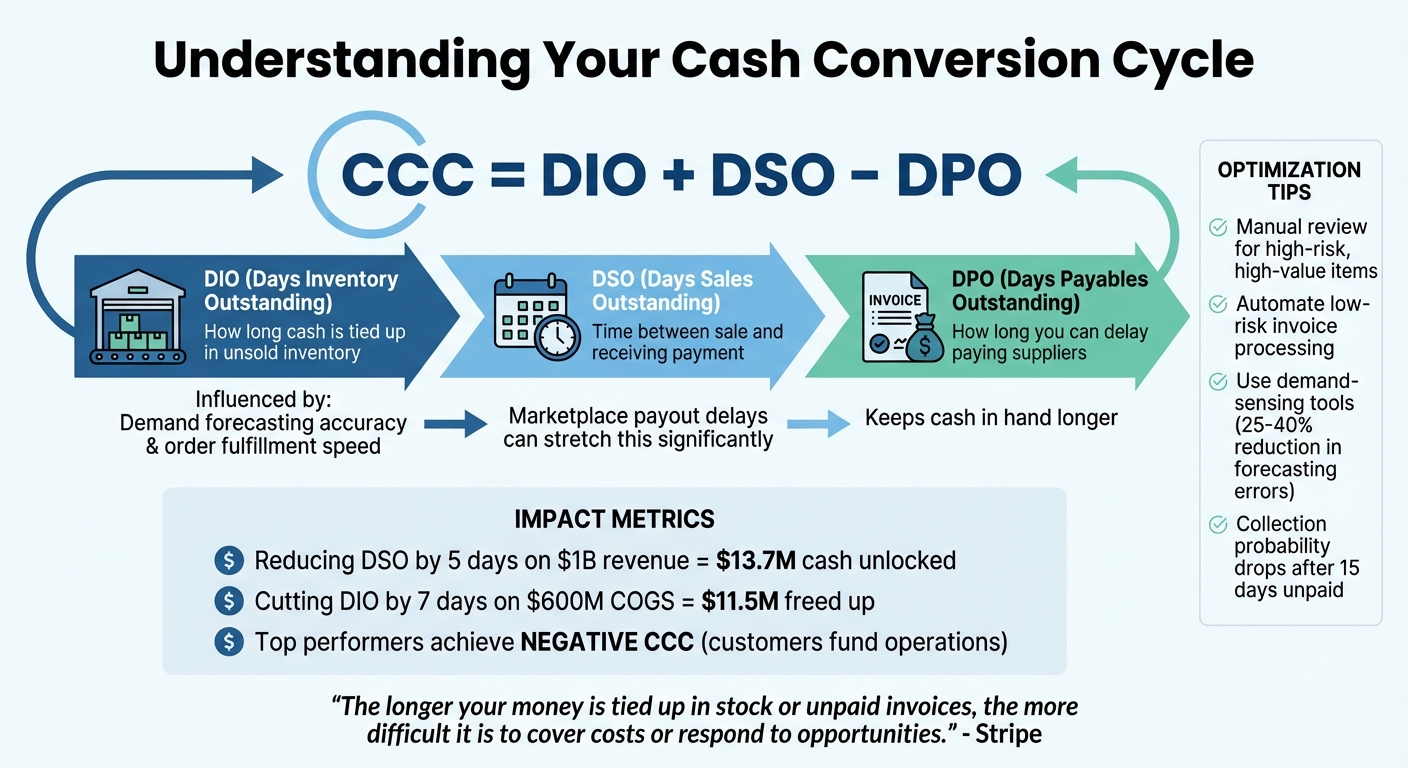
The Cash Conversion Cycle (CCC) measures how long it takes to turn cash spent on inventory into cash from sales. The formula is: CCC = Days Inventory Outstanding (DIO) + Days Sales Outstanding (DSO) - Days Payables Outstanding (DPO) [3][4].
Each piece of this equation affects your cash flow:
- DIO tracks how long cash is tied up in unsold inventory. This is influenced by how accurately you forecast demand and how quickly you fulfill orders.
- DSO measures the time between making a sale and receiving payment. Marketplace payout delays can stretch this period significantly.
- DPO reflects how long you can delay paying suppliers. Extending this timeframe helps you keep cash in hand longer [3].
"The longer your money is tied up in stock or unpaid invoices, the more difficult it is to cover costs or respond to opportunities." - Stripe [3]
The impact of these metrics is real. For example, reducing DSO by just five days on $1 billion in revenue can unlock $13.7 million in cash. Similarly, cutting DIO by seven days on $600 million in cost of goods sold frees up approximately $11.5 million [2]. Some top-performing retailers even achieve a negative CCC, meaning they get paid by customers before they pay suppliers - essentially letting customers fund operations [3][4].
Improving your CCC requires a targeted approach. For high-risk, high-value items, manual review is often worth the effort, while low-risk invoices can be streamlined with automation [2]. Automated invoice audits can catch issues, like missing purchase order numbers, that might otherwise delay payment. This is critical, as collection probability drops significantly after invoices remain unpaid for more than 15 days [2]. On the inventory side, demand-sensing tools can cut forecasting errors by 25–40% within six months, leading to noticeable reductions in inventory days [2].
Fixed vs Variable Costs in eCommerce
Knowing which costs remain steady and which change with sales volume is critical for effective capital allocation.
- Fixed costs - such as office rent, salaries, and software subscriptions - stay constant regardless of how much you sell [8]. These costs create a baseline "burn rate", which can strain cash flow during slower periods.
- Variable costs - like inventory purchases, shipping, digital advertising, and marketplace fees - fluctuate with sales volume [1][8].
To stay financially healthy, aim for an operating cash flow ratio of at least 1.25 [8]. Matching funding sources to cost types can also help. For example, variable costs like inventory and marketing are best supported by flexible, sales-based financing, where repayments adjust based on revenue. On the other hand, fixed costs are better suited for stable, long-term funding options like retained earnings or traditional credit lines.
A practical example: In March 2024, Microsoft reported $147 billion in current assets and $118.5 billion in current liabilities, resulting in $28.5 billion in working capital [5].
Steps to optimize your cost management include:
- Using the "direct method" for cash flow reporting to track actual cash movements clearly [8].
- Partnering with third-party logistics providers to secure bulk shipping discounts, which can turn variable costs into more predictable expenses [6].
- Maintaining cash reserves that cover 5–7 months of operations to cushion against potential sales declines [6].
Understanding these cost structures sets the stage for building a tailored capital stack to fuel growth.
Building a Capital Stack for Growth
Your capital stack is the mix of funding sources that supports your business. For eCommerce, a well-designed stack often includes operating cash for daily needs, retained earnings for organic growth, revenue-based financing for inventory and marketing, and possibly equity capital for larger expansions [1][6][7].
The U.S. eCommerce market grew from $789 billion in 2020 to over $1.1 trillion by 2024 [1]. Direct-to-consumer (D2C) businesses alone represent a $1.5 trillion market, growing at 25% annually, with D2C sales increasing from 8.1% to 19.2% of total retail sales [9]. Scaling in such a dynamic environment demands a flexible and efficient capital structure.
| Component | Description | Best For |
|---|---|---|
| Operating Cash | Cash readily available in bank accounts | Day-to-day expenses and emergency needs |
| Inventory Financing | Funds for purchasing stock | Seasonal demand and bulk purchase discounts |
| Revenue-Based Finance | Repayments tied to sales performance | Scaling marketing or inventory investments |
| Retained Earnings | Reinvested profits | Long-term, sustainable growth |
| Equity Capital | Investment from VCs or angel investors | Major expansions or tech advancements |
Aligning your capital stack with your Cash Conversion Cycle is key. Funding should cover the time it takes to turn inventory into sales revenue, factoring in delays from marketplace payouts [6]. A healthy current ratio - current assets divided by current liabilities - typically falls between 1.5 and 2.0 [7].
"Working capital is the buffer that keeps you from running out of money while you wait for more to come in." - Stripe [7]
The smartest strategies combine short-term financing for quick inventory turnover with long-term funding for stability. Manage payables wisely - only pay invoices early if it offers a clear financial benefit, like early payment discounts [7]. For businesses with seasonal sales fluctuations, prioritize financing options where repayments adjust during slower periods, ensuring cash flow remains steady [6].
Where to Deploy Capital for Maximum Impact
Successful eCommerce brands know that where you put your money matters. By focusing on key areas like inventory, marketing, and technology, they’re able to grow revenue, cut costs, and improve customer satisfaction. The goal? To squeeze measurable ROI from every dollar spent - whether that’s quicker shipping, better conversions, or smarter inventory management.
Inventory and Supply Chain Funding
In eCommerce, inventory is both your biggest asset and your biggest risk. Last year, retailers lost a staggering $818 billion due to inventory issues - 52% from stockouts and 44% from overstocking [14]. Companies with efficient inventory management processes are 79% more likely to grow revenue faster than their competitors [14].
One way to manage this is by purchasing in bulk. Not only does this secure volume discounts, but it works best for products with proven demand and quick turnover. To avoid stockouts during unexpected demand surges or supply chain hiccups, maintaining a safety stock is critical. This buffer can be calculated by factoring in lead time variability and supplier reliability [2].
Another smart move? Strategically distributing inventory across multiple fulfillment centers. While this can cut shipping costs and delivery times, it only makes sense if the sales volume in a particular region justifies the added holding costs [10]. For example, in the U.S., placing inventory strategically can enable 2-day shipping for 96% of the population [10].
Take Touchland, for instance. Under CEO Andrea Lisbona’s leadership, the company navigated a pandemic-driven surge in demand, handling up to 700 orders daily and selling 10,000 dispensers in just three months. They used pre-orders and waitlists - reaching 34,000 customers - to manage inventory and capital during this chaotic period [12].
"We were already growing quickly when COVID began, then we completely sold out the first week of the pandemic." - Andrea Lisbona, Founder & CEO, Touchland [12]
To avoid losing money on unsold products, brands should run aging reports every 60–90 days. If inventory isn’t moving, liquidate it through bundles or flash sales before it loses value [2].
Once your inventory is in check, the next step is to invest in customer acquisition to keep the growth momentum going.
Marketing and Customer Acquisition Spending
Marketing dollars should be laser-focused on driving measurable growth. The trick is to prioritize products with high margins and fast turnover while carefully analyzing performance by customer cohort to ensure every dollar is well spent [11].
Performance marketing requires a sharp eye on ROI. Segment products based on their profitability and how quickly they sell [11]. Seasonal campaigns - like Black Friday or holiday shopping - demand flexible budgets that can scale up during peak times without overextending cash flow during slower months.
Social commerce is also gaining traction. In fact, 70% of B2C leaders are increasing their spending on social selling [13]. Meanwhile, nearly 20% of eCommerce leaders are prioritizing Generative AI for personalized product recommendations and sales strategies, compared to fewer than 5% of slower adopters [13].
But marketing is just one piece of the puzzle. Investing in technology and fulfillment ensures your operations can keep pace with growing demand.
Technology and Fulfillment Investments
Technology is the backbone of operational success. Leading brands invest in eCommerce platforms, automation tools, and fulfillment systems to streamline processes, improve order accuracy, and scale efficiently [13].
Checkout optimization, for example, is a high-impact area. More than 70% of online shopping carts are abandoned, with nearly 20% of shoppers leaving because the checkout process is too complicated [11]. Simplify things by reducing form fields, offering digital wallet options like Apple Pay or Google Pay, and displaying shipping costs upfront [11].
Outsourcing to third-party logistics (3PL) providers can also be a game-changer. These partnerships offer bulk shipping discounts and access to distributed warehouses, cutting final-mile delivery costs and speeding up shipping [10]. With warehouse rental prices climbing 10% in recent years [12], many brands are finding 3PL solutions more cost-effective than owning their own facilities.
Andrea Hamilton, founder of The Finer Things 1920, saw her business thrive after outsourcing fulfillment to ShipBob. This move reduced shipping times from three weeks to under two days and tripled customer subscriptions in less than a year [12].
"Last time we shipped our own packages, it took us 3 weeks. It took ShipBob less than 2 days." - Andrea Hamilton, Founder, The Finer Things 1920 [12]
Automation also plays a critical role in inventory management. Automated systems can set reorder points based on real-time sales data, helping prevent human error and stockouts during busy periods [12]. Many leaders are also adopting MACH architecture (Microservices, API-enabled, Cloud-native, and Headless) to build scalable, flexible systems [13].
Here’s a quick snapshot of how these investments pay off:
| Investment Area | Benefit | Metric to Watch |
|---|---|---|
| Inventory Splitting | Lower shipping costs & faster delivery | Shipping Zone Average |
| Checkout Optimization | Higher conversion rates | Cart Abandonment Rate |
| 3PL Automation | Better order accuracy & labor efficiency | Fulfillment Cycle Time |
These investments aren’t just operational tweaks - they’re the foundation for long-term growth. Companies in the top third of stock market valuation invest about 50% more in capital expenditures than their peers and see 65% higher sales growth as a result [15].
sbb-itb-d7b5115
How to Allocate Capital and Manage Cash Flow
Allocating capital wisely is about making every dollar count. The most successful brands have a clear understanding of where their money is going, how quickly they see a return, and how to navigate slow sales periods. This involves tracking profitability at the SKU level, keeping cash reserves for tough times, and using financing options that adapt to your revenue flow.
Making Decisions Based on Profitability and ROI
When deciding where to invest, focus on the return on investment (ROI) for each product. Break down profitability by SKU and sales channel to identify which products drive the most cash flow. A simple formula for cash-on-cash ROI is net profit divided by total capital deployed. For instance, a $10,000 inventory investment that generates $2,500 in profit yields a 25% ROI.
To improve cash flow, shorten your cash conversion cycle. This could mean negotiating better payment terms with suppliers, speeding up order fulfillment, or requiring upfront payments instead of offering 30- or 90-day terms [8]. The quicker you turn inventory into cash, the less you’ll need to rely on external funding.
"Hyper-focusing on expenses, cash flow, and receipts is wise in any economic climate – and doubly so in recessionary times." - Eric Youngstrom, Founder and CEO, Onramp Funds [6]
Keep an eye on your Operating Cash Flow Ratio (OCFR), calculated as Operating Cash Flow ÷ Current Liabilities. A ratio above 1.0 indicates you can meet your financial obligations, while a score of 1.25 or higher is ideal for eCommerce businesses [8]. If your ratio drops below 1.0, it could signal trouble covering essential costs like supplier payments or marketing expenses. A strong focus on ROI naturally leads to better cash flow management.
Cash Flow Management Strategies
Liquidity is the lifeline of any business. Aim to maintain cash reserves that can cover 5–7 months of operating expenses without relying on new revenue [6]. This safety net helps you weather seasonal dips, supply chain issues, or unexpected disruptions.
In addition, create a 12-month rolling cash flow forecast and update it weekly. By modeling optimistic, realistic, and conservative scenarios, you can spot potential cash shortages early and adjust your spending or secure financing as needed [6][16].
When it comes to financing, align it with your operational cycles. For example, if your inventory turnover is 60 days, avoid committing to a 12-month loan with fixed payments. Instead, choose short-term financing that matches your sales cycles. This approach reduces your overall financing costs while ensuring you have access to funds when needed [6].
Automating expense management can also help control spending. Tools that categorize expenses and set spending limits on virtual cards for specific vendors can prevent overspending [8]. Additionally, tie variable costs, such as marketing and shipping, directly to revenue. This way, your expenses naturally scale up during busy seasons and contract during slower periods.
Using Onramp Funds in Your Capital Plan

Flexible financing is a vital part of smart cash flow management. Revenue-based financing, like the solution offered by Onramp Funds, adjusts repayments based on your sales performance. Unlike traditional loans with fixed payments, this approach ensures you maintain liquidity when sales slow down [6][16].
Here’s how it works: Onramp Funds charges a fee of less than 1% of GMV, allowing you to borrow up to 25% of your anticipated monthly revenue [6]. There’s no APR, no fixed repayment schedule, and no minimum monthly payment. Instead, repayments are taken as a percentage of your sales. If a marketplace like Amazon places your funds on hold, your repayment is delayed accordingly.
For example, during peak shopping seasons like Black Friday, your sales and repayments may increase. But in slower months, such as January or February, repayments automatically decrease to match your revenue.
"Reduce your cost of capital with shorter-term, faster-turnover financing – this reduces your costs while allowing access to additional cash to support your sales and inventory turnover cycles." - Eric Youngstrom, Founder and CEO, Onramp Funds [6]
The revenue-based financing market is expected to grow significantly, reaching $42.3 billion by 2027 with a CAGR of 61.8% [16].
| Financing Type | Repayment Structure | Equity Dilution | Speed of Access |
|---|---|---|---|
| Revenue-Based (Onramp) | Percentage of sales | None | 24–48 Hours |
| Traditional Bank Loan | Fixed monthly payments | None | 1–3 Months |
| Venture Capital | None (Exit-based) | High | 3–9 Months |
Setting Up Onramp Funds as Part of Your Financial System
Integrating Onramp Funds into your financial setup can streamline cash flow and make accessing capital a seamless part of your operations. The process is quick - taking just minutes - and positions funding as a core element of your business strategy.
Determining Your Funding Needs and Timing
Start by mapping out your cash conversion cycle to identify when and where you might encounter funding gaps. Many eCommerce businesses, for example, face cycles lasting 60–120 days. Let’s say you’re placing a $50,000 purchase order 90 days ahead of Black Friday. In such a case, you might need funding 30–60 days beforehand to cover costs and avoid running out of stock.
Break your capital needs into these categories:
- Inventory: Multiply units by the landed cost in USD.
- Marketing: Plan ad spend for platforms like Meta, Google, and Amazon.
- Technology: Account for subscriptions, apps, and automation tools.
- Operations: Include costs like 3PL fees, freight, and packaging.
Develop a 12-month forecast that aligns with your sales and seasonal trends. For instance, if you aim to maintain 60–90 days of inventory before Q4, calculate the purchase orders and timing needed. On the marketing side, use your target return on ad spend (ROAS) - many brands aim for a 3–5× ROAS - to set monthly budgets.
Decide how you’ll use Onramp: as a consistent tool for routine expenses or as a flexible option for seasonal spikes and product launches. Establish clear internal guidelines, such as drawing funds when inventory drops below 45 days or when campaigns hit a specific ROAS threshold. Document these in your standard operating procedures to keep your processes consistent.
Here’s how to get started with Onramp in three steps:
- Provide basic business information to receive an initial funding estimate in about a minute.
- Connect your eCommerce platforms (e.g., Shopify, Amazon, Walmart) and bank accounts.
- Review personalized funding offers based on your sales data and select the one that fits your needs. Once approved, funds are typically deposited into your account within 24 hours.
"Received our offer and cash was in our bank within 24 hours. Their Austin, TX team helped deploy the funds to grow our business."
- Nick James, CEO, Rockless Table
To qualify, your business must be a U.S.-based legal entity (e.g., LLC or C-Corp) with at least $10,000 in average monthly sales. Onramp evaluates factors like sales history, cash flow, and existing debt to determine funding - no balance sheet or collateral required.
How Sales-Based Repayments Work
Onramp’s repayment model is designed to align with your sales cycles. Instead of fixed dollar amounts, repayments are based on a percentage of your daily or weekly sales. For example, if your repayment rate is 10% and you make $5,000 in sales in a day, $500 is automatically collected. On slower days, such as $1,000 in sales, only $100 is collected. If your sales pause temporarily (e.g., due to an Amazon payout hold), repayments pause too, keeping cash outflows in sync with revenue.
"With payments synchronized with your sales cycle, Onramp only takes money out of your account when you get paid by your customers. No sales, no debits."
- Onramp Funds
Onramp offers two repayment options:
- Variable Repayment: A percentage of daily sales, adjusting to seasonal changes.
- Fixed Payment: Consistent dollar amounts for stable cash flow forecasting.
To maintain healthy cash flow, aim to keep sales-based repayments at 10–20% of your gross sales. Evaluate your gross margin per order to determine what portion can safely go toward repayments. Run stress tests using 50–70% of forecasted sales to ensure you remain profitable even after repayments.
Record these repayments in your financial reports using specific general ledger codes (e.g., "Onramp Advances", "Onramp Repayments", "Financing Fees"). Add them as variable line items in your 13-week cash flow forecast and track key metrics like revenue growth, inventory turnover, and marketing payback periods in your dashboards.
Benefits of Using Onramp Funds as Infrastructure
Incorporating Onramp Funds into your financial system comes with several advantages:
- Speed: Onramp uses real-time sales data for underwriting, with funding delivered in under 24 hours - much faster than traditional bank loans, which often take months.
- Equity-Free Growth: Access capital without giving up ownership or providing personal guarantees.
- Transparent Costs: Onramp charges a flat fee (typically 2–8% of the funded amount) and collects small percentages of daily sales, keeping costs aligned with revenue.
- Seamless Integration: Direct API connections to platforms like Shopify and QuickBooks automate approvals, reconcile repayments, and provide cash flow insights, reducing administrative work.
Onramp has been a game-changer for many businesses, with customers reporting 60–73% revenue growth within 180 days of funding. Around 75% of users choose to borrow again. The platform has funded over 3,000 eCommerce loans and is highly rated, with an A+ from the Better Business Bureau and a "Great" rating on Trustpilot.
"Onramp has simplified cash flow by automating everything: easy to request, set it and forget it payments - quick and fast!"
- Torrie V., Founder and Owner, Torrie's Natural
Conclusion
Think of capital as a vital part of your infrastructure by creating a perpetual funding system to support your operations. This perspective reshapes how you handle your cash conversion cycle, allocate funds for inventory and marketing, and maintain liquidity during seasonal ups and downs. Instead of relying on one-off loans, focus on building a scalable financial framework, much like your fulfillment centers or technology systems. These principles lay the groundwork for the key takeaways below.
Key Takeaways
Cash is one of the most powerful tools in your business arsenal. As highlighted in the Umbrex CFO Handbook, "Cash is silent capital: it funds growth without diluting equity, pays down debt without rating pain, and buffers shocks without press-release drama" [2]. Use your cash conversion cycle to identify where cash gets stuck and where funding gaps exist. For short-term needs like inventory restocks, advertising, or seasonal demand spikes, revenue-based financing can be a smart solution, allowing repayments to naturally align with your sales performance. Aim to build 5–7 months of cash reserves to navigate downturns without scrambling for emergency funding [6].
You can further optimize working capital by negotiating longer payment terms with suppliers, automating receivables collection, and cutting shipping costs through dimensional weight optimization. For example, if your business generates $10 million in annual revenue, reducing your cash conversion cycle by just five days could free up approximately $137,000 [2] - money that can be reinvested into growth.
These takeaways provide a practical roadmap for immediate action.
Next Steps for Your Business
Start by auditing your current capital structure. Calculate your cash conversion cycle by adding Days Sales Outstanding (DSO) and Days Inventory Outstanding (DIO), then subtracting Days Payables Outstanding (DPO). This will help you pinpoint where cash gets tied up and identify the operational costs causing the biggest funding gaps. Create a 12-month forecast that accounts for seasonal trends and purchase schedules.
Consider integrating Onramp Funds into your financial system. This approach offers flexible, sales-based funding with quick access - funds are delivered in under 24 hours, and repayments adjust with your daily sales. This ensures cash flow remains steady during slow periods while allowing you to scale up during peak seasons. Develop clear internal policies, such as setting thresholds based on inventory levels or marketing performance, to make capital access a consistent and predictable part of your operations. By doing so, you’ll create a financial infrastructure that supports sustainable growth.
FAQs
What is the Cash Conversion Cycle, and how can eCommerce brands use it to improve cash flow?
The Cash Conversion Cycle (CCC) is a key metric that shows how fast a business can transform its inventory investments into cash. For eCommerce brands, improving this cycle can lead to better cash flow and more opportunities for growth.
Here’s how you can refine your CCC by focusing on three critical areas:
- Speed up receivables: Work on collecting payments from your customers more quickly. This could involve offering incentives for early payments or streamlining your billing process.
- Streamline inventory management: Reduce the number of days inventory sits idle by maintaining the right balance - enough to meet demand but not so much that you're stuck with excess stock.
- Negotiate better payment terms: Discuss extended payment terms with your suppliers. Aim to give yourself more time to pay while maintaining positive relationships.
Keeping a close eye on your CCC and addressing any bottlenecks can unlock cash to fuel your business growth, boost efficiency, and keep you ahead of the competition.
What makes revenue-based financing a better option than traditional loans for eCommerce businesses?
Revenue-based financing provides eCommerce businesses with a flexible way to secure funding without giving up ownership. Instead of fixed monthly payments, businesses repay the funds as a percentage of their sales. This means payments automatically adjust based on revenue, offering relief during slower sales periods.
Another advantage is how quick and accessible it is. Businesses can often receive funds within a few days, with no need for credit checks or personal guarantees. Plus, it avoids the high interest rates tied to traditional loans, making it an appealing option for businesses aiming to grow and expand efficiently.
How can treating capital as infrastructure help eCommerce businesses handle seasonal demand changes?
Treating capital as infrastructure gives eCommerce businesses a stable financial backbone to navigate both bustling peak seasons and quieter periods. With strategic capital management, businesses can secure the funds required to stock up on inventory, ramp up marketing campaigns, and handle fulfillment costs when demand surges.
During slower months, this mindset helps maintain liquidity, ensuring steady cash flow and avoiding operational hiccups. By treating capital as a long-term resource, businesses can better adapt to seasonal changes and focus on steady, sustained growth.
Related Blog Posts
Onramp Funds
Funding built around your sales
Connect your store and see what you qualify for. Repay as a percentage of sales, with no personal credit check.
Funding in as little as 24 hours.
