


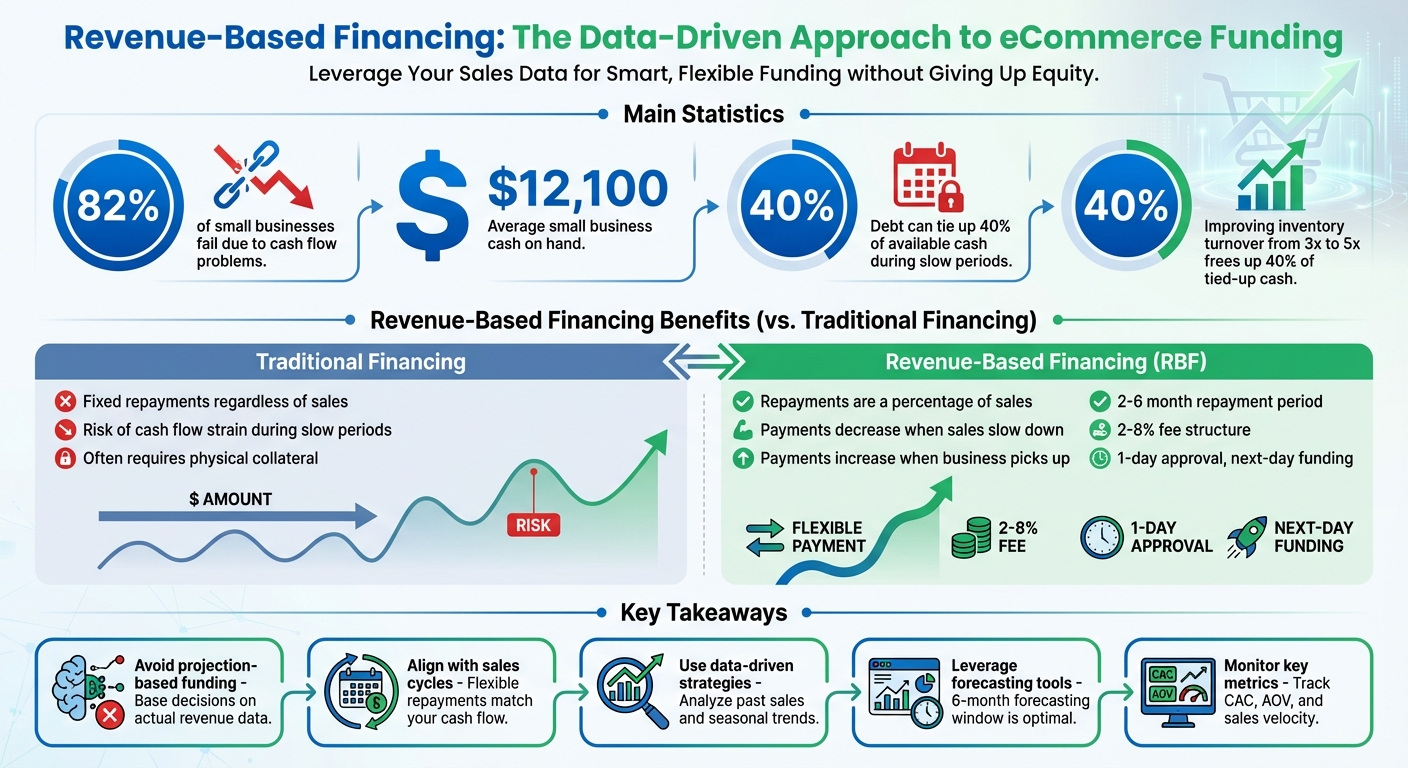
When funding decisions are based on optimistic projections instead of actual revenue, businesses risk cash flow issues, debt burdens, and operational disruptions. This is especially true for eCommerce businesses, where seasonal highs and lows can create financial instability. Revenue-based financing (RBF) offers a smarter alternative by tying repayments to actual sales, providing flexibility during slow months and high-demand periods. Here's the key takeaway:
- Avoid funding based on projections: 82% of small businesses fail due to cash flow problems. Align funding with real revenue to mitigate risks.
- RBF aligns with sales cycles: Repayments are a percentage of sales, easing financial strain during slower periods.
- Use data-driven strategies: Analyzing past sales, spotting seasonal trends, and building accurate cash flow forecasts ensure smarter financial planning.
- Leverage tools: Platforms like QuickBooks and Onramp Funds simplify forecasting and provide tailored funding solutions.
Deep Dive on Revenue Based Financing
sbb-itb-d7b5115
The Dangers of Funding Based on Optimism
Relying on strong sales and optimistic projections instead of actual cash flow can lead to financial trouble. Funding decisions grounded in data are essential to maintaining healthy cash flow, as optimism-driven choices often come with a hefty price tag. Did you know that 82% of small businesses fail due to cash flow problems? [3] The average small business operates with razor-thin margins, holding just $12,100 in cash on hand [3]. This leaves little room for error when projections don’t pan out. For many eCommerce businesses, funding decisions that seem logical during periods of high demand can quickly become unsustainable when sales slow down - especially during peak seasons.
Taking on Too Much Debt During Peak Seasons
Peak sales periods, like Black Friday or the holiday season, can create a false sense of financial security. Strong sales often tempt businesses to take on excessive debt for inventory expansion or aggressive marketing. But when sales inevitably taper off, the debt burden can drain cash reserves during slower months [3][4].
Take Black Friday, for example. Many eCommerce founders borrow heavily to stock up on inventory, banking on previous years' performance. When sales dip post-peak, they’re often left with unsold inventory and hefty debt, tying up as much as 40% of available cash [6]. Bulk purchasing to secure discounts can compound the issue, freezing even more capital. By improving inventory turnover from 3x to 5x through smarter, data-driven ordering, businesses could free up nearly 40% of their tied-up cash [6].
Running Out of Cash and Facing Operational Problems
Misaligned funding doesn’t just affect debt - it can disrupt daily operations, too. When revenue falls short of expectations, the ripple effects are felt across the business. Cash shortages may delay inventory orders and lead to missed payments for suppliers or employees [6][7]. This can create a vicious cycle of late payments and operational hiccups [6].
Beyond delayed payments, businesses might face stockouts of high-demand items, losing revenue and frustrating customers. Marketing efforts during slow periods can also take a hit, reducing the long-term effectiveness of campaigns and return on ad spend [3].
Even when revenue appears strong, warning signs of undercapitalization - like relying on new loans to cover old debts or frequently delaying supplier payments - shouldn’t be ignored. Sometimes, growing revenue can mask deeper issues like rising customer acquisition costs, declining sales trends, or poor cash flow management [5]. Without funding strategies that align with actual revenue patterns, businesses often struggle to cover their essential costs during predictable slow periods, such as February after the holiday rush [4].
How to Analyze Revenue Patterns for Funding Decisions
When it comes to funding decisions, relying solely on optimism can lead to risky outcomes. Instead, the key is to base your decisions on actual revenue data. Understanding your real cash flow - not just projections - lays the groundwork for smarter financial planning. A common mistake many eCommerce businesses make is assuming that their best month represents a new baseline. To avoid this trap, dive into your data to uncover genuine revenue trends over time.
Review Past Sales Data
Start by pulling detailed sales records from your eCommerce platforms. Focus on metrics like transaction volume, average order value, and customer lifetime value. These numbers can help you identify growth patterns and seasonal shifts in revenue [3]. Dig deeper into profitability by determining which products bring in the most revenue and analyzing return rates and reasons [4].
Be cautious of months that could skew your analysis. For instance, months with three bi-weekly pay periods can throw off cash flow calculations if the additional payroll expenses aren't accounted for [8]. These nuances are crucial when estimating how much cash you’ll actually have on hand. To reduce the risk of overestimating, keep your forecasts within a six-month window, as longer projections often lead to unreliable assumptions [8].
Once you've assessed your historical data, the next step is to connect these findings to broader seasonal and market trends.
Spot Seasonal Patterns and Market Changes
After reviewing historical sales, expand your analysis to identify recurring seasonal patterns. Many eCommerce businesses experience revenue swings, particularly between high-volume holiday periods and the slower months that follow [3]. However, seasonal trends aren’t always easy to spot. For example, August often sees a dip in activity for many businesses due to vacation-related slowdowns [4].
Recognizing these cycles allows you to time funding requests more effectively. If your data consistently shows a revenue dip in early Q1 after the holiday rush, you can secure funding ahead of time to cover operational expenses during that predictable lull. Additionally, understanding consumer behavior - like the fact that a 50% discount at year-end is often more appealing than deeper cuts of 70% or 90% - can guide inventory and pricing strategies to maintain healthier margins [4].
To further stabilize cash flow, consider diversifying your product offerings. For instance, if your brand primarily focuses on winter items, adding summer gear or evergreen products can help balance revenue throughout the year [3].
Building Accurate Cash Flow Forecasts
Understanding your revenue patterns is just the beginning. The next step is building a cash flow forecast that maps out when money flows in and out of your business. This forecast is essential for determining if and when you might need additional funding.
To make this process easier, consider tools that can automate forecasts using your real sales data.
Cash Flow Forecasting Tools for eCommerce
There are several tools designed to streamline cash flow forecasting by pulling data directly from your eCommerce platforms and accounting software. For example, QuickBooks offers 30- and 90-day projections [8]. If you need something more robust, Cash Flow Frog and PlanGuru provide advanced forecasting features for businesses with more complex needs [8]. Another option, Mercury, delivers an eCommerce-specific forecasting model. It integrates customer acquisition costs, retention trends, and inventory planning to give you a clearer picture of your future cash position [9].
"A forecast is only as good as the assumptions behind it. Start simple, use directional logic based on real data, and revise over time." - Dan Kang, CFO, Mercury [9]
These tools also sync with platforms like Amazon and Shopify to track payout schedules. This is critical because your available cash depends on when platforms release funds - not just when customers make purchases [8]. For eCommerce businesses, the ideal forecasting window is around six months, as accuracy tends to drop significantly for projections beyond a year [8].
Planning for Inventory and Payment Schedules
Once you’ve set up your forecasting tools, the next step is integrating payment schedules and inventory planning into your cash flow model. Your forecast should account for major expenses, like inventory purchases. Use your monthly sales projections to estimate how much inventory you’ll need, and then incorporate those purchase orders into your cash flow plan [9]. This helps you avoid unexpected payment crunches.
"Forecasting when and how much inventory to buy - and how those decisions affect your cash balance - is critical." - Dan Kang, CFO, Mercury [9]
Payment terms are just as important as the amounts themselves. For instance, if your suppliers require payment within 30 days but your platform holds customer payments for two weeks, that gap needs to be reflected in your forecast [10]. Negotiating a two-week extension on supplier payment terms could save you from having to rely on external funding [8]. Additionally, watch out for months with three bi-weekly payroll cycles instead of two - these can disrupt your cash flow if they aren’t factored into your projections [8][11].
Using Onramp Funds for Revenue-Based Financing

Onramp Funds offers a flexible way to secure financing that matches your sales cycle, making it easier to manage cash flow during slower periods. Instead of relying on rigid loan structures, this revenue-based approach provides funding that adapts to your business's financial ups and downs.
Repayment That Matches Your Sales Flow
Repayments through Onramp Funds are tied directly to your sales. If sales slow down, your payments decrease; when business picks up, payments increase. This ensures your cash flow stays under control. The repayment period typically ranges from 2 to 6 months, allowing you to settle the funding quickly when revenue is strong [12].
"If [revenue] is lower than usual, they will lower your minimum payment and raise it a bit once sales increase." - Onramp Funds [12]
Fast, Transparent, and Tailored Funding
Onramp Funds customizes funding based on at least six months of your eCommerce sales data. There’s no need to give up equity, and the process is free of hidden fees. Instead, you’ll pay a clear fee structure ranging from 2-8% [1]. Approval happens within one day, and funds are deposited the next day [12]. Compared to traditional banks, which often hesitate to lend to eCommerce businesses due to a lack of physical collateral, this approach is much faster and more tailored to your needs.
Simple Integration with Top eCommerce Platforms
Getting started is straightforward: connect your eCommerce platform directly to Onramp Funds. The system works seamlessly with platforms like Shopify, Amazon, Walmart Marketplace, TikTok Shop, and more [2]. You’ll also link financial tools like Xero or Stripe to provide a clear view of your financial history [2].
Tracking and Adjusting Your Funding Strategy
Revenue patterns can shift quickly due to factors like changes in ad platforms, supply chain disruptions, or unexpected spikes in returns [13]. That’s why it’s so important to compare your actual sales to your forecasts regularly and adjust your funding strategy as needed. This flexible approach builds on the earlier concept of data-driven financing, ensuring your funding aligns with your current revenue trends.
Use Real-Time Dashboards to Track Revenue Changes
Real-time dashboards provide a clear view of your business's performance. By connecting your sales platforms and accounting tools to these dashboards, you can immediately spot any deviations from your forecasts. For example, if your daily sales velocity dips below expectations, the dashboard will alert you, allowing you to take quick action - like scaling back inventory orders or temporarily reducing marketing spend.
Keep an eye on key metrics such as Customer Acquisition Cost (CAC) and marketing ROI [9]. Tools like conditional formatting (e.g., highlighting negative cash flow in red) can make it easier to identify when external funding may be necessary [8].
Establish Triggers for Funding Adjustments
Setting specific thresholds can help you take timely action to adjust your funding. For instance, you could create a trigger for a 10% decline in your Average Order Value (AOV) or a sharp increase in CAC [9]. These triggers allow you to address liquidity challenges before they escalate.
Here’s how you can use data-driven triggers to guide your decisions:
To increase the reliability of your financial forecasts and funding triggers, sync tools like QuickBooks or Xero with your sales platforms [13]. This integration ensures standardized reporting, giving you the clean, actionable data you need to make confident decisions - whether it’s time to secure additional funding or scale back expenses.
Conclusion
Data-driven funding is a game-changer for eCommerce growth. By tying funding to actual revenue rather than overly optimistic projections, you can maintain sustainable growth, steer clear of unmanageable debt during busy seasons, and avoid cash shortages during slower periods. This approach ensures your business stays steady and ready to scale when the time is right.
The strategies and tools discussed in this guide - like analyzing past sales, using real-time dashboards, and setting adjustment triggers - are designed to help you make smarter financing decisions. For instance, Onramp Funds offers revenue-based financing that adjusts repayments based on your sales, aligning cash outflows with your actual income. This kind of flexibility is crucial for eCommerce businesses grappling with unpredictable demand or seasonal changes.
Putting these insights into action is straightforward. Start by reviewing your recent sales data to identify consistent trends. Connect your accounting tools to automated dashboards, which can flag potential issues up to three months in advance. Use conservative forecasts with built-in buffers for slower periods, and establish clear triggers to know when it’s time to revisit or tweak your funding strategy.
When your funding aligns with revenue, building cash reserves and reinvesting profits into high-impact areas like marketing becomes far more manageable. Plus, with integrated cash flow tools, you could save as much as 20 hours a month [14], giving you more time to focus on growing your business while your funding keeps pace with verified revenue trends.
FAQs
What are the main advantages of revenue-based financing for eCommerce businesses?
Revenue-based financing gives eCommerce businesses a quick and adaptable way to secure funds, often in as little as 24–48 hours. Repayments are tied to your sales, meaning they adjust to match your cash flow. Plus, there’s no need to sacrifice equity or offer personal guarantees.
This financing option is especially useful for handling seasonal inventory demands, investing in growth opportunities, or covering temporary cash flow shortages. It’s a smart approach that works in step with your revenue patterns, helping you manage and grow your business effectively.
How can eCommerce businesses use seasonal revenue trends to make smarter funding decisions?
To spot seasonal revenue trends, start by diving into at least two years of monthly sales data. Identify recurring spikes, such as those around Black Friday, Cyber Monday, or the back-to-school rush, as well as slower periods. Compare the year-over-year growth for each month, and use moving averages to smooth out any anomalies. This helps you zero in on genuine seasonal patterns. Adding metrics like customer acquisition cost (CAC) and customer lifetime value (CLV) can also shed light on whether those high-revenue periods bring in more profitable customers.
Once you’ve pinpointed these patterns, align your funding strategies with them. For instance, consider securing financing - like a line of credit or revenue-based funding - a month or two before your busiest sales periods. This gives you the cash to stock up on inventory and ramp up marketing efforts ahead of time. Then, during the peak, you can use the increased cash flow to pay down the balance. Revenue-based funding works particularly well here since repayments adjust with your sales, easing the pressure during slower months.
To stay ahead, build a rolling forecast that updates monthly with actual sales data. This approach lets you fine-tune both the timing and amount of funding you’ll need, ensuring you’re ready for high-demand periods without overextending yourself during quieter times. By leveraging data-driven insights, you can manage cash flow effectively and support consistent growth.
What are the best tools to automate cash flow forecasting for eCommerce businesses?
Automating cash flow forecasting allows eCommerce businesses to transform raw sales data into precise, forward-looking financial plans - without the hassle of manual spreadsheets. Many cloud-based tools connect directly to payment processors, accounting software, and inventory systems, offering a clear picture of your cash inflows and outflows.
Take AI-powered platforms, for instance. They can process your data in real-time, spotting potential liquidity gaps and funding needs before they become issues. Some tools also work effortlessly with popular platforms like Shopify or QuickBooks, enabling you to create cash flow statements and explore "what-if" scenarios with ease. These solutions streamline financial planning, helping you align funding decisions with actual revenue patterns and avoid cash flow hiccups or overextending your resources.
Related Blog Posts
Onramp Funds
Funding built around your sales
Connect your store and see what you qualify for. Repay as a percentage of sales, with no personal credit check.
Funding in as little as 24 hours.
