

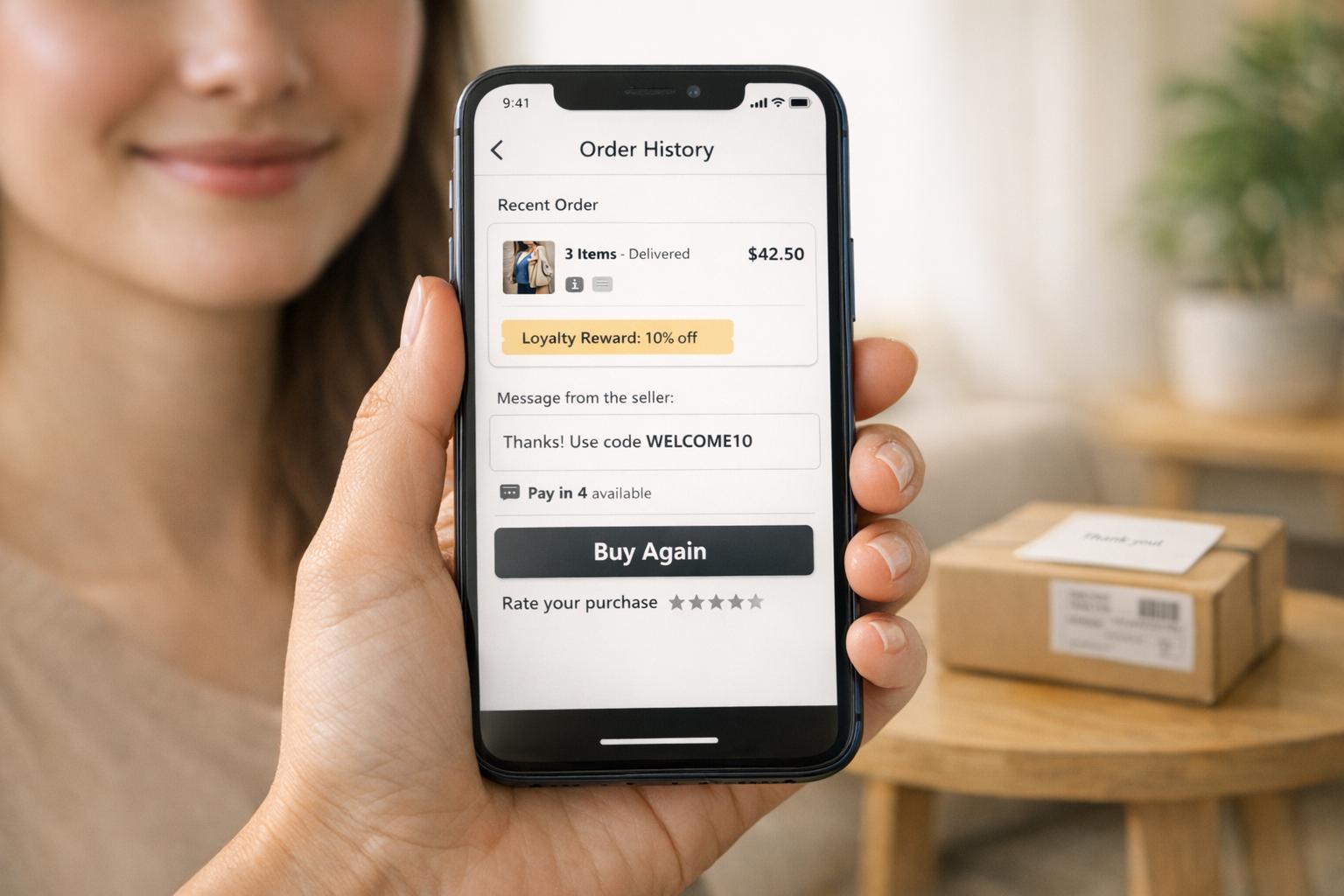
TikTok Shop thrives on discovery, but turning viral buyers into loyal customers is a challenge. Sellers need strategies to encourage repeat purchases, which are more cost-effective and profitable than acquiring new customers. Here's a quick summary of effective tactics:
- Offer Exclusive Discounts: Use targeted discounts for loyal shoppers (e.g., 5% for first-time buyers, 25% for repeat customers). Combine with TikTok-funded coupons to increase conversions by up to 45%.
- Engage Post-Purchase: Send personalized thank-you messages, share tutorials, and use TikTok's interactive features like duets and live events to build connections.
- Leverage TikTok CRM: Segment customers (e.g., recent buyers, lapsed customers) and send tailored messages or exclusive coupons to encourage loyalty.
- Act on Feedback: Use customer comments to improve products, update listings, and resolve issues quickly.
- Invest Wisely: Use revenue-based financing to fund creator partnerships, ads, and inventory without the strain of fixed repayments.
Repeat buyers contribute 44% of revenue while being only 21% of customers. Building loyalty ensures steady growth and long-term success on TikTok Shop.
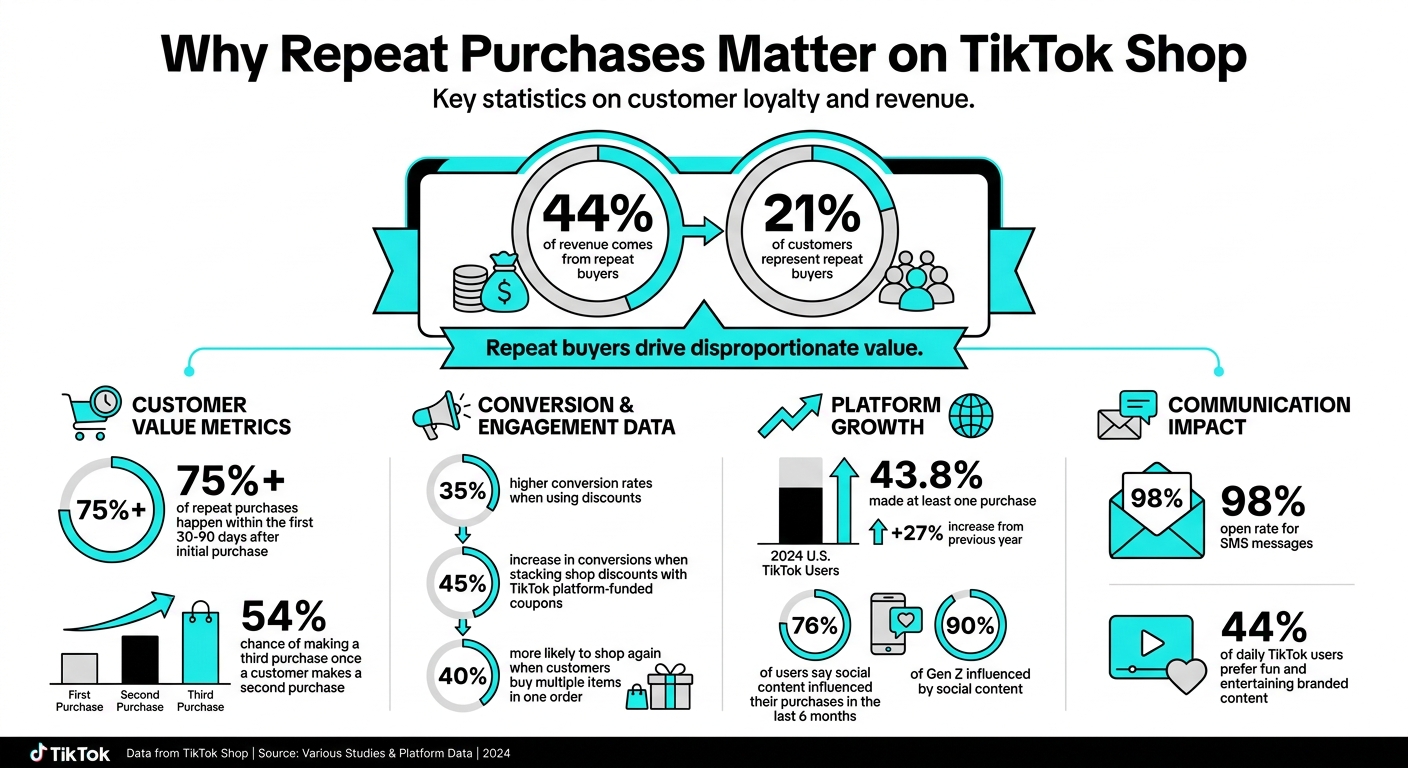
TikTok Shop Repeat Purchase Statistics and Customer Loyalty Data
Offer Exclusive Discounts for Returning Customers
Offering targeted discounts can encourage repeat purchases while keeping your profits intact. TikTok Shop sellers who incorporate discounts report conversion rates up to 35% higher compared to those who don’t[4]. However, broad promotions can quickly eat into margins, so a discount laddering strategy is key. This approach rewards loyal customers without compromising profitability.
Creating Discount Campaigns for Loyal Customers
Start by segmenting customers based on their purchase history. Here’s a simple framework:
- First-time visitors: Offer a modest 5–10% off to encourage that initial purchase.
- Engaged followers: Reward them with 15–20% discounts.
- Repeat buyers: Provide the highest tier, with 25% or more, to thank them for their loyalty.
To maximize the value of your offers, combine shop discounts with TikTok platform-funded coupons. This allows TikTok to cover part of the discount cost, making your promotion more appealing to customers while protecting your bottom line. Sellers who stack these discounts have reported up to a 45% increase in conversions[4].
Consider implementing Buy More Save More (BMSM) promotions. For example, offer 5% off for two items or 10% off for three. These deals not only increase Average Order Value (AOV) but also encourage customers to return. In fact, customers who buy multiple items in one order are 40% more likely to shop again[4]. Additionally, setting free shipping thresholds about 30% higher than your current AOV can motivate customers to add more to their carts, helping you offset shipping costs[4][6].
Once you’ve fine-tuned your discount campaigns, focus on timing them to maximize engagement and conversions.
When and How to Send Discounts
Timing plays a crucial role in the success of your promotions. Short timeframes create urgency - flash sales lasting 4 to 24 hours can spark FOMO and drive immediate action[4][5]. For slower-moving inventory, extend the offer window to 10–14 days, giving more customers a chance to act on the promotion[4].
Pair your biggest discounts with major TikTok events like Singles’ Day or TikTok Shop Festivals. These high-traffic periods are ideal for capturing shoppers who are already in a buying mindset[4]. To amplify your reach, coordinate TikTok promotions with email and SMS campaigns. Use unique promo codes for each channel to track which ones drive the most repeat business[7].
Set voucher validity for a limited time after claim to create a personalized countdown, encouraging quicker redemptions[5]. Before launching, always test your offers in "incognito buyer" mode to ensure stacked discounts appear correctly and don’t overlap in unintended ways[6].
Finally, use the TikTok Seller Center to precisely schedule your promotions and monitor their performance through Data Compass reports. This allows you to track redemption rates in real-time and tweak your strategy as needed.
sbb-itb-d7b5115
Engage Customers After Purchase to Build Loyalty
The period immediately after a purchase - typically the first 30 to 90 days - is a golden window for building customer loyalty. In fact, over 75% of repeat purchases happen during this time, and loyal customers, who make up just 21% of your customer base, contribute a hefty 44% of your revenue [1]. This highlights the importance of a well-thought-out, personalized follow-up strategy. While exclusive discounts can encourage repeat buys, meaningful post-purchase engagement transforms one-time buyers into devoted brand advocates. Here's an eye-opening stat: once a customer makes a second purchase, their chances of making a third jump to 54% [1]. Below, we’ll explore two actionable strategies to strengthen post-purchase connections.
Send Personalized Thank You Messages
An order confirmation isn’t just a receipt - it’s your first chance to reassure the buyer and build trust [1]. Instead of sticking to generic templates, craft messages that feel warm and personal. Include details like the specific product they bought and tailor suggestions based on their preferences [1]. A "What to Expect" section can also be a game-changer, walking customers through the next steps for fulfillment and delivery, which helps ease any lingering doubts or buyer's remorse [8].
Want to go the extra mile? Slip in a handwritten thank-you note or a small product sample. For critical updates, consider SMS - it boasts a whopping 98% open rate [1]. These small but thoughtful touches can set the stage for a deeper relationship with your customers, paving the way for more exclusive interactions down the line.
Share Exclusive Content with Returning Customers
Once you’ve made that initial connection, sharing exclusive content can solidify customer loyalty even further. A few days after delivery (3–5 days is ideal), send helpful content like product tutorials, styling tips, or care instructions. Platforms like TikTok are perfect for this - short, engaging videos can show customers how to get the most out of their purchase [1].
TikTok also offers a unique opportunity to build community. Engage with niche groups like #BeautyTok or #FashionTok, share customer stories, and interact with user-generated content using features like duets and stitches [9][3]. Considering that 76% of users - and a staggering 90% of Gen Z - say social content influenced their purchases in the last six months [9], this kind of social proof can drive future sales.
Another idea? Turn live shopping events into interactive experiences. Host Q&A sessions, demo products in real time, and offer flash discounts exclusively for attendees. Make sure your team is on standby to respond to comments and DMs during these events [3].
"Shoppers do not just buy once. Retention is strong, repeat purchases are common, and discovery is built into the experience" [2].
Use TikTok Shop CRM for Personalized Outreach
TikTok Shop CRM now incorporates AI to monitor customer behavior and craft tailored campaigns. By connecting with TikTok Ads Manager and Seller Center, sellers gain access to analytics that reveal how customers interact with their shop. With tools like the TikTok Pixel, which tracks actions like page views, cart additions, and purchases, you can fine-tune your outreach efforts to match customer behavior.
This means your CRM strategy should focus on turning those spontaneous moments of discovery into long-term customer relationships.
Segment Customers for Targeted Campaigns
TikTok Shop's CRM integrates seamlessly with the Broadcast Feature, which you can find in the Marketing section of your Seller Center. It offers seven preset customer segments for targeting:
- Potential New Customers: Users who favorited or added items to their cart in the last 30 days but haven’t purchased.
- Recent Customers: Those who made their first purchase within the last 30 days.
- Repeat Customers: Buyers who made another purchase within 30 days.
- Frequent Customers: Those with multiple purchases in the last 90 days.
- Lapsed Customers: Customers who purchased within the past year but not in the last 90 days.
- New Followers.
- Existing Active Followers [10].
For even more precision, you can create custom segments based on five key categories: Demographics (age, gender, region), Purchasing Behavior (browsing history, cart activity, order value), Shop Follower status, Engagement (interactions with LIVE sessions and shoppable videos), and Historical Outreach Performance (responses to previous messages) [10]. To get the most out of custom segments, it’s recommended to include at least three conditions when defining your audience [10].
"Targeting the right customer segment with the right message through the right channel is the key to growing customer loyalty." - TikTok Shop Seller University [10]
A smart strategy? Focus on Lapsed Customers - those who bought within the past year but not in the last 90 days - by offering exclusive "win-back" coupons. You can also target Potential New Customers who have added items to their cart but haven’t checked out. When sending broadcast messages, include private coupons that are only visible to the recipient. This sense of exclusivity can encourage conversions [10].
Once your audience is segmented, use automation to streamline your outreach and maintain consistent engagement.
Automate Follow-Up Messages
Automation plays a huge role in scaling your retention efforts. TikTok Shop's CRM lets you set up automated outreach triggered by specific customer actions, like abandoned carts or incomplete checkouts [10]. You can also automate post-purchase thank-you messages to build loyalty right after a sale.
AI-powered targeting takes this a step further by ensuring the right products are shown at the best possible time. As Ahmad Amin explains:
"AI-driven targeting helps you show the right products to the right people at the right time. Personalized recommendations can increase conversions and drive repeat purchases" [3].
By leveraging predictive analysis, you can anticipate future buying patterns and set up dynamic ad placements that adjust to customer behavior.
With the TikTok for Shopify app, you can centralize your product catalog, orders, and ad management in one place [9]. This unified system allows you to run automated ad campaigns efficiently while still keeping the personal touch.
While automation handles routine follow-ups, it’s essential to have team members monitoring flagged DMs and comments for key engagement opportunities [3]. Combining automation for scale with a human touch for critical interactions ensures a well-rounded customer experience.
These targeted and automated CRM strategies complement exclusive discounts and post-purchase engagement efforts, helping you build stronger connections with your customers.
Use Customer Feedback to Drive Loyalty
Customer feedback is like a treasure trove for building repeat business. When you actively listen to your customers and make changes based on their input, you’re showing them that their opinions matter. This can turn occasional buyers into loyal supporters who keep coming back.
TikTok Shop offers several ways to gather feedback, from comment sections to direct messages in the Seller Center. Treat this feedback as a way to build stronger relationships and fine-tune your products or services.
Collect Feedback Through TikTok Shop Features
Your comment section can act as a live focus group. Every comment, question, or concern gives you a window into how customers perceive your brand. As Joanna Griffiths, founder of Knix, explains:
"The answers are in the comments. And I think I really want to stay close to the customer and what it is that they're saying to us. So most of our great product ideas come from comments and suggestions that come from our customers." [11][12]
You can encourage this type of engagement by including simple questions in your video captions, like “Which color do you love most?” or “Drop an emoji if you’re excited for this launch.”
TikTok’s video reply feature is another great tool for addressing common questions. For instance, in December 2025, Hannah Perry, founder of Floof, used an educational video to explain serving sizes for her cotton candy cakes. That video went viral, racking up over 3,000 comments and turning a simple FAQ into a massive engagement opportunity [12]. Similarly, Michelle Razavi, co-founder of Elavi, used video replies to clarify ingredient concerns, like why her cashew butter includes blue spirulina. This transparency helped her build trust with her audience [12].
Don’t overlook the Seller Center as a resource. It’s a hub where you can review customer messages, order histories, and even media uploads about your products. TikTok Shop encourages sellers to maintain an 80% response rate within 24 hours, so timely replies can help you resolve small issues before they escalate into disputes [13].
To keep feedback sections productive, use tools like Creator Care Mode and keyword filters to block spam or offensive terms - up to 500 in total. The "Manage multiple comments" feature also allows you to clean up to 100 comments at once, ensuring valuable insights aren’t buried under irrelevant noise [11][12].
These strategies help you gather the kind of feedback that leads to meaningful product improvements.
Apply Feedback to Product Improvements
Taking action on customer feedback is a surefire way to build loyalty. When customers see you making changes based on their input, they feel more connected to your brand.
Start by looking for recurring themes in the feedback. If you notice the same questions or complaints popping up, it’s a clear sign that something needs attention [12][13]. Maybe your product descriptions aren’t clear enough, your packaging could use an upgrade, or a particular feature isn’t meeting expectations.
The Seller Center is a great tool for digging deeper into complaints. By reviewing order histories, customer messages, and any photos or videos they’ve shared, you can identify the root cause of issues [13]. Whether it’s a shipping delay or a quality problem with your supplier, understanding the “why” behind negative feedback helps you make meaningful changes.
If feedback highlights confusion about a product, consider updating your TikTok Shop listings. This might mean clarifying descriptions, adding better photos, or even creating a demo video. If shipping issues are a common complaint, it might be time to switch to a more reliable courier. For quality concerns, reevaluating your supplier relationships could be the solution [13].
Closing the loop with customers after you’ve made improvements is where the magic happens. A simple follow-up message to let them know you’ve addressed their concerns can turn a frustrated customer into a loyal advocate. As Elle Nix puts it in her seller guide:
"Follow-through is what separates a one-time sale from a repeat customer." [13]
Scale Retention Efforts with Revenue-Based Financing
Building customer loyalty requires more than just great products - it takes smart financial strategies to bridge the gap between fleeting success and long-term growth. To drive repeat purchases on TikTok Shop, you need more than retention tactics; you need flexible funding to fuel those efforts. Whether it’s partnering with creators, amplifying successful content with ads, or keeping your top-selling items in stock, having the right capital can turn first-time buyers into loyal customers.
The problem with traditional loans? They come with rigid repayment plans that don’t account for the ups and downs of eCommerce. Revenue-based financing, on the other hand, offers a flexible solution, letting you invest in growth without the pressure of fixed monthly payments.
How Revenue-Based Financing Drives Growth
Revenue-based financing gives you the cash flow to invest in strategies that encourage repeat purchases. For example, Onramp Funds provides funding tailored specifically for eCommerce businesses, including TikTok Shop sellers. The best part? You can access this equity-free capital in as little as 24 hours.
Here’s how this funding can help:
- Paid amplification: TikTok’s algorithm favors content backed by ad spend, helping you extend your reach. And if you’re a new seller, TikTok’s tiered ad credit offers - like spending $1,500 to receive $1,500 in ad credits - can double your marketing budget [15][16].
- Creator partnerships: The TikTok Creator Marketplace connects you with influencers who can build authentic connections with your audience. Customers are 1.5× more likely to make immediate purchases when influenced by creators [14][16].
- Stock reliability: Keeping your best-sellers in stock ensures TikTok’s recommendation system continues promoting your products, keeping them visible to shoppers [15].
With the right funding, you can supercharge your marketing efforts and ensure your business is ready to capitalize on TikTok’s unique selling environment.
Flexible Repayment Based on Sales
One of the biggest perks of revenue-based financing is its flexibility. Instead of fixed payments, you repay a percentage of your revenue. This means you pay more when sales are booming and less during slower periods. This adaptability is especially helpful on TikTok Shop, where sales can spike unexpectedly. For instance, in 2024, 43.8% of U.S. TikTok users made at least one purchase - a 27% increase from the previous year [14].
With Onramp Funds, your financing adjusts to your business’s performance. As WITHIN highlights:
"High repeat rate = long-term value. This signals customer quality" [14].
Conclusion
Driving repeat purchases on TikTok Shop means shifting from a traditional sales funnel to TikTok's "infinite loop" model. As highlighted by the TikTok Business Blog [16], this approach focuses on nurturing long-term customer relationships. In this model, the purchase isn't the end - it's the start of an ongoing interaction that builds loyalty and encourages repeat business.
Key strategies like offering exclusive discounts, engaging customers on a personal level, segmenting through CRM, and collecting feedback help your brand stay top of mind. TikTok's features, such as product tags, Live Shopping, and collaborations with creators, provide multiple ways to bring customers back. Since 44% of daily TikTok users prefer fun and entertaining branded content [16], your retention efforts should feel natural and align with the platform's unique style - avoiding overly aggressive sales tactics.
Consider this: in 2024, 43.8% of U.S. TikTok users made at least one purchase - a 27% jump from the previous year [14]. But one-time buyers won't sustain growth. As WITHIN explains:
"High repeat rate = long-term value. This signals customer quality" [14].
The goal is to turn first-time buyers into loyal advocates who organically promote your brand through unboxing videos, tutorials, and other creative content. Achieving this requires not only strong strategies but also financial flexibility.
To scale these efforts, revenue-based financing from platforms like Onramp Funds can be a game-changer. This type of funding adapts to your sales performance, enabling you to invest in creator partnerships, paid promotions, and inventory without the strain of fixed payments. With financial freedom, you can focus on fostering deeper customer connections.
The path forward is clear: keep customers engaged, encourage them to share their experiences, and invest in tools that drive repeat business. Every purchase should be the start of a longer relationship, creating a cycle of engagement that turns one-time buyers into loyal, lifelong supporters. This approach is the foundation of sustainable growth on TikTok Shop.
FAQs
How do I choose discount tiers without hurting margins?
To create discount tiers that don't eat into your profits, it's all about finding the right balance between enticing customers and keeping your margins intact. Start by analyzing your costs so you can offer discounts that are appealing but still leave room for profitability.
Experiment with A/B testing to figure out which discount levels resonate most with your audience. A tiered approach can work wonders - offering smaller discounts for lower tiers and more generous ones for higher tiers encourages customers to spend more.
Make sure these discounts align with your campaign objectives, and keep a close eye on performance metrics. This way, you can tweak your strategy as needed to ensure it’s driving results without cutting too deeply into your bottom line.
What post-purchase messages should I send in the first 30–90 days?
In the first 30 to 90 days after a purchase, the focus should be on building trust and encouraging customers to buy again. Start by sending a thank-you message right after their purchase. Follow up within 30 days with personalized messages that show you value their business.
To keep them engaged, consider offering incentives like discounts or exclusive deals. This not only encourages repeat purchases but also strengthens the relationship. Additionally, ask for feedback or reviews during this time - it’s a great way to involve them further.
Using tools like your CRM or other engagement platforms to automate these messages ensures you stay consistent and maintain communication. This approach helps nurture loyalty and keeps your brand top of mind.
Which TikTok Shop CRM segments are best for win-back campaigns?
When it comes to win-back campaigns on TikTok Shop, focusing on the right customer segments can make a big difference. Two of the most effective groups to target are recent customers and cart abandoners.
- Recent customers: These are shoppers who’ve made a purchase recently. Reaching out to them with personalized offers or reminders can encourage repeat purchases while your brand is still fresh in their minds.
- Cart abandoners: These are the people who added items to their carts but didn’t complete the purchase. A well-timed message or incentive can nudge them to finish what they started.
By tailoring your messaging to these high-intent audiences, you can re-engage them effectively and boost your chances of driving repeat sales.
