

TikTok Shop has become a massive $33 billion marketplace by 2026, but with its growth comes stricter rules for sellers. Compliance is critical to avoid penalties like frozen commissions, shop bans, or even legal fines. Misleading claims - such as exaggerated product promises or inaccurate listings - are the most common violations. Here's what you need to know:
- Why It Matters: Trust drives repeat purchases. Non-compliance can harm your ratings, income, and legal standing.
- Common Violations: False claims like "100% effective" or using unverified phrases like "clinically proven."
- Key Requirements: Accurate product details (e.g., size charts, ingredient lists, certifications) and honest descriptions.
- Order Fulfillment: Maintain high tracking accuracy and meet delivery benchmarks to avoid account penalties.
TikTok Shop’s compliance policies are strict but manageable with proper attention to detail. Sellers who prioritize accuracy in product listings, safety documentation, and fulfillment practices can protect their accounts and grow their businesses.
Product Attributes and Accurate Representations
When listing products on TikTok Shop, providing accurate and complete information is non-negotiable. Missing or incorrect details can result in immediate listing rejection or even account penalties. Here's what you need to know to stay compliant.
Required Product Attributes on TikTok Shop
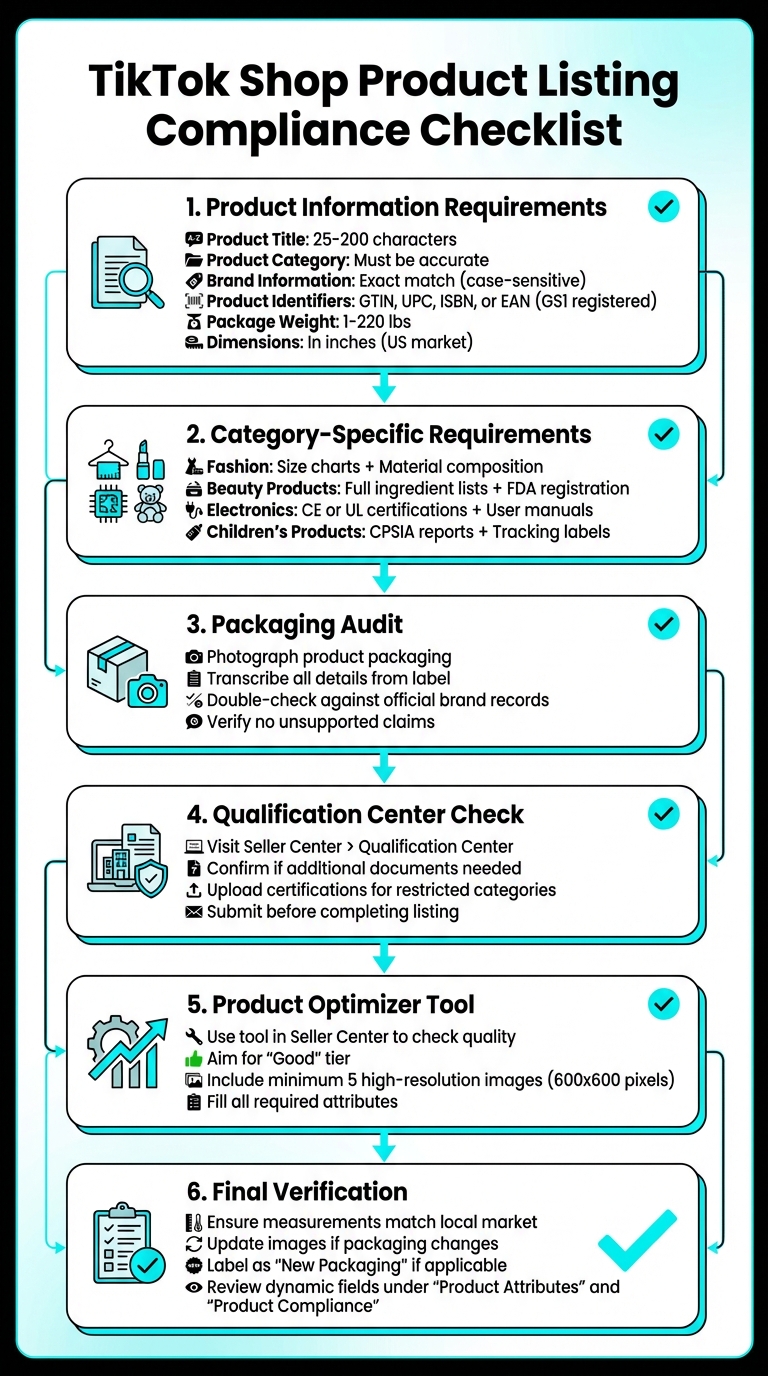
Your Product Title should be between 25 and 200 characters, and selecting the correct Product Category is critical. For the Brand Information field, ensure the brand name matches exactly as it appears on trademark registrations and physical packaging, including proper letter casing. Any discrepancies here will lead to automatic rejection [4].
You'll also need Product Identifiers like GTIN, UPC, ISBN, or EAN codes, which must be registered with the GS1 database. These codes confirm the product's legitimacy. Additionally, provide accurate package weight (1–220 lbs) and dimensions in inches if selling in the US [6].
Certain categories demand extra details. For example:
- Fashion: Include detailed size charts (bust, waist, hips in inches) and list material compositions (e.g., 90% Cotton, 10% Polyester).
- Beauty Products: Provide full ingredient lists.
- Electronics: Attach certifications like CE or UL, along with user manuals.
- Children’s Products: Include CPSIA reports and tracking labels [4][8].
Depending on your product’s category and target region, compliance requirements may vary. For instance, US sellers may need to include California Prop 65 warnings, while EU sellers must meet GPSR standards. Don’t forget to add the Manufacturer/Trader Name and Address and any required safety labels for transparency [3].
How to Verify and Enter Accurate Product Details
Start by conducting a packaging audit. Photograph the product and transcribe details like ingredients, origin, and specifications directly from its label. This helps you avoid making unsupported claims [7][2]. Double-check all information against official brand records to ensure accuracy [4].
Visit the Qualification Center to confirm whether your product requires additional documents or authorizations. For restricted categories like toys or electronics, upload necessary certifications or test reports before completing the listing process [4][8].
To improve your listings, use the Product Optimizer Tool in the Seller Center. This tool flags incomplete listings, categorizing them as "Poor" or "Fair." To reach the "Good" tier, make sure to include at least five high-resolution images (600 x 600 pixels or higher) and fill in all required category-specific attributes [5]. The listing form adapts dynamically, so selecting a specific category will reveal additional mandatory fields under "Product Attributes" and "Product Compliance" [6].
Finally, ensure all measurements align with the local market. For US customers, use inches for dimensions, pounds for weight, and Fahrenheit for temperature. This consistency minimizes confusion and reduces the likelihood of returns. If your product packaging changes, update your images immediately and label them as "New Packaging" to avoid complaints about misrepresentation [4][7].
sbb-itb-d7b5115
Creating Honest Product Listings
Getting your product listings right isn’t just about staying out of trouble - it’s also about boosting sales and keeping customers happy. TikTok Shop organizes listings into Poor, Fair, and Good tiers based on how accurately they represent the product. To land in the "Good" category, you’ll need clear descriptions, quality images, and transparent pricing [5]. Stick to these principles, and your listings can avoid violations while increasing conversions.
Writing Product Descriptions That Match Actual Specifications
Your product descriptions should be detailed and accurate, with at least 500 characters to fully capture product specifications [4]. Include key details specific to your product type - like fabric details for clothing or technical features for electronics [4][5].
Steer clear of unverifiable claims. Instead of absolutes, use measured phrases like "helps reduce the appearance of" [7]. If you’re making before-and-after claims, always include disclaimers such as "Results may vary" [2]. TikTok bans certain claims outright, like those related to DNA repair, supernatural abilities (e.g., "love charms"), or permanent weight loss [2].
Using Real Product Images
Images are just as important as descriptions when it comes to building trust. TikTok Shop requires at least five high-resolution photos (800 x 800 pixels minimum, up to 2,000 x 2,000 pixels) in a square 1:1 aspect ratio. Stick to JPG or PNG formats [10][11]. Your main image should feature a pure white background (#FFFFFF) without any text, logos, or promotional elements [10]. Show multiple angles and close-ups to highlight product details [5].
For the best results, use natural or softbox lighting at a 45° angle to avoid shadows and maintain true colors [11]. Avoid using filters that exaggerate the product’s appearance, like skin-smoothing or teeth-whitening effects [2][7]. If your packaging changes, update your main image right away and consider adding a comparison shot ("New vs. Old") to avoid confusion and complaints about misrepresentation [7]. Any AI-generated or modified visuals must be clearly labeled, and misleading AI content is strictly forbidden [2].
Displaying Accurate Pricing and Promotions
Your pricing must be consistent across the listing. For example, rounding up from $19.99 to $20.00 is fine, but rounding down to $19.00 is not allowed [2]. Avoid misleading practices like listing one variation of a product at an unrealistically low price just to attract clicks in search results [9].
If you’re using strike-through pricing, make sure the MSRP is accurate and submitted through the Seller Center [12][13]. Different products, like t-shirts and sweatshirts, should be listed separately [9]. For promotions, be transparent about any conditions - like "Only for new customers" or "Minimum purchase of $55" [2]. Lastly, keep shipping costs reasonable. Charging more for shipping than the product itself (e.g., $19.99 shipping on a $4.99 item) could lead to account suspension [9].
Meeting Safety and Certification Standards
Safety certifications play a key role in backing up your product claims. TikTok Shop requires sellers to provide approved documentation for certain restricted categories before listing products. Without these certifications, safety claims and category qualifications will be denied [14]. Under the Product Safety and Authenticity Verification Act (EPSAA), which goes into effect on March 15, 2025, sellers can face fines of up to $10,000 per unsafe product listing and $100,000 for systemic violations [17]. Ensuring your products meet these safety standards is just as important as providing accurate product details to build trust with TikTok Shop consumers.
"Claiming electrical safety without approved testing or certification violates these requirements. Tests and certifications must come from recognized electrical safety or FCC laboratories." - TikTok Shop [14]
Safety Certifications by Product Category
Each product category has its own set of required documents to validate safety claims. Here’s a breakdown of what’s needed:
- Electronics: A Certification of Compliance (COC) from an ISO-17025 accredited lab, issued within the last two years. Products with Bluetooth or Wi-Fi must also display a valid FCC Safety Marking [14].
- Children’s Products: A Children’s Product Certificate (CPC), CPSIA test reports, and a tracking label file are mandatory [14][15].
- Beauty and Personal Care: Sellers must provide proof of active FDA registration and compliant cosmetic labeling. Over-the-counter products, like sunscreens or acne treatments, also require a "Drug Facts" label [15].
- Electric Bikes and Scooters: Compliance with ANSI/CAN/UL 2849 is required, even though it’s technically voluntary under national law. Electric bikes also need a General Certificate of Conformity (GCC) for 16 CFR Part 1512 [8][14].
- Drones: A valid FCC ID issued through the FCC equipment authorization process is essential [14].
- Refurbished Electronics: Diagnostic and data erasure reports from approved providers like Phonecheck, Blancco, or Blackbelt are required [14].
How to Organize and Submit Compliance Documents
To submit your safety documents, go to Seller Center > My Account > Account Settings > Qualification Center [14][15]. Make sure your COC comes from an accredited lab and includes all relevant safety standards [8][14]. For resellers, purchase invoices must be dated within the last 365 days [14]. Photos should clearly show safety markings (e.g., CE, FCC, UL), and labels must be intact, flat, and securely attached - double-stickering is not allowed [14].
If your documents are rejected, check the notification in your Seller Center bell icon for the reasons, then update and resubmit your materials [14]. Ensure the product described in your test reports matches the product shown in your submitted photos [14]. Most compliance documents for the U.S. market must be submitted in English to pass the review process [16].
Maintaining Compliance During Order Fulfillment
Order fulfillment isn’t just about getting packages out the door - it directly impacts your seller ratings and account health. In fact, during Q1 2026, 68% of negative seller ratings were tied to preventable processing errors, not product quality issues [22].
To stay in good standing, aim for these key performance benchmarks: a Valid Tracking Rate (VTR) of at least 95%, an On-Time Delivery Rate (OTDR) of 80% or higher, and a Late Dispatch Rate (LDR) no greater than 4% [20]. Starting in 2026, tracking updates must sync within 15 minutes of handing off the package to the carrier to maintain API integration [22]. This means accurate tracking and timely shipping aren’t optional - they’re essential.
"TikTok Shop's 2026 success metric isn't just speed - it's predictability. Buyers forgive a 2-day ship if the ETA is accurate, updated hourly, and includes proactive delay notifications." - Rajiv Mehta, Head of Global Seller Operations, TikTok Commerce [22]
Providing Accurate Tracking and Shipping Information
Accurate tracking info is non-negotiable. If you’re using Seller Shipping (your own carrier), make sure to manually enter the tracking ID, carrier name, and service. Keep in mind, you’ll only have one chance to edit this information [19]. To avoid delays, upload tracking details as soon as you dispatch the order [18][19].
Reusing shipping labels is a big no-no. TikTok’s anti-fraud system flags duplicate label IDs, which can result in 48-hour payout holds [22]. Other red flags include shipping empty packages, using counterfeit labels, or providing tracking numbers that show no updates within 24 hours [21].
Orders must be dispatched within 2 business days and delivered within 6 business days of shipment [20]. If tracking information isn’t uploaded within 5 business days, TikTok Shop will cancel the order automatically [20]. For dropshipping, your ads must clearly state the actual country of origin (“Shipped from [country]”) and include realistic delivery estimates based on historical data, not best-case scenarios [23].
Want to simplify things? TikTok Shipping Services can help.
Using TikTok Shipping Services for Transparent Fulfillment
Manual tracking can be tricky, but TikTok Shipping offers a hassle-free, automated solution. When you use TikTok Shipping, your orders are exempt from VTR calculations and late delivery penalties [20]. By selecting "Arrange Shipment", the system automatically updates tracking details, reducing the risk of manual errors [19]. Starting January 2026, all USPS labels for TikTok Shop orders must be purchased and printed through TikTok Shipping [24].
Take Luna Threads as an example. This Portland-based apparel company linked their NetSuite WMS directly to TikTok Shop using API v4.2 in January 2026. They slashed their dispatch time from 38 hours to just 14 minutes, achieving a 99.4% dispatch rate. The result? A 210% jump in organic impressions and a conversion rate boost from 3.2% to 5.9% [22].
TikTok Shipping also enables bulk label printing through Seller Center, cutting down on manual work and improving efficiency [24]. Whether you drop off packages or schedule a pickup, the Logistics Service Provider is notified within 48 hours for pickups [19]. This streamlined process helps you stay compliant while delivering a better experience for your customers.
Conclusion
Staying compliant on TikTok Shop is more than just following rules - it's about building a trustworthy, profitable business. Accurate product listings create confidence, encourage repeat customers, and help reduce disputes, all of which lead to smoother day-to-day operations [7].
Maintaining strong account health isn’t just about avoiding penalties; it directly impacts your sales potential. Compliance practices boost efficiency and support long-term growth. On the other hand, violations can lead to frozen commissions and steep financial losses.
"When you align your shop with these principles, you're not just avoiding penalties - you're building a sustainable brand that customers will keep coming back to." - Ecorn Agency [25]
Think of compliance as a smart investment in your business’s future. Following TikTok Shop's standards not only helps you avoid penalties but also reduces refund requests and disputes. Sellers who adopt structured workflows - like pre-publish checklists or monthly audits - can grow their operations without risking serious violations [1].
Need financial support to strengthen your compliance efforts or scale your business? Onramp Funds offers equity-free financing options to help manage cash flow, invest in inventory, or fund marketing initiatives while keeping your operations on track. Learn more at Onramp Funds.
The takeaway? Transparency and honesty are your best assets. Using natural visuals, accurate descriptions, and reliable tracking information not only keeps you compliant but also gives you an edge in a marketplace where authenticity drives sales [7]. Success on TikTok Shop starts with accuracy and integrity.
FAQs
What claims are most likely to get my TikTok Shop listing flagged?
Listings frequently get flagged for making over-the-top promises like "cures acne" or "eliminates wrinkles completely." Claims that suggest medical treatments or cures, or any misleading details that misrepresent a product, can also cause problems. This tends to happen most often with health, beauty, and wellness products. To avoid complications, make sure your claims are truthful and align with TikTok Shop's content policies.
What documents do I need to sell restricted products in the U.S. on TikTok Shop?
To list restricted products on TikTok Shop in the U.S., you’ll need to provide specific documentation depending on the product category. This could include certifications, safety approvals, or authorization letters. Additionally, TikTok Shop might ask for extra documents during the approval process. Make sure to submit everything required to stay within the platform’s guidelines.
How can I fix low tracking accuracy and avoid fulfillment penalties?
To ensure smooth operations and avoid fulfillment penalties on TikTok Shop, focus on accurate order processing and reliable shipping methods. Provide clear and precise tracking updates, so customers stay informed about their orders.
Additionally, prioritize transparent product descriptions and send timely shipping notifications to enhance customer trust. Regularly review your performance metrics to catch and resolve potential issues early. By staying proactive, you can minimize delivery problems and disputes, helping to maintain a positive seller rating.
Related Blog Posts
Onramp Funds
Funding built around your sales
Connect your store and see what you qualify for. Repay as a percentage of sales, with no personal credit check.
Funding in as little as 24 hours.
