


Subscription revenue transforms Shopify businesses by replacing unpredictable one-time sales with steady, recurring income. This shift allows brands to plan cash flow, inventory, and growth with more confidence. With 30% or more of monthly revenue guaranteed, businesses can forecast better, negotiate supplier deals, and secure financing more easily.
Key takeaways:
- Predictable cash flow: Subscription models stabilize income, making inventory and staffing decisions easier.
- Higher growth potential: Subscription-based companies grow 3.4x faster than the S&P 500.
- Improved financing options: Revenue-based financing, like Onramp Funds, leverages MRR (Monthly Recurring Revenue) for flexible funding.
- Stronger customer retention: Subscriptions reduce churn and increase customer lifetime value (LTV).
For Shopify brands, subscription revenue isn't just a sales tactic - it's a financial planning tool that supports long-term growth.
Episode 156 - Building Recurring Revenue: Subscriptions in your Shopify Store

How Subscription Revenue Creates Predictable Cash Flow
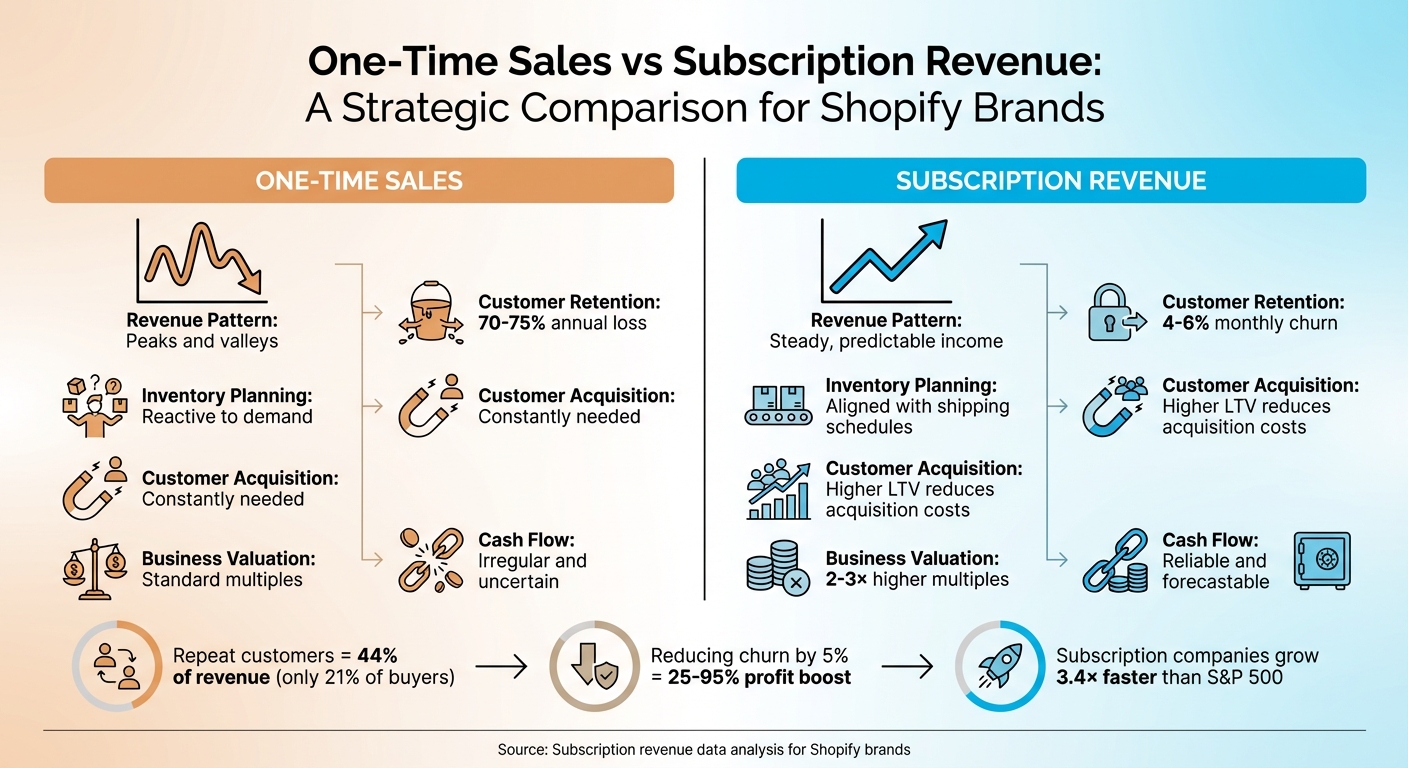
Subscription revenue shifts the financial landscape for Shopify brands, offering a steady income stream in place of the unpredictable highs and lows of one-time sales. With recurring payments arriving consistently, businesses no longer need to rely on constantly attracting new customers or hoping for sudden sales surges.
This predictability makes a huge difference. It allows brands to confidently manage inventory, plan investments, and negotiate better deals with suppliers. As Andrey Gadashevich, CMO of RecurrinGO, puts it:
"Subscription revenue is money that keeps coming in - predictably and consistently... For Shopify store owners, this is essential financial security you can take to the bank" [3].
The financial benefits are clear. Over a 12-year period, subscription-based companies grew their revenue 3.4 times faster than the S&P 500 [1]. Additionally, businesses with strong subscription models often enjoy valuation multiples 2–3× higher than those relying on one-time sales [3]. This reliability appeals to investors and lenders, making subscription revenue a cornerstone for sound financial planning.
What is Monthly Recurring Revenue (MRR)?
Monthly Recurring Revenue (MRR) is the key metric for subscription businesses. It represents the predictable monthly income generated from active subscriptions, calculated by multiplying the total number of subscribers by the average revenue per subscriber [3].
However, accurately tracking MRR requires more than just counting subscriptions. The formula for Net New MRR includes:
- New MRR: Revenue from new subscribers.
- Expansion MRR: Additional revenue from upgrades or add-ons.
- Reactivation MRR: Revenue from reactivated accounts.
- Minus:
Shopify simplifies this process with its analytics tools, offering insights like customer cohort reports. These reports help identify which marketing channels attract long-term subscribers versus those that lead to quick cancellations [5].
One mistake to avoid is frontloading annual payments into a single month. For example, if a customer pays $120 upfront for a year, this should be recorded as $10 per month in MRR. Also, exclude one-time fees, trial subscriptions, and discounts from your MRR calculations [9].
Why Stable Cash Flow Matters for Shopify Brands
Predictable income transforms decision-making. Instead of reacting to last week’s sales, you can plan for the next quarter - or even the next year - with confidence.
Josephine Cheng from Replo explains it well:
"Predictable revenue enables precise forecasting for inventory, staffing, and marketing" [12].
This stability allows businesses to confidently schedule major expenses like hiring, expanding warehouse space, or launching new marketing campaigns [10].
Subscription models also improve cash flow efficiency. With prepaid billing, businesses can achieve a neutral or even negative Cash Conversion Cycle (CCC), meaning they receive customer payments before paying suppliers [1]. In contrast, traditional retail often involves paying suppliers months before products are sold.
Take Better Booch, an organic kombucha brand, as an example. By 2025, 70% of its total orders come from subscriptions [7][12]. This steady income allows the brand to plan production, manage inventory, and grow without worrying about where the next month’s revenue will come from.
Stable cash flow also strengthens supplier relationships. Regular monthly orders often lead to better pricing and payment terms. Similarly, lenders view recurring revenue as a sign of financial health, making it easier to secure financing for growth.
One-Time Sales vs. Subscription Revenue
The difference between one-time sales and subscription revenue goes beyond how customers pay - it reflects two entirely different business models with unique financial outcomes.
Traditional ecommerce relies on single transactions, which means constantly chasing new customers [3]. Most stores lose 70–75% of their customers within a year of their first purchase [4]. This creates a cycle of high acquisition costs without long-term value.
In contrast, subscription models focus on retention. Monthly churn rates typically range between 4% and 6% [4], and retaining customers leads to exponential growth over time. Repeat customers make up 44% of revenue, even though they account for only 21% of buyers [4]. Reducing churn by just 5% can boost profits by 25% to 95% [3].
The data paints a clear picture. While one-time sales demand constant effort to attract new customers, subscriptions create a financial foundation that grows over time. This reliability not only supports better planning but also opens doors to financing opportunities and long-term growth for Shopify brands.
Adjusting Inventory and Operations for Subscription Models
Subscription revenue changes the game for inventory and operations by replacing unpredictable sales spikes with steady, scheduled demand. Instead of reacting to random orders, you're working with a predictable flow of customer needs. This shift allows Shopify brands to move from guesswork to precise planning.
The impact on operations is massive. Take Better Booch, for example - 70% of their orders come from subscriptions [7][12]. This lets them forecast how much kombucha to produce weeks ahead of time. It eliminates the chaos of rushing to restock or the risk of overordering and ending up with product sitting in storage. This kind of precision sets the stage for fine-tuning inventory strategies using detailed retention data.
Using Retention and Churn Data for Inventory Planning
Subscription apps make inventory planning much easier. They track active payments and forecast demand by SKU across various shipping windows - whether it's 7, 14, 30, 60, or 90 days [13][5]. But there’s a catch: not all subscribers stick around. With the average B2C subscription churn rate at 6.77% [5], you can’t just multiply active subscribers by units needed. You have to account for "at-risk units", which are tied to customers likely to pause or cancel based on past trends [5].
Alex Lisboa from Shopify offers a practical approach:
"Use this visibility to place your purchase orders against a known subscriber schedule. Factor in your at-risk units using pause/cancel probabilities, and define your required buffer. This is a number you should be reviewing with your ops team every week" [5].
For instance, let’s say your inventory report shows 500 units in stock, but you’ll need 800 over the next 30 days. If 10% of subscribers typically pause or cancel, your actual need drops to 720 units. This approach avoids overordering while keeping enough stock on hand to manage unexpected demand.
Odd Bunch, a produce-delivery startup, is a great example of simplifying operations to match subscription demand. In 2025, founder Divy Ojha moved from offering 300+ SKUs to a curated "mystery box" model. Within hours of launching, 200 people signed up, surpassing two weeks' worth of prior sales. This operational shift led to a 53% net retention rate at 12 months, which is three to four times higher than the meal service industry average [8].
Most brands benefit from keeping a two-to-four-week stock buffer specifically for subscription orders [12]. Automated low-stock alerts can help you stay ahead by flagging when inventory dips below the level needed for upcoming renewals [13]. Tagging subscription orders in your Shopify admin also makes it easier to distinguish them from one-time purchases, simplifying forecasting and fulfillment [12].
Managing Operations with Predictable Demand
Subscription data doesn’t just help with inventory - it transforms daily operations too. For example, you can align labor and supplier schedules with renewal dates, avoiding the need to staff up for random sales spikes. This ensures your team is working efficiently and focused on predictable tasks.
Kloo, a coffee concentrate brand, streamlined operations by switching from glass bottles to recyclable refill pouches for subscribers. This change allowed them to offer a lower price of $25 per bottle for subscribers compared to $33 for one-time buyers, while also increasing profit margins and cutting shipping costs [8]. The lighter packaging sped up fulfillment for recurring orders and improved overall efficiency.
To further optimize, align your billing cycles with fulfillment calendars. Set clear cut-off dates for order changes and establish "pack windows" dedicated to subscription orders [12]. This separation from one-time sales reduces errors and speeds up processing. Synchronizing billing and fulfillment creates a smoother workflow and reinforces financial stability.
Predictable demand also strengthens supplier relationships. Consistent monthly orders give suppliers confidence, making them more likely to offer better pricing or payment terms [14]. Instead of placing sporadic orders, you’re building a steady partnership that benefits both sides.
Joe Barger, Head of Business Intelligence at PrettyLitter, sums it up well:
"Continuous adaptation is a key to success. What works today may not work tomorrow, and you need to always keep a pulse on what's working or not" [5].
Weekly reviews are essential for staying on top of things. Compare stock levels with what’s needed for the next 30, 60, and 90 days. Adjust procurement orders based on recent churn rates and additional revenue from add-ons or bundles [5]. Sync supplier restock schedules with major renewal dates - like the 1st or 15th of the month - to ensure fresh inventory arrives exactly when it’s needed.
Subscription models make operations more proactive. With data showing exactly what your customers need and when they need it, you can plan smarter and run leaner.
sbb-itb-d7b5115
Using Subscription Revenue to Secure Financing with Onramp Funds
Predictable subscription revenue does more than stabilize your business operations - it can also give your brand a financial edge when seeking funding. For Shopify brands, steady Monthly Recurring Revenue (MRR) signals consistent cash flow and reduced risk, making them more attractive to lenders. One option that stands out is revenue-based financing, which provides capital without requiring equity or rigid debt terms.
Let’s dive into how this financing model works for Shopify brands.
Revenue-Based Financing for Shopify Brands
Onramp Funds offers a financing solution that doesn’t require equity. Instead, you repay a percentage of your revenue - usually between 5% and 15% - until the principal and an upfront fee are covered. For subscription-based Shopify brands, this model works seamlessly with predictable MRR. For instance, if your MRR is $20,000.00 and churn is low, lenders can confidently approve funding up to 50% of your trailing MRR[3].
One of the best parts? Repayments adjust automatically based on your actual sales. If sales slow down or churn unexpectedly increases, your repayment amount decreases accordingly. There are no personal guarantees, no collateral, and no credit checks involved[2]. Onramp evaluates your business holistically, taking into account sales history across platforms like Shopify, Amazon, Walmart, and others[2]. This means your total revenue ecosystem plays a role in determining your eligibility.
These flexible terms make Onramp Funds an excellent choice for subscription brands looking for tailored financing.
Onramp Funds Financing Features
Onramp Funds offers quick, hassle-free access to capital, with funding decisions made in under 24 hours. Once approved, the funds are deposited promptly, allowing you to restock inventory or ramp up marketing without delays.
The platform integrates directly with Shopify and subscription apps like Recharge or RecurrinGO. This integration automatically syncs your MRR, churn rates, and sales data daily[3][15]. By automating these processes, Onramp eliminates the need for manual uploads and ensures repayment tracking is accurate in real time. If your MRR dips below a certain threshold, repayments can pause or adjust downward, helping you maintain cash flow during slower periods[15].
Onramp’s fee structure is straightforward. You’ll know exactly what you’re paying upfront, with no hidden interest or compounding charges. Fees typically range from 8% to 20%, depending on your business risk profile. Subscription brands often qualify for lower fees due to their stable revenue streams[3]. Additionally, Onramp provides analytics dashboards that help you forecast future funding needs and track key metrics like your LTV:CAC ratio (aiming for a healthy 3:1 ratio)[3][15].
Onramp Funds Financing Plans Compared
Onramp offers three financing options tailored to different business needs. Here’s a breakdown of how these plans work for subscription-based Shopify brands:
For most subscription businesses, Revenue-Based Financing is the ideal choice because it aligns repayment with cash flow. For example, a consumables brand with $20,000.00 in MRR secured $100,000.00 from Onramp at a 12% fee. They repaid the loan by dedicating 10% of their revenue over 12 months. This funding allowed them to meet inventory demands, increase customer lifetime value by 25% through upsells, and keep churn under 4%[3][15].
If your brand operates with 60–80% gross margins and maintains an LTV:CAC ratio above 3:1, Onramp’s financing can help you grow without giving up equity or taking on traditional debt. By leveraging your subscription data - like MRR, churn, and retention - you can access capital that scales alongside your business.
Case Studies: Shopify Brands Using Subscription Models
These examples showcase how subscription models can lead to more predictable cash flow and smarter inventory management. They highlight how steady subscription revenue not only supports operational efficiency but also opens doors to flexible financing options, creating a foundation for sustainable growth.
Case Study 1: Smarter Inventory Planning
Stumptown Coffee Roasters partnered with Shopify and Ordergroove in 2021 to expand their subscription offerings. Under the leadership of Dave Oliva, the brand introduced curated subscription options like "Roaster's Pick" and "Blend Shuffle" to simplify product delivery.
Today, recurring revenue accounts for 66% of Stumptown's eCommerce income, with a 15% year-over-year growth in this area. They’ve also seen a 6–7% increase in retention through the third recurring order[16]. Dave Oliva explained the impact:
"It's easier to plan the volumes we need and plan inventory months in advance."
This predictability enabled their sourcing team to confidently purchase green coffee, knowing much of it was already pre-sold to subscribers. Additionally, the subscription model allowed Stumptown to feature slower-moving inventory in subscription boxes, ensuring steady product turnover[16].
While Stumptown leveraged subscriptions to enhance inventory management, another brand used the model to unlock growth through flexible financing.
Case Study 2: Growth Through Revenue-Based Financing
Equator Coffees faced challenges in securing upfront capital for inventory and marketing while aiming to grow its subscription business. In July 2021, led by Senior Performance Marketing Manager Elan Lieber, the company transitioned to a more adaptable subscription platform. This new system allowed subscribers to pause, skip, or swap products, offering greater flexibility.
The results were remarkable: within seven months, Equator Coffees achieved a 372% increase in subscription sales and a 260% rise in Gross Merchandise Value. Subscriptions soon made up over 50% of their online revenue[17]. Subscribers also proved incredibly valuable, with a lifetime value five times higher than one-time buyers[17].
The consistent revenue stream from subscriptions enabled Equator Coffees to secure revenue-based financing, with funds accessible in under 24 hours. This financing model, which adjusts repayments based on sales performance, provided a safety net during slower sales periods. It also allowed the company to invest in product expansion and marketing without straining cash flow.
Conclusion
Subscription revenue reshapes how Shopify brands approach financial planning. Instead of relying on unpredictable sales spikes, businesses can use Monthly Recurring Revenue (MRR) to better predict inventory needs, manage staffing, and maintain cash flow. This shift from uncertainty to consistency helps brands streamline their cash conversion cycle, often allowing them to collect payments from customers before vendor bills are due.
The focus shifts from short-term transaction margins to Lifetime Value (LTV) and customer retention. Flexible subscription options play a key role in improving financial results. For example, in August 2025, Oats Overnight saw an 82% year-over-year increase in recurring orders by adopting flexible subscription management tools[11]. Similarly, Apothékary reduced payment failures by 44%, safeguarding their predictable revenue stream with better recovery features[11]. These strategies not only enhance retention but also create a solid foundation for accessing flexible financing options.
With steady cash flow in place, revenue-based financing becomes a logical next step. Onramp Funds offers a solution tailored for subscription brands, with repayment terms that adjust alongside sales performance across platforms like Shopify, Amazon, Walmart, and DTC channels. During slower seasons, payments decrease, ensuring cash flow remains intact. Plus, with funding available in under 24 hours, brands can seize opportunities - whether it’s restocking inventory or launching a marketing campaign - without disrupting their operations.
The numbers speak for themselves: subscription-based companies have grown revenue 3.4 times faster than the S&P 500 over the past 12 years[1]. For Shopify brands ready to embrace subscription revenue, the combination of steady cash flow and adaptable financing creates a path to sustainable growth. As Rukmani Subramanian from Shopify News aptly stated:
"The brands that adapt will grow - predictably and profitably. The ones that don't? They risk falling behind in a competitive, fast-evolving landscape"[11].
FAQs
How does subscription revenue help Shopify brands manage cash flow more effectively?
Subscription revenue offers Shopify brands a way to manage cash flow more efficiently by creating a steady and predictable income stream. Unlike one-time purchases, recurring revenue makes it easier to forecast earnings, which helps reduce financial uncertainty and improves planning for critical expenses like inventory restocking and marketing campaigns.
This consistent cash flow also allows brands to use their resources more strategically. For instance, they can explore flexible financing options, such as loans with repayment terms tied to sales performance. This flexibility can be a lifesaver during seasonal slow periods or unexpected sales slumps. By stabilizing income and supporting smarter financial decisions, subscription revenue helps Shopify brands maintain growth and handle market ups and downs with greater ease.
How does Monthly Recurring Revenue (MRR) help Shopify businesses secure financing?
Monthly Recurring Revenue (MRR) plays a crucial role in helping Shopify businesses secure financing, especially through revenue-based funding models. MRR refers to the steady, predictable income generated from subscriptions or repeat customers. This consistent revenue stream gives lenders confidence in a business's cash flow, making it easier to qualify for funding options that prioritize stable sales over traditional metrics like credit scores or collateral.
For Shopify brands, showcasing reliable MRR can unlock access to flexible funding options. These often include repayment plans that adjust in line with sales performance, offering more adaptability for growing businesses. Many financing providers require a minimum monthly revenue - commonly around $3,000 - to qualify. The dependability of MRR assures lenders that the business can handle repayments, making it a key factor in obtaining the capital needed for expansion.
How does subscription data help Shopify brands improve inventory planning?
Subscription data offers Shopify brands a window into customer purchasing habits, helping them predict demand with greater accuracy. By analyzing this information, businesses can fine-tune their inventory planning - keeping shelves stocked with the right products while avoiding the pitfalls of overstocking or running out of bestsellers.
This data also highlights seasonal trends and recurring buying patterns, allowing brands to proactively adjust inventory levels. The result? Fewer excess inventory costs, smoother operations, and healthier cash flow. When subscription insights are woven into inventory strategies, Shopify brands can better align stock with actual customer demand. This not only boosts operational efficiency but also enhances customer satisfaction by consistently meeting expectations.
Related Blog Posts
Onramp Funds
Funding built around your sales
Connect your store and see what you qualify for. Repay as a percentage of sales, with no personal credit check.
Funding in as little as 24 hours.
