


eCommerce sellers face constant cash flow challenges. From paying suppliers upfront to delayed marketplace payouts, these hurdles can limit growth opportunities. Traditional loans often fail to keep up with the fast-paced needs of online businesses.
The solution? Modern funding tools like revenue-based financing, supply chain financing, and AI-driven digital lending. These tools provide quick access to funds, flexible repayment terms, and seamless integration with platforms like Amazon, Shopify, and TikTok Shop. They align funding with your sales performance, helping you restock inventory, scale marketing, and seize new opportunities without giving up equity.
Key Takeaways:
- Revenue-Based Financing: Repay a percentage of sales, reducing stress during slow months.
- Supply Chain Financing: Bridge the gap between supplier payments and marketplace payouts.
- Digital Lending Tools: Approve funding within 24 hours using real-time sales data.
For example, Onramp Funds offers fast, sales-linked funding with no personal guarantees. Sellers generating $10,000+ in monthly sales can access up to $2 million in capital, fueling growth while maintaining financial flexibility.
eCommerce Funding Secrets Every Seller Should Know
sbb-itb-d7b5115
Key Elements of Modern Capital Infrastructure
Modern capital infrastructure has moved beyond traditional bank loans. Today, it revolves around three main components: revenue-based financing that adjusts with your sales, supply chain financing to keep inventory flowing, and digital lending tools that integrate seamlessly with your platforms. Let’s break down how each of these elements works and supports accessible capital.
Revenue-Based Financing with Onramp Funds
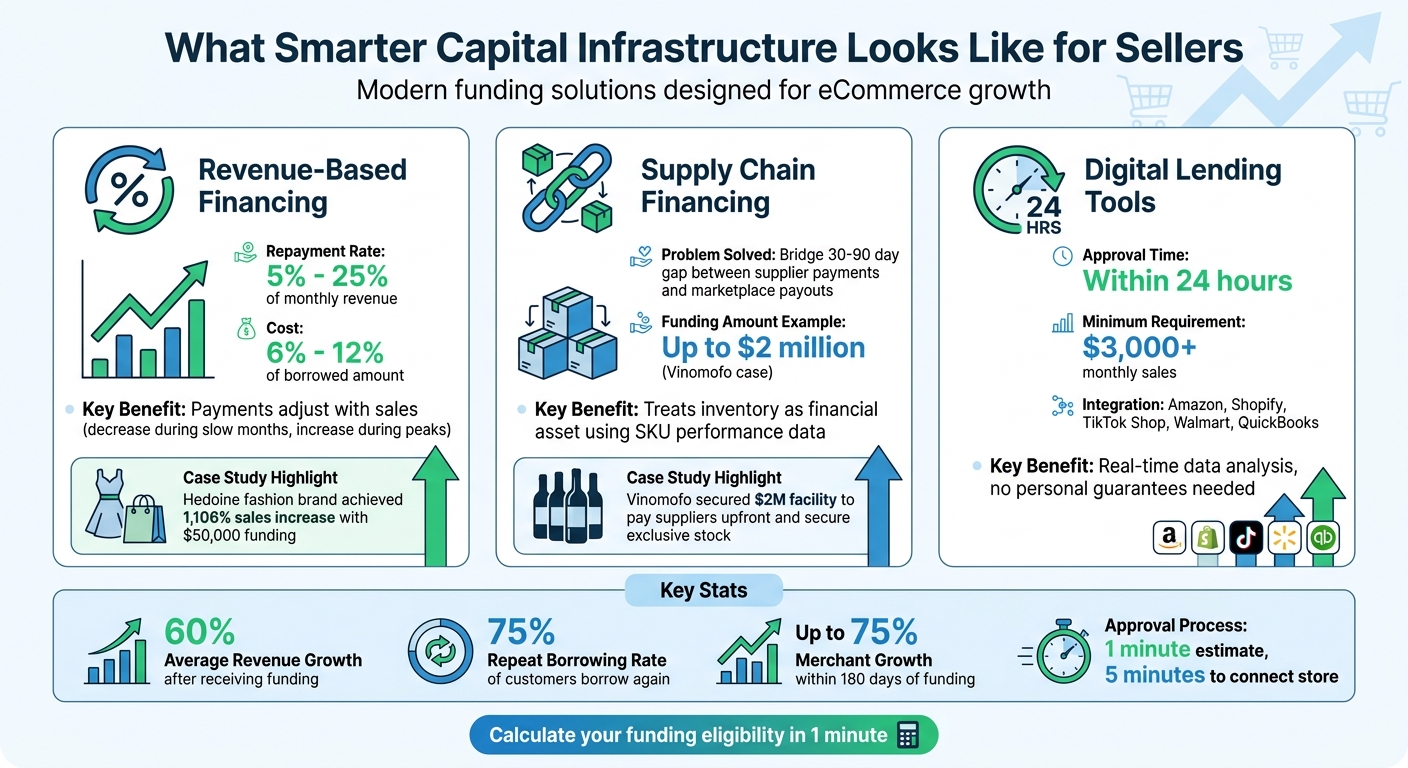
Revenue-based financing (RBF) offers a flexible repayment model. Instead of fixed monthly payments, you repay a percentage of your monthly revenue - typically between 5% and 25% [5]. This means payments decrease during slow months and increase when sales pick up.
Onramp Funds takes this a step further by tying repayments directly to your eCommerce sales. Whether you’re selling on Amazon, Shopify, TikTok Shop, or Walmart Marketplace, payments are automatically deducted from your sales. This eliminates the stress of fixed obligations during seasonal dips. The cost? Between 6% and 12% of the borrowed amount [5].
In late 2019, fashion brand Hedoine used $50,000 in revenue-based funding to fuel Instagram and Facebook ad campaigns. The result? A staggering 1,106% increase in sales during the first quarter of 2020 [5].
This example illustrates how access to timely capital can drive growth without requiring equity sacrifices or personal guarantees. Next, let’s look at how supply chain financing fills the gap between supplier payments and marketplace payouts.
Supply Chain Financing Integration
Supply chain financing solves a common cash flow issue: paying suppliers upfront while waiting 30 to 90 days for marketplace payouts [1]. This timing mismatch can stall growth if not handled effectively.
By treating inventory as a financial asset, modern supply chain financing provides liquidity right when it’s needed. Using data like SKU performance and sales velocity, it ensures you have the capital to restock and produce without draining your operating funds [3].
Take Australian wine retailer Vinomofo as an example. With 500,000 customers and most of its funds tied up in inventory, traditional banks refused to lend. By securing a $2 million trade finance facility through Octet, Vinomofo was able to pay suppliers upfront, secure exclusive stock at better rates, and maintain its working capital cycle [6].
This approach ensures businesses can keep their best-selling products available while staying financially stable.
Digital Lending Tools for eCommerce Sellers
Digital lending platforms simplify the borrowing process by connecting directly to your eCommerce systems. Forget piles of paperwork and long approval times - these tools pull real-time data from platforms like Shopify, Amazon, QuickBooks, and payment processors to automate underwriting. Funding can be approved and delivered within 24 hours [1].
Onramp Funds offers a great example. Once you connect your store, the platform analyzes your sales history to generate a funding offer - no personal guarantees or equity needed. A built-in funding calculator even provides accurate estimates based on your monthly sales, making it ideal for sellers earning at least $3,000 per month.
Warren Brown, Head of Product at Settle, explains it best: "Working capital isn't just about staying afloat. It's what powers growth, keeps shelves stocked, and gives you the flexibility to act fast when new opportunities come up" [1].
These digital tools give sellers the agility they need to thrive in today’s fast-paced eCommerce environment.
Onramp Funds: Features and Benefits for eCommerce Growth
Onramp Funds is designed to meet the unique financial needs of eCommerce businesses. By addressing common hurdles like slow funding, strict repayment terms, and tedious application processes, the platform offers a modern solution for sellers looking to grow.
Fast Funding Within 24 Hours
Speed is critical when you need to restock inventory or ramp up a successful ad campaign. Onramp Funds provides capital in as little as 24 hours after approval. Instead of relying on personal credit scores, the platform uses real-time store performance data. Connecting your eCommerce platforms - such as Amazon, Shopify, or TikTok Shop - syncs your live sales data, eliminating unnecessary paperwork and speeding up the underwriting process.
To qualify, your business must:
- Generate at least $10,000 in monthly sales.
- Be registered in the U.S. as an LLC, S-Corp, or C-Corp with a valid EIN.
- Provide up to six months of business bank statements to verify sales history.
Once approved, funds - up to $2 million depending on your store's performance - are deposited directly into your business account.
"Connect your store, get approved, and receive funding in less than 24 hours." – Onramp Funds [8]
The platform has earned a 4.2 out of 5 rating on Trustpilot from 227 reviews (as of April 2026), with users frequently highlighting its easy process and quick access to funds.
This quick funding sets the stage for repayment terms that adapt to your business.
Flexible Repayment Options Tailored to Sales
Onramp Funds offers a repayment structure that aligns with your revenue. Instead of fixed monthly payments, you repay a percentage of your daily or weekly sales - starting as low as 1% - until the balance is settled. For those who prefer fixed installments, a flat fee ranging from 2% to 8% of the funded amount is available. For Amazon sellers, fees typically range between 0.5% and 4% of sales, with an estimated APR of 11.9% to 19.9% and a 90-day payoff window [7].
"Onramp has been the bridge when it came to quick capital for additional inventory, or working capital... and always comes in a time to support our growth." – Verified user on Trustpilot [8]
This funding model requires no personal guarantees or collateral, offering an equity-free way to secure capital that grows alongside your business.
Integration with Major eCommerce Platforms
Onramp Funds also stands out for its seamless integration with major eCommerce platforms like Amazon, Shopify, Walmart Marketplace, TikTok Shop, BigCommerce, WooCommerce, Squarespace, and SHOPLINE. These integrations ensure your sales data is continuously synced, keeping your funding offers up-to-date.
Eric Youngstrom, Founder and CEO of Onramp Funds, explains:
"We re-underwrite the merchant every night, so the offer is always ready." – Eric Youngstrom [9]
This nightly re-underwriting uses machine learning to analyze sales performance and forecast the next 90 days, eliminating the need for personal credit checks. Merchants have reported growth of up to 75% within 180 days of receiving funding, with some even tripling their sales within two years. If your business hasn’t yet hit the $10,000 monthly sales threshold, you can still connect your store to be monitored and notified once you qualify [9].
"We want to offload the work from the merchant and do it on their behalf." – Eric Youngstrom [9]
With automated repayment deductions from your sales, you can focus on growing your business while Onramp Funds handles the rest.
Step-by-Step Strategies for Financial Flexibility
Building on the idea of flexible capital solutions, here’s how you can fine-tune your financial approach.
Assess Monthly Sales and Funding Eligibility
Start by reviewing your six-month Profit & Loss statements to get a clear picture of your profitability and revenue trends. Use this data to create cash flow projections, ensuring you can manage repayments without disrupting daily operations.
Understanding your cash conversion cycle - the time it takes to pay suppliers and receive customer payments - is key. This insight helps you determine when extra capital might be necessary[1]. Keep in mind that Onramp Funds requires a minimum of $10,000 in monthly sales. Connecting your eCommerce platform early speeds up the funding process. This preparation ensures you’re ready to estimate your funding needs accurately with their calculator.
Use the Onramp Funds Calculator for Accurate Estimates
Leverage the Onramp Funds calculator to figure out how much funding you qualify for and how repayment will work. By inputting your financial details, the tool customizes a plan based on factors like average monthly sales, growth trends, and how you plan to use the funds - whether for inventory, marketing, or other operational needs[4].
The calculator also provides a repayment schedule tied to a percentage of your daily or weekly sales. On top of that, nightly re-evaluations of your sales performance and 90-day forecasts ensure funding offers remain in sync with your business’s growth trajectory[1].
Understand the Fee Structure
Onramp Funds uses a straightforward fixed fee model, charging between 2% and 8% of the funded amount. This fee depends on your sales velocity and overall business profile. With this transparency, you can plan your margins confidently, avoiding surprises from hidden costs or variable rates.
Before committing, compare the fixed fee to your projected sales to confirm it aligns with your profit margins[4]. To make the most of this structure, allocate funds to high-impact activities - like purchasing bulk inventory during peak seasons or scaling winning ad campaigns. Keep in mind that rapid growth can speed up repayment, which may affect short-term cash flow[1].
Comparison of Onramp Funds Pricing and Plans
Onramp Funds stands out by offering pricing and plans tailored to each seller’s sales performance. Instead of rigid, one-size-fits-all tiers, the platform creates funding offers based on your unique sales history. This approach focuses on flexibility, allowing sellers to choose repayment models that align with their business needs.
With the Variable Repayment (Revenue-Based) model, payments are directly tied to daily sales. Remittance rates start as low as 1% of revenue, meaning payments decrease during slow periods and increase during peak seasons. This setup works well for businesses with seasonal sales patterns or unpredictable daily revenue streams [10].
Alternatively, the Fixed Repayment model offers consistent, predictable payments. Sellers pay the same amount each period, regardless of sales fluctuations. This stability simplifies cash flow management and ensures a steady APR, making it a solid option for brands focused on scaling [10]. Both models include a flat fee ranging from 2% to 8% of the funded amount [10].
Plan Comparison Table
| Plan Name | Price | Description | Key Features | Limitations |
|---|---|---|---|---|
| Custom Funding Offers | Variable | Tailored funding based on needs | Fast funding, equity-free, personalized support | Requires integration with supported platforms |
| Fixed Fee Structure | 2-8% fee | Predictable, fixed repayment costs | Transparent costs, no hidden fees | Limited to $3,000+ monthly sales |
| Revenue-Based Financing | Based on sales | Flexible repayment tied to sales | No fixed monthly payments; sales-based remittance | Requires sales history and store connection |
These options give sellers the freedom to select a plan that matches their business rhythms. Notably, Onramp customers report an average revenue growth of 60% after receiving funding, with 75% opting to borrow again [10]. Sellers can get an initial estimate in just 1 minute and connect their store in about 5 minutes [10]. For Amazon sellers, estimated APRs range between 11.9% and 19.9% [7]. By aligning their funding choice with their sales dynamics, sellers can strengthen their financial stability and growth potential.
Practical Examples for eCommerce Growth
Inventory Stocking for Peak Season: In August 2025, Flexport Inc. and BlackRock Inc. expanded their supply-chain financing pool by $250 million to help U.S. importers manage rising tariffs and customs costs [12]. This funding highlights how sellers can prepare for seasonal spikes - like Black Friday and Cyber Monday - by securing financial resources ahead of time. This approach ensures shelves are fully stocked and ready to meet high demand during peak shopping periods [11].
Negotiating Supplier Discounts: Having access to upfront capital gives sellers a stronger position when negotiating with suppliers. For instance, paying suppliers early can lead to discounts of up to 10% on purchase costs [11]. To put this into perspective, a seller placing a $50,000 inventory order could save around $5,000 by opting for immediate payment instead of waiting for net-30 terms.
Scaling Marketing During Product Launches: Funding can also fuel targeted marketing efforts during critical product launches. By allocating resources for short-term operational needs - like marketing campaigns during high-traffic events - businesses can significantly boost their growth [1]. With 53% of mobile shoppers leaving websites that take longer than 3 seconds to load [2], investing in site performance and ad budgets ensures smooth handling of traffic surges and maximizes conversions.
Reducing Vendor Financing Costs: In 2023, a leading electronics manufacturer in China cut vendor financing costs by 13% through a fintech-driven supply chain finance initiative that used dynamic discounting and real-time data [12]. Similarly, eCommerce sellers who integrate their platform data with financing tools can enjoy faster approvals and better terms. Real-time insights into inventory turnover and sales velocity help demonstrate business stability and boost financial flexibility [11][3]. These strategies highlight how tailored funding solutions can enhance financial agility and drive long-term eCommerce growth.
Conclusion: Building a Stronger Financial Foundation
Aligning financing with your business's natural operating rhythm is key to maintaining stability, especially for eCommerce sellers. These businesses often face unique timing challenges - suppliers frequently require 50% payment upfront, while marketplace payouts can take over 30 days to arrive[1]. This creates a gap where working capital becomes a lifeline.
To tackle this, start by calculating your Cash Conversion Cycle using this formula: Days Inventory Outstanding + Days Sales Outstanding - Days Payables Outstanding[1]. This calculation pinpoints exactly when and where your business needs funding, helping you deploy capital strategically to keep operations running smoothly. With this insight, you can focus on securing funds for critical periods like peak inventory builds or major marketing pushes.
Once you've mapped out your cash flow needs, the next step is finding a funding solution that adjusts to your sales patterns. Onramp Funds offers a revenue-linked model designed to scale with your business. If sales slow down, your payments automatically decrease. When sales pick up, repayments adjust accordingly[1]. This approach ensures your cash flow stays steady, giving you the flexibility to seize short-term opportunities without overextending.
Onramp Funds also integrates seamlessly with platforms like Shopify, Amazon, and QuickBooks, allowing you to access working capital in just a few days. For businesses generating at least $10,000 in monthly sales, this streamlined process provides an efficient way to secure the funding needed for growth[1]. Whether you're negotiating discounts with suppliers or launching a time-sensitive marketing campaign, this system ensures you're ready to act quickly.
Check out the Onramp Funds calculator to explore your funding options. Having a clear plan today means you'll be prepared to capitalize on tomorrow's opportunities.
FAQs
How do I choose between sales-based and fixed repayment?
Choosing the right repayment method - sales-based or fixed - largely hinges on your cash flow situation and growth plans.
Sales-based repayment adjusts according to your revenue. This can be helpful if your income fluctuates due to seasonal trends or other factors, as payments will scale with what you earn. On the other hand, fixed repayment involves consistent, predetermined amounts, offering stability but potentially creating challenges if your sales dip unexpectedly.
To decide, take a close look at your cash flow. If your revenue is unpredictable or varies throughout the year, sales-based repayment might be a better fit. However, if your cash flow is stable and predictable, fixed repayment could provide the consistency you need.
Will fast repayment hurt my cash flow if sales spike?
Flexible repayment terms can make a big difference when sales are booming. Traditional loan structures with fixed or large payments might put unnecessary pressure on your cash flow during these periods. On the other hand, revenue-based financing adjusts repayments in line with your sales, allowing you to manage your finances more smoothly, even during high-demand times.
What should I fund first to get the best ROI?
To get the most out of your investments, focus on areas that directly impact growth and profitability. Key priorities include:
- Inventory management: Concentrate on products with high margins or seasonal demand to optimize stock and sales.
- Marketing campaigns: Invest in campaigns with strong return on ad spend (ROAS) to maximize marketing efficiency.
- Technology upgrades: Consider tools like automation or analytics software to improve operations and decision-making.
These strategies can increase sales, streamline processes, and improve cash flow. Keep a close eye on performance metrics and adjust your funding allocations as needed to maintain steady growth and financial stability.
Related Blog Posts
Onramp Funds
Funding built around your sales
Connect your store and see what you qualify for. Repay as a percentage of sales, with no personal credit check.
Funding in as little as 24 hours.
