

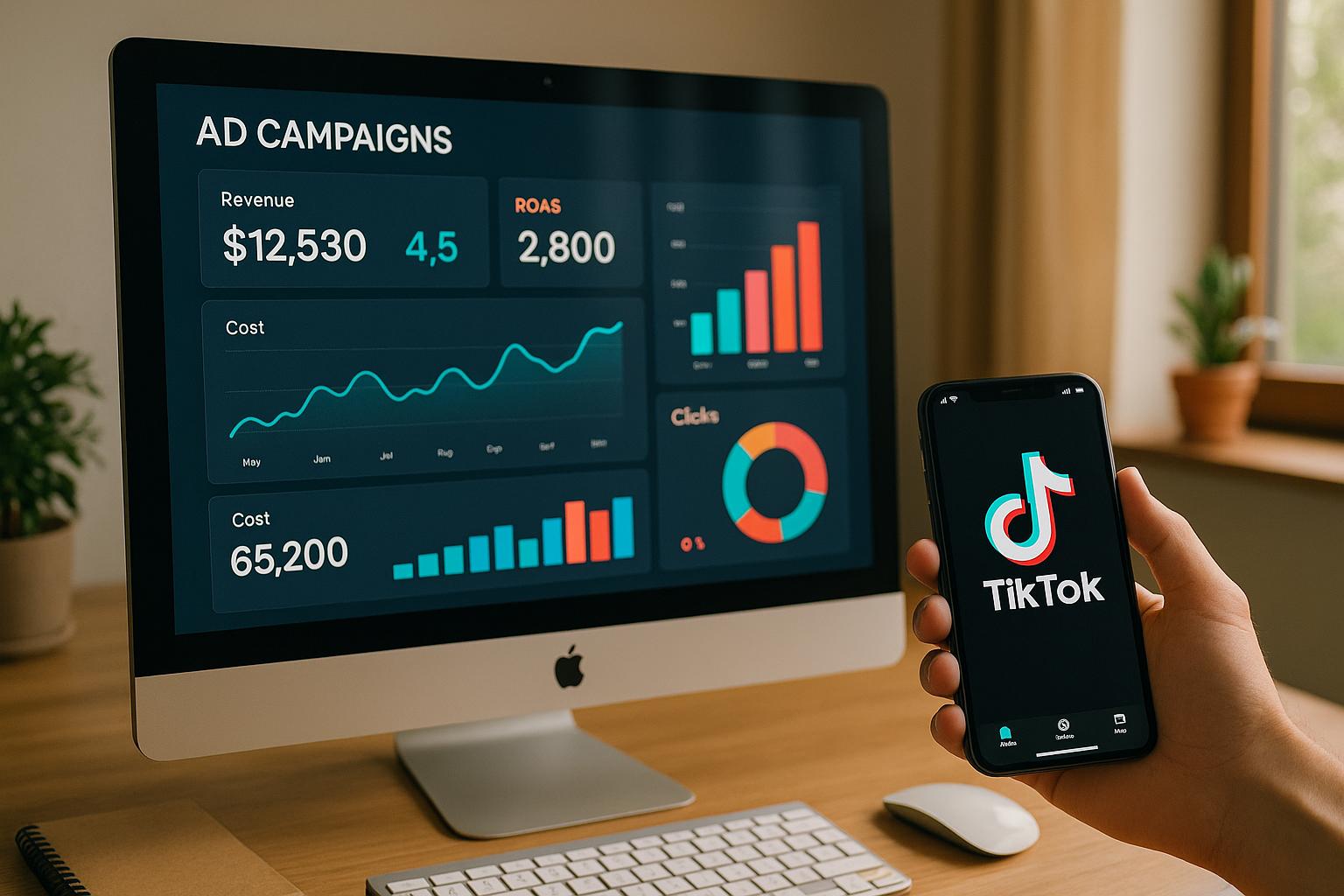
TikTok ads can drive massive eCommerce growth, but scaling campaigns often leads to rising costs and lower ROI. To avoid this, focus on:
- Data-driven scaling: Gradually increase budgets (20–30% increments) and monitor KPIs like ROAS, CPA, and CTR.
- Creative updates: Rotate ad content every 3–7 days to prevent fatigue and maintain engagement.
- Targeting strategies: Use broad targeting, lookalike audiences, and retargeting to expand reach and boost conversions.
- Financial flexibility: Consider revenue-based financing to support ad scaling without cash flow issues.
TikTok’s unique algorithm demands a tailored approach. Combining smart budget allocation, frequent creative refreshes, and precise targeting ensures sustainable growth while keeping ROI intact.
How To Run TikTok Ads And Scale Them (The Right Way)

Data-Driven Budget Allocation for Scaling
Scaling successfully isn't about taking wild guesses - it's about making decisions rooted in data. This ensures your budget is allocated wisely, guided by measurable KPIs that keep your campaigns on track.
Setting Measurable KPIs for Budget Decisions
Before you start scaling, it's essential to define clear benchmarks. Three key metrics to focus on are Return on Ad Spend (ROAS), Cost Per Acquisition (CPA), and Click-Through Rate (CTR) [4][7].
Start by reviewing your historical data to establish baseline performance. For instance, if your campaigns typically achieve a ROAS of 3.0 and maintain a CPA below $20, these can act as your benchmarks. You might set goals like keeping ROAS above 2.5 and CPA under $25 - this ensures you scale only when your campaigns meet or exceed these targets [4][7].
Each KPI serves a specific purpose:
- ROAS reveals how much revenue you're generating for every dollar spent, helping you gauge profitability as you increase spending.
- CPA ensures that acquiring customers doesn't eat into your margins.
- CTR reflects how engaging your ads are and whether your creative is resonating with your audience.
TikTok's analytics tools provide real-time insights into metrics like impressions, reach, CTR, video play rate, and conversions. You can even filter data by audience segment or creative type for a more detailed analysis [4][6][7].
Gradual Budget Scaling Methods
Scaling too quickly can confuse TikTok's algorithm. Sudden budget jumps often disrupt its optimizations [3].
Instead, adopt a gradual approach by increasing budgets in 20–30% increments. This gives the algorithm time to adjust while maintaining the momentum of its learned strategies.
Make sure your campaigns are ready for scaling. For conversion campaigns, this means waiting until an ad group achieves at least 50 conversions in a week before increasing the budget [9].
Here’s an example: A fashion retailer in SoHo scaled their campaigns by increasing budgets by 25% at a time. They also segmented their audiences and rotated creatives weekly. The result? They cut their CPC from $1.40 to $0.95 and boosted their ROAS from 1.7× to 3.4× [3].
To further optimize during scaling, tools like Campaign Budget Optimization and automated bidding can help - just be sure to monitor them closely [2]. Alongside incremental increases, evaluating broader metrics ensures your scaling efforts remain sustainable.
Blended Metrics for Performance Evaluation
Focusing solely on platform-specific metrics like ROAS or CTR only gives you part of the picture. To make smarter budget decisions, include broader metrics like the Marketing Efficiency Ratio (MER) and the payback period [4][7].
- MER is calculated by dividing total revenue by total ad spend across all channels, offering a big-picture view of your marketing efficiency.
- Payback period measures how quickly your ad spend is recouped through sales. This metric is vital for managing cash flow, especially for eCommerce businesses relying on revenue-based financing, where repayments align with sales [4][7].
By combining these blended metrics with TikTok-specific KPIs, you can ensure your scaling efforts improve overall ROI. AI-powered tools can also assist by analyzing historical data to identify the most effective audiences and creatives, recommending budget adjustments, and automating bidding to maximize cost efficiency [3][4][8].
To complement these strategies, having access to flexible funding can ease the financial strain of scaling. For businesses needing additional capital, revenue-based financing offers a smart solution. Since repayments align with sales, it allows you to increase ad budgets without overextending your resources or inventory during rapid growth phases.
Creative Strategies for Maintaining ROI While Scaling
Scaling TikTok ads while keeping ROI intact requires a dynamic approach to creative strategy. As your budget grows, your creative efforts need to evolve in tandem. Even with perfect targeting and budget management, campaigns can falter if the creative content doesn’t stay fresh and optimized. The key? Develop a system for refining your creative assets that grows alongside your spending.
Continuous Creative Testing and Updates
Testing isn’t a one-and-done task - it’s an ongoing process that keeps your ads competitive. Regularly A/B test ad formats, hooks, and user-generated content (UGC) to identify the elements that drive engagement and conversions [2][6].
Focus your attention on critical factors like video length, opening hooks, and calls-to-action (CTAs). These are the first things users notice and determine whether they’ll stop scrolling. Experiment with different video lengths and hooks to find the sweet spot for your audience.
Keep a close eye on performance metrics like click-through rate (CTR), conversion rate, cost per acquisition (CPA), and return on ad spend (ROAS) [2][6]. These numbers reveal which creatives are influencing business outcomes - not just generating likes or views.
TikTok’s Creative Center is a valuable resource for staying on top of industry trends [4][6]. Use its analytics tools to dig deep into performance data, breaking it down by audience segments and creative types. This allows you to make data-driven decisions and fine-tune your campaigns.
Here’s why it’s worth the effort: TikTok video ads boast engagement rates 15% higher than other platforms, and 83% of users report finding these ads entertaining [5]. However, to tap into this potential, your content must align with TikTok’s emphasis on authenticity and entertainment.
Once your creative strategy is solid, the next step is refining your targeting methods to amplify your campaign’s reach.
Identifying and Fixing Creative Fatigue
Even the best-performing ads can lose their charm over time. Creative fatigue creeps in when your audience sees the same content repeatedly, leading to lower engagement and higher costs. Signs of fatigue include declining CTR, reduced engagement, and rising CPA - even if your budget stays the same [2][3].
TikTok’s analytics dashboard can help you spot these warning signs. If you notice video completion rates dropping or user interactions decreasing, it’s time to update your creative assets [2]. Don’t wait for performance to tank - proactively refresh your content when metrics start to dip.
Rotate your creatives every 3–7 days, depending on the size of your audience [2][3]. Larger audiences can handle longer cycles, while smaller, more targeted groups require fresh content more frequently.
Refreshing doesn’t always mean starting from scratch. You can breathe new life into successful formats by changing the actors, settings, or music. For example, if a product demo worked well, try the same concept with a different presenter or backdrop. This approach keeps the core elements intact while offering something new for your audience to engage with [3][6].
User-generated content (UGC) and collaborations with micro-influencers are also excellent ways to keep your creative pipeline flowing. UGC resonates particularly well on TikTok because of its authenticity and relatability, often outperforming polished branded content [2][6]. Partner with customers and influencers to create fresh variations without stretching your budget.
Advanced Targeting and Retargeting Methods
Creative strategies work best when paired with precise targeting. As you scale, smart targeting becomes essential for reaching untapped audiences and re-engaging those who’ve shown interest but haven’t converted. Broad targeting, lookalike audiences, and retargeting are powerful tools to optimize conversions as your ad spend increases [2][3][4].
Broad targeting is especially effective for top-of-funnel campaigns. By allowing TikTok’s algorithm to identify users likely to engage, you can uncover new customer segments you might have overlooked [3][4].
Lookalike audiences are another valuable strategy. These help you reach people who share characteristics with your best customers, increasing the likelihood of conversion [3].
For users who’ve shown interest but didn’t take the final step, retargeting campaigns can seal the deal. Tailor your messaging to address potential objections or highlight additional benefits. For example, if someone visited a product page but didn’t buy, show them a video featuring customer testimonials or a time-sensitive discount [3].
Here’s an example of these strategies in action: In Q2 2025, a SoHo-based fashion retailer scaled their TikTok ads by segmenting campaigns by borough, rotating creatives weekly using Spark Ads, and collaborating with local influencers and UGC creators. The results? CPC dropped from $1.40 to $0.95, ROAS jumped from 1.7× to 3.4×, and month-to-date sales surged by 42% [3].
AI-powered tools can take your targeting to the next level by analyzing creative performance, predicting which audiences are most likely to convert, and automating bidding to maximize efficiency [3]. These tools can identify top-performing creative elements and suggest new variations, helping you optimize faster and more effectively as you scale.
sbb-itb-d7b5115
TikTok-Specific Scaling Methods
TikTok's unique algorithm and user dynamics demand a tailored approach to scaling ads, setting it apart from other platforms. The focus on engaging, relatable content combined with advanced machine learning means advertisers need to understand these nuances to succeed. By using strategies built on data-driven insights and creative execution, marketers can fine-tune their campaigns for TikTok’s specific environment.
Vertical vs. Horizontal Scaling
There are two main ways to scale TikTok ads: vertical scaling and horizontal scaling. Each has its own strengths and challenges, and the choice between them can significantly impact your results.
- Vertical scaling is all about increasing the budget for ad sets that are already performing well. It’s a straightforward strategy, leveraging proven winners without introducing new complexities. However, a sudden budget jump can temporarily disrupt performance, as TikTok’s algorithm typically needs 2–3 days to recalibrate when scaling this way.
- Horizontal scaling, on the other hand, involves duplicating successful campaigns to target new audiences, test different placements, or expand into new regions. This approach broadens your reach and allows you to create lookalike audiences based on your best customers [2].
To make horizontal scaling work, it’s crucial to avoid overlapping audiences, which can drive up costs and hurt efficiency. Using audience exclusions strategically can prevent campaigns from competing against each other [2].
Successful advertisers often combine these methods. Start by scaling vertically with your top-performing ads, then expand horizontally to diversify your audience and minimize risks. This balanced approach ensures steady performance while exploring new growth opportunities. Once your scaling strategy is in place, maintaining momentum with always-on campaigns can further refine results.
Always-On Campaigns for Algorithm Learning
Always-on campaigns are a cornerstone of TikTok ad scaling. Unlike traditional campaigns that start and stop, always-on campaigns provide a steady flow of data, allowing TikTok’s algorithm to optimize continuously. This consistency supports gradual budget increases without disrupting performance [2][3].
The best always-on campaigns use a full-funnel strategy to engage users at every stage of their journey:
- Top of Funnel (TOFU): Focus on creating awareness with entertaining content that introduces your brand to new audiences.
- Middle of Funnel (MOFU): Engage users who’ve shown interest, often with retargeting ads featuring customer testimonials or product demos.
- Bottom of Funnel (BOFU): Target users ready to convert with compelling offers and clear calls-to-action [3].
For example, a retailer might use fun, engaging product videos for TOFU, follow up with testimonials for MOFU, and close the deal with time-sensitive discounts for BOFU. Keeping all stages active ensures that your audience moves seamlessly through the purchase journey [3].
Always-on campaigns also prevent the inefficiencies caused by pausing and restarting campaigns, which can force the algorithm to relearn audience preferences. To maximize effectiveness, segment your audiences by funnel stage and use diverse ad formats like In-Feed ads, Spark Ads, and Top View placements. Regularly refreshing creative content helps avoid ad fatigue while ensuring optimal performance.
Modern Attribution Models for TikTok Ads
Traditional last-click attribution often fails to capture TikTok’s full impact on the customer journey. While TikTok plays a significant role in influencing early purchase decisions, final conversions often happen on other platforms, creating a measurement gap that can lead to underestimating its value.
Modern attribution models, such as regression-based models and Marketing Mix Modeling (MMM), provide a more accurate picture. These methods analyze multiple data points - like ad spend, sales trends, and seasonal factors - to determine TikTok’s contribution to overall revenue [2].
The shift toward blended attribution models reflects the growing complexity of customer journeys, which often involve multiple touchpoints. These models help brands better understand how TikTok fits into their broader marketing efforts [2].
To implement modern attribution effectively, track key metrics such as:
- Return on Ad Spend (ROAS)
- Cost Per Click (CPC)
- Conversion Rate
- Impressions
- Frequency
- Audience Overlap [2][3]
Monitoring these metrics before and after scaling helps identify what’s driving growth and what might need adjustment.
Additionally, AI-powered tools are becoming increasingly valuable for predictive modeling, creative analysis, and automated bidding. These tools can process large amounts of data to uncover patterns and opportunities that might otherwise go unnoticed [3]. Features like Campaign Budget Optimization (CBO) allow TikTok’s algorithm to distribute budgets across ad sets for maximum efficiency, often outperforming manual adjustments [2]. However, automated tools require careful oversight to ensure budgets aren’t wasted on underperforming segments.
Financial Support for Scalable Growth
Scaling TikTok ads effectively requires more than just creative ideas and smart strategies - it also demands access to immediate capital. Many eCommerce sellers discover winning campaigns that could drive significant growth but hit a roadblock when they lack the cash flow to scale ad budgets or stock up on inventory to meet rising demand. Quick and flexible funding can break through these barriers, enabling sellers to grow without delays.
How Flexible Funding Helps Scale TikTok Ads
Fast and adaptable financing can completely change the way eCommerce sellers approach scaling TikTok ads. Instead of waiting for organic cash flow to catch up or cautiously increasing budgets, sellers can act immediately, avoiding disruptions that might reset TikTok’s algorithm.
Take this example: A mid-size fashion retailer used flexible financing to increase ad budgets in 25% increments while refreshing ad creatives and fine-tuning audience segmentation. The result? Lower costs, a better return on ad spend (ROAS), and a sharp boost in sales.
Revenue-based financing offers even more advantages. Repayments are tied to sales performance, so sellers pay more during high-revenue periods and less when sales slow down. This flexibility reduces financial strain and aligns with the unpredictable revenue cycles of eCommerce businesses.
How Onramp Funds Fuels Scalable Growth
Onramp Funds steps in as a key player in this space. They provide revenue-based, equity-free financing tailored to the needs of eCommerce businesses, including those selling on TikTok Shop. Their process is designed to be fast and hassle-free: sellers can get an initial estimate in just one minute, securely connect their store in five minutes, and access funds in under 24 hours after final approval. This quick turnaround allows sellers to act on time-sensitive marketing opportunities.
"Applied, got our offer, and had cash in our bank account within 24 hours. Their Austin, TX based team was very professional and helped me deploy the cash to effectively grow our business." - Nick James, CEO Rockless Table[1]
Onramp Funds has already facilitated over 3,000 eCommerce loans and boasts an A+ rating from the Better Business Bureau. Their services are available to businesses generating at least $10,000 in average monthly sales, operating as legal U.S. entities, and selling on supported platforms. With repayments tied to sales, businesses can scale confidently, knowing their payments will adjust to match their performance.
Balancing Marketing and Inventory Investments
When scaling TikTok ads, striking the right balance between marketing and inventory is crucial. If you pour too much into ads without enough inventory, you risk stockouts. On the flip side, overstocking without adequate marketing can tie up cash and hurt your ROI. Flexible funding bridges this gap, giving sellers the resources to meet demand as TikTok campaigns drive sales. This is especially important with TikTok Shop and live shopping features, where real-time demand can surge unexpectedly.
"Onramp offered the perfect solution with revenue-based financing to secure the capital we needed to invest in inventory and pay it back at a reasonable time frame once we made sales." - Jeremy, Founder and Owner of Kindfolk Yoga[1]
Shopify data reveals that eCommerce brands using flexible funding solutions are 2.3 times more likely to scale ad spend profitably compared to those relying solely on organic cash flow[7]. By closely monitoring key metrics - like return on ad spend, cost per click, conversion rates, and inventory turnover - sellers can ensure that their marketing investments lead to sustained growth. Balancing these investments ensures that scaling efforts deliver strong returns, creating a solid foundation for long-term success.
Building a Scalable TikTok Ad Strategy That Delivers ROI
Scaling TikTok ads successfully isn’t just about throwing more money into campaigns - it’s about putting together a well-rounded strategy built on four key pillars: data-driven decisions, creative optimization, platform-specific scaling techniques, and financial flexibility. When these elements work together, they create a framework for sustainable growth and profitability.
Data-driven budget allocation is the starting point for any scalable TikTok ad strategy. Keeping a close eye on metrics like ROAS (Return on Ad Spend), CPC (Cost Per Click), and conversion rates ensures that growth doesn’t come at the cost of profitability. Scaling too quickly can disrupt TikTok’s algorithm, so a systematic approach is crucial. By letting data guide decisions, you can make adjustments that align with your goals while avoiding costly mistakes. However, data alone isn’t enough - creative content plays a huge role in maintaining performance.
Creative optimization is essential for keeping campaigns fresh and engaging. TikTok’s audience is highly dynamic, and ad fatigue can set in fast. That’s why regularly refreshing your creative assets is a must. Experimenting with different formats - like In-Feed Ads, Spark Ads, and Top View placements - can help you maintain strong engagement even as budgets grow. Rotating creative content strategically not only keeps your audience interested but also helps lower acquisition costs and boost sales.
Platform-specific scaling methods take advantage of TikTok’s unique features to maximize results. Vertical scaling focuses on increasing the budget of high-performing campaigns, while horizontal scaling broadens your reach by targeting new audiences. Running always-on campaigns allows TikTok’s algorithm to continuously learn and optimize, while tools like Campaign Budget Optimization and advanced bid strategies ensure efficiency as spending increases. Audience exclusions are another smart move - they prevent overlap, which can drive up costs and hurt performance. Together, these methods create a solid foundation for scaling efforts.
Financial flexibility is often the deciding factor in whether scaling efforts succeed or fall short. Having access to working capital is critical, especially when opportunities to scale arise quickly. Solutions like Onramp Funds allow eCommerce sellers to increase their ad budgets immediately, without waiting for organic cash flow to catch up. This kind of agility ensures that your scaling strategy doesn’t stall due to financial constraints.
Finally, AI-powered tools like predictive modeling and automated bidding have become standard for scalable campaigns. These technologies take much of the guesswork out of optimization, allowing campaigns to grow efficiently with less manual oversight.
The key to success lies in treating scaling as an ongoing process, not a one-time action. Regular reviews, consistent creative testing, strategic audience expansion, and a strong financial foundation all contribute to sustainable growth. Brands that master this approach not only scale profitably but also build a lasting edge in TikTok’s competitive advertising landscape.
FAQs
What’s the best way to measure the success of my TikTok ads as I scale them?
To gauge the success of your TikTok ads as your campaigns grow, it’s essential to focus on key performance indicators (KPIs) that match your business objectives. Some critical metrics to monitor include:
- Cost per Acquisition (CPA): This tells you how much you’re spending to bring in each new customer.
- Return on Ad Spend (ROAS): Tracks how much revenue you’re earning for every dollar spent on ads.
- Conversion Rate: Measures how many users take desired actions, like making a purchase or signing up.
- Click-Through Rate (CTR): Shows how often viewers are clicking on your ads.
- Engagement Rate: Reflects interactions such as likes, comments, and shares.
By keeping a close eye on these metrics, you can pinpoint what’s performing well and what needs adjustment, helping your campaigns stay effective as you scale. For businesses aiming to grow even faster, solutions like Onramp Funds can provide financial support to boost your marketing efforts while maintaining healthy cash flow.
How can I avoid creative fatigue in TikTok ads and keep my audience engaged?
To keep your TikTok ads fresh and engaging, it’s important to regularly update your content. Try experimenting with different visuals, sounds, and messaging to capture attention. TikTok users appreciate content that feels authentic and aligns with current trends, so consider using popular audio, trending hashtags, or joining in on challenges to stay relevant.
Pay close attention to your ad performance. A noticeable drop in engagement can be a clear sign that it’s time to refresh your creatives. Another way to maintain interest is by diversifying your ad formats - mix in-story ads with carousel ads or branded content to keep things dynamic and appealing. This variety can also boost your return on investment (ROI).
If you’re planning to scale your TikTok campaigns, managing your cash flow becomes essential. Onramp Funds offers eCommerce businesses quick, equity-free financing solutions. This allows you to invest in marketing and other growth opportunities without putting unnecessary pressure on your budget.
How can revenue-based financing help eCommerce businesses scale TikTok ads effectively?
Revenue-based financing gives eCommerce businesses a fast, ownership-preserving way to fund growth initiatives like TikTok ads. It’s a funding option that allows sellers to invest in marketing campaigns without giving up equity, offering a repayment structure that adapts to how well the business is performing.
Here’s how it works: instead of fixed monthly payments like a traditional loan, repayments are directly tied to your revenue. You only pay when your business makes sales. This setup provides breathing room during slower months, helping you manage cash flow while still scaling your advertising efforts effectively.
Related Blog Posts
Onramp Funds
Funding built around your sales
Connect your store and see what you qualify for. Repay as a percentage of sales, with no personal credit check.
Funding in as little as 24 hours.
