


Sales-based repayment, also called revenue-based financing, is a flexible funding option for eCommerce businesses. Instead of fixed monthly loan payments, you repay a percentage of your sales - typically 5% to 15%. This means payments automatically adjust based on how much revenue you generate. When sales are high, you pay more; when sales are low, you pay less. This model allows businesses to access capital without the stress of rigid payment schedules or giving up equity.
Key benefits include:
- Revenue-aligned payments: Payments scale with your sales, easing cash flow during slow months.
- Fast funding: Approval often takes less than 24 hours, with funds available the same day.
- No equity loss: You retain full ownership of your business.
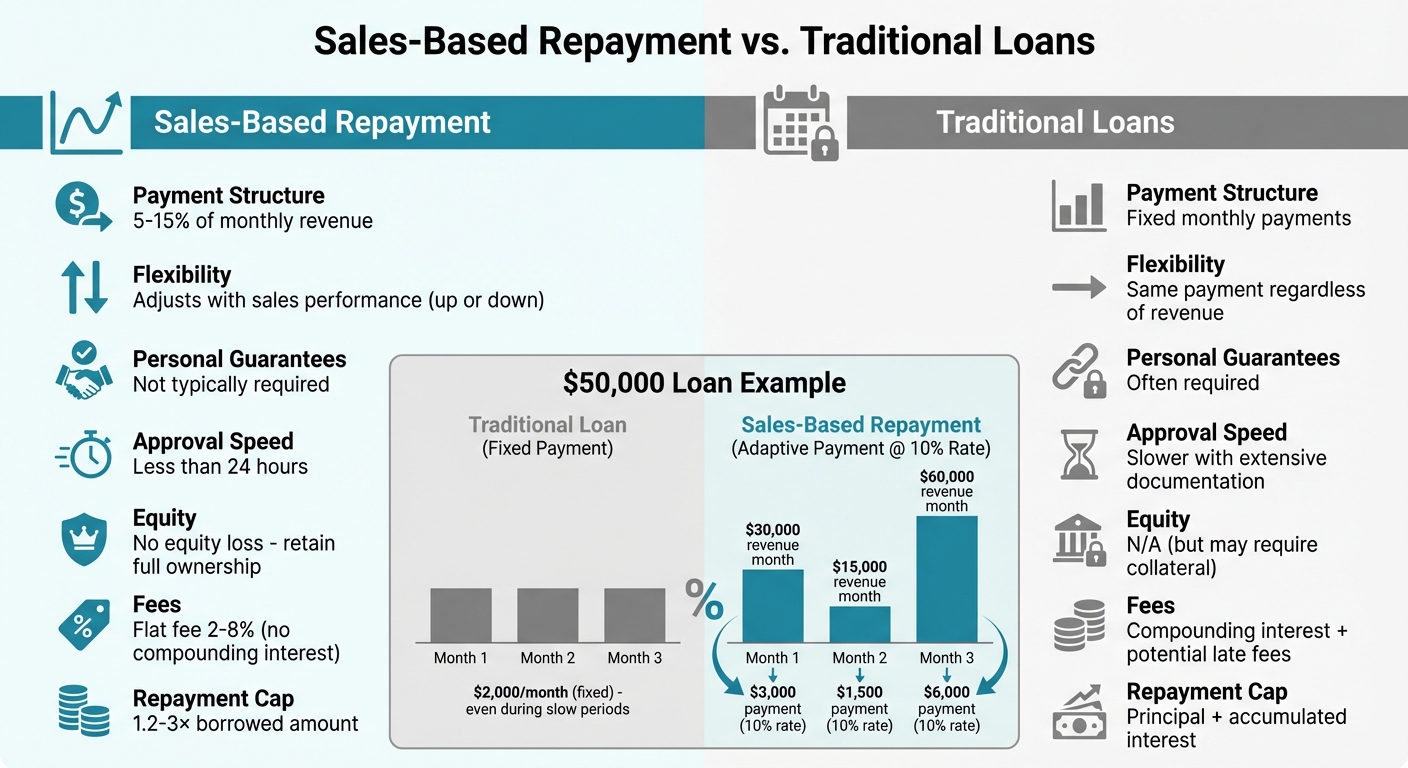
For example, borrowing $50,000 with a 10% repayment rate means if your monthly revenue is $30,000, you pay $3,000. If revenue drops to $15,000, your payment adjusts to $1,500. Repayments continue until you meet a predetermined cap, such as 1.5× the borrowed amount.
This approach is ideal for managing seasonal sales fluctuations or funding growth projects like inventory restocking, marketing campaigns, or tech upgrades. By linking repayments to revenue, sales-based financing offers flexibility and reduces financial strain, making it a practical alternative to traditional loans.
How to get Revenue-based Financing for your Shopify Store?

sbb-itb-d7b5115
What Is Sales-Based Repayment?
Sales-Based Repayment Defined
Sales-based repayment is a funding option where businesses receive upfront capital and repay it through a percentage of their future revenue. These payments are automatically deducted daily or monthly, depending on the agreement [2]. Unlike traditional loans with fixed monthly payments, this model adjusts based on your actual sales. Typically, repayment rates fall between 5% and 15% of revenue, continuing until the original funding plus a one-time fee is fully repaid.
This approach doesn’t require giving up equity in your company. For example, with a 10% repayment rate, a business generating $30,000 in revenue would pay $3,000, but if revenue drops to $15,000, the payment would decrease to $1,500. This flexibility helps businesses manage cash flow more effectively.
Repayments continue until a predetermined cap - usually 1.2 to 3 times the principal - is reached. For instance, borrowing $20,000 with a 1.5× cap means you’ll repay a total of $30,000. There’s no strict timeline; payments are tied to your revenue until the cap is met [5]. This structure allows eCommerce businesses to invest in growth while maintaining predictable costs.
Now, let’s see how this model compares to traditional loans, especially in terms of cash flow management.
Sales-Based Repayment vs. Standard Loans
Sales-based repayment offers a more flexible alternative to standard loans. Here’s how they differ: a traditional $50,000 loan might require fixed monthly payments of around $2,000, regardless of how much revenue your business generates.
With sales-based repayment, the amount adjusts with your actual revenue. For example, a Shopify merchant borrowing $50,000 might agree to repay 10% of daily sales until $60,000 (including fees) is repaid. On a slow day with $1,000 in sales, the payment would be $100. In contrast, a traditional loan would still demand the full monthly payment, which could strain cash reserves during slow periods [2]. This flexibility makes sales-based repayment a safer option for businesses looking to scale sustainably.
However, there’s a trade-off. Traditional loans come with compounding interest and potential late fees, while sales-based repayment typically charges a one-time fee - usually between 6% and 12% of the borrowed amount - with no interest or penalties for slower repayment. That said, if your revenue grows quickly, you may repay the funding faster, which could result in a higher effective annual percentage rate compared to some traditional loans [7].
How Sales-Based Repayment Works with Onramp Funds
Let’s break down how Onramp Funds simplifies the process of funding and repayment for eCommerce businesses. Using a revenue-based approach, they make it easy to access capital and repay it flexibly, aligning with your sales performance.
Connecting Your Store to Onramp Funds
Getting started is quick and straightforward. In just five minutes, you can connect your eCommerce platform - whether you sell on Amazon, Shopify, Walmart, TikTok Shop, eBay, or others - via a secure API integration. This connection provides Onramp Funds with real-time access to your sales data. By doing so, they can assess your eligibility without the hassle of traditional credit checks, balance sheets, or collateral requirements [4][8]. This integration not only speeds up the process but also eliminates unnecessary paperwork.
Approval and Fund Disbursement
Once your store is connected, the approval process kicks off and typically takes less than 24 hours. Onramp Funds evaluates your sales performance, usually requiring 6–12 months of consistent sales history to determine your funding eligibility and terms. There’s no need to prove profitability or submit extensive documentation.
If approved, funds are disbursed as a lump sum - often on the same day. Qualified sellers can access up to $2 million, depending on their sales performance. To help you plan, Onramp offers a funding calculator where you can input your sales history to estimate repayment amounts before accepting the offer [4][8][9].
The repayment terms are simple: a flat fee ranging from 2% to 8% of the funded amount. There’s no compounding interest or hidden charges. For instance, borrowing $50,000 with a 5% fee means your total repayment would be $52,500 [8].
How Revenue-Based Repayment Works
Repayments are automatically deducted as a fixed percentage of your revenue - typically between 5% and 20% - until the principal and flat fee are fully paid [4][6]. The percentage stays the same, but the actual payment adjusts based on your sales.
Here’s an example: If you borrow $50,000 with a 10% remittance rate and your November sales hit $60,000, you’d pay $6,000 that month. If December sales climb to $80,000, your payment increases to $8,000, helping you pay off the loan faster. On the flip side, if January sales dip to $30,000, your payment adjusts to $3,000 - offering relief during slower periods.
This setup ensures flexibility. Payments align with your revenue, providing breathing room during seasonal downturns while enabling quicker repayment during strong sales months. There’s no fixed timeline or monthly minimum, and remittance rates can start as low as 1% of daily sales, automatically adjusting with your revenue flow [8].
Benefits of Sales-Based Repayment for eCommerce Businesses
Let’s dive into why sales-based repayment can be a game-changer for eCommerce brands.
Payments That Adjust to Your Revenue
One of the standout perks of sales-based repayment is how payments scale with your sales. If your revenue takes a dip - say, it drops by 40% during a slow month - your repayment also decreases by 40% [6]. This adaptability helps ease cash flow pressure when sales are down.
For eCommerce businesses, this flexibility is especially helpful. It allows you to maintain cash flow even during seasonal slowdowns, like the quieter months of Q1 following the Q4 holiday rush [6]. This alignment between payments and revenue makes it easier to scale safely, even in unpredictable market conditions.
Fast Access to Capital Without Losing Equity
Sales-based repayment offers quick funding - sometimes in as little as 24 hours - without requiring you to give up any ownership of your business [7][3]. Unlike equity financing, where investors take a stake and gain decision-making power, this option lets you repay a fixed percentage of your revenue over time [3]. That means you stay in control of your business, free from dilution or outside interference.
The approval process is simple and fast. Most providers only need access to platforms you already use, like Stripe, Shopify, Facebook, or accounting tools such as Xero or QuickBooks [7]. This eliminates the lengthy, paperwork-heavy approval process that comes with traditional loans. Combined with its flexibility, this makes sales-based repayment a practical alternative to conventional financing.
Comparing Sales-Based Repayment to Standard Loans
Here’s a quick breakdown of how sales-based repayment stacks up against traditional loans:
Repayment caps typically range from 1.2 to 1.6 times the borrowed amount [6]. For instance, if you borrow $50,000, you’ll repay between $60,000 and $80,000 in total. The repayment timeline adjusts naturally - stronger sales speed it up, while slower sales extend it without penalties [6]. This makes it an adaptable and low-pressure way to secure funding.
How to Use Sales-Based Repayment Effectively
Making the most of sales-based repayment requires a thoughtful approach to securing and using funds. Here's how to leverage this financing option for your eCommerce business.
Review Your Sales History
Start by digging into your revenue data from the past 12 to 24 months. Look for monthly averages, seasonal spikes, and any growth patterns. This analysis will help you figure out how much you can comfortably repay without putting a strain on your cash flow. Since sales-based repayment adjusts with your revenue, this step is crucial.
Be conservative when deciding how much to borrow. A good rule of thumb is to base your funding request on your average monthly revenue, but leave a 20–30% buffer for unexpected slow periods. Use tools like your Shopify or Amazon dashboard to model different scenarios, especially during low-sales months. This preparation ensures you don’t overextend your resources and can keep your business running smoothly.
Use Funds for Growth Priorities
Once you’ve analyzed your sales trends, focus on using the funds where they’ll make the biggest impact. Aim for projects or investments that deliver a return within three to six months. For example:
- Restocking inventory to prepare for seasonal demand.
- Running targeted marketing campaigns during peak sales periods.
- Upgrading technology to improve operational efficiency.
Let’s say you invest $50,000 in inventory ahead of Q4. If this leads to $60,000 in sales in November and $80,000 in December, and you’re repaying 10% of revenue, you’d remit $6,000 and $8,000 for those months, respectively [4][1]. This kind of strategic use of funds ensures you can handle repayments while fueling growth.
You can also experiment with initiatives like scaling ad spend or testing new platforms. These efforts, when carefully measured, can drive sales and make repayment easier.
Track Revenue and Adjust Your Approach
After using the funds, keep a close eye on your sales and cash flow. Check your eCommerce dashboards weekly to spot trends early and make adjustments as needed. If sales are slower than expected, you’ll naturally repay less, but it’s still smart to tweak your marketing or inventory strategies to boost revenue. Always keep a 20% cash reserve for unexpected downturns.
Review your repayment progress every two weeks to stay on track. If your sales outperform expectations, consider paying off the loan early - most sales-based repayment plans don’t charge penalties for doing so. This flexibility allows you to manage your finances effectively, even during fluctuating sales periods.
Conclusion
Onramp Funds' sales-based repayment model offers a way for businesses to grow without the financial strain that often comes with traditional loans. By linking repayments to a percentage of your revenue - usually between 5% and 20% - you pay more when sales are strong and less during slower months. This approach helps maintain steady cash flow throughout the year.
Speed and ease are just as important as flexibility. With approvals typically completed within one business day and funds available in 24 hours, you can seize growth opportunities quickly. Whether it’s restocking inventory before a busy season or scaling up ad campaigns during a high-performing period, this funding model allows you to act fast. Plus, there’s no need to give up equity or provide collateral; you retain full ownership of your business while accessing capital that adapts to your revenue.
The repayment structure is designed to be manageable. Payments adjust automatically based on your sales, ensuring you’re not overburdened during slower periods. At the same time, as your sales grow, you can repay the funding faster, making it a flexible and stress-free option compared to fixed loan payments.
To maximize the benefits, it’s important to use the funds strategically. Focus on investments that deliver returns within three to six months - such as stocking up for seasonal demand, running targeted marketing campaigns, or upgrading technology to improve efficiency. By aligning your funding with these priorities, you can scale your business without jeopardizing cash flow.
This model isn’t just about quick access to capital - it’s about sustainable growth. It gives eCommerce brands the freedom to invest in their future without the rigid terms or equity trade-offs that can limit potential.
FAQs
How can I determine a safe repayment percentage for my cash flow?
To determine a safe repayment percentage, start by evaluating your average monthly revenue. Then, choose a percentage - usually between 4% and 8% - that allows you to cover operating expenses while keeping enough funds available for growth and unforeseen expenses.
For instance, if your monthly revenue is $50,000, a 4% repayment rate would mean paying back $2,000. You can adjust this percentage based on your profit margins and the consistency of your cash flow. This approach helps ensure you’re not overextending financially, especially during slower months.
What happens to my payments if my sales drop sharply or pause?
If your sales take a dip or come to a halt, your payments will automatically adjust to reflect your current revenue. With a revenue-based repayment approach, payments shrink - or even pause - during slower times, easing financial pressure and aligning with your cash flow.
Can I pay off early, and does that change the total I repay?
Yes, you can pay off your loan early without worrying about prepayment fees. By doing so, you typically reduce the total amount you end up paying since it cuts down the interest that would have accrued over time.
Related Blog Posts
Onramp Funds
Funding built around your sales
Connect your store and see what you qualify for. Repay as a percentage of sales, with no personal credit check.
Funding in as little as 24 hours.
