


Sales-aligned funding offers a flexible way for eCommerce businesses to manage cash flow by tying repayments to sales performance. Unlike loans with fixed monthly payments, this model adjusts repayments based on revenue, reducing financial strain during slow months. Here's why it matters:
- Repayment Flexibility: Payments scale with sales, ensuring businesses aren't overburdened during low-revenue periods.
- Reduced Default Risk: Avoid missed payments as obligations shrink when sales dip.
- Easier Qualification: Focuses on sales data rather than credit scores or collateral.
- Quick Access: Funds are often available within 24 hours of approval.
This funding is ideal for U.S. eCommerce sellers facing seasonal revenue spikes, rising costs, or fluctuating cash flow. However, it typically comes with higher overall costs compared to fixed loans. To qualify, sellers need consistent monthly revenue, 3–6 months of sales history, and platform integration (e.g., Shopify, Amazon).
Carefully analyze your cash flow and margins before choosing this option. If your business has steady growth and needs flexible capital for inventory or marketing, sales-aligned funding could be a practical solution.
Amazon FBA loans VS revenue based financing
sbb-itb-d7b5115
How Sales-Aligned Funding Reduces Risk
Sales-aligned funding offers a repayment model that adapts to your revenue, unlike fixed monthly payments. This flexibility reduces financial strain during slower sales periods, making it particularly suited for eCommerce businesses dealing with fluctuating income. Here's how this approach minimizes risk and provides a safety net for businesses.
Flexible Repayments During Sales Fluctuations
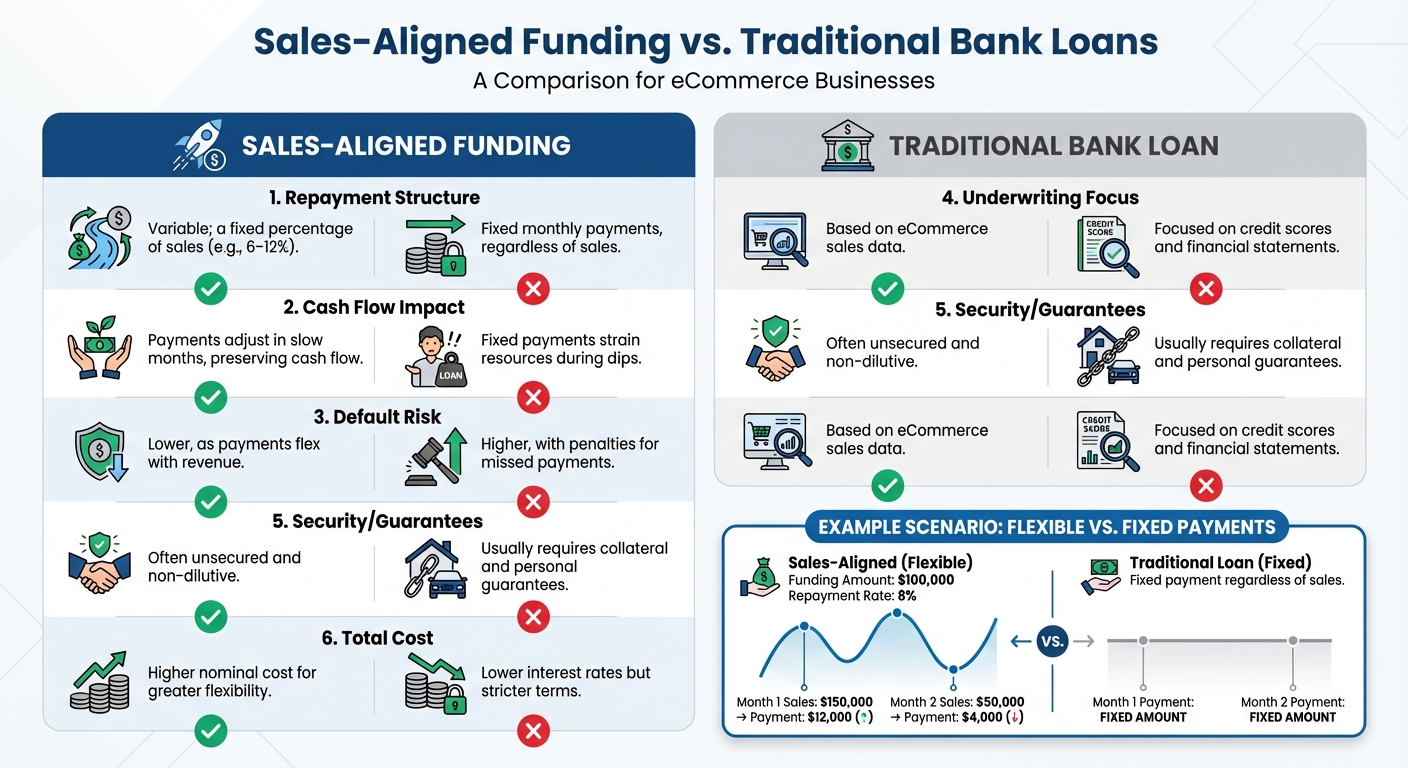
Imagine you secure $100,000 in funding with an 8% repayment rate. If your monthly sales drop from $150,000 to $50,000, your repayment automatically adjusts from $12,000 to $4,000 [1][2]. This adjustment keeps your cash flow manageable, even during slow months. On the other hand, a traditional bank loan would require fixed monthly payments, regardless of your sales performance. This rigidity might force you to cut back on critical expenses like advertising or inventory, or even turn to expensive short-term credit. Sales-aligned funding eliminates that pressure by syncing repayments with your actual revenue.
Reducing the Risk of Default
Fixed-payment loans can lead to default if your business faces consecutive months of low sales. Sales-aligned funding reduces this risk by lowering payment obligations when revenue dips. Providers typically allow repayments to continue until you’ve paid back an agreed-upon total - usually 1.1 to 1.5 times the original amount - without setting strict monthly minimums or fixed deadlines. This structure is ideal for eCommerce businesses, where revenue can be unpredictable, offering a safeguard against missed payments.
Sales-Aligned Funding vs. Traditional Loans
To better understand the benefits, here’s a side-by-side comparison of sales-aligned funding and traditional bank loans:
The key trade-off lies in cost versus flexibility. While traditional loans may come with lower interest rates, their rigid repayment schedules can strain your cash flow. Sales-aligned funding, though potentially more expensive overall, gives you the breathing room to maintain operations and avoid drastic measures like cutting payroll or marketing budgets. This adaptability makes it a practical choice for businesses navigating uncertain revenue streams.
Eligibility for Sales-Aligned Funding
Sales-aligned funding takes a different approach by focusing on your current sales performance and eCommerce platform data rather than relying on credit scores or hard collateral. This makes it an option for sellers experiencing strong revenue growth, even if they lack a robust credit history or significant physical assets.
Basic Qualification Requirements
To qualify, your business needs consistent monthly revenue between $3,000 and $10,000. Most providers also require three to six months of sales history, though businesses with 12 months or more of verified data often receive better terms. Unfortunately, pre-revenue or very early-stage companies usually don’t meet the requirements since they lack the sales data necessary for underwriting.
You’ll also need to integrate directly with platforms like Shopify, Amazon, Walmart, or WooCommerce and link your business bank account through secure APIs. This integration allows for real-time revenue verification, enabling providers to approve applications in hours rather than weeks. This streamlined process eliminates the need for stacks of paperwork typically required for traditional loans.
Once you meet these basic qualifications, it’s time to evaluate your business’s readiness.
Evaluating Your Business Readiness
Start by reviewing your sales trends over the past six to 12 months. Consistent or growing revenue without major fluctuations is a good indicator that your business can handle revenue-share repayments.
Next, assess your gross margins. After factoring in costs like goods sold, advertising, platform fees, and operating expenses, ensure you have enough margin left to comfortably cover repayments. Stronger margins mean you’re in a better position to manage the flexible repayment structure without straining your inventory or marketing budgets.
Finally, prepare a clear growth plan. Detail how you’ll use the funds - whether it’s for scaling inventory, introducing new products, or launching targeted ad campaigns - and how these investments will increase both sales and profits. A well-documented plan not only strengthens your case but also ensures the funding aligns with your business goals.
How to Use Sales-Aligned Funding in Your Business
Once you've confirmed that your business qualifies, the next step is figuring out how to access and put your funding to work. The process is quick and simple - most sellers receive their funds within 24 hours of approval.
Application and Approval Process
The first step is to connect your eCommerce platform directly to the funding provider's portal through a secure API. This connection gives the lender instant access to key metrics like your revenue, order volume, return rates, and customer behavior. This eliminates the hassle of dealing with piles of paperwork. You'll also need to link your business bank account to verify cash flow and profit margins.
To speed things up, make sure your sales, refund, and advertising data are clean and synced. If you use accounting software like QuickBooks or Xero, syncing it can provide a complete financial overview, often leading to faster approval.
Most applications are reviewed within hours instead of dragging on for weeks. Once approved, you'll receive an offer that outlines the funding amount, fees, and a repayment structure tied to your sales. Pay close attention to these terms, especially how repayments adjust during slower sales periods. After you agree to the terms, you can integrate your account for automated repayments.
Connecting Funding With Your eCommerce Platform
Once you accept the funding offer, the money is deposited directly into your business account - usually within 24 hours. Repayments are automated, based on a fixed percentage of each sale. This setup adjusts naturally with your revenue, reducing payments during slower months and increasing them during busier times. This flexibility helps protect your cash flow when you need it most.
Integrating your funding with your eCommerce platform also helps you make smarter operational decisions. For example, syncing it with inventory management or ERP systems gives you real-time insights into stock levels. This means you can use the funds to restock popular products before they sell out, rather than scrambling to catch up later. With automated repayments and seamless integration, you can focus on using the funds to drive growth.
Getting the Most From Your Funding
With your funding in place and repayments automated, it's time to maximize its potential. Focus on high-margin opportunities to get the best return on your investment. For instance, use the funds to prepare for seasonal demand spikes - secure bulk inventory discounts ahead of busy shopping periods like Black Friday or Cyber Monday. This strategy not only boosts profits but also keeps repayments manageable during slower months.
Make high-margin products a priority and automate financial reporting to maintain accurate, up-to-date data. Tools that sync your warehouse, eCommerce platform, and accounting software can help minimize errors and keep your financial records clean. This not only simplifies your day-to-day operations but also makes it easier to qualify for additional funding as your business grows.
Is Sales-Aligned Funding Right for Your Business?
Key Takeaways
Sales-aligned funding is designed for businesses with steady or growing revenue, healthy profit margins, and sales patterns that fluctuate due to seasons or marketing cycles. Unlike traditional loans with fixed payments, this type of funding adjusts repayments based on your actual sales. That means when sales slow down, your payments decrease, helping to protect your cash flow and reduce the risk of default.
However, there’s a trade-off. The overall cost can end up being higher than a traditional bank loan, particularly if sales grow slowly and repayment stretches over a longer period. To qualify, you’ll need a proven sales track record and be comfortable sharing real-time data from your eCommerce platform with the funding provider. If you run a high-margin, fast-growing eCommerce business that needs flexible capital for inventory or marketing, sales-aligned funding could be a good match.
Before moving forward, it’s crucial to model your cash flow under various sales scenarios. Calculate how much you’d repay during low, average, and high sales months, then compare those totals with the costs of a term loan or line of credit. Ensure your profit margins can handle the revenue share while still covering key expenses like inventory, marketing, and operations.
These steps will help you evaluate your options and make informed decisions.
Next Steps for Sellers
Start by gathering your sales data from the past 6–12 months, including revenue, returns, advertising costs, and fees. Use this data to create a simple forecast for the next quarter or two, identifying potential funding gaps. This will help you determine if a sales advance could provide the capital you need to stock up before a busy season or scale a successful ad campaign.
If your cash flow analysis looks strong, you can pre-qualify with Onramp Funds. Simply connect your eCommerce platform (such as Shopify, Amazon, TikTok Shop, or WooCommerce) and your business bank account securely. Within hours, you’ll receive a customized offer outlining the advance amount, fixed fee, and sales-based repayment terms. Carefully review the details, including the total repayment cap and the percentage of sales you’ll remit, to decide if the flexibility and speed align with your growth strategy.
FAQs
How do I estimate my monthly payment if sales drop suddenly?
If your sales take a dip, you can calculate your monthly payment by applying your repayment rate to your current revenue. Let’s say your repayment rate is 6%, and your monthly sales total $20,000. In this case, your payment would come out to $1,200. This revenue-based repayment model adjusts your payments based on your sales, meaning they decrease during slower months. It’s designed to align repayments with what you’re actually earning.
What sales or margin levels make sales-aligned funding too risky?
When your monthly revenue drops below $3,000, sales-aligned funding can become a risky choice. At this level, repayment becomes unreliable, especially if your profit margins are too slim to handle the repayment percentages. These factors can lead to a higher chance of default and financial strain. It's crucial to take a close look at your revenue and margins to determine whether this funding option is truly viable for your business.
Will sharing my Shopify or Amazon data affect my store operations?
Sharing your Shopify or Amazon data can simplify your store's operations by offering a single source of accurate performance metrics. It also allows for smooth data integration, which can lead to smarter decisions and improved efficiency. With this streamlined process, you gain clearer insights into how your business is performing, helping you make choices with greater confidence.
Related Blog Posts
Onramp Funds
Funding built around your sales
Connect your store and see what you qualify for. Repay as a percentage of sales, with no personal credit check.
Funding in as little as 24 hours.
