


Your sales are climbing, but your bank account tells another story. Many eCommerce businesses face this paradox: revenue growth looks great on paper, yet cash flow struggles to keep up. This disconnect becomes more pronounced as businesses scale, creating challenges like covering payroll, restocking inventory, and paying suppliers.
Here’s why this happens:
- Inventory costs are paid upfront: You pay suppliers months before seeing revenue from sales.
- Payment delays: Platforms like Amazon hold funds for 14+ days, creating cash flow gaps.
- Expenses outpace revenue: Marketing and operational costs are paid early, while revenue takes time to materialize.
Even fast-growing brands, such as Outdoor Voices, have faced liquidity crises despite impressive revenue numbers. The result? Businesses often struggle to stay afloat due to timing mismatches between cash inflows and outflows.
To manage this, businesses can:
- Use data to improve inventory planning and reduce cash tied up in unsold stock.
- Opt for faster payout options to access funds sooner.
- Consider revenue-based financing to bridge cash flow gaps without giving up equity.
Scaling is tough, but with smarter cash flow management, you can grow without running out of money.
E-commerce Cash Flow Masterclass with Matt Putra | CFO Weekly Ep. 155
sbb-itb-d7b5115
Why Revenue Growth and Cash Flow Don't Match
Revenue numbers and actual cash on hand often don't align due to timing issues that are especially pronounced in eCommerce. As businesses grow, this gap tends to widen, driven by three main factors that highlight how operational timelines create a disconnect between reported revenue and available cash.
Inventory Purchases Require Upfront Cash
In eCommerce, cash is often tied up in inventory long before any revenue comes in. For example, a direct-to-consumer brand might pay suppliers months before seeing any sales. A seasonal business could pay for inventory in September, even though sales won’t start until November. Unlike service-based businesses, eCommerce companies lock up funds in physical inventory, often ordered 2–3 months ahead of demand. This creates a liquidity challenge, especially during periods of rapid growth. [1] [2] [3]
Payment Delays Create Cash Flow Gaps
Revenue is recorded as soon as a customer makes a purchase, but the actual cash often takes weeks to arrive. Many marketplaces, for instance, hold payments for at least 14 days before releasing funds. This delay can be a major strain on working capital, particularly when cash is needed immediately to restock inventory or cover operational expenses. These timing gaps can make managing cash flow even harder. [2] [3]
Operating Costs Outpace Revenue Growth
Expenses like marketing and advertising are paid upfront, while the revenue they generate comes later. Platforms like Google and Meta require immediate ad payments, but the resulting sales revenue takes time to materialize. On top of that, rising customer acquisition costs - partly due to changes like iOS privacy updates - mean businesses need to spend more cash upfront to keep growing. For mid-sized eCommerce companies scaling from $2 million to $50 million in revenue, this often leads to shrinking EBITDA margins. Add to that increased costs for technology, staffing, and compliance, and the gap between spending and revenue becomes even more pronounced. [2] [3]
Examples of the Revenue-Cash Flow Gap in Action
Case Study: A Growing Business Facing Cash Shortages
In 2020, the activewear brand Outdoor Voices experienced a severe liquidity crisis that nearly brought the company to its knees. This happened despite raising $64 million from prominent investors and expanding to 11 retail locations. The situation highlights how rapid revenue growth can sometimes disguise critical cash flow issues. Under the leadership of founder Ty Haney, the brand saw impressive revenue growth. However, the cost of scaling - particularly in operations and customer acquisition - significantly drained their cash reserves. The company had to spend heavily upfront on inventory and marketing, while the cash from sales trickled in over several months. This created a dangerous mismatch: revenue looked strong on paper, but the available cash couldn’t keep up with the demands of running the business. [5]
This is a textbook example of what experts refer to as the "growth paradox." Simon Davis of SBO Financial explains it well:
Scaling up means you need to increase your inventory purchases and marketing spend faster than your cash inflows can keep up. [4]
Even with revenue growing by 20% month-over-month, a business's bank account can still approach zero. [5] This gap between revenue and cash flow is a challenge many eCommerce businesses face as they grow.
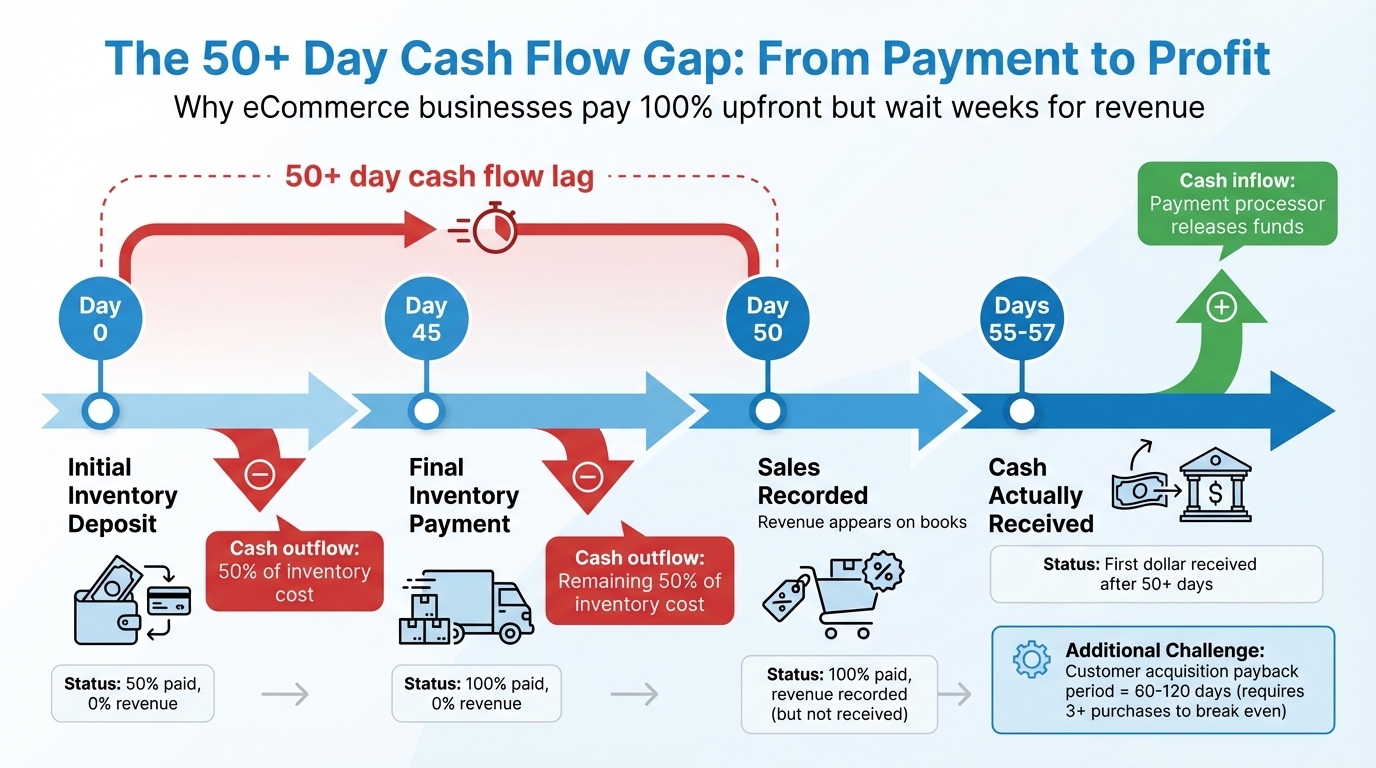
To better understand this, consider the typical timeline for a direct-to-consumer business. On Day 0, the company pays a 50% deposit for inventory. By Day 45, the remaining 50% is due when the inventory arrives. At this point, 100% of the costs have been paid, but no sales have occurred yet. Sales are recorded on Day 50, but the cash from those sales doesn’t hit the account until Days 55–57, after payment processor delays. This creates a cash flow lag of over 50 days from the initial expense to receiving the first dollar. [4]
The situation becomes even more complicated when factoring in customer acquisition costs. For many eCommerce brands, the payback period for acquiring a customer can range from 60 to 120 days. Essentially, a customer needs to make three or more purchases before the business recoups the cost of acquiring them. [5] Meanwhile, advertising platforms demand immediate payment, leaving businesses to shoulder the upfront costs while waiting months for profits to materialize. This dynamic creates a cash drain that grows with every new customer acquired, making the cash flow gap even more pronounced.
How to Manage Cash Flow While Growing Revenue
As your revenue grows, keeping cash flow in check can become a real challenge. Here are some strategies to help you stay ahead.
Improve Inventory Planning
One of the best ways to free up cash during growth is by fine-tuning your inventory management. Instead of relying on guesswork, use historical sales data and trends to forecast demand 2–3 months in advance. This approach not only prevents overstocking but also cuts down on storage costs.
A crucial metric to monitor is Inventory Days - the average time it takes to sell your inventory. Keeping this number under 60 days ensures less cash is tied up in unsold products. For instance, a direct-to-consumer brand reduced its Inventory Days from 90 to 45 by switching to just-in-time (JIT) inventory practices. This shift freed up $250,000 annually for marketing and shortened its cash conversion cycle by 35 days.
JIT inventory can also reduce holding costs by 20–30%. By ordering stock based on actual demand, rather than prepaying months in advance (like for holiday inventory), you can eliminate the typical 50-day lag between paying suppliers and receiving customer payments [1][2][3].
While better inventory management unlocks cash, speeding up payment receipts can further improve liquidity.
Use Faster Payment Options
Payment timing can make or break your cash flow. Platforms like Amazon often hold funds for 14 days or more, while Shopify typically processes payouts bi-weekly. These delays can leave you scrambling to cover inventory and marketing expenses with money you’ve technically already earned but can’t yet access.
To address this, opt for faster payout schedules. Shopify Payments offers daily or weekly payouts, and Amazon’s early disbursement feature can cut payout delays by up to 80%, boosting cash flow by 10–15% [2][3].
For Shopify Payments, simply adjust your settings to enable daily or weekly payouts, which can get you access to funds 2–7 days faster. On Amazon Seller Central, enrolling in the "Disburse Funds Early" feature can shrink your cash gap from 14 days to just 2. One seller used this to secure the working capital needed for growth without taking on debt [3].
Get Revenue-Based Financing from Onramp Funds

If you still need additional cash after optimizing inventory and payouts, revenue-based financing (RBF) can provide a flexible, equity-free solution. With RBF, you repay a percentage of your revenue - usually between 5% and 12% - so payments adjust naturally with your sales performance [2].
Onramp Funds specializes in providing fast RBF options for eCommerce businesses. By connecting your sales data, you can access up to 50% of your monthly revenue in as little as 24–48 hours, without personal guarantees. The repayment structure flexes during slower sales periods, making it easier to manage cash flow.
For example, a $2 million direct-to-consumer brand used $300,000 from Onramp Funds to stock up on inventory ahead of its peak season. Thanks to the revenue-based repayment model, the brand maintained 20% growth even during a slower quarter. The total repayment was capped between 1.2 and 1.6 times the borrowed amount, with no hidden fees or equity dilution [2].
This financing approach bridges the gap between spending and receiving customer payments, allowing your business to grow without draining cash reserves.
Conclusion: Managing the Revenue-Cash Flow Gap
Generating higher revenue doesn’t automatically mean you’ll have cash on hand. Why? Because running an eCommerce business means paying for inventory, marketing, and operations long before your customers pay you. Add in marketplace payment delays that can stretch beyond 14 days and the need to order inventory 2–3 months ahead of sales, and it’s no wonder cash often gets tied up in the business cycle.
These challenges highlight how scaling in eCommerce can strain your cash flow.
To navigate this, proactive cash management becomes critical. Reducing Inventory Days and speeding up payment receipts are key steps to maintaining liquidity. These aren’t just best practices - they’re survival tactics when your business starts to grow quickly.
But what if operational tweaks aren’t enough? That’s where revenue-based financing can step in. Revenue-based financing from Onramp Funds offers a way to bridge the gap without sacrificing equity or flexibility. Repayments are tied to your actual sales - typically between 5–12% - allowing you to fund inventory and marketing while staying agile during slower periods [2].
The revenue-cash flow gap isn’t disappearing anytime soon. However, with the right strategies and financing options, you can scale your business without exhausting your cash reserves. Start by optimizing your cash conversion cycle, and use flexible financing to keep your growth on track.
FAQs
What’s the fastest way to spot a cash flow problem if revenue is rising?
The fastest way to spot a cash flow problem during periods of revenue growth is by keeping an eye on a few key indicators. Look for delayed customer payments, which can disrupt the flow of incoming cash. Inventory shortages might also hint at cash flow strain, especially if you're struggling to restock due to limited funds. Additionally, watch for rising operational expenses - even with increasing sales, higher costs can quickly outpace your available cash. These red flags can help you identify potential cash flow challenges early.
Which metrics should I track to shorten my cash conversion cycle?
To shorten your cash conversion cycle, keep a close eye on three key metrics: Days Inventory Outstanding (DIO), Days Payables Outstanding (DPO), and Days Sales Outstanding (DSO). These measurements provide insights into how quickly you move inventory, how long you take to pay suppliers, and how fast customers are paying you. Together, they can help you manage cash flow more effectively.
When does revenue-based financing make sense for an eCommerce brand?
Revenue-based financing (RBF) is a great option for eCommerce brands dealing with fluctuating sales and needing funding that matches their revenue cycles. It’s particularly suited for businesses with consistent or growing monthly sales - usually starting at around $10,000 - and avoids the inflexibility of traditional loans or the need to give up equity. This type of financing can be especially helpful during seasonal peaks, product launches, or growth phases when cash flow can be unpredictable, making flexibility a must.
Related Blog Posts
Onramp Funds
Funding built around your sales
Connect your store and see what you qualify for. Repay as a percentage of sales, with no personal credit check.
Funding in as little as 24 hours.
