


Revenue-based financing (RBF) and traditional loans are two ways businesses can secure funding, but they work very differently. RBF ties repayments to a percentage of your monthly sales, making it flexible for businesses with fluctuating income. In contrast, traditional loans require fixed monthly payments, regardless of sales performance. RBF is faster to secure and doesn’t require collateral or personal guarantees, while traditional loans often demand strong credit scores, collateral, and extensive paperwork. However, traditional loans can be cheaper overall due to predictable interest rates. Choosing the right option depends on your business's cash flow, credit history, and growth needs.
Quick Comparison
| Feature | Revenue-Based Financing | Traditional Loans |
|---|---|---|
| Repayment | % of monthly revenue (variable) | Fixed monthly payments |
| Approval Time | Fast (often 24 hours) | Slow (weeks/months) |
| Requirements | Sales performance-based | Credit score & collateral |
| Flexibility | Adjusts with revenue | None |
| Personal Guarantees | Rare | Often required |
| Cost | Higher with strong sales | Lower, predictable |
RBF suits businesses with seasonal or unpredictable sales, while loans work well for those with steady income and strong credit.
Amazon FBA loans VS revenue based financing

How Repayment Works: Fixed vs. Flexible
The way you repay a loan can significantly impact your cash flow, especially when your sales fluctuate.
Revenue-Based Financing: Payments That Match Sales
Revenue-based financing adjusts your monthly payments based on a percentage of your revenue until you hit a predetermined repayment cap. Here’s how it works: if you agree to pay 10% of your monthly revenue and bring in $50,000, your payment would be $5,000. If the next month your revenue drops to $20,000, your payment adjusts to $2,000. This setup ensures that your repayments align with your sales performance.
Most lenders set the repayment percentage between 5% and 20% of your monthly revenue, depending on factors like your business’s risk level and growth prospects. For eCommerce businesses with seasonal sales cycles, this flexibility can help avoid cash flow issues during slower months.
By contrast, traditional loans follow a fixed repayment schedule.
Traditional Loans: Fixed Payments Every Month
Traditional loans require you to make the same payment every month, regardless of your sales. Once you sign the agreement, you’re locked into this fixed amount, which is calculated based on the loan principal, interest rate, and term length.
For example, a $100,000 loan with an 8% interest rate and a five-year term would require monthly payments of about $2,028. While this predictability can make budgeting easier, it can also create challenges. If your sales slow down, covering a fixed payment along with other expenses - like inventory or advertising - could strain your cash flow.
Comparing Flexibility and Risk
Here’s a quick breakdown of how these two repayment methods stack up:
| Feature | Revenue-Based Financing | Traditional Loans |
|---|---|---|
| Payment Structure | Based on a percentage of monthly sales (variable) | Fixed monthly payments |
| Flexibility During Slow Periods | High – payments adjust with sales | Low – payments remain constant |
| Cash Flow Impact | Lower risk of cash flow issues | Higher risk during slow sales periods |
| Lender Relationship | Lender benefits when your business grows | Lender's returns are fixed |
| Personal Guarantees | Rarely required | Often required |
| Total Cost | Can increase with higher sales | Predictable but less flexible |
With revenue-based financing, the lender’s returns are tied to your revenue, meaning they have a vested interest in your business’s success. This can relieve some pressure during tough times, as payments shrink when sales dip. On the other hand, traditional loans don’t offer this flexibility. If you miss a payment, you could face penalties or even risk defaulting.
That said, revenue-based financing can become pricier as your business grows because payments increase with your revenue. In contrast, traditional loans keep payments steady throughout the repayment term.
For eCommerce businesses, especially those on platforms like Amazon or Shopify where sales can swing due to seasonality, promotions, or market trends, revenue-based financing offers a flexible option. It allows you to handle ups and downs without putting your operations at risk.
Getting Approved: Speed and Requirements
When you need funding fast, the approval process and clear requirements can make all the difference.
Revenue-Based Financing: Fast and Straightforward
Revenue-based financing is designed with simplicity and speed in mind. The application process is typically online, and decisions are often made within 24 hours. Instead of relying on collateral or credit scores, lenders focus on your business's sales performance and cash flow. To apply, you'll usually need to share access to your sales data, recent bank statements, and some basic business details.
Because no collateral is involved, approval hinges entirely on your revenue performance rather than pledged assets.
"When looking at the underwriting process, flexibility and ease are what make an RBF transaction attractive. In lieu of focusing on other aspects of a company's economic portfolio - prior venture capital investment, etc. - an RBF underwriting process instead focuses on a company's revenue potential, historical performance, collateral and market opportunity. This streamlines the review process and allows bootstrapped businesses or non-venture-backed companies to still access financial resources for growth without any dilution or governance requirements." - John Borchers, Former Forbes Councils Member
Revenue-based financing stands in stark contrast to the slower, more complex process of traditional loans.
Traditional Loans: Slow and Document-Heavy
Applying for a traditional loan can be a lengthy and detailed process. Banks require extensive documentation, including your credit history, financial statements, and proof of collateral. Decisions can take weeks - or even months - to finalize.
A strong credit score is a must. Most banks expect a personal credit score of at least 680, and anything below 650 can make approval nearly impossible.
For eCommerce businesses, this slow process can mean missing out on key growth opportunities. Revenue-based financing addresses this challenge by prioritizing speed and focusing on the metrics that truly matter to your business.
Who Qualifies: Different Standards
The criteria for qualifying for revenue-based financing and traditional loans vary significantly. Traditional banks tend to emphasize personal credit history and collateral, while revenue-based financing takes a different route. Let’s break down how each option evaluates businesses.
Revenue-Based Financing: Sales Performance Matters
Revenue-based financing zeroes in on your business's sales performance. Instead of focusing on personal credit or collateral, lenders assess your company's revenue trends and growth potential.
The requirements are straightforward: consistent monthly sales and steady cash flow. Providers often analyze eCommerce data from platforms like Amazon or Shopify to gauge your business's performance. This sales-first approach makes it a great option for startups and growing businesses that may lack substantial assets or a long credit history.
An added bonus? This model aligns the lender’s success with your business’s growth. Strong and growing sales not only improve your chances of approval but also strengthen the partnership between you and the lender.
Traditional Loans: Credit and Collateral Are Key
Traditional loans, on the other hand, rely heavily on your personal credit history and collateral. Banks typically require a high credit score, extensive documentation, and tangible assets such as real estate, equipment, or inventory to secure the loan.
This process can be more challenging for newer businesses or those without significant collateral, as the focus is on financial stability and risk mitigation.
Personal Risk: What’s on the Line
The level of personal risk differs greatly between these two options. With traditional loans, personal guarantees are often required, meaning your personal assets - like your home or savings - could be at risk if you default on payments.
Revenue-based financing, however, eliminates the need for personal guarantees or collateral. Instead, the funding is tied to your future revenue streams. This reduces personal financial risk and allows you to concentrate on scaling your eCommerce business without worrying about putting personal assets on the line.
The rising popularity of revenue-based financing reflects this shift. The market is projected to grow from $6.4 billion in 2023 to $178.3 billion by 2033, as more entrepreneurs seek funding options that don’t demand personal guarantees or substantial collateral.
sbb-itb-d7b5115
What It Costs: Fees vs. Interest
After understanding eligibility and approval timelines, it’s crucial to dive into the costs involved. How fees are calculated can significantly impact both your monthly payments and the total amount you repay. Revenue-based financing and traditional loans approach costs in very different ways, which can influence your decision depending on your business needs.
Revenue-Based Financing: Fees Tied to Sales
Revenue-based financing relies on a factor rate instead of traditional interest rates. This means you repay a fixed multiple of the amount borrowed, no matter how quickly you pay it back. Factor rates typically range from 1.2× to 3× the loan amount. For instance, borrowing $25,000 at a 1.6 factor rate means you’ll repay $40,000 in total.
The unique feature here is that monthly payments adjust based on your revenue. When sales are strong, you pay more; when they dip, your payments decrease. This setup can be a lifeline for businesses dealing with seasonal sales patterns or unexpected revenue drops, as it aligns repayments with cash flow.
Traditional Loans: Interest Rates and Fixed Payments
Traditional loans, on the other hand, calculate costs using an interest rate applied over the loan term. For example, as of May 2025, the maximum fixed interest rate for a U.S. Small Business Administration (SBA) 7(a) loan of $25,000 or less is 15.5%. These loans come with fixed monthly payments, offering predictability but no flexibility.
Fixed payments can simplify budgeting but might strain your finances during slower sales months. On the upside, paying off the loan early can reduce the total interest you owe.
Cost Breakdown: Comparing the Numbers
Here’s a side-by-side look at how the costs stack up for a $25,000 loan:
| Factor | Revenue-Based Financing | Traditional Loan |
|---|---|---|
| Cost Structure | Factor rate (1.6× example) | 15.5% interest rate over 5 years |
| Total Repayment | $40,000 | $36,000 |
| Monthly Payment | Variable (based on revenue %) | Fixed (approx. $600) |
| Predictability | Payments fluctuate | Payments remain steady |
| Early Payoff Benefit | No cost reduction | Potential savings on interest |
In this example, revenue-based financing costs $4,000 more overall than a traditional loan. However, the flexibility of adjusting payments to match your revenue can ease cash flow pressures during slower months. Traditional loans, while more predictable and potentially cheaper, require a fixed payment every month, regardless of how your business is performing.
The right choice depends on your business’s revenue patterns and financial goals. If your sales are steady and your credit is strong, a traditional loan might be the better fit. But if your revenue is unpredictable or seasonal, the flexibility of revenue-based financing could outweigh its higher cost.
Which Works Better for eCommerce
eCommerce businesses often grapple with fluctuating sales and seasonal demand. Unlike physical stores, online retailers must continuously invest in inventory and marketing to stay competitive. Choosing the right financing option can be the difference between steady growth and unnecessary financial stress. Let’s explore how these options align with the unique demands of eCommerce.
Why Revenue-Based Financing Fits eCommerce
Revenue-based financing aligns well with the unpredictable nature of eCommerce. Online retailers often see sales spikes during events like Black Friday or the holiday season. With revenue-based financing, payments adjust according to sales performance, offering much-needed flexibility during slower months.
"Revenue-based financing is often a useful model for companies without a lot of assets they can use to secure loans, like small ecommerce businesses."
This model is particularly appealing for scaling businesses that lack extensive credit history or physical assets. Instead of focusing on traditional credit metrics, revenue-based financing evaluates sales performance, making it accessible to businesses with strong growth potential.
Speed is another key advantage. When a product goes viral or a marketing campaign gains traction, online stores need to act fast. Waiting weeks for a traditional loan approval can mean missing out on these fleeting opportunities. Revenue-based financing typically offers a faster process, enabling businesses to capitalize on these moments quickly.
When Traditional Loans Make More Sense
For eCommerce businesses with steady revenue and strong credit, traditional loans may be a better fit. Fixed payment structures provide predictability, making budgeting easier for businesses with consistent cash flow.
Established businesses with good credit scores often qualify for lower interest rates on traditional loans. If your cash flow can comfortably handle fixed payments, this option could save you money over time compared to revenue-based financing.
Traditional loans also work well for one-time investments with clear costs and returns. For example, if you need funding to purchase a large inventory order and have predictable sales timelines, the fixed repayment structure of a traditional loan might be a better match.
Keeping Full Ownership with Revenue-Based Financing
One major advantage of revenue-based financing is that it allows you to retain full ownership of your business. Unlike equity financing, which requires giving up a stake in your company, revenue-based financing is non-dilutive. This means you maintain complete control over business decisions, profits, and future strategies.
"RBF offers an attractive middle ground between traditional debt and equity financing. For e-commerce businesses with fluctuating sales and a need for adaptable funding options, RBF may provide a valuable opportunity for growth without diluting ownership."
This aspect becomes increasingly important as your business grows. If you eventually sell your company or take it public, maintaining full ownership ensures you reap all the rewards of your hard work.
The growth potential in eCommerce is enormous. The revenue-based financing market itself reflects this trend, growing from $901.41 million in 2019 to an estimated $42.3 billion by 2027, with an annual growth rate of 61.8%. This rapid expansion highlights how well this financing model supports modern eCommerce businesses.
For many online retailers, especially those navigating growth or seasonal sales shifts, revenue-based financing offers unmatched flexibility, speed, and ownership retention. While traditional loans can work for established businesses with stable cash flow, the dynamic and fast-moving nature of eCommerce makes revenue-based financing a natural choice for most. These factors explain why so many online retailers lean toward this option when scaling their operations.
Real Example: Onramp Funds for eCommerce
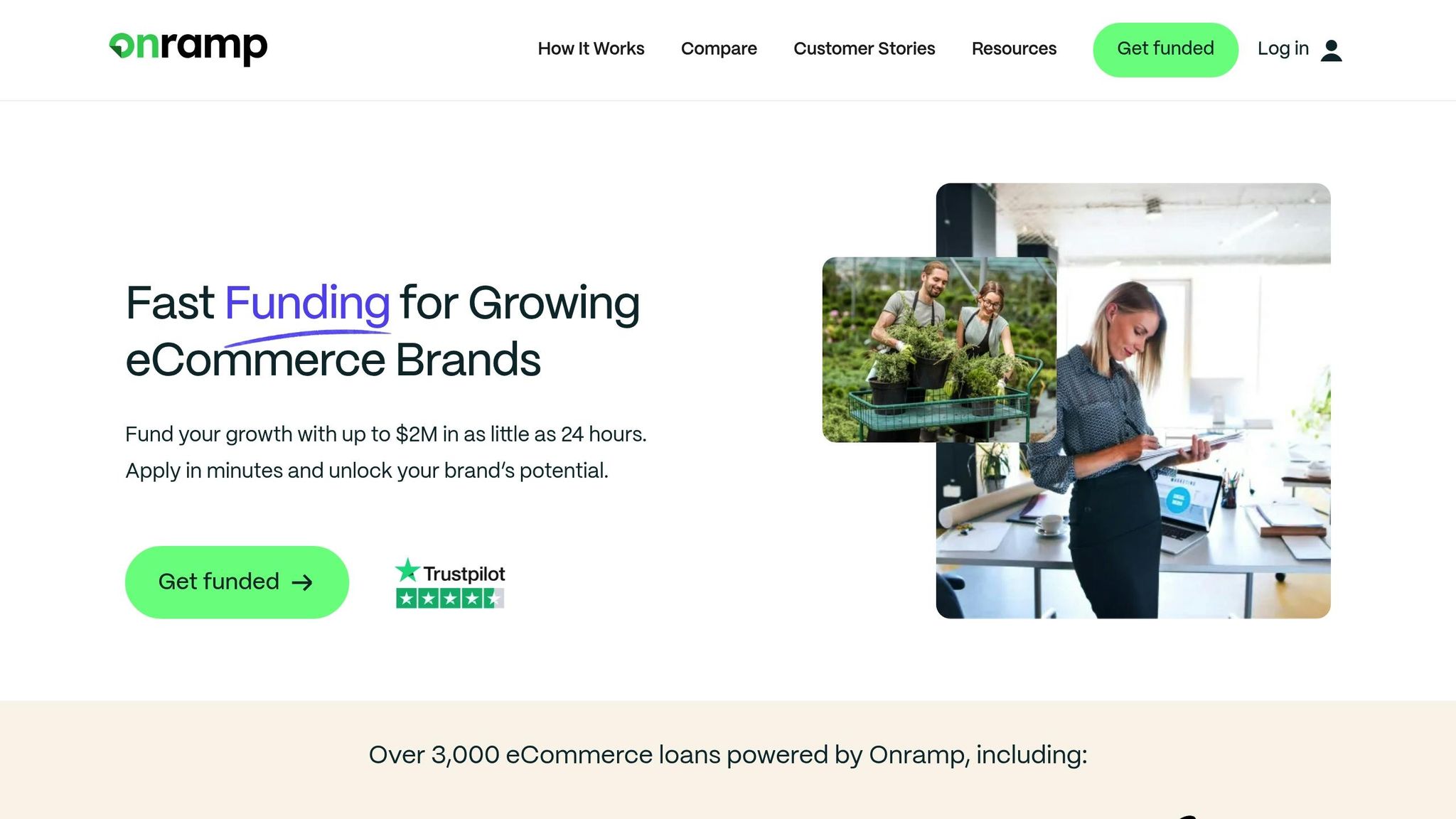
To understand how revenue-based financing operates in real-world scenarios, let's take a closer look at Onramp Funds - a financing platform tailored specifically for eCommerce businesses. Based in Austin, this platform demonstrates how modern financing solutions can meet the unique challenges of online sellers.
Fast Funding with Flexible Repayments
One of Onramp Funds’ standout features is its ability to provide funding in under 24 hours. Unlike traditional banks that often involve lengthy approval processes, this platform makes quick financing a reality.
The approval process is straightforward. Business owners simply connect their eCommerce store to Onramp Funds, which uses real-time sales data to assess eligibility. This eliminates the need for piles of paperwork or personal credit checks, focusing instead on actual business performance. The result? A faster, more efficient experience that fits seamlessly into the fast-paced world of eCommerce.
"Onramp Funds stands out by delivering same-day approvals, no paperwork, and a pay-as-you-sell model that matches the speed of modern eCommerce."
Nick James, CEO of Rockless Table, shared his story: "Applied, got our offer, and had cash in our bank account within 24 hours. Their team helped deploy the cash swiftly."
The platform also boasts an impressive underwriting approval rate of nearly 50%, far exceeding the typical 10–30% approval rates seen with other funding providers. This success is driven by a machine-learning algorithm that evaluates 240 factors to determine risk and identify businesses likely to repay loans.
Compatible with Major eCommerce Platforms
Onramp Funds integrates with key platforms like Amazon, Shopify, Walmart Marketplace, BigCommerce, WooCommerce, Squarespace, and TikTok Shop.
Getting started is simple. Business owners connect their store to receive a pre-qualification offer. To qualify, businesses need at least $10,000 in monthly sales and a consistent sales history of three months.
Adam B. from The Full Spectrum Company described his experience: "Onramp's process is very straightforward and easy to navigate. I had funds in my account within a day of final approval."
Customer feedback highlights the platform’s reliability. Onramp Funds holds an "Excellent" rating on Trustpilot based on 202 reviews, with customers frequently praising the ease of the process and the support provided by their Austin-based team.
In addition to quick funding, the platform’s repayment model is designed to grow alongside the business.
Supporting Business Growth
Onramp Funds offers equity-free financing, meaning business owners retain full control of their company while accessing the capital they need for inventory, marketing, or operational growth.
The pay-as-you-sell model is particularly well-suited for eCommerce businesses. Payments adjust automatically based on sales volume, easing the burden during slow periods and scaling proportionally during busy seasons or after successful campaigns.
With fixed fees ranging from 2–8%, Onramp Funds provides a transparent and predictable financing option. This structure eliminates the uncertainty of variable interest rates, keeping costs tied to business performance.
For eCommerce businesses that need to act quickly on opportunities, Onramp Funds delivers a combination of speed, ease of use, and flexibility that traditional lenders simply can’t match. By aligning repayment with revenue and offering seamless integration, it provides a financing solution that grows with the business rather than holding it back.
Conclusion
Choosing between revenue-based financing and traditional loans comes down to understanding what aligns best with your business's needs and growth patterns. Revenue-based financing stands out for its flexibility, offering repayments tied to sales - an ideal setup for businesses with seasonal or fluctuating income. On the other hand, traditional loans come with fixed payments, which work well for businesses with stable revenue and strong credit histories. However, traditional loans often involve personal guarantees, collateral, and lengthy approval processes, which can be a mismatch for the fast-moving world of online selling.
For eCommerce businesses, revenue-based financing often proves to be a better fit. It removes personal financial risk, offers quick access to funds - sometimes within 24 hours - and adjusts repayment amounts based on sales performance. This approach not only provides the agility needed to seize market opportunities but also allows businesses to retain full ownership while focusing on growth without the constraints of rigid loan terms.
FAQs
What makes revenue-based financing a better fit than traditional loans for businesses with fluctuating sales?
Revenue-based financing offers repayment terms that adapt to your sales, making it a great fit for businesses with fluctuating or seasonal income. Instead of dealing with fixed monthly payments like you would with traditional loans, this model eases financial pressure during slower periods.
For eCommerce businesses, this setup can be a game-changer. It helps you maintain better control over cash flow, seize growth opportunities, and concentrate on scaling - without the stress of rigid payment deadlines. Payments are calculated as a percentage of your revenue, so they naturally adjust to match how your business is performing.
What makes the approval process for revenue-based financing faster compared to traditional loans?
The approval process for revenue-based financing (RBF) moves much quicker because it zeroes in on your business's current sales and cash flow instead of digging deep into credit scores or requiring collateral. By linking your financial accounts, lenders can assess your performance swiftly and often provide funding decisions within just a few days.
On the other hand, traditional loans usually involve drawn-out credit checks, collateral demands, and piles of paperwork, which can stretch the process out for weeks or even months. RBF cuts through the red tape, offering a fast and straightforward way to secure funding - perfect for businesses that need quick and flexible financial support.
Why is revenue-based financing a better fit for eCommerce businesses compared to traditional loans?
Revenue-based financing works well for eCommerce businesses because it offers repayment terms that adapt to your sales performance. Instead of sticking to fixed monthly payments, you repay a percentage of your revenue. This means during slower sales periods, your payments decrease, and when sales pick up, you pay more.
This approach makes managing cash flow easier, especially during seasonal ups and downs or times of rapid growth. It also removes the stress of fixed debt payments, giving you the freedom to focus on growing your business. Whether it's investing in inventory or boosting your marketing efforts, you can allocate funds without overburdening your finances.
Related posts
Onramp Funds
Funding built around your sales
Connect your store and see what you qualify for. Repay as a percentage of sales, with no personal credit check.
Funding in as little as 24 hours.
