


Revenue-based financing (RBF) is a flexible funding option for eCommerce businesses that ties repayments to your revenue. Here's why it's gaining popularity:
- Repayments adjust with sales: Pay more during high-revenue months and less during slower periods.
- Fast access to funds: Approvals often happen within 24–48 hours, allowing you to act quickly on opportunities.
- No equity loss: You retain full ownership of your business.
- Simple qualification: Requirements include $10,000+ in monthly sales and six months of sales history.
RBF is ideal for inventory purchases, marketing campaigns, or operational upgrades. Unlike traditional loans, it doesn't require collateral or fixed payments, making it a practical solution for businesses with seasonal or fluctuating sales. Platforms like Onramp Funds streamline the process with integrations to platforms like Shopify and Amazon, offering funding tailored to your business performance.
What is Revenue Based Financing? (RBF)
What Is Revenue-Based Financing and How Does It Work?
Revenue-based financing (RBF) is a funding option where eCommerce businesses receive upfront cash in exchange for repaying a set percentage of their future revenue. Unlike traditional loans with fixed monthly payments, RBF aligns with your business's performance. When sales are high, repayment amounts increase; when sales slow down, payments decrease. This flexibility makes it an appealing choice for businesses with fluctuating revenue.
How Revenue-Based Financing Works
With RBF, you get upfront funding based on your business's revenue history and future projections. Repayment is tied to a fixed percentage of your monthly sales - typically between 5% and 20% of gross revenue. For instance, if you secure $100,000 with a 6% repayment rate, you'll pay 6% of your monthly sales until the total repayment cap is met.
The repayment cap is a predetermined total - usually 1.2x to 2.5x the funding amount. Once you reach this cap, your obligation ends, and there are no additional fees or compounding interest.
Payments adjust automatically based on sales volume. During high-revenue months, repayments are higher, while slower periods result in smaller payments. This process is fully automated through integrations with major eCommerce platforms like Amazon and Shopify, as well as payment processors. These integrations ensure that repayments are deducted directly from your sales deposits without manual effort.
How RBF Stands Out From Other Financing Options
RBF offers several advantages over traditional bank loans and equity financing, particularly for eCommerce businesses that experience seasonal or unpredictable sales cycles:
| Aspect | Revenue-Based Financing | Traditional Bank Loans | Equity Financing |
|---|---|---|---|
| Monthly Payments | Variable (% of revenue) | Fixed, regardless of sales | None (ownership trade-off) |
| Ownership | Fully retained | Fully retained | Diluted ownership |
| Approval Speed | 24–48 hours | Weeks to months | Weeks to months |
| Collateral | Not required | Often required | Not required |
| Total Cost | Fixed upfront (e.g., 1.2x–2.5x) | Variable with interest | Ongoing equity loss |
Unlike bank loans, which demand fixed payments no matter your sales performance, RBF adapts to your revenue, easing cash flow pressures during slower periods. Equity financing, on the other hand, requires giving up a share of your business, which can dilute your control. RBF avoids both these pitfalls, allowing you to retain full ownership while making repayments that fluctuate with your revenue.
What You Need to Qualify for Revenue-Based Financing
The requirements for RBF are straightforward, making it a more accessible option for many eCommerce businesses:
- Minimum monthly revenue: Typically between $3,000 and $20,000, depending on the provider.
- Sales history: At least six months of consistent sales to demonstrate reliability.
- Healthy gross margins: Usually above 30–40%, indicating strong profitability per unit sold.
- Business registration: Must be a registered U.S. business, such as an LLC, C-Corp, or S-Corp.
RBF providers integrate with platforms like Amazon, Shopify, BigCommerce, WooCommerce, Squarespace, Walmart Marketplace, and TikTok Shop. These integrations allow providers to assess sales trends and seasonal patterns in real-time, streamlining the application process.
Unlike traditional loans that require extensive documentation and personal credit checks, RBF focuses primarily on your business's revenue consistency. Providers typically request basic financial records, such as bank statements and revenue reports. Funding amounts usually range from 10% to 60% of your annual recurring revenue (ARR), with established sellers eligible for up to $2 million - no collateral or proof of past profitability required.
Key Benefits of Revenue-Based Financing for eCommerce Growth
Revenue-based financing offers a smart way for eCommerce businesses to scale by addressing common challenges like unpredictable sales cycles and the need for quick access to capital. Here’s how it can help online retailers grow strategically.
Repayments That Adjust to Your Sales
One of the standout features of revenue-based financing is that your repayments scale with your revenue. When sales are strong, you pay more; when sales dip, your payments decrease accordingly. This flexibility helps ease cash flow concerns during slow periods.
For instance, imagine a Shopify store that generates $100,000 in sales during peak months but drops to $40,000 in slower ones. With a 5% repayment rate, the business would pay $5,000 during high-revenue months and just $2,000 during the slower ones.
"Payments align with your sales, so you never face fixed obligations during slow months. You pay us when you receive sales deposits."
– Onramp Funds
This structure eliminates the stress of fixed monthly payments that traditional loans often require. Instead, repayments naturally adjust to your business performance. During growth spurts - like after a successful marketing campaign or a hot new product launch - higher payments speed up repayment, freeing up cash to reinvest in your business. It’s a system that works in tandem with your scaling efforts.
Quick and Easy Access to Funds
In the fast-paced world of eCommerce, timing is everything. Revenue-based financing leverages real-time sales data to approve funding quickly - often within 24 to 48 hours. By integrating directly with platforms like Shopify, Amazon, and Walmart Marketplace, lenders can instantly evaluate your sales performance, cash flow, and overall business health.
The application process is straightforward: connect your eCommerce store, provide basic business details, and get an initial funding estimate almost immediately. There's no need for piles of paperwork, personal credit checks, or collateral. It's a simple, performance-based assessment.
This speed is critical when opportunities arise, like stocking up for Black Friday, launching a marketing campaign, or locking in inventory before a supplier price hike. With minimum requirements of around $10,000 in monthly sales and six months of sales history, even newer eCommerce businesses can access this type of funding, making it an appealing option for those who might not qualify for traditional loans.
Retain Full Ownership and Control
Unlike other funding methods, revenue-based financing doesn’t require you to give up equity in your business. You keep complete ownership and control, along with all future profits. This means you’re free to make decisions - whether it's shifting your product focus, testing new marketing strategies, or entering new markets - without needing approval from outside investors.
"Don't give away a stake in your business just to keep up."
– Onramp Funds
By preserving equity, you also keep your options open for future funding rounds if your scaling plans grow. Maintaining full ownership ensures that your business decisions are guided by your vision and your data, not by external stakeholders.
How Revenue-Based Financing Supports Data-Driven Scaling Decisions
Revenue-based financing (RBF) ties your funding and repayment directly to your business's real-time sales performance. Unlike traditional loans that depend on credit scores or collateral, RBF aligns with how your business is actually doing, making it a flexible and responsive option for growing companies.
Using Real-Time Sales Data for Funding and Repayment
RBF providers use your sales data to create funding offers tailored to your business. By connecting to platforms like Amazon, Shopify, or Walmart Marketplace, they can analyze your revenue patterns, seasonal trends, and cash flow almost instantly.
"We're a modern lender that bases our lending decisions using your business performance data."
– Onramp Funds
The funding amount is typically 1 to 2 times your monthly revenue. For instance, if your sales total $50,000 in a month, you might qualify for $50,000 to $100,000 in funding. This ensures you're only accessing capital that matches your capacity.
Repayment is equally flexible. Instead of fixed monthly payments, you pay back a percentage of your revenue - commonly between 1% and 25% of your monthly sales.
"Your payments sync with your sales, you'll never have to worry about your ability to repay during a slower month. You pay us when you receive sales deposits."
– Onramp Funds
For example, if your Q4 sales rise to $80,000 with a 5% repayment rate, your payment would be $4,000. But if January sales drop to $30,000, your payment adjusts to just $1,500. This system ensures repayments are manageable, even during slower months, while allowing you to reinvest during high-growth periods.
Making Better Investment Decisions
The benefits of RBF extend beyond funding - it equips you with actionable insights for smarter investments. With access to detailed sales analytics through RBF platforms, you can make data-informed decisions about where to allocate your capital. Instead of guessing which areas will drive growth, you can rely on actual performance data.
These insights reveal which products generate the most revenue, which marketing strategies deliver the best returns, and when seasonal trends create opportunities. For inventory management, sales velocity data helps you stock up on high-performing products before peak demand, while marketing analytics highlight campaigns that have driven strong results in the past. This allows you to confidently fund initiatives, knowing that successful outcomes will speed up repayment, while underperformance will automatically reduce your payment obligations.
RBF also provides a safety net for testing new products or entering new markets. You can fund a product launch or market expansion with the reassurance that if sales don’t meet expectations, your repayment adjusts accordingly. When these initiatives succeed, the accelerated repayment cycle fuels further growth.
This continuous cycle - investing, analyzing performance, and adjusting repayments - creates a sustainable scaling model. Every decision is backed by real business data, helping you grow strategically rather than relying on projections or guesswork.
sbb-itb-d7b5115
Practical Ways to Use Revenue-Based Financing in eCommerce
Revenue-based financing (RBF) offers eCommerce businesses a flexible way to grow without the rigid terms of traditional loans. Here's how it can be applied across essential areas of your business.
Building Inventory for Seasonal Demand
RBF makes it easier to stock up on inventory ahead of busy seasons, with repayments that scale based on your sales performance. This approach helps protect your cash flow while ensuring you're ready for peak demand.
For instance, imagine an online apparel store securing RBF funding to prepare for a high-demand season. With sales increasing during the busy period, repayments rise accordingly. During slower months, repayments adjust downward, ensuring the business maintains financial stability.
Hal, a client of Onramp Funds, highlights this advantage:
"Onramp helps us with inventory acquisition over time. They really help us out!"
This kind of flexibility is especially important for sellers on platforms like Amazon, where staying stocked during major shopping events is crucial for maintaining visibility and rankings. Beyond inventory, RBF can also fuel growth through targeted marketing efforts.
Increasing Marketing and Advertising Campaigns
Once inventory needs are covered, many businesses use RBF to strengthen their marketing strategies. By funding campaigns with RBF, businesses align repayment with revenue, minimizing financial strain while driving growth.
Nick James, CEO of Rockless Table, shared his positive experience:
"Applied, got our offer, and had cash in our bank account within 24 hours. Their Austin, TX-based team was very professional and helped me deploy the cash to effectively grow our business."
Whether you're looking to expand digital ad campaigns, explore new marketing channels, or collaborate with influencers, RBF provides the resources to boost revenue while keeping repayments manageable during slower sales periods.
Improving Operations and Infrastructure
RBF isn't just about inventory and marketing - it can also support critical upgrades to your operations and infrastructure. These improvements can streamline processes, enhance customer satisfaction, and reduce costs.
For example, a business might use RBF to upgrade its fulfillment system, speeding up order processing and cutting shipping times. Investments in technology, like better inventory management tools or conversion optimization software, can also lead to higher sales and greater efficiency. The flexibility of RBF ensures these upgrades align with your revenue cycle, avoiding the pressure of fixed repayments during slower months.
As Onramp Funds puts it:
"As the owner of your business, you know your business best. Use your funds on inventory, shipping and logistics, marketing spend, or anything else that would help grow your business and drive sales. We are always happy to strategize with you!"
This adaptable approach makes RBF a valuable resource for scaling an eCommerce business. It allows you to invest wisely across key areas while ensuring repayments fit seamlessly into your revenue flow.
Onramp Funds: Your Partner in Revenue-Based Financing
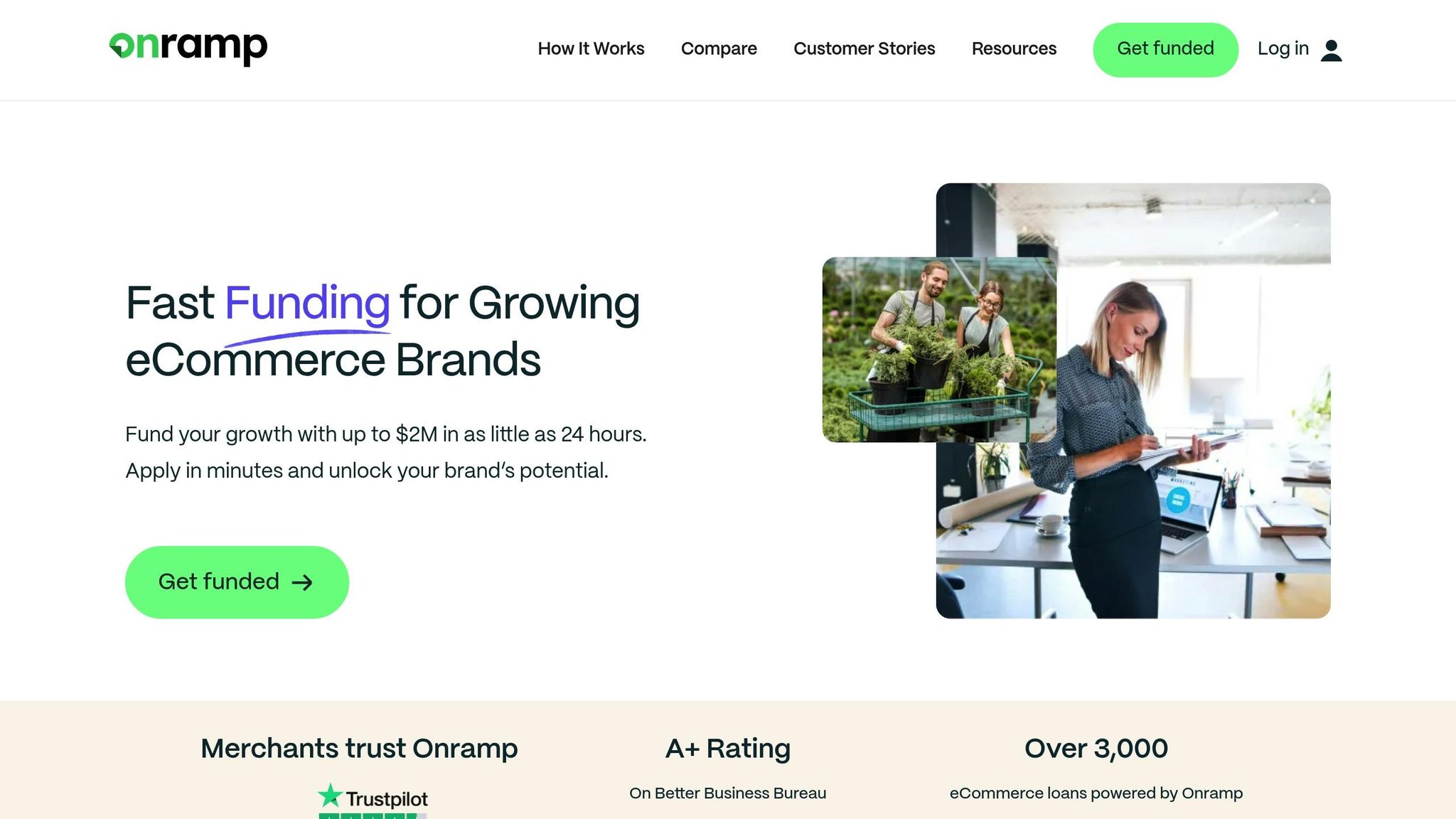
Onramp Funds provides fast and flexible revenue-based financing tailored specifically for online sellers. With over 3,000 eCommerce loans funded and an A+ rating from the Better Business Bureau, they understand the unique demands and opportunities of running an online business.
Quick, Flexible, and Transparent Funding
In the fast-paced world of eCommerce, timing is everything. Onramp Funds ensures you can seize opportunities with approvals in as little as 24 hours - perfect for stocking up on inventory or launching marketing campaigns at just the right moment.
What sets them apart is their repayment model. Instead of fixed payments, they align repayments with your sales. You'll pay a percentage of your monthly revenue, so during high-sales months, you'll pay more, while slower months mean smaller repayments. This approach helps maintain cash flow during seasonal dips and gives you the flexibility to reinvest during peak times.
Transparency is another key feature. Onramp Funds uses a fixed-fee structure, so you’ll know the total repayment amount upfront. There are no hidden fees or unexpected charges - just clarity from the start. As Adam B. from The Full Spectrum Company shared:
"Onramp's process is straightforward. I had funds in my account within a day of final approval."
With seamless integrations and personalized support, Onramp Funds makes financing simple and stress-free.
Seamless Integrations and Personalized Support
Onramp Funds connects effortlessly with major eCommerce platforms such as Amazon, Shopify, BigCommerce, WooCommerce, Squarespace, Walmart Marketplace, TikTok Shop, Shopline, and Stripe. These integrations allow them to assess your real-time sales data and automate repayments, making the process efficient and hassle-free.
Setting up these integrations is quick - just 5 minutes - and requires only read-only access. This enables Onramp Funds to evaluate your sales history and cash flow without traditional credit checks or piles of paperwork. Their data-driven approach bases funding decisions on your actual business performance, not outdated metrics.
To top it off, their Austin-based team provides personalized support at every step. From helping you strategize how to use your funds to addressing any questions, their local experts understand the ins and outs of eCommerce businesses.
With easy integrations and dedicated support, getting started is a breeze.
Simple Requirements and Easy Application Process
Onramp Funds keeps the entry requirements minimal, making it accessible for growing businesses. You’ll need $10,000 in average monthly sales and must operate a legal business entity in the United States (LLC, Single-Member LLC, C-Corp, or S-Corp). There’s no minimum time in business required, so even newer ventures can qualify.
The application process is simple and quick:
- Step 1: Get an initial funding estimate in about 1 minute by answering a few basic questions.
- Step 2: Securely connect your eCommerce store (about 5 minutes) to receive customized funding offers based on your sales data.
- Step 3: Link your bank account, choose the best offer, and complete the process.
Once approved, funds are typically available in your account within hours. This speed, combined with flexible repayments and the ability to retain full ownership of your business, makes Onramp Funds an ideal partner for eCommerce entrepreneurs looking to grow.
For busy online sellers, this streamlined process provides financing that adapts to the ebb and flow of your business cycles.
Conclusion: Scale Your Business With Revenue-Based Financing
Revenue-based financing (RBF) offers eCommerce businesses an effective way to grow without the usual hurdles of traditional bank loans or giving up equity. Instead of rigid monthly payments that can squeeze your cash flow during slower months, RBF adjusts repayments based on your actual sales. This means you get breathing room when sales dip and contribute more when revenues climb.
The benefits of RBF go beyond just flexible repayment terms. Whether you're gearing up for a busy season, launching a marketing campaign, or adding new products, this financing model aligns with your business's natural cycles. Payments scale with your performance, making it easier to adapt to changing demands.
Another major advantage of RBF is speed. Approvals can happen in as little as 24 hours, giving you the chance to act quickly on opportunities like inventory discounts or emerging market trends - something traditional loans can't always offer. Plus, funding decisions are based on real-time sales data, not outdated credit scores or the need for collateral.
For eCommerce sellers who want to grow while keeping full control of their business, Onramp Funds simplifies access to capital. With over 3,000 eCommerce loans funded and integrations with major platforms, their team understands the unique needs of online businesses. Based in Austin, they offer personalized support to help you make the most of your financing.
Getting started is straightforward. All you need is $10,000 in average monthly sales and a registered business entity in the U.S. The application process is quick and can get you funded in less than 24 hours, ensuring you're ready to seize growth opportunities when they arise.
Revenue-based financing isn't just about securing funds - it’s about scaling smarter. With a partner that grows alongside your business, you can expand sustainably without giving up ownership or control. This approach creates a solid foundation for long-term success.
FAQs
What makes revenue-based financing more flexible and less risky than traditional bank loans?
Revenue-based financing offers a repayment structure that aligns with how your business performs. Unlike traditional bank loans with fixed monthly payments, this model ties repayments to a percentage of your revenue. In other words, when sales are strong, payments increase; during slower periods, payments decrease. This flexibility can be a lifeline for businesses navigating fluctuating income.
Another advantage? It usually doesn’t require collateral or equity, which means less risk for both you and your business. This straightforward approach allows eCommerce businesses to concentrate on scaling without the stress of strict repayment deadlines.
What do eCommerce businesses need to qualify for revenue-based financing?
To be eligible for revenue-based financing, your eCommerce business needs to meet the following criteria:
- Operate on approved platforms: This includes popular options like Amazon, Shopify, TikTok Shop, WooCommerce, BigCommerce, Squarespace, or Walmart Marketplace.
- Consistent monthly sales: Your business must generate an average of at least $10,000 in sales each month.
- Legal registration: The business must be officially registered as an entity in the United States.
These requirements help ensure that funding options are aligned with businesses that demonstrate steady sales and the potential for growth.
How does revenue-based financing help eCommerce businesses grow and make smart investments?
Revenue-based financing offers eCommerce businesses a flexible way to secure funding that grows in step with their sales. This makes it a great option for scaling up. Businesses can channel these funds into essential areas like stocking up on inventory, running marketing campaigns, or streamlining logistics - all without sacrificing equity or committing to strict repayment schedules.
Since repayments are tied to a percentage of revenue, businesses can better navigate cash flow challenges, especially during periods of fluctuating sales. Leveraging data-driven insights, this financing model helps sellers make smarter decisions and drive growth while keeping their finances steady.
Related Blog Posts
Onramp Funds
Funding built around your sales
Connect your store and see what you qualify for. Repay as a percentage of sales, with no personal credit check.
Funding in as little as 24 hours.
