


Real-time sales data is transforming how eCommerce businesses secure funding. Instead of relying on outdated credit scores or financial documents, sellers can now connect their online stores to financing platforms and access funding almost instantly. This approach uses live sales metrics to create tailored funding offers that align with a business's actual performance, making repayment terms flexible and reducing financial risks. Key benefits include:
- Faster funding approvals - often within 24 hours.
- Dynamic repayment terms that adjust with sales trends.
- Tools like Shopify Analytics and Onramp Funds simplify the process by integrating directly with eCommerce platforms.
Kixmon – TikTok Shop Profit Tracker | Real-Time Net Profit & P&L Analytics Tool
How to Access Real-Time Sales Data from Your eCommerce Platform
Getting access to real-time sales data is simpler than you might think. Most eCommerce platforms come equipped with automated analytics dashboards, offering quick access to the numbers you care about most. For example, Shopify updates its sales and finance reports in about one minute [4]. These built-in tools provide a solid starting point, and you can always enhance your insights by integrating additional analytics tools.
Start with your platform’s native dashboard, then consider linking external tools for a more comprehensive view. While the built-in dashboard gives you the basics, tools like Google Analytics can provide deeper insights into customer behavior and purchasing trends. If you’re juggling multiple sales channels, data pipeline tools can bring everything together by consolidating data from platforms like Shopify, Amazon, and BigCommerce into one central location. This helps minimize discrepancies and ensures you’re working with accurate, unified data.
Connecting Your Store to Sales Analytics Tools
Most eCommerce platforms make it easy to access live data. For example, Shopify’s Live View feature gives you real-time updates on customer activity and geographical data during high-traffic events like Black Friday or flash sales [3]. To explore standard reports in Shopify, head to Analytics > Reports and use the Category filter to zero in on specific "Sales" reports.
For more advanced analysis, third-party integrations are the way to go. You can connect your store using platform APIs or pre-built connectors available in app stores, which link your data to specialized analytics software. Many platforms now include AI-powered assistants - like Shopify Sidekick - that can generate custom reports and write data queries using natural language, saving you the hassle of manual data exports and cleanup [5]. Ruby Friel, Founder of Still Life Story, shared how Shopify’s analytics helped her business grow:
By using Shopify's analytics and reporting to identify bestsellers and sales trends, we were able to grow our revenue year over year by 50% at Christmas [6].
Once you’ve connected your tools, focus on tracking the metrics that matter most for making informed funding decisions.
Key Metrics to Track for Funding Decisions
When evaluating your funding needs, keep an eye on metrics that reflect both your current financial health and your growth potential. Start with net sales - your revenue after discounts and returns - which gives you a clear picture of actual earnings [4]. Another important metric is average order value (AOV), calculated by dividing total revenue by the number of orders. A strong AOV can help forecast future revenue streams. Additionally, your sell-through rate - the percentage of inventory sold compared to what you’ve acquired - should ideally be 80% or higher to demonstrate efficient use of capital [6].
It’s equally important to track metrics that highlight potential challenges. For instance, customer return rates can eat into profit margins and may affect how much funding you’ll need to maintain operations. Monitoring customer lifetime value (CLV) can justify marketing expenses and show lenders that your business is built for the long haul. And with around 70% of online shoppers abandoning their carts [6], keeping an eye on cart abandonment rates can help you identify opportunities to recover lost revenue.
How Onramp Funds Uses Your Sales Data to Provide Funding
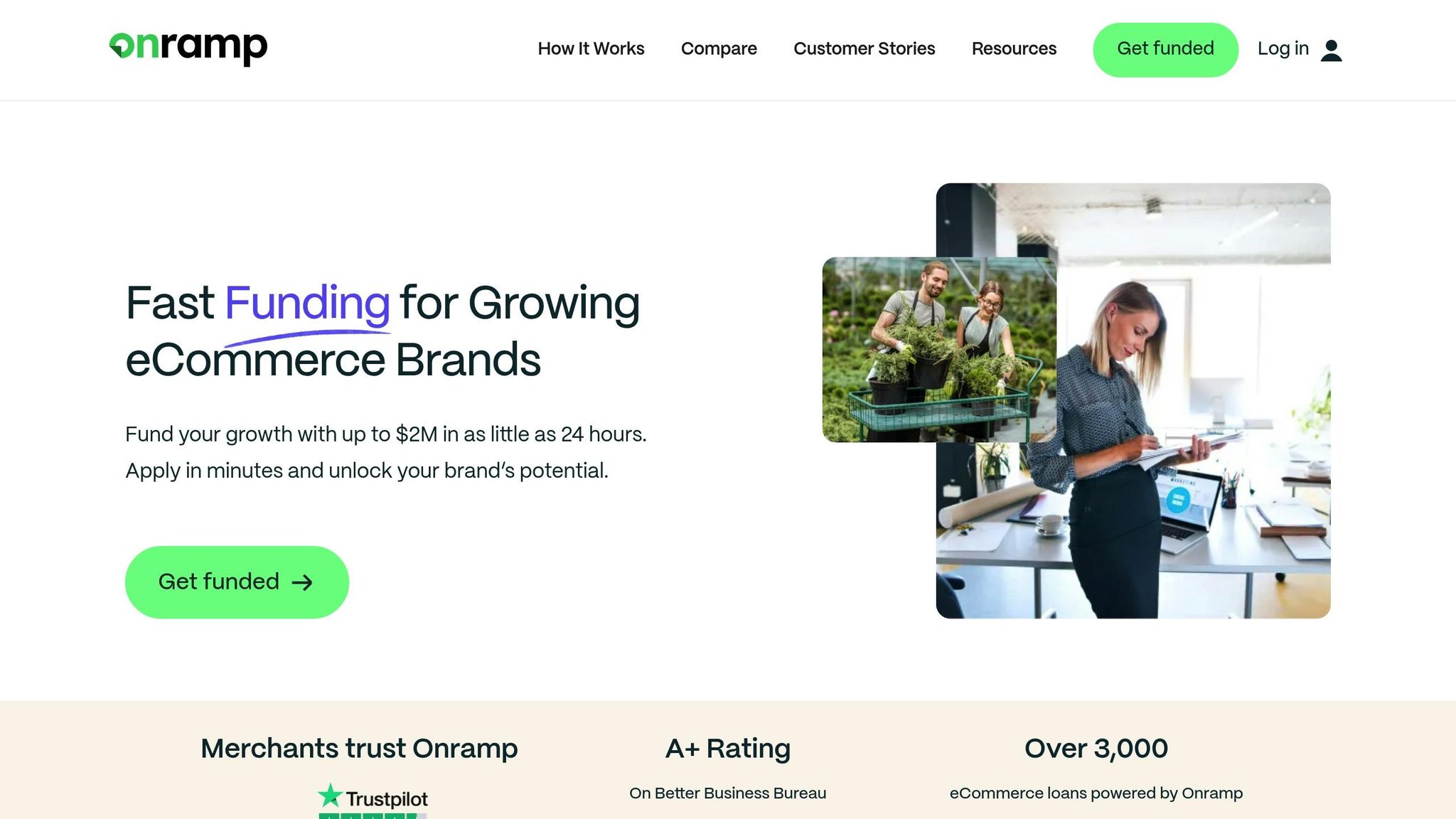
Onramp Funds takes a fresh approach to business financing by focusing on how your business is performing rather than relying on personal credit scores or collateral. By connecting directly to your eCommerce store through secure, read-only access, the platform pulls real-time data from Shopify, Amazon, TikTok Shop, and Walmart. The setup is quick - just five minutes - and zeroes in on three main factors: your sales history, current cash flow needs, and existing debt [1][7].
This system ensures that financing aligns perfectly with your cash flow, so you only get funding that your business can realistically manage [1][7]. Instead of offering a one-size-fits-all loan, Onramp tailors multiple funding options to match your growth strategy and sales trends [1][2]. To qualify, your business must generate at least $10,000 in monthly sales and operate as a U.S.-based legal entity [1].
The results are impressive. Onramp Funds has provided over 3,000 eCommerce loans, with an average customer revenue increase of 73% within 180 days of funding [7]. Even better, 75% of customers return for additional funding [7]. Jeremy, the Founder and Owner of Kindfolk Yoga, shared his experience:
Onramp offered the perfect solution with revenue-based financing to secure the capital we needed to invest in inventory and pay it back at a reasonable time frame once we made sales [1].
Up next, learn how the funding calculator uses your sales data to provide instant estimates.
Using the Onramp Funds Funding Calculator with Your Sales Data
Getting started with Onramp’s funding calculator is simple. Enter your average monthly revenue, and you’ll receive an initial estimate in under a minute [1]. For a more precise offer, connect your store directly to let the platform automatically pull your most recent sales data [1]. Once connected and verified, funds can be deposited into your bank account in less than 24 hours [1][7]. This speed is possible because Onramp uses real-time data, eliminating the need for lengthy paperwork and approval processes common with traditional lenders.
The fee structure is straightforward - ranging from 2% to 8% of the funded amount - with no hidden interest rates, personal credit checks, or equity requirements [2][8]. Nick James, CEO of Rockless Table, shared how this speed impacted his business:
I applied for funding, received an offer, and had cash in my company bank account within 24 hours, allowing me to scale operations immediately [1].
Torrie V., Founder of Torrie’s Natural, appreciated the platform’s simplicity:
Onramp has simplified cash flow by automating everything: easy to request, set it and forget it payments - quick and fast! [1]
Now, let’s dive into the three financing options tailored to fit varying business needs.
Onramp Funds Financing Options Comparison
Onramp Funds provides three financing options, each designed to suit different business models and cash flow patterns. The primary differences lie in repayment terms and fee structures.
| Feature | Custom Funding Offers | Fixed Fee Structure | Revenue-Based Financing |
|---|---|---|---|
| Fees | 8-15% tailored to your sales data | 6-12% upfront, transparent | 10-20% total fee |
| Repayment Flexibility | Adjustable based on your sales performance | Fixed weekly payments for predictability | 5-15% of daily sales (auto-adjusts) |
| Platform Integrations | Shopify, TikTok Shop, Amazon, Walmart | Primarily Shopify | All major eCommerce platforms |
| Funding Speed | Within 24 hours | Up to 48 hours | Within 24 hours |
| Best For | Businesses experiencing growth spikes | Sellers who prefer stable, predictable payments | Managing seasonal sales fluctuations |
Revenue-based financing stands out for its flexibility. Payments automatically decrease during slower sales periods and increase when business picks up [2][8]. There are no monthly minimums, so you won’t feel financial strain during quieter months. Fixed repayment options offer predictable schedules for those who prefer consistency, while custom funding provides maximum flexibility, adapting to your sales trends and growth goals.
sbb-itb-d7b5115
5 Steps to Secure Better Funding Using Real-Time Sales Data

Step-by-Step Process
Using real-time sales data can open the door to funding options that align closely with your business's actual performance. Here's how to make it happen:
Export accurate sales data. Start by securely connecting your eCommerce platform through an API. This gives lenders read-only access to your latest performance metrics, which often leads to larger funding offers [1]. Automating this process reduces the risk of errors and ensures your data is always up-to-date.
Once your sales data is ready, the next step is to dig into your cash flow.
Analyze cash flow gaps and trends. Look closely at your sales velocity using this formula: (Opportunities × Average Deal Value × Win Rate) / Sales Cycle Length [10]. This calculation helps estimate your daily revenue and highlights when you might need extra capital. Additionally, check your inventory turnover ratio. A healthy range is between 5 and 10. If your ratio dips below 5, it may indicate you're holding too much slow-moving stock, signaling it's not the right time to increase inventory funding [10].
Input metrics into Onramp Funds' portal. Enter your average monthly revenue into their calculator to get an initial funding estimate [1]. If your business generates at least $10,000 in monthly sales, you can qualify for performance-based funding [1].
Review funding offers. You'll receive a variety of options with fees ranging from 2% to 8% of the funded amount [2]. Take time to compare the structures. Revenue-based financing adjusts to seasonal sales patterns, while fixed fee options give you predictable repayment terms. Use this information to develop a repayment plan that works for your business.
Align repayment terms with business performance. Revenue-based financing can be a smart choice because payments adjust automatically based on daily sales, sometimes as low as 1% during slower periods [2]. This flexibility helps maintain healthy cash flow during downturns and scales up when sales rebound. Businesses leveraging real-time data for funding decisions often see a 60% increase in revenue within 180 days of receiving capital. Plus, 75% of sellers return for additional funding to fuel further growth [2].
How Real-Time Sales Data Reduces Financial Risks
Real-time sales data isn't just about tracking numbers - it’s a powerful tool for reducing financial risks and making smarter funding decisions.
One major benefit is avoiding the common pitfalls of overborrowing or underborrowing. With access to up-to-the-minute sales metrics, you can pinpoint exactly how much funding your business needs. This level of precision helps you steer clear of excessive debt while ensuring you have enough capital to keep operations running smoothly.
It also takes the guesswork out of seasonal planning. Instead of relying on estimates to determine how much inventory to stock for Black Friday or how to prepare for slower post-holiday periods, real-time data highlights exactly when demand surges or drops. For example, Shopify’s daily reporting tools reveal shifts in demand, allowing businesses to adjust funding and inventory strategies before cash flow gaps arise. One retailer used this approach during the holiday season and saw a 50% year-over-year revenue increase by identifying best sellers through analytics and stocking up accordingly [9][11].
Platforms like Onramp Funds take this a step further by integrating real-time sales insights directly into funding decisions. By connecting to your store with read-only access, Onramp evaluates your actual cash flow and debt capacity. This ensures that any funding you receive aligns perfectly with your business’s performance, enabling equity-free growth while minimizing risk.
"Your payments sync with your sales, you'll never have to worry about your ability to repay during a slower month. You pay us when you receive sales deposits." - Onramp Funds [1]
Shopify’s unified data approach also helps cut costs by up to 37% while ensuring payments adjust to your actual sales. This alignment protects your cash flow by matching repayment schedules with real-time performance. Revenue-based financing through Onramp adapts repayments to your sales deposits, so slower months don’t create financial strain, and busier periods help you pay off debt faster. By aligning funding with live KPIs, businesses can avoid cash crunches and maintain financial stability year-round.
Conclusion
Imagine reshaping your funding strategy by tapping into the power of real-time sales data. For eCommerce sellers, this means basing financing decisions on actual business performance - tracking metrics like daily sales velocity, cash flow trends, and inventory turnover as they unfold.
This approach ensures you secure the right amount of funding - avoiding the pitfalls of borrowing too much or too little. It also allows you to respond to seasonal demand shifts and align your capital with revenue patterns. By linking tools like Shopify Analytics or TikTok Shop data, you can allocate funds with precision - whether it's restocking top-selling products or fueling high-ROI marketing campaigns.
Onramp Funds takes this concept further by integrating directly with your eCommerce store, analyzing real-time performance to deliver funding decisions within 24 hours. Plus, their revenue-based repayment model adjusts dynamically with your sales. With over 3,000 eCommerce loans already issued, this approach has helped businesses achieve measurable growth [1][2].
The takeaway here is clear: syncing funding with live performance isn't just smart - it’s a safer, more effective way to grow your business. Use these insights to drive your next phase of success.
FAQs
How can real-time sales data help eCommerce businesses make smarter funding decisions?
Real-time sales data provides eCommerce businesses with a current and detailed look at their revenue and cash flow. This clarity helps sellers make better forecasts, showcase steady performance to potential investors, and secure financing that matches their actual sales patterns.
Using tools like sales analytics, you can pinpoint cash flow requirements, uncover growth opportunities, and minimize financial risks. This data-driven method ensures funding decisions are quicker, more strategic, and aligned with your business's specific performance metrics.
What key metrics should I monitor to make smarter funding decisions with real-time sales data?
To make smarter funding decisions, keep an eye on operating cash flow, customer lifetime value (CLV), and forecast accuracy. These indicators provide a clear picture of your financial health and help you anticipate future needs. Alongside these, track essential sales metrics like transaction volume, average order value (AOV), and inventory turnover. These figures reveal revenue patterns and how efficiently you're managing inventory. Together, these metrics give you a solid foundation to evaluate cash flow, customer value, and overall performance, ensuring your financing strategies align with your growth objectives.
How does Onramp Funds create funding options based on my sales data?
Onramp Funds taps into your real-time sales data from platforms like Shopify, Amazon, and other eCommerce channels to get a clear picture of your revenue patterns. With this insight, they provide tailored funding options designed to match your business's unique performance.
The funding amount, repayment rate, and schedule are adjusted based on your actual sales, making the financing flexible and easy to integrate with your cash flow. This way, you can secure the funds you need without putting unnecessary pressure on your business finances.
Related Blog Posts
Onramp Funds
Funding built around your sales
Connect your store and see what you qualify for. Repay as a percentage of sales, with no personal credit check.
Funding in as little as 24 hours.
