

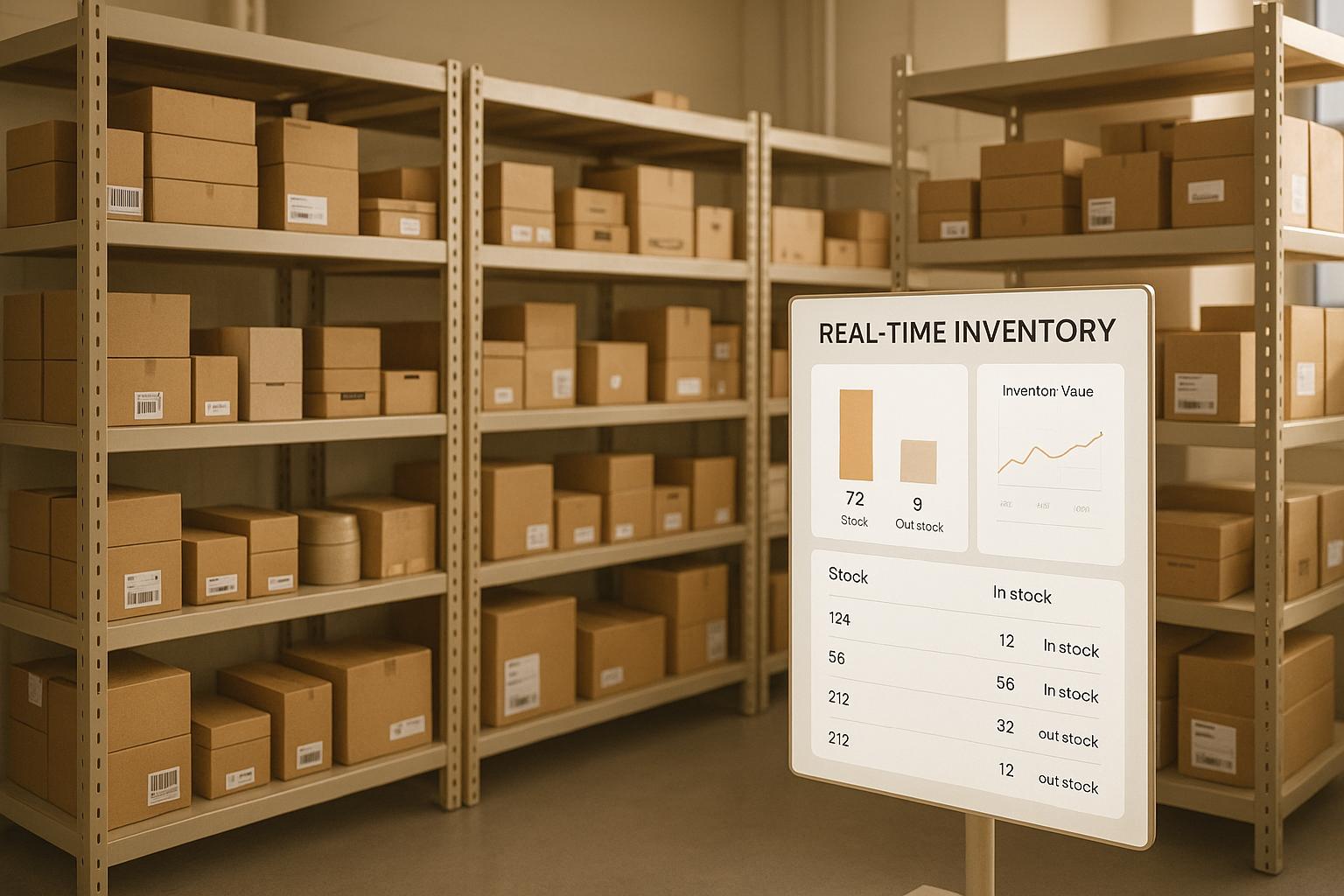
Real-time inventory tracking is essential for eCommerce businesses to stay competitive. By providing instant updates on stock levels across all sales channels and warehouses, it helps sellers avoid stockouts, overstocking, and missed sales opportunities. Here’s why it matters:
- 52% of shoppers abandon carts due to out-of-stock items.
- 69% of businesses lack full supply chain visibility.
- U.S. retailers lost $94 billion to inventory shrinkage in 2024 alone.
This technology integrates with platforms like Amazon, Shopify, and Walmart Marketplace, ensuring accurate stock displays and seamless order fulfillment. It also provides data for demand forecasting and optimizing purchasing decisions. Tools like barcode scanners, RFID systems, and centralized dashboards make this possible, offering up to 99% accuracy in tracking.
The result? Faster order processing, happier customers, and reduced costs. Investing in these systems, along with proper staff training and analytics, can transform inventory management and drive growth.
How to Use Inventory Tracking Software
Key Benefits of Real-Time Inventory Tracking
Real-time inventory tracking reshapes stock management by delivering up-to-the-minute data that supports smarter decision-making and improves the overall customer experience.
Improved Accuracy and Inventory Visibility
With real-time tracking, businesses gain immediate access to SKU counts, enabling precise calculations for metrics like average inventory, inventory turnover ratios, optimal stock levels, and lead times [2]. This level of accuracy empowers sellers to make better decisions regarding purchases, pricing, and promotions.
Modern tools, such as barcode scanners and RFID technology, automatically record inventory movements, achieving data accuracy rates as high as 99% [5]. Unlike traditional methods, which often involve manual input and guesswork, real-time systems quickly identify discrepancies, reducing errors.
This level of visibility eliminates common challenges like double-selling, misplaced stock, or mistakes from spreadsheet-based tracking [6]. It also provides a unified, real-time overview across multiple locations [4], ensuring sellers always know exactly how much inventory is available. This is especially valuable for businesses with several fulfillment centers, as it helps them balance stock levels efficiently - avoiding shortages in one location while preventing overstock in another. Such precise tracking accelerates order processing, directly contributing to better customer satisfaction.
Faster Fulfillment and Happier Customers
Real-time inventory tracking significantly boosts the speed and accuracy of order fulfillment. When staff can instantly check stock availability and locate items, they spend less time searching and more time processing orders. This translates to quicker shipping times and fewer mistakes during fulfillment.
The technology also plays a crucial role in omnichannel shopping. Customers receive accurate stock availability when browsing or making purchasing decisions [3]. For sellers operating across multiple channels, real-time tracking ensures consistent inventory updates, avoiding mismatches that could lead to missed sales or customer dissatisfaction. Beyond faster order processing, these systems also streamline operations, reducing costs and improving efficiency.
Cost Reductions and Streamlined Operations
Real-time inventory tracking delivers noticeable cost savings by improving operational efficiency. By automating processes, businesses can cut down on manual counting, reduce labor costs, and minimize stock shrinkage. These systems also help sellers maintain optimal inventory levels, identify slow-moving products before they become dead stock, and adjust purchasing strategies to avoid overstocking - reducing cash flow issues tied to excess inventory.
Technologies like Artificial Intelligence (AI), Machine Learning, and advanced barcode scanning work together to automate data collection, predict demand trends, and fine-tune stock levels [2]. While the initial investment in these tools and training may seem high, the long-term savings are significant - fewer stockouts, lower labor costs, and improved customer satisfaction. Additionally, warehouse operations benefit from these efficiencies, as staff can locate items faster, pick orders with greater accuracy, and handle returns more effectively. This reduces fulfillment costs and enables businesses to manage higher order volumes without needing to increase their workforce proportionally.
Tools and Technologies for Real-Time Inventory Tracking
Real-time inventory tracking relies on a blend of software, hardware, and centralized dashboards to ensure stock data is accurate and accessible. These tools form the backbone of the operational efficiency discussed earlier.
Inventory Management Software
At the heart of any real-time tracking system is reliable inventory management software. This software integrates smoothly with eCommerce platforms and offers features like barcode scanning, automated reordering, multi-location management, demand forecasting, analytics, cloud-based functionality, mobile support, and third-party integrations [7].
When choosing software, focus on solutions that align with your business needs and growth plans. Key capabilities to look for include real-time stock tracking across multiple locations, automatic inventory updates, low-stock alerts, SKU monitoring, and inventory turnover tracking [7].
Many scalable platforms provide these essential features, along with seamless integration into major eCommerce channels.
"Scalability, integration ease, and robust reporting features" - Tiago Pita, Brand and Ecommerce Director at Whole Food Earth, on Zoho Inventory [8]
Hardware for Automated Data Capture
Accurate inventory tracking starts with reliable hardware like barcode scanners and RFID systems. These tools reduce the errors associated with manual data entry and improve stock tracking precision [9].
While barcode systems are cost-effective and widely used, they have limitations, such as vulnerability to damage and restricted data storage capacity [9]. RFID technology, on the other hand, offers superior accuracy - up to 99% compared to barcodes' 63% - and can scan items remotely, even through obstacles [10].
Levi's Brazil saw inventory accuracy jump from 67% to nearly 100% after 18 months of using RFID [11]. Similarly, The Siman Group increased their accuracy from 65-70% to 95% after adopting RFID technology [11].
"We use barcode scanners and keep our inventory system updated in real time. This way, if there's an issue with stock levels, we know right away and can fix it fast." - Peter Hoopis, President of Hoopis Pickleball [8]
IoT sensors bring an added layer of precision, especially for high-value or temperature-sensitive goods. A notable example: In May 2021, DHL transported 200 million COVID-19 vaccines across 120 countries using IoT sensors to ensure proper temperature control [8].
Centralized Dashboards for Multi-Channel Management
While software and hardware collect and process data, centralized dashboards bring it all together, offering a clear, real-time view of inventory across channels. These dashboards simplify order management, prevent overselling, and reduce stockouts [13].
The best dashboards integrate easily with sales platforms, accounting systems, shipping providers, and customer management tools [12]. They provide real-time updates, user-friendly interfaces, and scalability to handle growing SKUs, locations, and orders as businesses expand [12].
For example, Graeter's Ice Cream reduced order fulfillment times by 30% and cut stockouts by 25% after implementing SkuNexus [14].
"A2X has been an absolute game changer for our business! The software is incredibly user friendly and makes reconciling accounts a breeze." - Noam B., Capterra [13]
When evaluating dashboard options, prioritize features like real-time tracking, seamless integrations, automated processes, centralized control, and advanced analytics [14]. Investing in the right dashboard technology can significantly enhance efficiency and reduce manual effort. This is especially crucial given that out-of-stock items cost U.S. retailers over $82 billion in lost sales annually [15].
sbb-itb-d7b5115
How to Implement Real-Time Inventory Tracking
Turning the concept of real-time inventory tracking into reality requires a structured approach. This process unfolds in three key phases, each building on the last to develop a dependable system.
Review Current Inventory Processes
Before diving into new technology, take a step back and evaluate your existing inventory management practices. This means identifying inefficiencies and pinpointing areas for improvement. Conduct regular audits to compare actual inventory counts with system records and organize SKUs to ensure accurate tracking [17][16]. Timing these audits during slower periods can help avoid disruptions [16].
During these audits, inspect incoming products for any defects, confirm inventory accuracy against system data, and gather all necessary documentation to maintain precision [17][16]. Properly organizing products and SKUs is a cornerstone of effective real-time tracking [18]. Document your findings and generate reports to compare current data with past records. These historical records are invaluable for tracking improvements in accuracy, efficiency, and cost savings over time [16].
Once you've identified the gaps, the next step is selecting the right tools to address them.
Choose and Integrate the Right Tools
The tools you select should seamlessly integrate across all sales channels, offering real-time updates and precise stock levels [19]. Businesses managing inventory across multiple channels have been shown to achieve up to a 190% increase in revenue compared to those operating on a single channel [19].
When choosing software and hardware, consider factors like the number of sales channels, inventory complexity, must-have features, scalability, and budget [19]. Integration is key - data from various sales channels must be collected, processed, and analyzed to enable faster and better decision-making [20].
For smooth operations, designate specific warehouses to handle order fulfillment. If you have physical stores, incorporate them into your inventory system or establish a virtual warehouse to keep track of all items [19]. Centralizing product data reduces errors and serves as the backbone of your real-time tracking system. Additionally, set clear out-of-stock policies that show live inventory levels, notify customers promptly when items are unavailable, and offer alternatives like similar products or backordering options [19].
With tools in place, the final step is ensuring your team knows how to use them effectively.
Train Staff and Track Performance
Even the most advanced system won't deliver results without a well-trained team. Staff training is critical to making your inventory management system work smoothly [21].
Create a detailed training plan that includes hands-on demonstrations, online tutorials, and practical exercises. This approach helps staff gain confidence and reduces mistakes [24]. Training should also cover how to avoid common errors and troubleshoot issues, ensuring employees feel equipped to handle challenges [24]. Assign key users to provide ongoing support and schedule regular reviews to ensure the system remains accurate [24][22][25].
For day-to-day operations, have dedicated technicians manage inventory, particularly for mobile or truck stock, and make sure they are available to answer questions [23]. Regular audits remain essential to verify that system records align with actual inventory levels [22][25].
Using Data Analytics for Continuous Improvement
Once you've implemented real-time tracking, the next step is using that data to transition from reacting to problems to proactively managing your inventory.
Demand Forecasting and Stock Optimization
Real-time inventory data becomes even more powerful when paired with historical sales records. Together, they help businesses spot demand trends and predict changes before they disrupt operations [26]. By using predictive analytics, you can look beyond what’s selling now and analyze how sales speed varies across different times. This helps you keep inventory at just the right levels, avoiding the high costs of stockouts or overstocking [27].
Electronic Data Interchange (EDI) systems make this process even smoother. They provide real-time inventory tracking, improve accuracy, and enhance demand forecasting, ensuring you’re better prepared for fluctuations [28].
"Phocas has helped us to analyze stock that isn't moving or is moving slowly, so we can move stock around to make the best use of it...It ensures timely adjustments to orders and fosters a more responsive supply chain ecosystem."
– Mark Law, IT Director, Hayley Group [29]
Automated Replenishment and Cost Management
Advanced inventory systems can cut stockouts by as much as 60% through automated replenishment [31]. These systems automatically trigger reorders based on real-time stock updates, reducing the risk of running out of popular products. Considering that many retailers only achieve about 65% inventory accuracy [32], automation becomes a game-changer.
To make this work, use data to set optimal reorder points. Factor in lead times, sales velocity, and safety stock levels to reduce both shortages and excess inventory [30]. Regularly revisit these points as demand shifts, and keep safety stock in place to handle unexpected spikes or supplier delays [30]. This is critical when you realize that 70% of online shoppers will shop elsewhere if your product is out of stock, and 37% may never return [33].
"Our data in Phocas, combined with our retail partners' sales data, lets us plan inventory to place the right commitments with our resources and vendors overseas. This allows us to make sure we're holding the right number of weeks' stock domestically to meet demand. It ensures that we're running a profitable business."
– Harvey Lewis, General Manager, Caprice Australia [29]
You can also use ABC analysis to focus your replenishment efforts on high-value items that generate the most revenue [30]. For slow-moving or obsolete stock, inventory reports can help you identify these items so you can clear them out with discounts or promotions, freeing up space for more profitable products [30]. These strategies not only streamline inventory management but also set the stage for sustainable growth.
Scaling with Financial Support from Onramp Funds

As your data-driven strategies open doors to growth, having access to scalable funding becomes essential. Whether you’re upgrading inventory systems, increasing stock for bestsellers, or branching into new sales channels, growth requires capital - and traditional financing often isn’t fast enough.
This is where Onramp Funds steps in. Their tailored financing solutions provide funding within 24 hours, with repayment tied directly to your sales. This revenue-based model offers flexibility, especially during seasonal peaks or market shifts.
"Whether you're selling on Amazon, Shopify, or Walmart Marketplace, eCommerce growth requires capital - fast. From restocking bestsellers to scaling paid ads, sellers need funding that's flexible, fast, and tied to how digital businesses actually operate."
– Onramp Funds [36]
Onramp’s equity-free financing ensures you retain full ownership while gaining the capital to invest in advanced systems or stock trending products identified through your analytics. They support major platforms like Amazon, Shopify, BigCommerce, WooCommerce, Squarespace, Walmart Marketplace, and TikTok Shop, making it easy to integrate financing with your inventory decisions.
With global eCommerce sales projected to hit $6.3 trillion by 2024 [35], and $300 billion lost annually due to markdowns from poor inventory management [1], flexible funding can help you seize growth opportunities while avoiding costly mistakes. When selecting financing partners, prioritize those offering robust APIs, adaptable pricing, and seamless integration to support your expansion [34]. Establish clear operating procedures to maintain consistency and simplify onboarding as your business scales [34].
Conclusion
Real-time inventory tracking has become a cornerstone for thriving in eCommerce. Studies reveal that modern tools like barcode scanning and RFID technology can deliver up to 99% accuracy, while smarter stock management can cut inventory carrying costs by up to 30%. And that’s not all - faster, more efficient processes can improve delivery times by about 25%, significantly enhancing customer satisfaction [5].
But the advantages go far beyond just knowing what’s in stock. Real-time tracking equips businesses with the data they need to make smarter, faster decisions. With instant access to accurate inventory information, you can avoid costly errors like overselling or backorders [37].
"Real-time inventory tracking is more than just keeping tabs on stock levels. It's about having immediate access to data that can drive strategic decisions, improve customer satisfaction, and ultimately increase revenue."
– Kentro.io [37]
When paired with data analytics, the impact of real-time tracking becomes even more transformative. By analyzing inventory data alongside historical sales trends, businesses can accurately forecast demand, fine-tune their product offerings, and even automate restocking. This shift to proactive inventory management helps prevent both stockouts and overstocking, while ensuring warehouse operations run efficiently [37]. These insights naturally open doors to customized financing solutions.
Flexible financing plays a crucial role in scaling operations based on these data-driven strategies. Growing eCommerce businesses often need financial support to keep up with demand, and options like Onramp Funds offer a revenue-based approach to help maintain inventory performance without overextending resources.
"Utilizing the full potential of data analytics is no longer optional for e-commerce businesses - it's essential for long-term success."
– Akhila Mathai, Mindster [38]
FAQs
How does real-time inventory tracking help eCommerce businesses avoid stockouts and overstocking?
Real-time inventory tracking gives eCommerce sellers a clear, up-to-the-minute view of their stock levels. This helps them dodge the expensive pitfalls of running out of stock or overloading their inventory. With accurate, live data at their fingertips, businesses can manage their inventory more effectively, adapt quickly to changing sales trends, and make better predictions about future demand.
This kind of visibility ensures that stock levels stay balanced, cutting down on missed sales from shortages or wasted money from overstocked items. In the big picture, real-time tracking boosts supply chain efficiency and keeps customers happy by making sure products are ready when they want them.
What tools and technologies are essential for real-time inventory tracking in eCommerce?
Real-time inventory tracking in eCommerce depends on a combination of modern tools and technologies to keep stock updates accurate and immediate. Key components include RFID tags, barcode scanners, and IoT sensors, which automate the process of recording inventory. For precise monitoring, technologies like Bluetooth Low Energy (BLE) and Ultra Wideband (UWB) are often used.
In addition, cloud-based warehouse management systems (WMS) and advanced analytics software play a crucial role. These systems synchronize data in real time, offer visibility across various locations, and help predict inventory needs. By using these tools, eCommerce businesses can avoid stock shortages, minimize excess inventory, and streamline their operations effectively.
How does data analytics improve real-time inventory tracking for eCommerce businesses?
Data analytics plays a key role in improving real-time inventory tracking by offering precise demand predictions. This allows eCommerce sellers to maintain optimal stock levels, avoiding the pitfalls of overstocking or running out of inventory. By examining sales trends and customer behavior, businesses can ensure smoother operations and reduce the risk of missed sales.
It also provides critical insights into inventory patterns, delivery efficiency, and supply chain performance. These insights empower businesses to make smarter, cost-saving decisions. The result? Streamlined logistics, lower operational costs, and happier customers who can rely on products being available when they need them.
Related Blog Posts
Onramp Funds
Funding built around your sales
Connect your store and see what you qualify for. Repay as a percentage of sales, with no personal credit check.
Funding in as little as 24 hours.
