

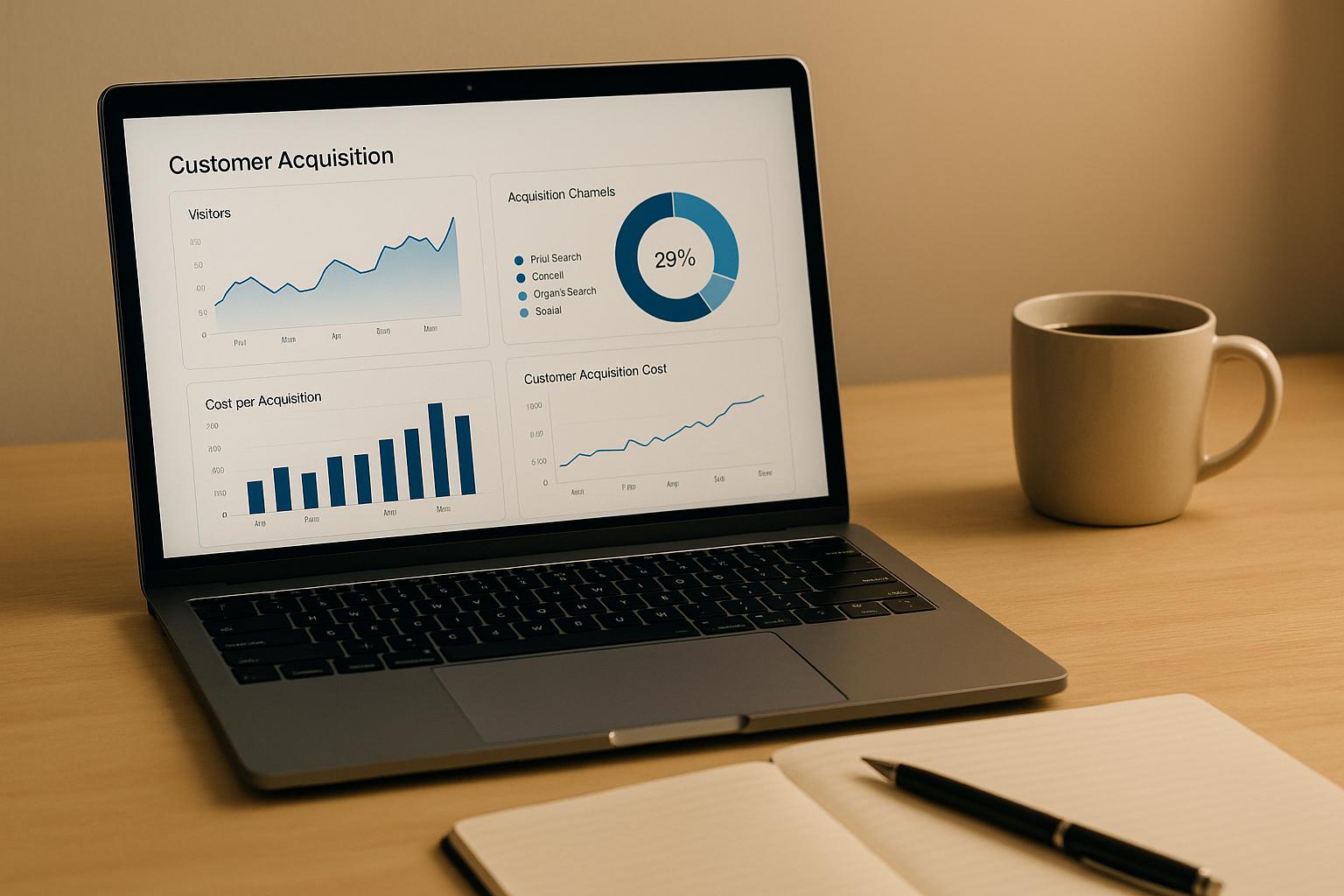
Reducing Customer Acquisition Cost (CAC) is critical for improving profitability in eCommerce. The key is to focus on strategies that maximize returns from your marketing spend while enhancing customer engagement and retention. Here’s a quick overview of six effective methods to lower CAC:
- Segment Your Audience: Use tools like Google Analytics and CRM data to target high-performing customer groups. Tailor your messaging to resonate with each segment for better conversion rates.
- Optimize Marketing Channels: Identify which channels deliver the best ROI. Reallocate budgets based on performance, and use advanced attribution models to understand the full customer journey.
- Increase Average Order Value (AOV): Implement upselling, cross-selling, and free shipping thresholds to boost revenue per transaction and offset acquisition costs.
- Personalize and Automate: Leverage dynamic content and automated tools to create tailored customer experiences that drive conversions and repeat purchases.
- Retarget and Build Loyalty: Use retargeting ads to recover lost sales and loyalty programs to encourage repeat business, reducing the need for constant new customer acquisition.
- Test and Refine Continuously: Conduct A/B testing, analyze customer feedback, and benchmark performance to improve strategies over time.
These approaches work together to reduce CAC by focusing on efficiency, customer value, and long-term growth. Whether it’s reallocating budgets, using automation, or improving personalization, each step contributes to a more profitable eCommerce business.
E-Commerce CAC Explained: How to Lower Customer Acquisition Costs and Scale Profitably in 2025
1. Understand and Segment Your Target Audience
If you're looking to lower your customer acquisition cost (CAC), the first step is understanding your audience and focusing on the customer segments that deliver the biggest returns. Instead of casting a wide net, successful eCommerce businesses zero in on the groups most likely to convert and bring in long-term value. This approach ensures your marketing dollars are spent where they matter most.
Use Data to Identify Key Audience Segments
The secret to effective segmentation lies in combining demographic details (like age, location, and income) with behavioral insights (such as browsing habits, purchase history, and cart abandonment patterns). Together, these data points paint a clear picture of who your customers are and how they engage with your brand.
Google Analytics is a go-to tool for understanding customer behavior. It allows you to break down users by demographics, location, device type, and on-site actions. For example, you might find that mobile users in specific states convert at much higher rates than desktop users elsewhere. Insights like these help you allocate resources more effectively.
Your CRM system adds another layer of depth by tracking customer interactions and purchase trends. Using RFM analysis (Recency, Frequency, Monetary value), you can pinpoint your most valuable customers. Those who shop frequently and recently are excellent candidates for upselling, while one-time buyers might need a different strategy to bring them back.
Customer surveys can fill in the gaps by uncovering the motivations and pain points that analytics can't capture. A quick post-purchase survey asking what influenced their decision can reveal insights that reshape your segmentation strategy.
Here’s an example: A global eCommerce brand discovered through analytics that the Netherlands delivered a 23% higher ROI compared to other regions. By focusing their campaigns on this market, tailoring their content, and expanding payment options, they managed to lower CAC while boosting conversions[3].
Create Targeted Messages for Each Segment
Once you’ve identified your key segments, the next step is crafting messages that speak directly to their needs. Personalized messaging is all about addressing specific pain points and motivations, making your marketing feel more relevant and engaging.
Take a beauty brand, for instance. When targeting younger customers, they might highlight skincare tips and prevention. For older customers, the focus could shift to anti-aging benefits and proven results. The product stays the same, but the messaging changes to match the audience.
Prose, a personalized haircare brand, demonstrated the power of targeted messaging by creating 50 unique content assets monthly through micro-influencers. This allowed them to reach high-intent customers across different segments while keeping costs low[1].
Geographic segmentation is another powerful tool. Regional preferences, local events, and even weather patterns can influence your approach. A clothing retailer, for example, might promote winter coats to customers in snowy states while showcasing summer collections to those in warmer areas.
For an even more tailored experience, dynamic content can adjust your website and email messaging based on customer segments. Returning visitors might see different homepage content than first-timers, and loyal customers could be offered exclusive deals unavailable to others.
To ensure your messages hit the mark, test and refine them for each segment. Monitor engagement, click-through, and conversion rates to see what works best. Over time, this data will help you fine-tune your strategy, ensuring your messaging aligns perfectly with each group. As your campaigns become more effective, you'll see CAC drop while conversions climb.
This targeted strategy lays the groundwork for optimizing your marketing channels even further.
2. Optimize Channel Strategy and Budget Allocation
How you allocate your marketing budget can significantly impact your ability to lower Customer Acquisition Costs (CAC). Instead of spreading your resources thin across every platform, successful eCommerce businesses zero in on the channels that deliver the best returns. This focused approach ensures that every dollar works harder to attract valuable customers. Let’s dive into how you can evaluate and optimize your channel strategy.
Evaluate Performance of Marketing Channels
Effective budget allocation starts with knowing which channels truly drive profitable customer acquisition. To do this, calculate your CAC for each marketing channel by dividing the total spend on a channel by the number of customers acquired through it during a specific time frame. This simple calculation helps identify where your money generates the most impact.
For instance, if you spend $2,000 on Facebook ads and acquire 100 customers, your Facebook CAC is $20. Compare that to spending $3,500 on Google Ads to acquire the same 100 customers, resulting in a Google Ads CAC of $35. These numbers immediately highlight which channel is more cost-effective.
However, CAC alone isn’t the full story. Assess customer quality by looking at metrics like average order value and retention rates. Regular benchmarking - both against your historical performance and industry standards - can reveal trends and opportunities for improvement.
Some experts warn that managing more than two high-performing channels at once can dilute your efforts[2]. Instead of assuming that more channels equal better results, focus deeply on a few that consistently perform well. For example, one brand saw better profitability and lower CAC by reallocating budgets based on regional performance data.
Set up monthly reviews to compare channel performance against your benchmarks. Use these insights to adjust budgets - reducing investment in underperforming channels and increasing it for top performers. This dynamic approach ensures your resources are always working as efficiently as possible.
Use Attribution Tools for Better Budget Distribution
Traditional analytics often rely on last-click attribution, which credits the final touchpoint before a purchase. While straightforward, this method overlooks the bigger picture of how customers interact with your brand across multiple channels. Multi-touch attribution tools provide a more nuanced view by assigning value to every interaction in the customer journey.
Imagine a customer who discovers your brand through a Facebook ad, conducts research via Google search, reads reviews, and then completes a purchase after clicking an email link. Last-click attribution would give all the credit to email, ignoring the roles of Facebook and Google. Multi-touch attribution, however, accounts for the contributions of all these channels.
Tools like Google Analytics 4 offer advanced attribution models, such as linear attribution (which evenly distributes credit across all touchpoints) and position-based attribution (which gives more weight to the first and last interactions). These models help you see how your channels work together to drive conversions.
Platforms like Facebook Attribution add another layer of insight by showing how social media interactions influence purchases, even if they don’t lead to immediate clicks. This is particularly useful for understanding the value of brand awareness campaigns, which often play a crucial role in future buying decisions.
Customer data platforms can further enhance your analysis by integrating information from multiple sources, creating a unified view of the customer journey. This holistic approach helps uncover patterns you might miss when analyzing channels individually.
Choosing the right attribution model depends on your business. For eCommerce brands with longer consideration periods, linear or position-based models often provide more reliable insights than single-touch methods[4][7]. These models allow you to allocate budgets based on the actual contribution of each channel, rather than relying on arbitrary last-click data.
Once you have accurate attribution data, use it to fine-tune your budget allocation. For instance, if your analysis shows that display ads play a key role in building awareness - even if they don’t drive direct conversions - you might maintain or even increase that budget. At the same time, you can optimize messaging to better support conversion-focused channels.
This data-driven approach ensures that every dollar you spend contributes to sustained customer growth.
3. Increase Average Order Value (AOV)
Once you've fine-tuned your audience targeting and channel strategies, it's time to focus on increasing your Average Order Value (AOV). Why? Because while acquiring new customers is important, getting your existing customers to spend more during each transaction is a smart way to improve your margins. Simply put, a higher AOV helps spread your fixed Customer Acquisition Cost (CAC) across bigger transactions, making each customer more profitable.
Boosting AOV also creates a ripple effect on your bottom line. By generating more revenue per customer, you not only improve margins but also speed up inventory turnover and strengthen your leverage with suppliers. When combined with targeted messaging and optimized channels, increasing AOV can significantly reduce CAC by maximizing the value of every customer interaction[1].
Implement Upselling and Cross-Selling Techniques
Two tried-and-true methods for increasing AOV are upselling and cross-selling. Upselling encourages customers to upgrade to premium versions or add extras, while cross-selling suggests complementary products that pair well with their main purchase. Done right, these strategies can boost AOV by 10–30%[1].
For upselling, timing is everything. Show premium options at the right moment - like using product comparison charts to highlight the benefits of an upgraded version. Cross-selling, on the other hand, works best with thoughtful recommendations. For instance, if someone is buying a smartphone, offering a case or screen protector makes perfect sense. Retailers can also use features like "Frequently Bought Together" widgets or present last-minute upgrades at checkout to encourage add-ons.
A great example of this in action: In 2023, Nordstrom teamed up with DTC brand Wildfang to launch a non-binary clothing line. Their influencer-driven campaign generated 160 pieces of content and 4.1 million impressions, which contributed to a noticeable increase in AOV[1]. Retailers can also create product bundles that save customers money compared to buying items individually. Tailoring these recommendations based on browsing history, past purchases, or preferences can make them even more effective.
Another way to nudge customers toward higher spending? Offer free shipping thresholds.
Offer Free Shipping Thresholds
Free shipping thresholds are a powerful motivator for shoppers. By setting a minimum order value just above your current AOV - say, from $45 to $50 or $60 - you can encourage customers to add more items to their cart to qualify for free shipping. It’s a simple strategy that can lead to meaningful increases in order size[1].
American shoppers, in particular, love free shipping offers. Adding visual cues like progress bars or offering multiple shipping tiers (e.g., free standard shipping at $50, free expedited shipping at $100) can push customers to spend more. When implemented well, this tactic can increase AOV by 30% or more[1].
To make these strategies work, keep an eye on key metrics like the conversion rates of upsell offers or the percentage of orders hitting the free shipping threshold. Adjusting these tactics over time will help you maximize their impact.
Driving sustainable AOV growth isn’t just about short-term gains. By offering personalized recommendations and fair pricing, you can boost profitability while building loyalty that keeps customers coming back[1].
4. Personalize and Automate the Customer Journey
Once you've worked on increasing your average order value (AOV), the next logical step is to focus on personalizing and automating your customer journey. This approach complements your previous efforts by making every interaction feel more relevant and timely. When customers sense that your brand genuinely understands their needs, they're more likely to make a purchase - and come back for more. By combining these strategies, you're not just improving AOV; you're also lowering your customer acquisition costs (CAC).
It's no secret that keeping customers is cheaper than acquiring new ones. By tailoring experiences and streamlining key interactions, you can boost customer satisfaction and see a better return on your marketing investment. In fact, companies that use advanced personalization techniques have reported up to a 20% jump in sales and a 10–15% drop in CAC [1][9].
Use Dynamic Content and Targeted Offers
Dynamic content changes in real time based on a customer's behavior. Instead of showing the same homepage to everyone, you can serve up personalized product suggestions, location-specific deals, or banners that align with each visitor's interests [1][9].
For example, personalized product recommendations are incredibly effective - they can drive up to 31% of revenue for eCommerce sites [9]. Think about how Amazon suggests items based on your browsing and purchase history. This strategy alone is said to account for up to 35% of their total sales [1]. Similarly, brands like Nordstrom use these tactics to showcase complementary items, which not only increase conversion rates but also boost AOV.
To make dynamic content work for you, rely on behavioral data like browsing habits, purchase history, and cart activity [1][9]. Targeted offers are another key tool - whether it’s exclusive discounts for returning customers, personalized bundles, or promotions tied to past purchases. Deliver these offers through pop-ups, email campaigns, or on-site messages, and make sure the timing is spot-on for maximum impact.
Once you've personalized the content, automation can take over to guide customers smoothly toward a purchase.
Automate Key Customer Interactions
Automation ensures that customers are engaged at the right moments. Tools like abandoned cart emails, post-purchase follow-ups, and personalized recommendations can significantly improve conversion rates and encourage repeat purchases.
Take abandoned cart emails, for example - they boast an impressive 45% open rate and can recover up to 10% of lost sales [9]. Post-purchase follow-ups, such as thank-you emails, requests for reviews, or cross-sell offers, can boost repeat purchases by as much as 20% [9]. And personalized email campaigns? They deliver six times higher transaction rates than generic ones [9].
Here’s a quick snapshot of how automation can drive results:
To implement these strategies, tools like Klaviyo and Mailchimp can handle email automation, while platforms like Dynamic Yield and Nosto specialize in on-site personalization. For Shopify users, Shopify Flow can help streamline workflows [9]. To gauge your success, track metrics like conversion rates, AOV, customer retention, and CAC before and after rolling out these changes [4]. Regular A/B testing and customer feedback are essential for refining your approach over time.
While these tools and strategies may require an upfront investment, the returns are well worth it. If cash flow is a concern, Onramp Funds offers revenue-based financing options tailored to help you scale your marketing efforts without giving up equity. With repayment tied to a percentage of sales, you can implement these strategies without stretching your resources thin.
sbb-itb-d7b5115
5. Use Retargeting and Loyalty Programs
After establishing a personalized and automated customer journey, it’s time to focus on strategies that bring customers back. Retargeting and loyalty programs are perfect for this, as they help you make the most of your existing customer base. Why is this important? Because acquiring a new customer costs about five times more than retaining an existing one [1][6]. By leveraging these strategies, you can stretch your marketing dollars further and improve profitability.
Encouraging repeat purchases spreads your acquisition costs across multiple transactions. Plus, retargeting ads have been shown to increase conversion rates by 70% compared to standard display ads [3]. On top of that, loyalty program members typically generate 12% to 18% more annual revenue than non-members [6].
Run Effective Retargeting Campaigns
Retargeting focuses on reconnecting with people who showed interest in your products but didn’t complete a purchase. With cart abandonment rates hovering around 70% [8], there’s plenty of untapped potential to recover lost sales without the expense of targeting brand-new audiences.
To maximize impact, reach out to cart abandoners within 24–48 hours using dynamic product ads. These ads showcase the exact items they viewed, serving as a personalized and relevant reminder rather than a generic nudge.
For instance, Flipcost demonstrated the power of retargeting in 2024 by using targeted email campaigns and discounts to re-engage customers who hadn’t made a purchase in 6–12 months. This approach focused on reactivating dormant accounts rather than acquiring new ones, generating revenue at a much lower cost than traditional acquisition campaigns [8].
Tailor your retargeting messages to match customer behavior. A shopper who glanced at a product once might need a gentle reminder, while someone who added items to their cart multiple times could respond better to a limited-time discount or free shipping offer. These incentives create urgency and help overcome hesitation.
As you refine your retargeting efforts, track metrics like click-through rate (CTR), conversion rate, and return on ad spend (ROAS). These insights will reveal which audience segments and messages are driving conversions and reducing acquisition costs.
After bringing customers back with retargeting, a strong loyalty program can ensure they stick around for the long haul.
Build and Promote a Loyalty Program
While retargeting captures short-term opportunities, loyalty programs build lasting relationships by encouraging repeat business. The best programs offer tiered benefits that reward customers for higher engagement and spending. With loyalty members driving 12–18% more revenue annually, features like points, discounts, and exclusive perks become essential [6]. However, the rewards must feel worthwhile - offering a $5 reward for spending $500 won’t motivate most shoppers.
Equally important is promoting your loyalty program. Make it visible on your website, during checkout, and in post-purchase emails. Many customers may not even know the benefits they’re missing out on, so consistent reminders are key. You can even use retargeting ads to highlight the perks of joining your program, such as earning points for completing a purchase.
When combined, retargeting and loyalty programs create a powerful cycle. Retargeting brings customers back for another purchase, while a well-designed loyalty program encourages them to buy again and again. This dynamic reduces your overall customer acquisition costs and boosts profitability. For businesses looking to scale these efforts, Onramp Funds offers revenue-based financing to help expand marketing initiatives without giving up equity.
6. Test and Improve Your Strategies Continuously
The eCommerce world moves fast - what worked yesterday might not work tomorrow. Market trends shift, consumer preferences evolve, and digital platforms are constantly updating their algorithms. To stay ahead, you need to test and refine your strategies regularly.
Testing isn’t just about tweaking things for the sake of it - it’s about protecting your budget and making sure your efforts pay off. The businesses that succeed are the ones that keep experimenting, learning, and improving. A key tool for this? Systematic A/B testing.
Conduct Regular A/B Testing
A/B testing allows you to make data-driven decisions to improve your customer acquisition strategy. By testing two variations of a single marketing element with different audience segments, you can determine which version performs better. For eCommerce businesses, A/B testing has been shown to boost conversion rates by up to 49% [5], which can directly lower your customer acquisition costs (CAC).
Start by clearly defining your goals. Are you trying to increase conversions, reduce bounce rates, or improve click-through rates? A specific objective makes it easier to measure success. Focus on testing one variable at a time - whether it’s your ad headline, landing page design, call-to-action button color, or promotional offer. Testing too many changes at once can muddy the results, making it hard to pinpoint what’s driving the improvements.
Prioritize elements that directly impact conversions and CAC. For instance, testing different layouts for a product page can reveal which design leads to more purchases. Even small tweaks, like adjusting the placement of a call-to-action button, can lead to noticeable gains.
Make sure your tests run simultaneously with properly segmented audiences to ensure fair comparisons. Let each test run for at least a week or until you’ve gathered enough data - several hundred conversions, for example. Jumping to conclusions too early can result in misleading insights.
Analyze Customer Feedback and Conversion Data
While A/B testing provides quantitative data, customer feedback gives you the "why" behind the numbers. Tools like on-site surveys, feedback widgets, post-purchase emails, and user interviews can reveal friction points that may be turning potential customers away. For example, if multiple users mention that your checkout process is confusing or your product descriptions are unclear, you’ll know exactly where to focus your efforts.
Heatmaps and session recordings are also invaluable for understanding user behavior. Heatmaps highlight where visitors click, scroll, and linger on your pages, while session recordings let you watch how users interact with your site in real-time. These tools can uncover usability issues, abandoned shopping carts, or moments of frustration that might otherwise go unnoticed.
Combine this qualitative feedback with hard data for a full picture. Use analytics tools like Google Analytics or Facebook Attribution to track key metrics such as CAC by channel, conversion rates, customer lifetime value, bounce rates, and your marketing ROI. Regular benchmarking - monthly comparisons of your performance against past results and industry standards - can help you spot trends and inefficiencies.
Here’s an example: One company reduced its CAC by 22% in just six months by using monthly benchmarking to adjust its attribution model [2].
Remember, optimization is never a one-and-done task. Set up regular review cycles - weekly for high-traffic campaigns or monthly for broader strategies - to ensure you’re always adapting to changing market conditions.
If you’re ready to scale your testing and optimization efforts, Onramp Funds offers revenue-based financing to help you invest in advanced analytics tools, hire experts, or expand your testing budget. Since repayments are tied to your sales performance, you can reinvest in growth strategies without giving up equity.
Get Flexible Financing to Support CAC Optimization
Lowering your Customer Acquisition Cost (CAC) often requires smart investments - whether it's scaling your best-performing ad campaigns, stocking up on inventory, or upgrading your marketing tools. The challenge? Many eCommerce businesses know exactly what steps to take but don’t have the cash flow to make it happen. That’s where flexible financing comes in, letting you focus your resources on the areas that matter most for reducing CAC.
One option that’s gaining traction is revenue-based financing. Instead of fixed monthly payments, this approach ties repayments to your actual sales, making it a perfect fit for the unpredictable nature of eCommerce.
Why Revenue-Based Financing Works for eCommerce
With revenue-based financing, you repay a percentage of your sales. When sales are booming, you pay more; when things slow down, you pay less. This adaptability is especially helpful for businesses dealing with seasonal demand or testing out new marketing strategies.
"Repayments adjust automatically with your sales deposits", explains the team at Onramp Funds.
Onramp Funds has already provided over 3,000 eCommerce loans using this model. A key advantage? You don’t have to give up equity in your business. Unlike traditional loans, which often come with rigid terms and lengthy approval processes, Onramp delivers funding within just 24 hours. This speed allows you to act quickly on marketing opportunities, seasonal trends, or urgent inventory needs.
Invest in Marketing and Operations to Reduce CAC
Revenue-based financing is particularly effective when channeled into high-impact areas that directly lower CAC.
- Scaling winning ad campaigns: Once you’ve identified a campaign that works, you need cash to scale it fast and maximize returns.
- Stocking up on inventory: Avoid stockouts on your bestsellers, ensuring your marketing dollars aren’t wasted and enabling upsells that boost the average order value.
- Upgrading your technology: Investing in better analytics, marketing automation, or website optimization tools can lead to long-term reductions in CAC.
Jeremy, the founder of Kindfolk Yoga, used Onramp’s financing to invest in inventory. He appreciated the flexibility, saying it allowed him to "pay it back at a reasonable time frame once we made sales."
Nick James, CEO of Rockless Table, highlighted the speed of the process:
"Applied, got our offer, and had cash in our bank account within 24 hours. Their Austin, TX-based team was very professional and helped me deploy the cash to effectively grow our business."
Onramp Funds supports businesses on major eCommerce platforms like Amazon, Shopify, BigCommerce, WooCommerce, Squarespace, Walmart Marketplace, and TikTok Shop. They tailor their offers based on your sales history, cash flow needs, and existing debt.
"Onramp has simplified cash flow by automating everything: easy to request, set it and forget it payments - quick and fast!" shares Torrie V., Founder and Owner of Torrie's Natural.
With automated repayments, you can spend less time worrying about cash flow and more time focusing on strategies that cut CAC and drive profitability.
Conclusion
Lowering Customer Acquisition Cost (CAC) isn't about quick fixes - it’s about building a well-rounded strategy that improves every step of your customer journey. The six strategies discussed here work together to create a system that not only reduces CAC but also boosts profitability.
By truly understanding and segmenting your audience, you can ensure your marketing dollars are aimed at the right people - those most likely to convert. Pair that with carefully chosen channels and smart budget allocation, and you’ll maximize the efficiency of your marketing spend. This kind of thoughtful planning lays the groundwork for sound financial decisions and long-term growth.
Boosting the average order value is another way to get more from each customer, which helps offset acquisition costs. On top of that, personalization and automation can transform the customer experience. Dynamic content turns more visitors into buyers, while automation keeps them engaged over time. Retargeting campaigns and loyalty programs encourage repeat purchases, reducing the need to constantly chase new customers.
Staying ahead requires constant testing and tweaking. Regular A/B tests and feedback analysis allow you to adapt quickly to changes in the market. Even small adjustments can add up over time, strengthening your core strategies like audience segmentation, channel efficiency, and customer value optimization.
Of course, implementing these strategies often means upfront costs - whether it’s scaling successful campaigns, upgrading tools, or investing in inventory for upselling. That’s where flexible financing options, like revenue-based financing from Onramp Funds, can make a difference. With repayments tied to sales, you can invest in reducing CAC without straining your cash flow.
While the eCommerce world will keep evolving, the fundamentals stay the same: know your audience, make smart channel decisions, increase customer value, and always look for ways to improve. Mastering these six strategies puts your business on the path to sustainable, profitable growth.
FAQs
How can customer segmentation help reduce Customer Acquisition Cost (CAC) in eCommerce?
Customer segmentation is a powerful way to bring down your Customer Acquisition Cost (CAC). By breaking your audience into smaller, more specific groups - based on things like demographics, buying habits, or preferences - you can create marketing strategies that are laser-focused. The result? Less wasted ad spend and better use of your resources.
Take this for example: instead of launching a broad, one-size-fits-all campaign, you could design special offers for loyal customers or run ads that align perfectly with the interests of high-value shoppers. This kind of targeted marketing not only boosts your conversion rates but also ensures every dollar in your budget works harder for you.
What are the best ways to use upselling and cross-selling to boost Average Order Value (AOV) in eCommerce?
Upselling and cross-selling are smart techniques to boost your Average Order Value (AOV) in eCommerce, and when done right, they can also improve the shopping experience.
- Upselling focuses on encouraging customers to choose a higher-tier version of the product they’re already considering. For instance, you might highlight features like superior performance, an extended warranty, or exclusive add-ons to make the upgrade more enticing.
- Cross-selling involves suggesting related items that complement the customer’s main purchase. Think of offering a protective case or charger alongside a new phone, or pairing a scarf with a winter coat.
The timing of these offers is crucial. Whether during browsing, at checkout, or even after the purchase, presenting these options at the right moment can make all the difference. With a thoughtful approach, these strategies can help grow your revenue while adding value to the customer’s purchase.
What is revenue-based financing, and how can it help lower customer acquisition costs (CAC) for eCommerce businesses?
Revenue-based financing is a funding option where you repay a set percentage of your sales, making it adaptable to your business's performance. When sales are slow, payments shrink; when sales are booming, payments grow.
This approach can be particularly useful for eCommerce businesses. It helps manage cash flow more effectively and eases the burden of customer acquisition costs (CAC). Since repayments are tied to revenue, you can channel funds into marketing or inventory without the stress of fixed monthly payments, giving your business room to grow strategically.
Related Blog Posts
Onramp Funds
Funding built around your sales
Connect your store and see what you qualify for. Repay as a percentage of sales, with no personal credit check.
Funding in as little as 24 hours.
