

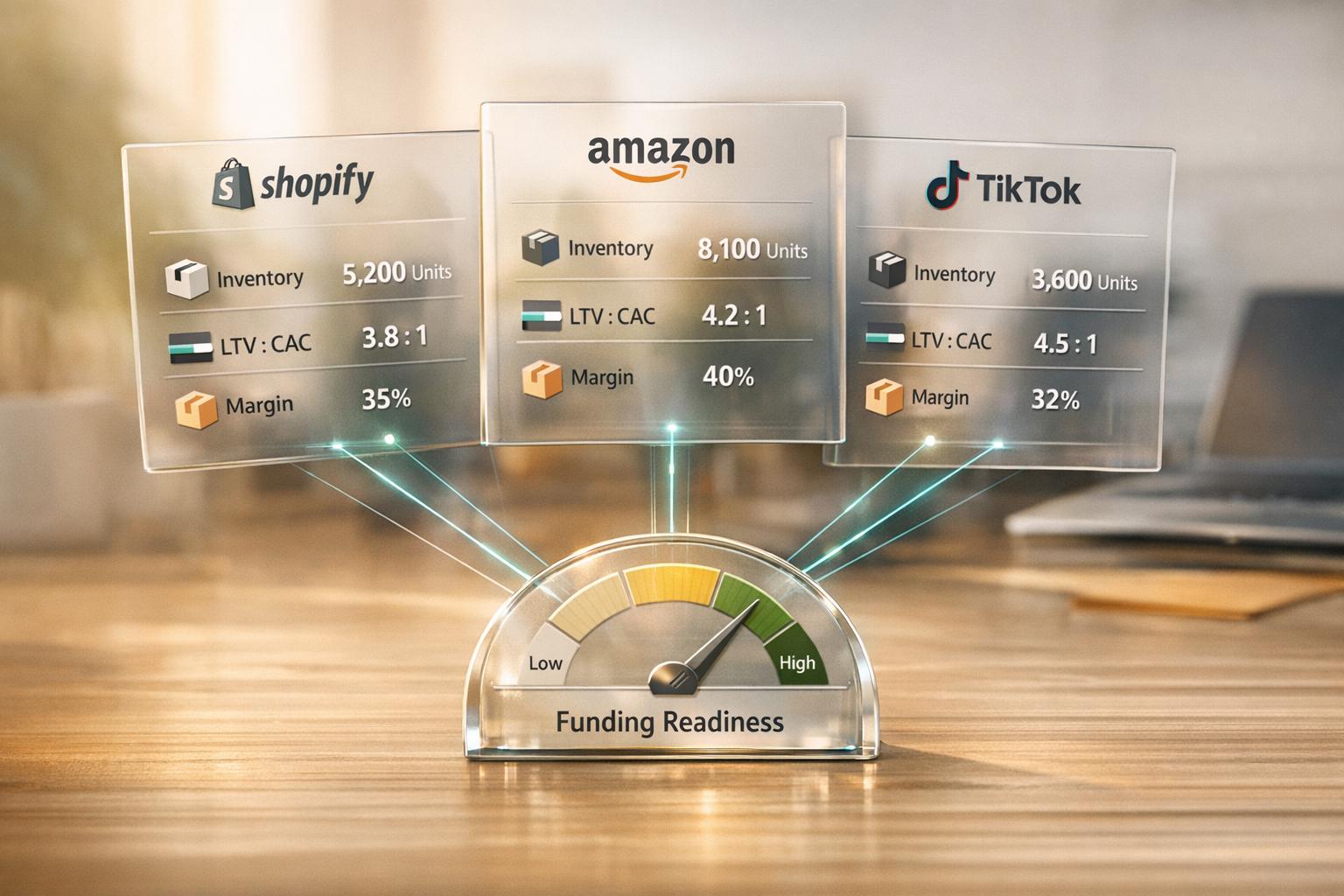
For eCommerce sellers, your sales and performance data aren't just for tracking growth - they're the key to securing funding. Lenders today prioritize real-time data over traditional credit checks. Metrics like sales trends, inventory turnover, and customer acquisition costs (CAC) show whether your business can effectively use capital.
Here's what matters most:
- Shopify: Focus on Average Order Value (AOV), Customer Lifetime Value (CLV), and inventory turnover.
- Amazon: Key metrics include Gross Merchandise Value (GMV), Order Defect Rate (ODR), and fulfillment performance.
- TikTok Shop: Engagement metrics (likes, shares) and conversion rates signal demand spikes.
- All Platforms: A CLV to CAC ratio of 3:1 and healthy gross margins are essential.
Why Most E-Commerce Brands Look Profitable (But Are Actually Broke)
Key Metrics to Track Across Sales Channels

Each sales platform provides unique data points that reflect your business's financial health and readiness for funding. Metrics on Shopify will differ from those on Amazon or TikTok Shop, so it's critical to focus on platform-specific indicators to get the full picture of your business's performance.
Shopify: Revenue, Order Volume, and Inventory Turnover

For Shopify, prioritize tracking Average Order Value (AOV) and Customer Lifetime Value (CLV). These metrics help show sustainable growth. An increasing AOV and repeat customers demonstrate your ability to manage debt repayment effectively. Additionally, your inventory turnover rate - the speed at which you sell and replenish stock - indicates how well you manage capital. Faster turnover reduces the risk of tying up cash in unsold inventory.
Another key metric is Gross Profit Return on Inventory (GPROI), which measures how much profit you generate for every dollar spent on inventory. To calculate it, divide your gross profit by the average inventory cost. A strong GPROI is a sign of efficient capital use, which funding providers value. Don't overlook your cart abandonment rate, either. With 60% to 80% of online shoppers abandoning their carts [4][5], a high rate could signal issues in your checkout process - something worth addressing before scaling traffic.
Amazon: GMV, Sales Rank, and Fulfillment Metrics

On Amazon, Gross Merchandise Value (GMV) reflects your total sales volume, but it's not the only metric lenders care about. They'll also look at your sales rank, fulfillment performance, and particularly your Order Defect Rate (ODR). A low ODR suggests your operations run smoothly, reducing perceived risk.
"A well-managed account signals reliability, reduced operational risk, and a lower chance of disruptions that could affect repayment." - Onramp Funds [8]
Your Stockout Rate is also crucial. Running out of stock can hurt your sales rank and limit future visibility on Amazon [6]. Most lenders require at least $10,000 in monthly Amazon sales before considering funding applications [8]. Additionally, your fulfillment method matters. Using FBA (Fulfillment by Amazon) is often seen as less risky than FBM (Fulfillment by Merchant) because it demonstrates operational consistency [8].
TikTok Shop: Engagement Metrics and Sales Trends

For TikTok Shop, engagement metrics such as likes, comments, and shares can signal upcoming sales spikes [3][6]. Monitor these alongside your GMV and order growth rate. Rapid growth in these areas can highlight the need for working capital. Social commerce is projected to exceed $80 billion by 2025 [7], making TikTok Shop a key channel for growth.
Your conversion rate is another critical metric. The average eCommerce conversion rate is typically between 2% and 3% [4]. Exceeding this benchmark suggests strong alignment between your products and audience. Additionally, ensure your contribution margins surpass 20%, and track your payback period - the time it takes to recoup ad spend. Recovering costs in under 60 days demonstrates to lenders that your scaling strategy is financially sound [1]. If engagement outpaces inventory, it's a clear signal to explore revenue-based funding.
Metrics Across All Platforms
Regardless of the platform, some metrics are universally important. For instance, your gross margin reflects your ability to handle repayment, while a CLV to CAC ratio of 3:1 or better shows sustainable customer acquisition.
| Platform | Critical Metric | Why It Matters |
|---|---|---|
| Shopify | Inventory Turnover | Capital recycling speed |
| Amazon | Order Defect Rate (ODR) | Account reliability |
| TikTok Shop | Engagement Growth | Demand spike prediction |
| All Channels | Gross Margin | Repayment capacity |
| All Channels | CLV to CAC Ratio | Sustainability in customer growth |
How to Use Onramp Funds with Multi-Channel Data
Onramp Funds takes a modern approach to funding by skipping traditional credit checks and collateral requirements. Instead, it connects directly to your sales platforms, providing a real-time view of your cash flow and growth. This streamlined process speeds up funding decisions and removes the hassle of manual reporting.
Connecting Your Sales Platforms to Onramp Funds
Getting started with Onramp Funds is simple. You can link your eCommerce platforms - like Shopify, Amazon, TikTok Shop, Walmart, and more - using pre-built integrations. Once connected, Onramp tracks key metrics such as monthly sales, growth trends over 3–12 months, and inventory turnover. For Amazon sellers, it even monitors account health indicators like Order Defect Rate (ODR), late shipments, and customer feedback to evaluate operational performance.
By integrating multiple sales channels, you gain a consolidated view of your revenue streams. This reduces perceived risk and speeds up funding approvals, often within 24 hours. The added transparency can also lead to better terms, giving you the flexibility to seize opportunities - whether it's restocking inventory ahead of a big sale or boosting ad spend during peak shopping periods.
"At Onramp, we use dynamic underwriting to fund sellers who are building real momentum - not just those with perfect credit or a 10-year business history." – Onramp Funds [8]
With everything connected, you can quickly assess your funding potential and make informed decisions.
Using the Onramp Funds Calculator
Once your data is integrated, you can use the Onramp Funds calculator to get an accurate funding estimate. Unlike traditional methods that rely on outdated statements, this tool uses real-time multi-channel sales data. To qualify, you'll need at least $10,000 in monthly sales [8].
Repayments are flexible, adjusting automatically based on your daily or weekly sales. This ensures you're not overburdened during slower periods. Fees range between 2% and 8%, with full transparency [8]. Since repayments are automated through your connected platforms, the process is efficient and requires minimal effort on your part. Most funding decisions are finalized within 24 hours [8].
Tools for Combining and Analyzing Multi-Channel Data
Bringing all your analytics together is a game-changer when preparing for funding. Juggling multiple dashboards can leave you with a scattered picture of your financial health. Unified analytics platforms solve this by consolidating data from sales, ad spend, and inventory into one central hub. Tools like Eva Commerce and Chord Commerce streamline this process by merging data from platforms like Amazon (both Seller and Vendor accounts) and Shopify into a single dashboard. No more switching between platforms to understand your business performance - it's all in one place [9][10].
Modern platforms take this a step further by using AI to connect the dots between your channels. For example, MetricMosaic can identify that a "customer" in Shopify is the same person as an "email subscriber" in Klaviyo or someone who clicked on a TikTok ad [11]. This eliminates the need for manual spreadsheets and provides a full view of each customer's journey. Tools like Estuary Flow simplify integration by connecting your eCommerce stack - Shopify, TikTok, Meta ads - with data warehouses such as BigQuery or Snowflake in less than 30 minutes [12]. These integrations make it easier to uncover accurate, actionable insights, which is crucial for creating unified dashboards.
The most effective dashboards go beyond surface-level metrics like gross revenue. By incorporating Cost of Goods Sold (COGS), they reveal true net profitability down to the SKU and store level [9][11]. This is critical for funding readiness because lenders are more interested in sustainable margins than just top-line sales. Demonstrating profitability at the product or channel level strengthens your case for financing.
Dashboards for Tracking Financial Performance
The right dashboard connects all your key systems - sales platforms like Shopify and Amazon, advertising channels like Meta and Google, and customer retention tools like Klaviyo. It should calculate blended metrics that show how these channels work together. For instance, instead of relying on Meta's reported 4x Return on Ad Spend (ROAS), a unified dashboard calculates blended ROAS by dividing total revenue by total ad spend across all platforms [11]. This gives you a more accurate picture of your profitability and directly supports your case for scalable funding.
Look for platforms that offer conversational analytics, allowing you to query metrics in plain English (e.g., "What was our blended ROAS last week?") without needing to build complex reports [11]. AI-driven tools like MetricMosaic can deliver a fully operational dashboard with real-time insights in just 24 to 48 hours [11]. For deeper analysis, segment your data by first touchpoint to compare customer lifetime value (LTV) across channels, such as TikTok Shop versus Amazon or Shopify [11].
How Often to Review Your Data for Funding Decisions
Daily reviews are crucial for fast-moving industries where prices and inventory levels can change quickly. Monitoring your data every day allows you to respond to sudden shifts, like a competitor lowering prices or inventory running low, before they affect your sales [15][16].
Weekly reviews help you safeguard profit margins and address issues before they escalate. A weekly check-in can reveal small problems - such as inefficiencies or missed opportunities - that, if left unchecked, could lead to significant revenue losses. Brands that skip weekly reviews risk losing 6–12% of annual sales to faster competitors [15]. Weekly reviews also help you maintain key metrics like the 3:1 LTV/CAC ratio, which investors often look for when evaluating scalability [13].
Monthly reviews provide a broader, strategic perspective. This is your chance to evaluate 30-, 60-, and 90-day revenue targets and ensure your unit economics meet funding benchmarks. During these reviews, focus on metrics like customer retention rates (aiming for 25–30% repeat customers) and inventory accuracy (at least 98%) [14][16]. Regular monthly assessments give you the insights needed to refine your funding strategy and prepare for long-term growth.
Matching Data Insights with Funding Needs
Your unified dashboard holds the key to smarter funding decisions. By analyzing data from platforms like Shopify, Amazon, and TikTok Shop, you can pinpoint exactly where your business needs capital. The most successful eCommerce brands don't spread their funding evenly - they focus on the top 20% of SKUs by gross margin dollars, often called "Margin Leaders" [1]. These products deliver the highest profits per dollar invested, making them the priority for inventory funding.
Looking at multi-channel data also uncovers marketing insights that single-channel analytics might miss. For instance, Instagram might not show high direct sales, but your dashboard could reveal it's driving significant traffic to your Amazon store. Cutting out such channels could disrupt the customer journey. Considering that 73% of shoppers use multiple channels before purchasing [18], your funding strategy should reflect these interconnected touchpoints rather than relying solely on last-click attribution. This approach helps you identify funding gaps more effectively, as explained below.
Finding Funding Gaps in Inventory and Marketing
Inventory gaps are easy to spot when you calculate Weeks-Of-Cover (WOC) by dividing your current inventory by average weekly sales [1]. For example, if a top-performing product has just two weeks of stock but your supplier requires an eight-week lead time, you have a clear funding gap. This matters because 90% of customers won't return after experiencing a stockout [17]. Tools like the Economic Order Quantity (EOQ) formula - √[(2 × Demand × Order Cost) ÷ Holding Cost] - can guide you in determining how much inventory to purchase using loan funds [1].
For marketing gaps, keep an eye on your LTV/CAC ratio (Customer Lifetime Value to Customer Acquisition Cost). A ratio of 3:1 or higher is generally considered healthy [1]. If your TikTok Shop shows a 4:1 ratio but you're maxing out your ad budget, it's a clear sign you need additional marketing funds to scale. Another key metric is your payback period, or the time it takes for ad spend to recover its cost. A contribution margin above 20% and a payback period under 60 days often justify additional marketing funding [1]. Typically, businesses allocate 60–70% of funding to inventory and 30–40% to marketing [1].
"Revenue rarely causes the collapse. It is the fog around operations, the small mismatches, duplicated work, and unclear costs, that slowly drain margin until nobody can remember where the money went." – Henry Jose, Zoho Inventory [17]
Using a 12-month cash flow calendar to forecast peak sales and lead times allows you to secure funds 60 days before major sales events [1]. Brands that forecast demand within ±5% accuracy can free up over 20% of their working capital [1].
Once you've identified these funding gaps, it's time to prepare your data for a smooth application process.
Preparing Your Data for Onramp Funds Applications
Onramp Funds simplifies the application process by integrating directly with platforms like Amazon, Shopify, and TikTok Shop to evaluate real-time sales data [8]. To ensure a seamless experience, organize your data carefully. Start by exporting 12 months of sales data and applying a weighted moving average to account for seasonal fluctuations [1].
Calculating GPROI (Gross Profit ÷ Average Inventory Cost) helps you measure profit per dollar invested [1]. For Amazon sellers, maintaining strong account health metrics like Order Defect Rate (ODR) and Late Shipment Rate is critical since these directly impact your funding eligibility [8]. Generally, funders look for businesses with at least $10,000 in monthly sales and 6–12 months of selling history [8].
Here's how your data should align with funding benchmarks:
| Data Category | What to Prepare | Target Benchmark |
|---|---|---|
| Sales Performance | Monthly revenue, growth trends across channels | $10,000+ monthly revenue [8] |
| Inventory Health | Turnover rate, WOC, sell-through rate | ±5% forecasting accuracy [1] |
| Marketing Efficiency | LTV/CAC ratio, ROAS, payback period | 3:1 LTV/CAC ratio [1] |
| Account Health | ODR, late shipment rate, customer feedback | Low ODR, high feedback scores [8] |
Implementing a real-time dashboard to track daily sales, inventory, and marketing spend can improve transparency and reduce perceived risk for funders [8]. Onramp Funds also uses a Remittance Rate - a percentage of daily sales, typically 10–25% - to automate repayments, aligning outflows with actual cash inflows [1].
Finally, confirm that your business entity (LLC, S-corp, etc.) is active and registered, and clearly outline how you'll use the funds. Whether you're restocking high-demand inventory or scaling ad spend for events like Prime Day, a clear plan strengthens your case [8]. Brands operating across three or more marketplaces often achieve an average GMV growth rate of 104% [2], so showcasing a multi-channel strategy can further boost your application.
Conclusion
Keeping a close eye on LTV:CAC ratios, GMV trends, and inventory turnover across platforms like Shopify, Amazon, and TikTok Shop turns funding decisions into well-informed strategies. With the focus shifting to profitable scale by 2026, investors are now prioritizing operational efficiency and consistent cash flows over pure growth metrics [20]. Businesses with strong unit economics are seen as safer bets for funding [19].
To support this, seamless integration with sales data is a must. Onramp Funds makes this easy by connecting directly to your sales platforms, using real-time performance data instead of outdated credit scores [8]. With this approach, businesses can secure funding in less than 24 hours, with repayment plans that align with actual sales [8]. Whether it's restocking high-margin SKUs ahead of Prime Day or ramping up ad spend on TikTok Shop, this data-driven model ensures every dollar is directed toward measurable results.
In 2025, the eCommerce funding landscape saw $1.7 billion raised across 206 deals, but investors are now digging deeper into metrics like contribution margin and EBITDA [20]. Companies that maintain accurate financial records, track performance by channel, and achieve ±5% accuracy in demand forecasting can unlock over 20% more working capital [1]. Such precision separates businesses that grow sustainably from those that plateau. Multi-channel data analytics play a pivotal role in achieving this level of precision and securing long-term growth.
As one industry expert puts it:
"Risk assessment in eCommerce financing isn't about red tape. It's about real data, real performance, and real-world agility." – Onramp Funds [8]
FAQs
Which metrics matter most for funding readiness across all channels?
When preparing for funding, certain metrics can provide crucial insights into your business's health and potential. Here's what to keep an eye on:
- Sales performance: Look at revenue trends, growth rates, and sales velocity to understand how your business is scaling.
- Inventory turnover: This shows how efficiently you're managing stock and meeting demand.
- Customer satisfaction indicators: Metrics like low cancellation rates and minimal refunds highlight strong customer relationships and product reliability.
- Account health metrics: Keep tabs on factors like order defect rates, late shipment rates, and customer reviews to ensure smooth operations.
- Platform-specific data: Evaluate fulfillment reliability and sales consistency on platforms you use to sell your products.
These metrics not only help you gauge your current financial standing but also identify areas where funding could make the biggest impact.
How can I combine Shopify, Amazon, and TikTok Shop data into one view?
To bring together data from Shopify, Amazon, and TikTok Shop, you'll need a centralized data platform or an omni-channel data modeling tool. These solutions help you integrate sales, inventory, and customer behavior data into one unified dashboard. The process is straightforward: connect each platform using their data export options or APIs, then clean and analyze the combined data. This approach lets you track trends, compare performance across platforms, and make smarter business decisions.
What data should I prepare before applying for Onramp Funds?
To get started, gather critical business data, such as monthly revenue, sales trends, inventory turnover rates, and account health metrics. These figures provide a clear picture of your business's performance and growth potential.
In addition, prepare essential supporting documents like tax returns and business registration records. These not only demonstrate your operational stability but also help ensure you meet any eligibility requirements. Having everything organized and ready can make the process smoother and more efficient.
Related Blog Posts
Onramp Funds
Funding built around your sales
Connect your store and see what you qualify for. Repay as a percentage of sales, with no personal credit check.
Funding in as little as 24 hours.
