


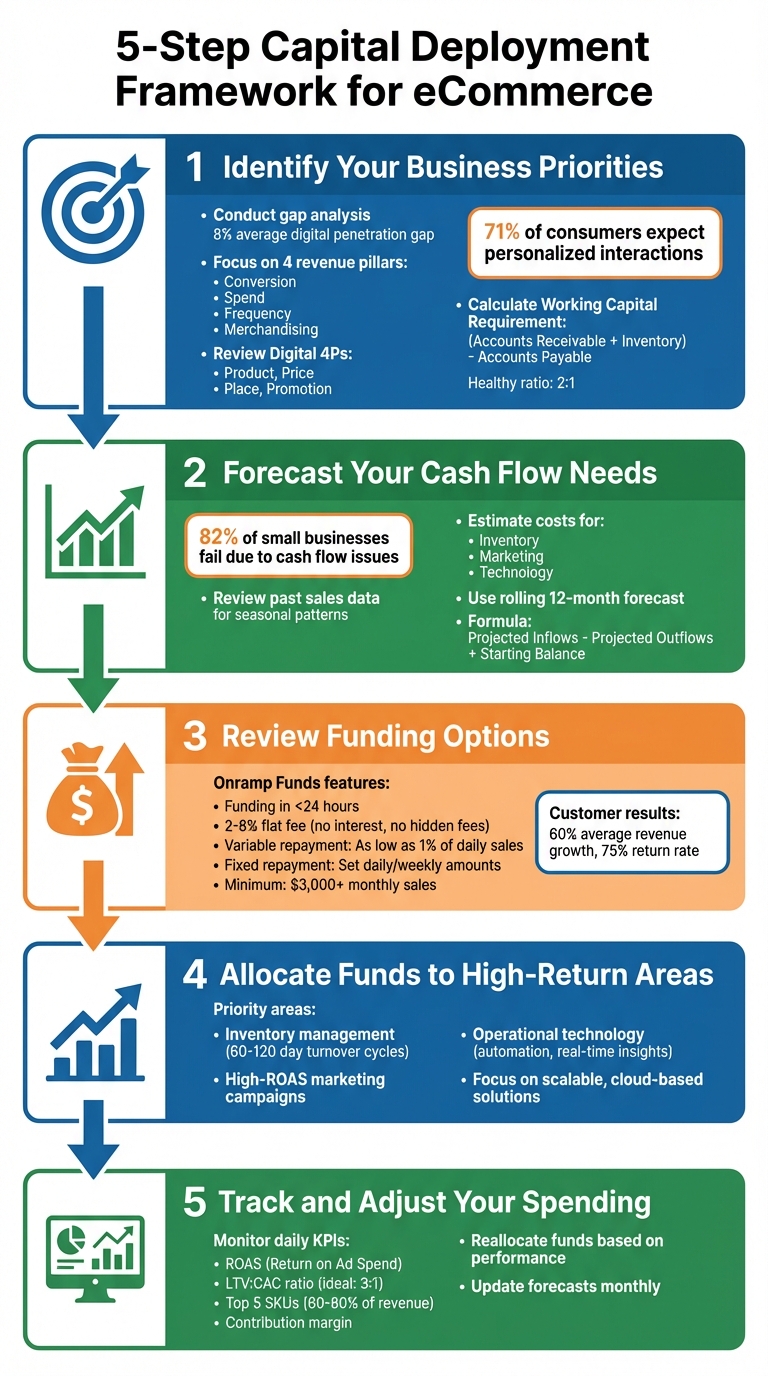
Smart capital deployment can make or break your business. For eCommerce, this means directing funds - whether from revenue, loans, or financing - into areas that drive growth, like inventory, marketing, or technology. Misallocating resources, such as overstocking slow-moving products or underfunding effective campaigns, can hurt cash flow and profits.
Here’s how to align spending with real business priorities:
- Pinpoint growth areas: Focus on improving conversion, repeat purchases, and merchandising. Use tools like gap analysis and monitor trends like mobile shopping and personalization.
- Forecast cash flow: Analyze past sales to predict seasonal needs and plan for inventory, marketing, and operational costs.
- Secure funding: Consider tailored financing like Onramp Funds, which offers sales-based repayment plans to ease cash flow pressure.
- Invest in high-return areas: Prioritize inventory management, effective marketing, and cost-saving technology.
- Track and adjust: Regularly monitor performance metrics like ROAS and reallocate funds based on results.
The key is balancing day-to-day stability with long-term growth. Use real data to guide decisions, ensuring every dollar works toward your business goals.
2025 Ecom Planning: The Framework That Could 10x Your Profit
Step 1: Identify Your Business Priorities
Before making any financial commitments, it's crucial to determine where your investments will have the most impact. Spending randomly on inventory, advertising, or software can quickly drain resources without delivering meaningful results. Instead, focus on identifying the operational needs that keep your business running smoothly and the growth opportunities that promise the highest returns.
Start by conducting a gap analysis to evaluate where your business currently stands compared to where it could be. For example, leading consumer goods companies often identify an 8% gap between their brand's digital penetration and the overall category penetration [5]. This kind of analysis can reveal untapped opportunities. Focus on the four key revenue-driving pillars: Conversion (how many visitors make a purchase), Spend (average order value), Frequency (how often customers return), and Merchandising (how well products are presented) [4]. By pinpointing gaps in these areas, you can align your spending with your business's most pressing needs and set the stage for targeted growth.
Find Your Growth Opportunities
To identify potential growth areas, take a closer look at the Digital 4Ps - Product, Price, Place, and Promotion [6].
- Product: Are your listings optimized with high-quality content, strong SEO, and enough customer reviews to build trust?
- Price: Are you relying on manual adjustments, or could dynamic pricing strategies improve your margins?
- Place: How well are you represented across channels like your website, Amazon, Walmart, and newer platforms like social commerce?
- Promotion: Are your campaigns personalized and data-driven, or are they still relying on broad, less effective tactics?
Consumer trends can guide these decisions. For instance, 71% of consumers now expect personalized interactions from brands, and during the 2024 holiday season, 79% of online orders were made on mobile devices [6]. These statistics highlight areas where your investments - whether in personalization tools or mobile optimization - can directly impact sales. Additionally, explore emerging opportunities such as AI-driven inventory forecasting or tapping into platforms like TikTok Shop, where creator-led content is generating significant revenue [3].
Review Your Operating Expenses
After identifying growth opportunities, take a step back to ensure your operations have the liquidity to support expansion. Growth is only sustainable if your essential operations are financially secure. Start by calculating your Working Capital Requirement (WCR) using the formula:
(Accounts Receivable + Inventory) – Accounts Payable [7].
A healthy working capital ratio is typically 2:1, meaning you have twice the assets needed to cover liabilities. If your ratio falls below 1:1, it may indicate potential liquidity challenges [7].
"Working capital – think of it as the fuel that keeps the engine running. It's the key to guaranteeing a business can keep the lights on, meet its financial commitments, and take advantage of growth opportunities." - PayPal Editorial Staff [7]
Review both fixed costs (like rent and software subscriptions) and variable expenses (such as shipping, packaging, and seasonal inventory). Using historical sales data to forecast your cash needs can help ensure that your business remains stable before allocating funds to growth initiatives. This way, you can avoid cash flow problems while still seizing opportunities to expand.
Step 2: Forecast Your Cash Flow Needs
Once you've set your priorities, the next step is to forecast your cash flow. This process ensures that your available funds align with your business needs. Without a reliable forecast, you could end up overspending on initiatives that drain your resources or underfunding crucial areas that fuel growth. In simple terms, cash flow forecasting involves estimating how much money will flow in and out of your business over a specific timeframe [8]. It helps you pinpoint when cash enters and exits, allowing you to plan accordingly.
The stakes couldn't be higher. Did you know that 82% of small businesses fail because of cash flow issues [9]? For eCommerce businesses - where profit margins are often slim - there's no room for error. A strong forecast protects you from the trap of looking profitable on paper but struggling to pay bills because customer payments lag behind supplier costs. To get started, subtract your projected outflows from inflows, then add your starting balance. This simple calculation gives you a clear picture of your monthly liquidity [8]. By doing this, you’ll know whether you can cover operational costs and still have room for growth. This step is essential for allocating funds effectively in the future.
Review Past Sales Data
Historical sales data is a goldmine for spotting cash flow trends. By reviewing monthly sales from previous years, you can uncover seasonal patterns that might otherwise catch you off guard [8]. For example, if your sales spike in the summer, you’ll likely need to ramp up inventory and marketing efforts ahead of time [9].
Past data also helps you estimate variable costs tied to sales volume, like shipping fees, commissions, or raw materials [8]. Let’s say you sold 1,000 units last July and spent $3,500 on shipping. If you expect similar sales this July, you can budget accordingly. Using a rolling 12-month forecast can help you balance short-term costs with long-term projections [8][9].
Once you’ve identified sales trends, break your expenses into key categories for a more detailed forecast.
Estimate Costs for Inventory, Marketing, and Technology
Categorizing your expenses is crucial for accurate forecasting. Start with inventory costs. Align your monthly purchase orders with the full cost of goods sold (COGS), which includes product costs, packaging, shipping, and fees [10]. Keep in mind that inventory ties up capital until sold, so aim to have enough cash on hand to replace your inventory at least twice during growth phases [9].
For marketing, calculate your Customer Acquisition Cost (CAC) for each channel - whether it's Meta, Google, or influencer partnerships - and include total ad spend and any related personnel costs [10]. Don’t rely on a static CAC number; competition often increases during peak shopping seasons, so adjust your forecasts accordingly. When it comes to technology, factor in both one-time costs like website development and recurring expenses such as software subscriptions, hosting, and payment processing [10][9].
Dan Kang, CFO at Mercury, offers sound advice:
"A forecast is only as good as the assumptions behind it. Start simple, use directional logic based on real data, and revise over time" [10].
Don’t forget to include non-monthly expenses like annual subscriptions, insurance, and tax payments in your forecast [8]. Taking a conservative approach to sales predictions ensures you’re prepared for slower periods and helps you avoid overspending during busier times.
Step 3: Review Funding Options with Onramp Funds
Once you’ve mapped out your cash flow forecast, the next step is securing funding that fits the unique demands of your eCommerce business. Traditional financing often struggles to keep up with the fast-paced and unpredictable nature of online selling. That’s where Onramp Funds steps in, providing funding solutions specifically tailored to the cash flow cycles of eCommerce businesses [11]. This funding aligns with the needs highlighted in your projections, ensuring you have the resources to keep operations running smoothly.
Onramp customers report an average revenue growth of 60% after accessing funding, with 75% returning for additional financing. Sellers frequently commend Onramp Funds for its user-friendly platform and transparent communication, earning it a "Great" rating on Trustpilot from 220 reviews [11]. As Steven Hollander, one satisfied customer, noted:
"OnRamp has been a trusted partner... for helping to fill the gaps in cash flow that come with being an e-commerce business" [11].
This funding solution effectively connects your cash flow forecast to flexible financing that meets the demands of online selling.
What Onramp Funds Offers
Here’s a closer look at the standout features of Onramp Funds.
Onramp provides funding based on your sales performance [11]. The process is quick and seamless - you can get a funding estimate in just one minute and receive the funds in under 24 hours by securely connecting your store through read-only APIs [11]. The platform integrates with major eCommerce platforms like Shopify, Amazon, Walmart, and TikTok Shop, using real-time data to calculate your funding eligibility [12].
The financing terms are refreshingly simple: a flat fee ranging from 2% to 8%, with no interest rates, no monthly minimums, and no hidden fees [11][12]. Onramp also offers two repayment models to suit your needs:
- Variable repayment: Payments are tied to your daily sales (as low as 1%), allowing you to pay less during slower periods and more when sales pick up [11][12].
- Fixed repayment: Payments are consistent, with set dollar amounts on a daily or weekly basis, making budgeting easier and more predictable [11].
Both options are designed to safeguard your cash flow during lean times while providing the funding you need for essential tasks like restocking inventory, covering shipping costs, or scaling up marketing efforts [12].
Compare Onramp Funds Plans
| Feature | Variable Repayment Plan | Fixed Repayment Plan |
|---|---|---|
| Funding Speed | Less than 24 hours | Less than 24 hours |
| Repayment Terms | Percentage of daily sales (as low as 1%) | Fixed daily/weekly dollar amount |
| Fee Structure | 2% – 8% Flat Fee | 2% – 8% Flat Fee |
| Eligibility | $10,000+ monthly sales | $10,000+ monthly sales |
| Platform Integrations | Shopify, Amazon, Walmart, TikTok Shop | Shopify, Amazon, Walmart, TikTok Shop |
| Best For | Seasonal or fluctuating sales | Predictable budgeting and stable cash flow |
The variable repayment plan is ideal for businesses with seasonal or fluctuating sales, as it adjusts to your daily revenue, keeping payments manageable during slower periods [11]. On the other hand, the fixed repayment plan is perfect if you prefer consistent, predictable payments that simplify accounting and lock in your costs [11]. Both plans are crafted to address short-term needs - like inventory turnover (every 60–120 days) or marketing pushes - without the burden of long-term debt [13].
sbb-itb-d7b5115
Step 4: Allocate Funds to High-Return Areas
Once you've secured funding through Onramp Funds, it's time to put that capital to work in areas that deliver measurable results. Think of your funding as an investment portfolio - every dollar should contribute to growth. Focus on key areas like inventory management, marketing with high returns, and improving operational efficiency through technology. This approach allows you to get the most out of your funding while avoiding unnecessary risks. Plus, since Onramp's repayment model is tied to your sales performance, you have the flexibility to make strategic investments without the stress of fixed monthly payments [16][13].
Strengthen Your Inventory Management
Effective inventory management is a cornerstone of maintaining healthy cash flow. The goal is to strike the right balance - avoiding costly stockouts while preventing excess inventory from tying up your capital. Start by analyzing your sell-through rate for each SKU to identify which products deserve additional investment. At the same time, weigh carrying costs against the potential losses that stockouts can cause [15].
Onramp's funding can help you maintain adequate inventory levels during peak demand periods, especially for products with turnover cycles of 60–120 days [13]. To make smarter purchasing decisions, use real-time data from your 3PL provider instead of relying solely on forecasts [15]. Also, keep a close eye on the full landed cost of each SKU - factoring in freight and duties - to avoid overinvesting in items that might appear profitable but actually offer limited margins [15].
Invest in Marketing That Delivers
Once your inventory is optimized, shift your attention to marketing. Allocate funds to campaigns that demonstrate clear returns. Use real-time sales data to identify which marketing channels are driving results. If a particular channel starts to underperform, don't hesitate to reallocate those resources to higher-performing areas.
This flexibility not only allows you to experiment with new marketing strategies but also ensures your day-to-day cash flow remains stable.
Modernize Your Technology
Investing in the right technology can transform your operations. Prioritize scalable, cloud-based tools that automate repetitive tasks and provide real-time insights. Focus on solutions that address specific bottlenecks, such as automated invoicing, real-time reconciliation, and smarter inventory management [14]. These upgrades can streamline your operations, helping you align your capital with your business goals.
Look for technology that grows with your business rather than adding unnecessary fixed costs. Tools like cloud-based eCommerce platforms, AI-driven demand forecasting, and automated reorder systems can help you make better capital decisions as you expand [14]. Since Onramp integrates seamlessly with platforms like Shopify, Amazon, Walmart, and TikTok Shop, ensure your tech stack provides accurate, real-time data to guide your funding strategies effectively.
Step 5: Track and Adjust Your Spending
Deploying capital is just the beginning - you need to keep a close eye on performance to ensure your funds are fueling growth rather than draining resources. While Onramp Funds' sales-based repayment model adjusts with your revenue, staying on top of your spending is essential. Regular tracking helps you spot which investments are paying off and which ones might need a rethink. Without this, you risk pouring money into underperforming areas while missing out on high-return opportunities.
Monitor Sales Performance
Keep tabs on key performance indicators (KPIs) every day. Metrics like ROAS (Return on Ad Spend), contribution margin, and LTV:CAC (Lifetime Value to Customer Acquisition Cost) - ideally at a 3:1 ratio - are crucial for understanding your business health. Pay special attention to your top five SKUs, as they often account for 60–80% of your revenue [1].
Tools like Google Analytics can help you pinpoint where customers drop off and allow you to segment buyers based on their behavior. For example, you can differentiate between first-time shoppers and repeat, high-value customers. Similarly, your email service provider can show which campaigns are driving initial sales and which ones are building long-term customer loyalty [1].
Test your marketing strategies weekly. Experiment with new creatives and subject lines, and segment your audience to identify churn risks or potential VIPs. Real-time inventory tracking across your sales channels is also essential - it prevents overselling and helps you identify products worth additional investment [1][2].
Shift Funds Based on Results
Use the insights from your monitoring efforts to quickly adjust your spending. If certain channels or campaigns are underperforming, reallocate those funds to areas showing stronger results. For instance, if email and SMS campaigns are boosting retention but paid social ads are falling flat, shift your budget accordingly [1]. Sales data can also guide your inventory purchases, helping you time them around promotional events and avoid tying up cash in slow-moving stock.
Onramp's repayment model gives you the flexibility to make these adjustments without added pressure. Since repayments scale with daily sales, you can redirect capital during slower periods and reinvest during high-revenue times. This flexibility allows you to test new strategies - such as content marketing or advanced demand forecasting - without putting unnecessary strain on your cash flow.
Conclusion
Aligning your capital deployment with your business's actual needs starts with relying on real data to make informed decisions. Begin by pinpointing your priorities and using historical sales data to forecast cash flow. This method helps you steer clear of the cash flow challenges that lead to failure for 82% of small businesses [16].
Once you’ve established a solid cash flow forecast, having a flexible funding solution becomes critical. Onramp Funds offers a sales-based repayment model paired with continuous performance monitoring, ensuring your capital matches your business's peak demands. This allows you to invest in key areas like inventory, marketing, and technology without compromising ownership or straining cash flow during slower periods [13].
Sustained growth depends on staying agile. Regularly update your forecasts with actual performance data - ideally on a monthly basis - to catch and address potential issues early [10].
FAQs
How can I determine which parts of my eCommerce business need the most funding?
To determine where your eCommerce business needs the most funding, start by taking a close look at your cash flow. Forecast both your income and expenses to get a clear picture of your financial situation. Focus on crucial areas like inventory management, marketing efforts, platform fees, and technology upgrades. Assess how these costs affect your working capital and calculate their return on investment (ROI). Allocate funds strategically, prioritizing areas where insufficient capital could hold back your growth.
What are the best strategies for forecasting cash flow in an eCommerce business?
Effective cash flow forecasting starts with having a clear view of your current and future financial situation. Begin by identifying your opening cash balance. From there, estimate your monthly cash inflows - this includes all revenue streams, such as sales from your website, marketplaces, and advertising channels. Then, outline all your cash outflows, like rent, software subscriptions, inventory purchases, shipping costs, and marketing expenses. Use a simple spreadsheet or accounting software to calculate your net cash flow and ending balance for each period.
To make your forecast even more precise, keep an eye on key metrics. For example, Operating Cash Flow (OCF) helps you confirm that your operations are generating positive cash. Tracking Customer Lifetime Value (CLV) gives insight into potential future revenue. Additionally, metrics like Days Sales Outstanding (DSO) and Days Payable Outstanding (DPO) reveal how quickly cash flows in and out of your business. Regularly compare your forecasts to actual results to fine-tune your assumptions and improve accuracy over time. This approach gives you a clear, data-backed understanding of your cash requirements, enabling smarter allocation of resources to areas like inventory, marketing, or technology.
How does Onramp Funds’ sales-based repayment model support eCommerce businesses?
Onramp Funds' sales-based repayment model adjusts to your business's revenue flow, offering a smarter way to manage repayments. Instead of locking you into fixed monthly payments, this approach takes a percentage of each sale. When your sales are booming, you pay more; during slower periods, you pay less. This setup helps maintain steady cash flow.
What’s more, there’s no need to put up collateral or give up equity. It’s fast funding that scales with your business, making it a great option for eCommerce sellers who need financial flexibility without dealing with rigid loan terms.
Related Blog Posts
Onramp Funds
Funding built around your sales
Connect your store and see what you qualify for. Repay as a percentage of sales, with no personal credit check.
Funding in as little as 24 hours.
