


When growing an eCommerce business, how you allocate funds can make or break your success. Many sellers waste money by treating funding as a general resource instead of tying it to clear growth goals. This guide breaks down how to align your capital with specific business objectives, ensuring every dollar works toward measurable results. Here's what you'll learn:
- Prioritize Growth Initiatives: Focus on 2-3 areas like launching new products, scaling inventory, or increasing marketing budgets.
- Tie Spending to Metrics: Link initiatives to financial outcomes like revenue, costs, and cash flow.
- Budget Smartly: Separate one-time costs (e.g., $10,000 for bulk inventory) from recurring expenses (e.g., monthly marketing spend).
- Forecast Cash Flow: Plan for cash in/outflows to avoid shortages during high-spending periods.
- Evaluate ROI: Use metrics like ROI, payback period, and contribution margin to measure success.
- Pick the Right Financing: Match funding options (e.g., revenue-based financing, term loans) to your initiative's needs.
Understanding Growth Initiatives and Their Financial Requirements
Common Growth Initiatives for eCommerce Sellers
For most U.S. eCommerce sellers, growth often revolves around five key activities. New product launches are a common strategy, involving the addition of SKUs, bundles, or private-label items to increase both average order value and overall revenue per customer. These initiatives come with costs like product design, sourcing (ranging from $1,000 to over $10,000), initial inventory purchases ($5,000–$100,000), and expenses for packaging, photography, and listing setup ($500–$5,000). Since capital remains tied up until the inventory sells, this requires careful planning.
Inventory scaling focuses on stocking up on proven bestsellers, preparing for seasonal demand, and maintaining safety stock. This is often the largest cash outlay, covering bulk orders, freight and duties, storage costs, and markdowns for excess stock. Many brands increase their inventory spending by 20–50% in anticipation of peak seasons. Marketplace expansion, such as launching on platforms like Amazon, Walmart, or Target Plus, involves platform fees (typically 8–20% of sales), listing tools, marketplace-specific advertising, and sometimes fulfillment costs. Initial budgets for testing new marketplaces often start in the low thousands.
Marketing budget increases are another major growth driver. These funds go toward paid ads, creative production, email and SMS tools, loyalty programs, and influencer collaborations. With customer acquisition costs rising by around 40% in recent years, many brands now allocate 10–30% of their revenue to marketing, depending on their margins and growth goals. Finally, operational system upgrades - such as warehouse automation, third-party logistics (3PLs), order management systems, and analytics tools - can range from a few hundred dollars monthly for software to six-figure investments for automation and multi-location fulfillment. Shopify data shows that merchants using integrated inventory and point-of-sale systems saw an 8.9% boost in gross merchandise value, a 22% reduction in total cost of ownership, and 25% lower annual software expenses [7].
Top-performing brands often focus on just 2–3 of these initiatives at a time, ensuring they balance growth with profitability rather than pursuing revenue at any cost [6][8]. Once you've identified the right initiatives, the next step is to align them with key financial metrics to measure their impact effectively.
Connecting Initiatives to Financial Metrics
After outlining your growth initiatives, it’s crucial to translate them into measurable financial outcomes. Each activity should directly connect to metrics like revenue, costs, and cash flow. Start by estimating the revenue impact: how many additional orders, what average order value, and what conversion rate improvements you expect. For marketplace expansion, calculate the added revenue while accounting for any potential cannibalization of existing channels [6][8].
Next, link each additional sale to its unit cost, including packaging and fulfillment expenses. Initiatives like new product launches and inventory scaling directly increase your cost of goods sold (COGS) and working capital requirements [7]. Then, factor in operating expenses (OpEx) - this includes additional spend on marketing, software fees, labor, and logistics tied to the initiative [7][9].
Timing is everything when it comes to cash flow. Map out when cash leaves your account (e.g., inventory purchases, ad prepayments, software setup fees) versus when it returns through customer payments or marketplace payouts. Be sure to account for payment terms and any delays in settlement. A simple monthly projection showing revenues, COGS, OpEx, and net cash flow for each initiative can help identify which projects drive profitable scale rather than just top-line growth [5][8].
Understanding unit economics and contribution margin is essential to evaluate whether growth efforts are improving or hurting profitability at the SKU or order level. Calculate revenue per unit, subtracting discounts, returns, COGS (including product, packaging, and freight), variable fulfillment costs, transaction fees, and marketing expenses. This will give you the contribution margin, expressed as both a dollar amount and a percentage of revenue. Compare contribution margins before and after implementing an initiative to determine if the growth maintains or enhances profitability [5][8]. Initiatives with strong contribution margins and positive unit economics are more likely to support sustainable growth, while those with weaker numbers should be reworked or deprioritized.
Given that acquiring a new customer can cost 5–25 times more than retaining an existing one, and that boosting retention by just 5% can increase profitability by 25–95%, many brands are shifting their focus toward retention strategies like email/SMS campaigns, loyalty programs, and subscription models [8]. When evaluating marketing-related projects, it’s vital to model customer acquisition costs by channel, allocate more resources toward retention, and track the lifetime value-to-acquisition cost ratio. This financial mapping ensures that your capital is aligned with achieving targeted growth outcomes.
sbb-itb-d7b5115
Calculating Capital Needs for Specific Initiatives
Building Detailed Capital Budgets
When planning your budget, it's important to separate one-time costs from recurring expenses. One-time costs might include things like a $5,000 fee for website development, $10,000 for an initial bulk inventory purchase, or expenses tied to setting up a new warehouse [1][12]. Recurring expenses, on the other hand, include ongoing costs such as monthly website maintenance or regular advertising spend, which will continuously impact your cash flow [1][12].
To get a clearer picture of your financial needs, calculate your Working Capital Requirement (WCR) using the formula:
(Inventory + Accounts Receivable) – Accounts Payable.
For instance, if you order $50,000 worth of inventory, expect $20,000 in receivables, and have $10,000 in payables, your WCR would amount to $60,000 [11]. Once you've outlined these costs, you can move on to forecasting cash flow and timing.
Forecasting Cash Flow and Timing
After crafting your capital budget, it’s time to map out when money will flow in and out of your business. Many sellers underestimate the timing of their capital needs, which can lead to cash shortages. A simple spreadsheet can help you track when payments are due and when revenue is expected. For example, with inventory purchases, note the payment structure - such as a 30% deposit upfront, 70% prior to shipping, and revenue arriving 30–90 days after sales [13].
Shipping timelines also play a role. Overseas suppliers typically take 3–6 weeks to ship goods, and payouts from platforms like Amazon or Shopify may be delayed by 7–14 days [1]. These timing gaps can create cash flow bottlenecks if not planned for.
"Forecasts aren't about getting every number right, they're about thinking through how your business works and what it needs to grow - plus how you can do that with fewer surprises and greater visibility."
– Dan Kang, CFO at Mercury [13]
Use recent monthly data as a baseline, then layer in the cash inflows and outflows specific to your new initiatives [13]. Be sure to include irregular expenses like quarterly subscriptions or annual premiums [14]. A rolling 12-month forecast can give you a better long-term view while still being practical [14]. This level of planning is crucial, especially when you consider that 82% of small businesses fail due to cash flow issues [12].
Estimating Return on Investment
To measure the success of your initiatives, calculate your Return on Investment (ROI) by dividing net profit by the total capital invested and multiplying by 100. For example, if you invest $30,000 in a product line and generate $45,000 in profit over a year, your ROI would be 50%.
You can also determine the payback period by dividing the initial investment by monthly profit. If that same $30,000 investment yields $2,500 in monthly profit, it would take 12 months to recoup your investment.
For a break-even analysis, calculate how many units you need to sell to cover all costs. Say each unit contributes $25 after variable costs, and your fixed costs total $10,000. You’d need to sell 400 units to break even. These metrics are invaluable for comparing initiatives and identifying which ones will deliver the quickest returns and the highest profitability.
Lastly, keep an eye on your working capital ratio (short-term assets divided by short-term debts). A healthy ratio typically falls between 1.50 and 2.00. Ratios significantly higher than 2.00 may suggest underutilized resources [10][11]. By using these ROI and financial health metrics, you can make smarter decisions about where to allocate your resources.
Prioritizing Initiatives and Allocating Capital
Ranking Initiatives for Maximum Impact
Once you've established clear financial metrics, the next step is deciding where to focus your capital for the biggest payoff. Start by ranking your initiatives based on three key factors: expected ROI, business fit, and execution complexity. ROI measures the speed of payback and the overall returns, business fit evaluates alignment with your goals, and execution complexity considers the effort required. For example, B2B sellers might prioritize optimizing inventory and logistics, while B2C sellers could focus on digital marketing and website improvements [1].
To make this process more structured, assign a score from 1 to 5 for each factor, then combine them for a total score. This helps you clearly identify which initiatives deserve funding.
Focus first on "quick wins" - projects that deliver high impact with minimal effort. Examples include improving conversion rates on high-traffic pages or sending abandoned cart recovery emails, which can achieve conversion rates close to 40% [2]. Once these are in place, shift your attention to high-impact but more complex efforts, like SEO strategies or loyalty programs, which can generate long-term value. Riskier projects, such as expanding into new markets, should wait until you have more capital and operational stability.
Converting Priorities into a Capital Allocation Plan
With your cash flow and ROI estimates in hand, you can now allocate your funds strategically to fuel growth. After ranking your initiatives, divide your capital into key categories like inventory, fulfillment, marketing, website upgrades, and supplier payments [1]. This way, you ensure all critical parts of your business get the resources they need.
For instance, if you have $100,000 in available capital, you might allocate a significant portion to your top initiative - such as inventory - then spread smaller amounts across marketing, website improvements, and a buffer for unexpected costs or seasonal changes. Diversifying your investments helps reduce risk, while aligning fund deployment with payment milestones ensures financial stability. Always keep market fluctuations in mind and adjust accordingly.
Planning for Different Scenarios
Prepare for three possible sales scenarios - best, base, and worst - and adjust your capital allocation to match each outcome.
In a best-case scenario, you can ramp up spending to capitalize on strong sales. In a worst-case scenario, you’ll need to scale back on high-commitment projects. Marketing budgets, for instance, are often easier to adjust quickly, whereas inventory commitments are less flexible.
"The ability to adapt based on data-driven insights and ongoing experiments is not just a strategy; it's a culture." – MatrixPoint [3]
This kind of scenario planning keeps your business nimble. If you're using revenue-based financing, like the model offered by Onramp Funds - where repayments fluctuate with your sales volume - it provides an extra layer of protection during slower periods. Regularly review your scenarios to ensure your capital is being reallocated in the most effective way.
Marketing should fund itself. Inventory can't. Here's why that changes everything for DTC brands.
Choosing the Right Financing for Growth Initiatives
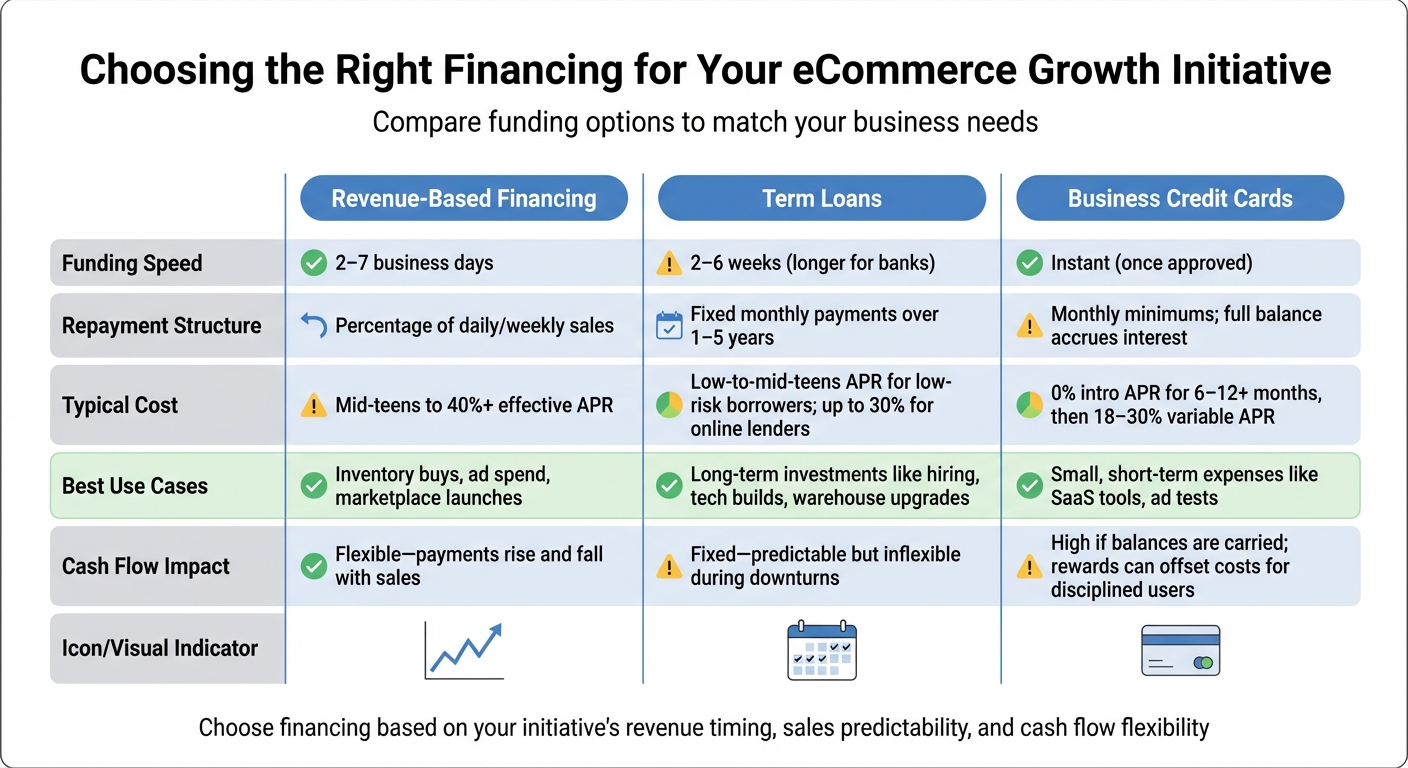
Matching Financing Options to Initiative Types
After identifying your top growth initiatives, the next step is choosing the best financing option to support them. The key is to align the financing type with the initiative's revenue timing and predictability.
For inventory scaling, such as large seasonal purchases or restocking fast-moving SKUs, inventory financing or short-term working capital loans are ideal. These options allow repayments to sync with your sales cycle [16][17]. If you're planning performance marketing campaigns on platforms like Meta, Google, or Amazon PPC - where returns generally appear within 30 to 90 days - business credit cards with 0% introductory APR periods or revenue-based financing are a good fit. These tools ensure that incremental sales can quickly cover costs [16][17]. For marketplace or channel expansion, like launching on Walmart or building a new DTC site, you'll need a mix of funding. Revenue-based financing works well for variable costs such as ads, while term loans or SBA loans are better suited for long-term investments like hiring or upgrading warehouses [17].
When assessing financing, don’t just focus on interest rates. Calculate the effective APR by including all fees and rates to make accurate comparisons [16][17]. Also, consider other factors like origination fees, platform charges, and penalties for prepayment or late payments. Think about how volatile your sales are and whether you can handle fixed payments during slower months. If you value retaining full ownership, equity financing may not be the best choice, even if it comes with strategic guidance. Businesses with seasonal sales often benefit from flexible options like revenue-based financing, while those with steadier cash flow can manage lower-cost term loans [16][17].
Using Onramp Funds for Growth
Onramp Funds specializes in sales-adjusted financing tailored to eCommerce businesses, making it a strong option for initiatives like inventory scaling, marketing campaigns, and marketplace expansion. Onramp provides capital based on your sales performance and collects repayments as a percentage of daily sales, ensuring that cash outflows stay aligned with your business cycles [16][17].
For inventory scaling, Onramp allows you to place larger purchase orders - especially before peak seasons - without worrying about fixed payments during slower periods. When funding marketing campaigns, you can confidently scale your ad spend, knowing that repayments will align with the revenue generated. And for marketplace expansion, Onramp's repayment model adjusts to channel performance, so if your Amazon or Walmart launch grows more slowly than expected, your payment obligations decrease accordingly [17].
Onramp integrates seamlessly with major eCommerce platforms like Amazon, Shopify, Walmart Marketplace, and TikTok Shop through read-only API connections. This setup enables fast pre-qualification - often within 10 minutes - and funding within 24 hours. Their fee structure is straightforward, featuring a fixed fee (typically 2–8%) with no interest, no recurring monthly bills, and no late charges. Payments adjust automatically with sales, and if there are no sales, no payment is due [15]. Onramp claims its model can save customers an average of 50% compared to traditional financing options [15].
Integrating Financing into Capital Models
Once you’ve chosen the right financing, it’s essential to integrate its terms into your capital model to maintain financial clarity. Record key details like funding amount, fees, repayment structure, and duration, and reflect these in your monthly cash flow forecast as both inflows (when funds are received) and outflows (as repayments). For term loans, repayments are fixed amounts, while for revenue-based financing, calculate repayments as a percentage of projected sales each month [17]. Separating interest and fees from the principal will help you track the true cost of capital and its impact on your net income and free cash flow [18].
When evaluating the ROI of specific initiatives, make sure to include all financing costs - fees, interest, and any discounts - to get an accurate picture of a project’s net benefit [18]. For example, if you’re funding a product launch with a term loan, estimate sales (minus costs like COGS and marketing), subtract operating expenses and loan repayments, and calculate the net cash gain and payback period. Similarly, for a six-month marketing push funded with revenue-based financing, determine the incremental gross profit, subtract ad spend and financing costs, and model repayments as a percentage of the additional revenue [16][18]. This approach ensures you have a clear understanding of whether an initiative will generate enough return to justify the cost of capital.
Monitoring and Adjusting Capital Allocation
After crafting your capital allocation plan, the next crucial step is keeping a close eye on performance. This ensures that every investment stays aligned with your growth goals and delivers the desired returns.
Setting Up Performance Dashboards
To stay on top of your investments, leverage dashboards that combine real-time sales data with ERP systems. These dashboards allow for data-driven decision-making by connecting your eCommerce platforms - like Shopify, Amazon, or Walmart - with financial tracking tools. This integration gives you a clear view of how effectively your capital is working.
Focus on the metrics that truly matter. For instance, when scaling inventory, track inventory turnover to see how quickly stock is selling. For marketing campaigns, measure ROAS (Return on Ad Spend) and CAC (Customer Acquisition Cost) to ensure spending remains efficient. Use SKU-level demand forecasting to identify top-performing products and cut out inventory that isn’t pulling its weight. Additionally, real-time reconciliation of sales, invoices, and funding provides an up-to-date snapshot of cash flow, helping you catch red flags like delayed supplier payments or inventory shortfalls [4].
Set a routine for monthly reviews to compare actual performance against your forecasts. However, avoid overreacting to short-term fluctuations. During these reviews, try scenario modeling to prepare for potential challenges. For example, assess what happens if a product launch falls 20% short of expectations or if you need to increase ad spend by $5,000 to maintain momentum. These insights can guide adjustments to your capital allocation strategy [4].
Reviewing and Reallocating Funds
Once you’ve monitored performance, use those insights to reallocate funds dynamically. This ongoing review process ensures your resources are consistently directed toward initiatives that yield the best ROI. For example, if a marketing campaign aimed for a 4:1 ROAS but only hits 2.5:1, it’s time to either tweak the strategy or reassign the funds. Similarly, if $50,000 invested in breaking into a new marketplace isn’t delivering the anticipated results, consider reallocating that money to a more promising effort.
Make these decisions based on unit economics. Revenue growth alone isn’t enough - if CAC rises faster than Customer Lifetime Value, you risk wasting capital. Using zero-based budgeting can help ensure every dollar is tied to measurable outcomes. Shift funds away from underperforming projects to those with clear, tangible returns. Flexible financing options, like revenue-based financing that adjusts repayments based on sales, can also support this dynamic approach to capital allocation [4]. Regularly fine-tuning your strategy based on real data keeps your focus sharp and aligned with your broader objectives.
Conclusion
Allocating capital to growth initiatives isn’t about jumping at every opportunity - it’s about making every dollar count by relying on data-driven decisions. The process begins with identifying and ranking initiatives based on measurable ROI and strategic alignment, then turning those priorities into actionable budgets. From there, you map out cash flow to understand when money is spent and when it’s expected to return. Metrics like CAC (Customer Acquisition Cost), LTV (Lifetime Value), and contribution margin help estimate returns, while the right financing tools are matched to each initiative’s risk and repayment timeline.
Brands that scale successfully treat their capital like an investment portfolio, ensuring every dollar is tied to a measurable outcome. They actively track performance through dashboards that monitor key metrics like ROAS (Return on Ad Spend), inventory turnover, and cash conversion cycles. Funds are reallocated from underperforming projects to those that consistently deliver results. This disciplined, zero-based approach - where every dollar must justify its place - distinguishes companies that grow profitably from those bogged down by inefficient spending.
With CAC climbing 40% over the past two years and profitability taking center stage, disciplined capital management is no longer optional[8]. For instance, improving customer retention by just 5% can increase profitability by 25–95%, which is why leading businesses are now channeling more resources into retention strategies, loyalty programs, and owned channels rather than spreading capital thin across too many initiatives[8].
Put this framework into action immediately. Start small: choose one upcoming initiative - whether it’s scaling a high-performing ad campaign or launching a new product line - and apply this method. Define a clear goal, estimate the capital required in concrete terms (e.g., $100,000 over six months), select the right financing option, set measurable targets, and create a plan to monitor progress. Use this first project as a test case, then expand the approach across your entire growth strategy. By refining and optimizing based on early results, you’ll set the stage for smarter and more profitable capital allocation moving forward.
FAQs
How can I prioritize the best growth opportunities for my eCommerce business?
To identify and act on growth opportunities effectively, start by building a prioritization matrix. Evaluate each initiative using three key factors: impact (like potential revenue or ROI), effort (considering budget, time, or resources), and urgency (such as seasonal trends or competitive pressures). Assign a score to each factor (e.g., 1-5), tally the total, and focus on initiatives that promise high impact with minimal effort. These "quick wins" should take precedence, while high-impact but high-effort projects can be scheduled as longer-term goals.
Make sure your initiatives align with clear and measurable business objectives - whether that's boosting quarterly sales by 15% or increasing repeat purchase rates by 20%. Leverage metrics like customer acquisition costs (CAC), lifetime value (CLV), and conversion rates to estimate potential outcomes. Before fully committing, test smaller-scale versions of your plans to confirm their effectiveness. Keep a close eye on performance, adjust priorities as needed, and channel resources into projects that deliver the strongest ROI. This structured method ensures your investments lead to meaningful growth in your eCommerce business.
How can I align my funding needs with specific growth goals?
To align your funding needs with your growth objectives, start by clearly defining your goals using the SMART framework - making them specific, measurable, achievable, relevant, and time-bound. Once you have a well-defined goal, identify the key performance indicators (KPIs) that will directly measure its success. For instance, if you're working on expanding your product lines, focus on metrics like projected revenue growth, gross margin, and inventory turnover. If your goal involves launching marketing campaigns, track metrics such as customer acquisition cost (CAC), return on ad spend (ROAS), and customer lifetime value (LTV). Assign each KPI to a specific budget line and forecast how these initiatives will influence cash flow, profitability, and overall capital requirements.
It's essential to regularly monitor these metrics to ensure your plan stays on course. Tools like financial dashboards can help you compare actual performance against your forecasts and make adjustments as needed. For example, if a marketing campaign isn't hitting its ROAS target, you could shift funds to channels that are performing better. By consistently reviewing and refining your strategy, you can make sure every dollar is contributing to measurable progress and driving meaningful growth.
What’s the best way to choose financing for my growth goals?
To choose the best financing option for your growth plans, start by assessing your current revenue, the stage of your business, and how you intend to use the funds. For instance, if you're planning to expand your product line or launch a seasonal marketing campaign, you'll need financing that can adapt to fluctuating sales. On the other hand, for larger, long-term initiatives like entering a new market or upgrading infrastructure, a fixed-payment loan might be a better match.
Steps to help you decide:
- Clarify your goal and funding needs: Determine exactly how much you need and what it’s for - whether it’s inventory, marketing, or infrastructure upgrades.
- Align repayment with cash flow: Flexible options like revenue-based financing are ideal for businesses with variable sales, while traditional loans work better for steady, predictable revenue streams.
- Weigh costs and timelines: Quick funding often comes with higher fees, but it can be worthwhile for short-term needs where speed is critical.
By matching your financing to your cash flow and growth strategy, you can make smarter investments, handle repayments without stress, and optimize your return on investment.
Related Blog Posts
Onramp Funds
Funding built around your sales
Connect your store and see what you qualify for. Repay as a percentage of sales, with no personal credit check.
Funding in as little as 24 hours.
