


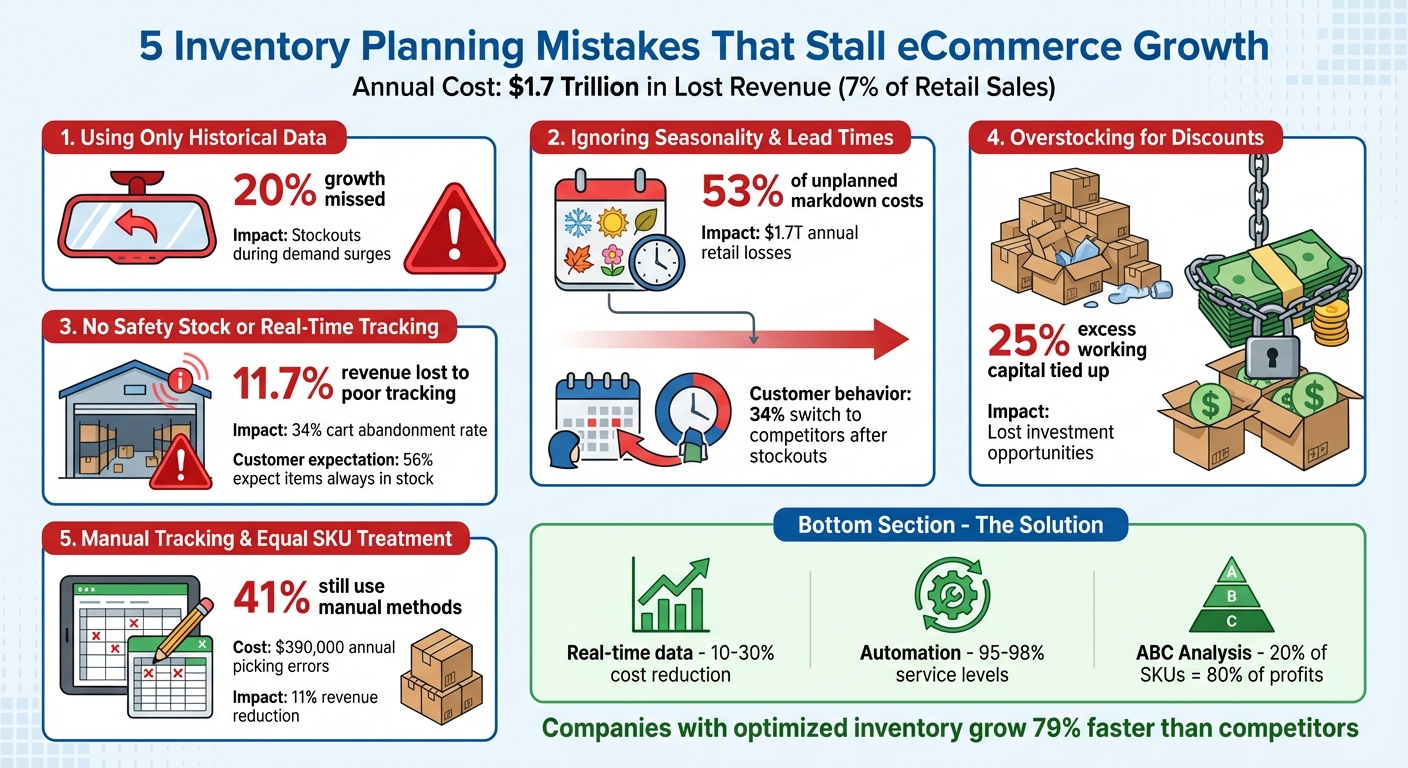
Inventory planning mistakes can quietly drain your profits and stall your eCommerce growth. Businesses lose billions annually to stockouts, overstocks, and outdated management methods. Without proper systems, you risk tying up cash in unsold inventory, losing customers due to stockouts, and wasting time fixing errors instead of focusing on growth.
Here’s what you need to know:
- Stockouts cost sales and customer trust: 70% of shoppers won’t return after encountering out-of-stock items.
- Overstocking locks up cash: Excess inventory ties up working capital, inflates storage costs, and leads to markdown losses.
- Outdated methods fail as you scale: Manual tracking and spreadsheets can’t handle growing multichannel operations.
- Seasonality and supplier delays matter: Ignoring trends and lead times causes costly mismatches in stock levels.
- Real-time data and automation are key: Tools that sync inventory and forecast demand reduce errors and improve efficiency.
The solution? Use real-time data, automate processes, and calculate safety stock to avoid costly mistakes. With proper inventory systems, you can cut costs, improve cash flow, and maintain customer satisfaction.
Keep reading for actionable tips to fix these common mistakes and create scalable systems for long-term growth.
Top 10 Inventory Management Mistakes | Inventory Management Problems With Solutions
Mistake 1: Using Only Historical Sales Data
It's easy to rely on last year's sales figures - they're familiar and readily available. But here's the problem: historical data only reveals what already happened. It doesn't prepare you for what's coming next. If your business grows 20% year-over-year, sticking to last year's numbers alone could leave you scrambling to meet demand during busy periods[7].
Historical data also misses unpredictable surges, like the sudden impact of an influencer mention or a viral post, which can quickly drain your safety stock[7][8]. Add supplier lead time variability to the mix, and the risks grow even larger. A vendor might promise a 30-day lead time, but global supply chain issues could push that to 45 or even 60 days[8][5]. If your forecast assumes everything will arrive on time, you’re setting yourself up for stockouts when delays strike.
"Hope is not a strategy." - Inventory Planner[8]
Think of historical data as a rearview mirror - it tells you where you've been but offers no insight into what’s ahead. To avoid blind spots, you need to incorporate real-time data into your planning.
Solution: Use Real-Time Data and Market Insights
Combine real-time sales data and external market trends with your historical baseline to create a clearer picture. For instance, if your business is growing at 20% this year, adjust your historical numbers upward by 1.20 to reflect that growth[7].
Don’t forget to factor in your marketing calendar. Whether you're gearing up for Black Friday or introducing a new product line, your forecast should account for the demand spikes these events will create[9][5]. A great example is Reiss Edgerton, CEO of AYBL, a $30 million athleisure brand. By automating replenishment and demand forecasting, his team saved around 100 hours per month on merchandising and purchasing tasks[8].
Another key metric to track is "days of inventory coverage", which measures how long your stock will last at your current sales pace. This approach helps you maintain a buffer against delays. For example, if your supplier's lead time is 30 days, aim to keep at least 45 days’ worth of stock for your top-selling items[7].
When demand spikes, cash flow often becomes a bottleneck. Flexible financing options can be a lifesaver, allowing you to scale your inventory without cutting into funds needed for marketing, payroll, or other growth areas. Companies like Onramp Funds offer quick access to capital during these critical periods, so you don’t have to choose between staying stocked and staying solvent[4].
Mistake 2: Overlooking Seasonality and Supplier Lead Times
Sales often follow seasonal trends - soaring during holidays and slowing down in off-seasons. Yet, many sellers assume demand remains steady year-round, leading to overstocking after peak seasons or running out of stock during high-demand periods. These mismatches become even riskier when coupled with unreliable supplier lead times.
Supplier delays can make the problem worse. For instance, a vendor might promise a 30-day delivery but take longer, leaving you with delayed shipments that miss critical events like Black Friday. This can lock up cash flow and frustrate customers. Globally, inventory mismanagement costs retailers an estimated $1.7 trillion annually, or 7% of sales. Even worse, 34% of customers switch to competitors when they encounter out-of-stock items [3][14].
Poor inventory planning also contributes to 53% of unplanned markdown costs [1]. Overstocking ties up valuable capital, while stock shortages lead to expensive backorders and rushed shipping.
To avoid these pitfalls, it’s essential to align your inventory planning with both seasonal trends and supplier lead times.
Solution: Build Seasonal Demand Models
Here’s how to tackle the challenges of seasonality and lead times effectively.
Start by comparing the right time frames. For example, when forecasting Q4 2025, use data from Q4 2024 instead of Q3 2025. This ensures you account for recurring patterns like holiday shopping surges [12][7]. If your business grew 20% this year, adjust last year’s daily sales figures by multiplying them by 1.20 to reflect that growth [7].
Next, calculate your lead time demand. Multiply your supplier’s average lead time (in days) by your average daily sales. For instance, if your supplier’s lead time is 30 days and you sell 50 units daily, you’ll need 1,500 units to cover that period [12]. To prepare for unexpected spikes or delays, calculate safety stock using this formula: (Maximum Daily Sales × Maximum Lead Time) – Lead Time Demand. This buffer ensures you’re ready for demand surges or shipment hiccups [12].
Finally, organize your inventory with ABC segmentation. Focus your resources on "A" items - typically the 15% of products that generate 70% of your sales. These items require daily monitoring and should always be well-stocked. "B" items, which usually make up 20% of your inventory and account for 20% of sales, can be reviewed weekly. Meanwhile, "C" items - around 65% of your products but only 10% of sales - can be checked monthly [13]. This system ensures you invest in fast-moving products while minimizing excess stock of slower sellers.
Mistake 3: Skipping Safety Stock and Real-Time Inventory Tracking
Operating without safety stock is like driving without insurance - risky and potentially costly. Many eCommerce businesses assume their forecasts are spot-on and their suppliers will always deliver on time. But what happens when a flash sale boosts orders by 40% or more? Those top-selling products can disappear in days [15]. Without a buffer, you’re left scrambling to explain stockouts to frustrated customers.
The situation becomes even more challenging when selling on multiple platforms. Unsynced inventory data can lead to overstocking, stockouts, and unnecessary returns, which together account for 11.7% of lost revenue for retailers [1]. And here’s the kicker: 34% of shoppers abandon their carts entirely when an item is out of stock [14].
"Misjudged inventory decisions account for an estimated 53% of unplanned markdown costs." - Coresight Research [1]
Real-time inventory tracking is essential to avoid confusing in-transit or reserved stock with available inventory. When your data is outdated by even a few hours, you risk making decisions that hurt your business. Automated replenishment systems and alerts can help recover up to 30% of revenue lost to stockouts [15].
The stakes are even higher during peak shopping periods. With 56% of consumers expecting online retailers to always have products in stock and ready to ship [14], failing to meet this expectation doesn’t just cost you a sale - it damages customer trust. That’s why calculating safety stock accurately and centralizing inventory tracking are so critical.
Solution: Calculate Safety Stock and Centralize Inventory Tracking
First, stop guessing and start calculating safety stock using a reliable formula:
(Maximum Daily Sales × Maximum Lead Time) – (Average Daily Sales × Average Lead Time) [11]
For example, if your maximum daily sales are 80 units and your maximum lead time is 45 days, while your average daily sales are 50 units with an average lead time of 30 days, your safety stock should be 2,100 units. This buffer shields you from sudden demand surges and supplier delays.
Next, determine your reorder point with this formula:
(Sales Velocity × Lead Time) + Safety Stock [11]
Let’s say you sell 50 units daily with a 30-day lead time and maintain 2,100 units of safety stock. You’d need to reorder when inventory drops to 3,600 units. This ensures you don’t run out while waiting for the next shipment.
To minimize inventory issues further, integrate a centralized tracking system. This system should instantly update inventory across all your sales platforms - whether it’s Amazon, Shopify, or TikTok Shop - as well as your warehouse. Choose tools that provide a consolidated view of on-hand, in-transit, and reserved inventory on a single dashboard [5]. With this setup, you can make smarter decisions about promotions, restocking, and fulfillment.
Take GadgetWorks, for instance. This electronics retailer faced a 12% daily stock discrepancy across four marketplaces, costing them $75,000 in lost sales during a crucial period. After implementing a centralized inventory solution, they reduced discrepancies to under 2% and recovered $40,000 in revenue the following year [2].
Lastly, focus on your high-performing products using ABC analysis. Allocate more safety stock to “A” category items - the 20% of SKUs that drive 80% of your profits [23,21]. These items deserve daily monitoring and generous stock levels. Meanwhile, “C” items can be managed with leaner inventory and less frequent reviews. This targeted strategy helps maintain service levels between 95% and 98% [3].
sbb-itb-d7b5115
Mistake 4: Overstocking for Supplier Discounts or Fear-Based Buying
Overstocking, whether driven by tempting supplier discounts or panic-induced decisions, can seriously disrupt effective inventory management.
Supplier bulk discounts may look appealing at first glance, but they often come with hidden costs. By tying up your working capital in inventory that moves slower than expected, you lose the chance to invest in other growth areas like marketing or expanding your product line. Plus, the longer inventory sits unsold, the higher the holding costs - think warehouse rent, utilities, and insurance. If market trends shift or the product becomes obsolete, you risk ending up with dead stock that’s nearly impossible to sell.
Panic buying, on the other hand, is often a reaction to fear - fear of stockouts or being delisted from major platforms. While the intention is to stay ahead of demand, the result can be excessive inventory. Companies that over-order in this way may carry up to 25% more working capital in unsold inventory compared to their more efficient competitors [2]. Instead of fueling growth, that excess cash sits idle in unsold goods.
"Inventory distortion from overstocks and stockouts drains an estimated $1.7 trillion each year - about 7% of retail sales." - IHL [3]
When businesses find themselves with too much stock, they often resort to deep markdowns to clear it out. While this might move inventory, it cuts into profit margins and reflects a struggle to stay afloat rather than a sign of sustainable growth.
Solution: Track Inventory Turnover and Key Metrics
To avoid these pitfalls, focus on aligning your inventory orders with actual performance data.
Start by monitoring your inventory turnover ratio. A low turnover rate indicates that too much capital is tied up in unsold stock, limiting your ability to reinvest in other areas. Run aging reports monthly to flag SKUs that haven’t moved in 60 to 90 days. This gives you a chance to address slow-moving items before they become a bigger problem.
Before jumping on a supplier discount, calculate your total landed cost. Factor in everything - unit price, shipping, tariffs, handling, and storage fees - and weigh this against the expected holding costs. This ensures that the discount won’t cost you more in the long run.
Use ABC analysis to segment your inventory effectively. Focus larger orders on your high-performing “A” items - the roughly 20% of SKUs that generate about 80% of your profits. Be more cautious with lower-margin or slow-moving products to avoid unnecessary overstock.
If traditional bulk buying feels too rigid, consider revenue-based financing options. For example, Onramp Funds offers working capital tied to your actual sales performance. This approach allows you to maintain optimal stock levels while repayments adjust automatically based on your sales, giving you flexibility without the burden of inflexible debt.
Mistake 5: Managing Inventory Manually and Treating All SKUs the Same
Relying on manual inventory management can create serious blind spots that negatively impact your business. When you're manually tracking stock across platforms like Amazon, Shopify, and Walmart, you're opening the door to issues like overselling, canceled orders, and even losing your Buy Box eligibility. Surprisingly, 41% of businesses are still using manual methods to monitor inventory levels [16]. Without real-time updates, a sale on one platform might not sync with others, leading to chaos [2].
Another downside of manual tracking is treating all SKUs equally. This approach wastes resources on underperforming items while ignoring the bestsellers - the 20% of products that typically generate 80% of your profits. As a result, cash gets tied up in slow-moving inventory, while your top-performing items risk running out of stock. On top of that, manual warehouses are prone to picking errors, costing businesses an average of $390,000 annually [10]. Poor inventory management can even slash annual revenue by 11% [16]. Instead of focusing on growth, teams often find themselves stuck fixing daily errors caused by outdated systems [2].
Solution: Automate Processes and Prioritize High-Performing SKUs
Automation offers a clear path to solving these challenges. Cloud-based inventory management software can sync stock levels across all your sales channels in real time, helping you avoid overselling before it becomes an issue [10][17]. For example, when a customer purchases an item on one platform, the system automatically updates inventory across your other channels.
To make the most of automation, start with an ABC analysis to categorize your SKUs. Here's how it works:
- "A" items: These are your top performers - the 20% of products driving 80% of your profits. Monitor these daily and set precise reorder points.
- "B" items: Mid-tier products that might only need weekly check-ins.
- "C" items: Low-cost, high-volume items that can be managed with automated replenishment alerts [17][18].
This strategy ensures your resources are focused where they deliver the highest return.
Take HomeGoods Direct as an example. By switching to a cloud-based inventory platform, they reduced stock discrepancies from 9% to just 1.2% in six months. This freed up $200,000 in working capital, which they reinvested to launch two new product lines, generating an additional $350,000 in annual revenue [2].
Automation also supports practices like cycle counting - small, ongoing inventory checks that maintain accuracy without disrupting daily operations. Instead of relying on a massive annual inventory count, you can continuously verify high-value "A" items while letting software handle routine replenishment for "C" items [17].
If you're generating $3,000 or more in monthly revenue, upgrading to advanced inventory management technology might feel like a big step. However, solutions like Onramp Funds can provide working capital to help you make these upgrades, with repayment terms that align with your sales performance.
"Companies with high-performing inventory management processes are 79% more likely to grow revenue faster than the industry average." - The Retail Exec [5]
How to Improve Inventory Management and Grow Your Business
Mastering inventory management boils down to three key strategies: data-driven forecasting, automation, and flexible financing. By combining historical data, real-time insights, and seasonal trends, you can shift from reacting to planning ahead. This approach not only reduces inventory costs by 10–30%, but it also helps maintain service levels in the 95–98% range [9][3].
Automation plays a crucial role by minimizing manual errors, which can cost businesses up to $390,000 annually. Automated systems centralize inventory updates across all sales channels, preventing overselling and freeing up your team to focus on scaling the business [10]. Pair this with focusing resources on your best-performing products, and you’ll see higher returns on your inventory investments [6][17].
Flexible financing is the lifeline for eCommerce sellers juggling cash flow challenges. Whether capital is tied up in slow-moving inventory or you need to restock popular items ahead of a demand surge, waiting isn’t always an option. Onramp Funds offers revenue-based financing, allowing repayment to align with your actual sales performance. This ensures you can maintain optimal stock levels without draining your operating cash. Together, these strategies tackle common inventory pitfalls head-on, creating a more streamlined and efficient approach to inventory management.
Comparison Table: Inventory Mistakes and Their Effects
The table below highlights common inventory mistakes, their impact, and how financing solutions can help mitigate these challenges:
Conclusion
Inventory planning mistakes can quietly drain your cash flow, damage customer trust, and stunt your business's growth. The financial impact of inventory mismanagement is clear - losses caused by inventory distortion are staggering [5]. Whether it's cash tied up in slow-moving products or scrambling to recover from stockouts, these challenges can bring growth to a halt [3]. The first step toward fixing these issues is recognizing where things are going wrong.
A well-thought-out strategy that uses real-time data, automation, and strategic financing can make all the difference. Companies that treat inventory as a strategic asset see revenue growth 79% faster than their competitors [5]. This approach underscores the article’s key takeaway: smart inventory management is the gateway to scalable growth.
Cash flow problems don’t have to slow you down. Onramp Funds offers revenue-based financing tailored to your sales, allowing you to restock quickly or clear excess inventory - often within just 24 hours. This kind of flexibility ensures you can maintain the right inventory levels whether you're selling on Amazon, Shopify, TikTok Shop, or Walmart Marketplace.
Start small - whether it’s recalculating safety stock, automating your reorder process, or centralizing inventory tracking. Each improvement builds on the last, creating a path toward scalable growth. Managing your inventory effectively not only protects your cash flow but also sets the stage for long-term success in eCommerce.
FAQs
How does real-time data help improve inventory management in eCommerce?
Real-time data transforms inventory management into a smoother, more effective process. By offering live updates on sales, stock levels, and shipments, it enables eCommerce businesses to quickly spot fast-selling items, slow-moving products, and when it’s time to reorder. This minimizes the chances of stockouts or overstocking while cutting down on manual errors and improving overall decision-making.
With precise, up-to-the-minute information, businesses can establish accurate reorder points and par levels. This ensures products are replenished just in time, avoiding unnecessary capital being tied up in excess stock. Real-time tracking also enhances demand forecasting, helping businesses respond swiftly to shifts in sales trends and keep inventory costs in check. The result? You’ll always have the right products on hand when customers need them, improving satisfaction and safeguarding your profits.
What are the downsides of relying only on historical sales data for inventory planning?
Relying only on historical sales data for forecasting can be risky. Why? Because past trends often don’t reflect current market realities. Shifts in consumer behavior, the arrival of new competitors, or changing buying habits can throw off predictions. This can lead to overstocking (tying up valuable cash in unsold products) or stockouts (missed sales and frustrated customers).
Historical data also overlooks critical external factors like seasonality, promotional campaigns, or rising trends. Without factoring in real-time demand signals and up-to-date market insights, inventory planning can quickly become a mess. The result? Higher storage costs, missed revenue opportunities, and cash flow challenges that could hold back your growth ambitions.
Why is automating inventory management important for eCommerce growth?
Automating inventory management is a game-changer for eCommerce businesses, tackling common headaches like stockouts, overstocking, and delays in fulfillment. Relying on manual tracking often leads to costly errors that can mess with cash flow, shrink profit margins, and erode customer trust. Automation, on the other hand, provides real-time insights into stock levels across all sales channels, helping businesses sidestep these pitfalls and operate more efficiently.
With automated tools, businesses can tap into features like AI-powered demand forecasting and safety stock calculations. These tools make it easier to prepare for seasonal surges without tying up too much cash in inventory. The result? Better cash flow, faster order fulfillment, and lower carrying costs. By transforming inventory management into a data-driven, streamlined process, automation allows eCommerce businesses to grow, increase revenue, and deliver a better experience for their customers.
Related Blog Posts
Onramp Funds
Funding built around your sales
Connect your store and see what you qualify for. Repay as a percentage of sales, with no personal credit check.
Funding in as little as 24 hours.
