


Running an eCommerce business means juggling two key expenses: inventory reorders and marketing campaigns. Both demand upfront cash, but cash flow delays - like supplier payments due 30-60 days before sales revenue comes in - can make it tough to fund both at the same time. Traditional loans are slow and rigid, leaving many sellers struggling to keep up.
The solution? Revenue-based financing. This approach adjusts repayments based on your sales, providing flexibility to manage cash flow while scaling. Here's how to balance inventory and marketing:
- Calculate Costs: Forecast sales and inventory needs using past data. For example, selling 1,000 units/month at $3/unit requires $18,000 for a 6-month reorder.
- Plan Marketing Budgets: Align ad spend with inventory levels to avoid stockouts. Use metrics like working capital and cash conversion cycles to guide decisions.
- Close Cash Flow Gaps: Identify periods where expenses exceed income and secure fast funding to avoid disruptions. Platforms like Onramp Funds can provide cash in under 24 hours.
- Use Revenue-Based Financing: Repay based on sales, freeing up funds for inventory and ads without rigid monthly payments.
eCommerce Financing Options to Scale Your Business - eCom Week LA 2021
How to Calculate Your Inventory and Marketing Cash Flow Requirements
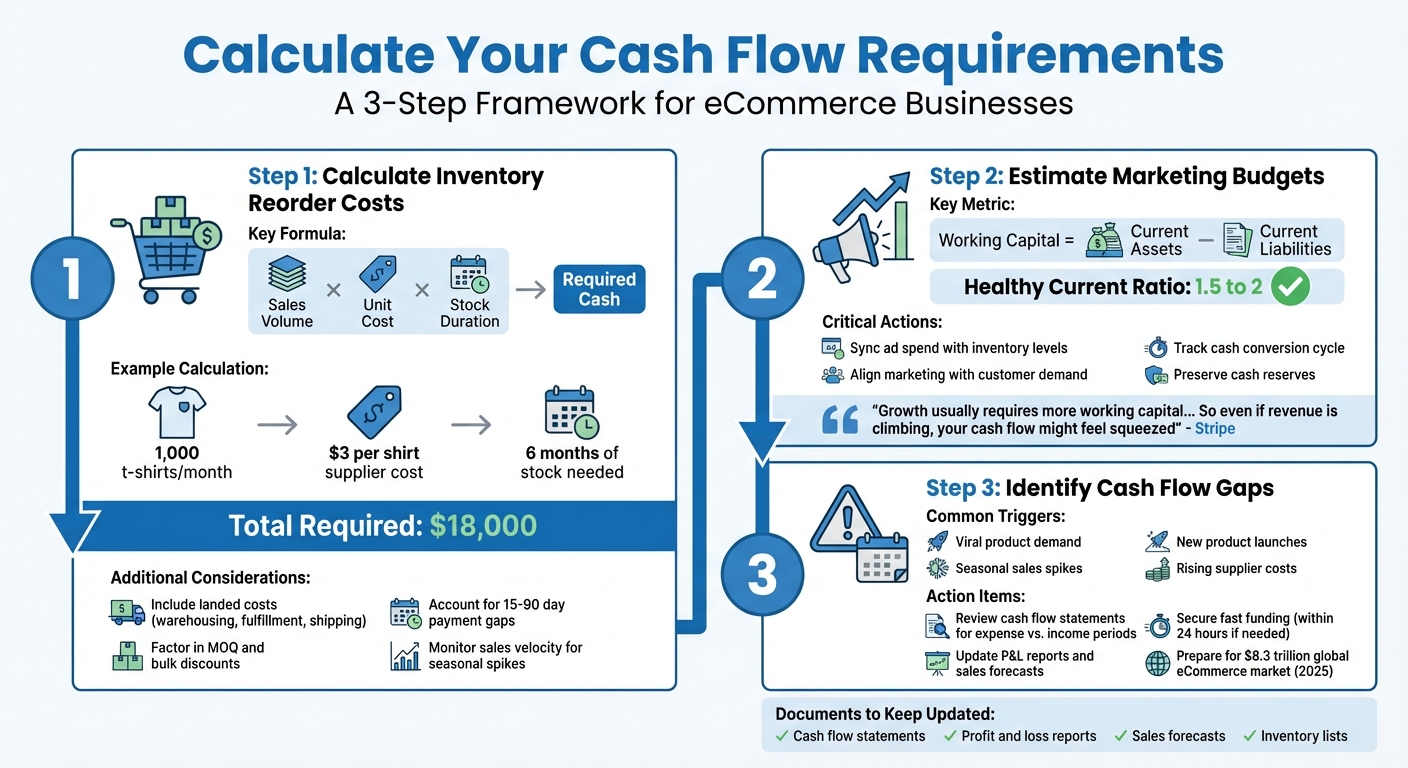
To keep your business running smoothly, you need to figure out how much cash is required for inventory, marketing, and bridging cash flow gaps. Start by estimating inventory costs, planning marketing budgets, and pinpointing periods where cash might be tight. These calculations are key to balancing your operations effectively.
How to Calculate Inventory Reorder Costs
Start by forecasting your sales volume. Look at your revenue and order data from the past 12 months to get a sense of demand trends [2][4]. For example, Shopify shared a model in August 2025 that illustrates this: if you plan to sell 1,000 t-shirts per month, with a supplier cost of $3 per shirt, and want to hold six months of stock, you’ll need $18,000 to finance the 6,000-unit reorder [2].
Don’t forget to calculate the total landed cost, which includes warehousing, fulfillment, and shipping fees. Also, consider your supplier's Minimum Order Quantities (MOQ) and whether bulk discounts justify the cost of financing a larger order [1][2][4].
One of the biggest challenges is managing the time gap between paying suppliers and receiving payouts from marketplaces. This gap can range from 15 to 90 days, with marketplaces often delaying payments by 14 to 30 days [4]. Keep an eye on your sales velocity to adjust reorder schedules and avoid running out of stock or over-ordering [4]. Use historical sales data to prepare for seasonal spikes, and secure financing early to meet rising demand [2]. Once you’ve nailed down your inventory costs, you can focus on aligning your marketing spend with your available cash.
How to Estimate Marketing Budgets for Growth
Your marketing budget should match your liquidity and growth goals. To figure out how much you can afford to spend, calculate your working capital by subtracting current liabilities from current assets [5]. A healthy current ratio - current assets divided by current liabilities - typically ranges between 1.5 and 2 [5].
"Growth usually requires more working capital: more inventory to meet demand, more receivables as sales grow. So even if revenue is climbing, your cash flow might feel squeezed - you're investing ahead of the curve and waiting for that money to cycle back." – Stripe [5]
It’s important to sync your marketing efforts with your inventory levels. Aggressive ad campaigns won’t help if you don’t have enough stock to fulfill orders. Plan your marketing spend around expected customer demand to preserve cash reserves [5]. Keep track of your cash conversion cycle - the time it takes to turn investments in marketing and inventory back into cash. A shorter cycle reduces the need for large cash reserves or external funding [5]. This careful balance helps you bridge the gap between upfront marketing expenses and delayed customer payments.
How to Identify Cash Flow Gaps
Cash flow gaps occur when operational costs tie up your capital, leaving you unable to purchase inventory to meet demand [2]. These gaps can happen for many reasons, like a sudden viral product, seasonal sales spikes, new product launches, or rising supplier costs [1][2].
Use your cash flow statements to spot periods when your expenses exceed incoming cash. For example, this might happen during a large ad campaign or when supplier payments are due before you receive marketplace payouts. With global eCommerce sales expected to surpass $8.3 trillion in 2025 [4], competition is fierce. If you can’t fund both inventory and marketing, you risk losing growth opportunities to competitors.
To stay ahead, keep your cash flow statements, profit and loss reports, sales forecasts, and inventory lists updated. If you need immediate funding to prevent stockouts, look for lenders who can provide cash within one business day, even if it means paying slightly higher interest rates [2]. Having access to fast funding can make all the difference when it comes to seizing growth opportunities.
How Onramp Funds Provides Revenue-Based Financing

Onramp Funds offers a smart financing solution tailored specifically for eCommerce businesses facing cash flow challenges. Designed to support sellers who need funding for both inventory and marketing, this platform operates on a revenue-based model. That means your repayment adjusts according to your actual sales, helping you sidestep the stress of fixed monthly payments [6][7].
What’s more, the financing is 100% equity-free, so you retain full ownership of your business [7]. With over 3,000 loans facilitated, Onramp customers have reported an average revenue growth of 73% within just 180 days of receiving funding [7]. The platform also boasts an A+ rating with the Better Business Bureau and a "Great" score on Trustpilot based on 220 reviews [7]. Let’s dive into how the application process works, who qualifies, and why this financing model stands out.
The Onramp Funds Application Process
Securing funding through Onramp is fast - less than 24 hours from start to finish. Here’s how it works:
- Step 1: Answer a few quick questions to get an initial estimate in just one minute [7].
- Step 2: Connect your eCommerce store (Amazon, Shopify, Walmart, or another supported platform) securely in about five minutes using read-only access [7]. Onramp reviews your sales history and cash flow data - no personal credit checks involved.
- Step 3: Link your bank account to receive multiple funding offers within 24 hours. Once you choose the terms that suit your needs, funds are typically deposited into your account within hours [7].
"Applied, got our offer, and had cash in our bank account within 24 hours." – Nick James, CEO of Rockless Table [7]
Eligibility Requirements and Supported Platforms
Qualifying for Onramp financing is straightforward. Your business must:
- Be a U.S.-based legal entity (LLC, C-Corp, etc.).
- Have at least $10,000 in average monthly sales [7].
There’s no minimum requirement for how long you’ve been in business, making this an excellent option for newer sellers who are already generating consistent revenue.
Onramp supports a variety of platforms, including Amazon, Shopify, Walmart, TikTok Shop, WooCommerce, BigCommerce, Squarespace, Shopline, and Stripe [7]. If you operate multiple stores, connecting them all can provide a more complete sales history, potentially increasing your funding offer. The connection process is secure, using read-only access to protect your data.
Benefits of Revenue-Based Financing
Onramp’s revenue-based financing offers several advantages that make it ideal for eCommerce sellers aiming to grow without taking on unnecessary risk:
- Flexible repayments: Payments automatically adjust based on your sales and can be made daily, weekly, or biweekly [6][1].
- Transparent fees: There are no hidden costs, and terms typically range from 1 to 6 months [6].
- No collateral required: Financing is unsecured, so you don’t need to pledge assets or provide personal guarantees.
This model’s flexibility and ease of use have earned Onramp a loyal customer base - 75% of borrowers return for additional funding [7].
| Feature | Variable (Revenue-Based) | Fixed Repayment |
|---|---|---|
| Best For | Inventory, marketing, and cash flow management | Scaling businesses with steady growth |
| Repayment Structure | Percentage of sales (adjustable) | Fixed, predictable amounts |
| Repayment Cadence | Daily, weekly, or biweekly | Regular intervals |
| Term Length | 1–6 months | 1–6 months |
| Collateral | Unsecured | Unsecured |
| Fees | One clear fee | One clear fee |
"Onramp offered the perfect solution with revenue-based financing to secure the capital we needed to invest in inventory and pay it back at a reasonable time frame once we made sales." – Jeremy, Founder and Owner of Kindfolk Yoga [7]
sbb-itb-d7b5115
How to Balance Inventory and Marketing Spending
Once you’ve secured financing, the next step is splitting those funds wisely to keep your inventory moving and your marketing efforts thriving. The aim is simple: invest in products that sell fast and fuel the marketing campaigns that help drive those sales. With accurate cash flow estimates in hand, it’s time to strategically allocate your budget for maximum impact.
Focus on Fast-Selling Products First
Using your cash flow calculations, prioritize funding for products with high turnover rates. These items generate revenue quickly and help minimize carrying costs. To calculate turnover, divide the cost of goods sold (COGS) by your average inventory. Products with higher turnover ratios should take priority when deciding what to restock [9].
Fast-selling products not only boost cash flow but also help you avoid excessive carrying costs, which can range from 20% to 30% of your inventory’s value annually [9]. By focusing on these items, you free up cash faster, allowing you to reinvest in new stock or marketing initiatives [8][10].
"Don't choose between investing in growth activities and producing inventory. Using inventory funding unlocks cash usually tied to inventory purchases to invest in the areas you need for growth." – James Humphreys, Head of Content Marketing, Katana [8]
How to Allocate Budgets for Maximum Returns
After securing your fast-moving inventory, the next step is fine-tuning your budget allocation. Seasonal demand plays a big role here - invest more in inventory during peak periods and shift funds toward marketing during quieter months. Experts recommend requesting around 20% extra financing to handle any unexpected costs [9].
Be cautious about over-investing in seasonal items too early. For example, stocking up on summer products during winter means you’ll be paying for storage and interest long before you see any sales [9]. Align your financing with your revenue cycles to keep cash flow optimized.
"It is a good business practice to never fully utilize your cash on hand for current expenses, such as buying inventory. This can leave your business exposed in case of unforeseen events and expenses." – Concetta Farina, Account Manager, Virtual Business Centre, BDC [9]
Tools for Forecasting Demand and Tracking Performance
Accurate forecasting is key to avoiding costly mistakes like overstocking or running out of popular items. Start by calculating projected sales volumes over specific timeframes. For instance, if you expect to sell 1,000 units per month, and you’re planning for six months, you’ll need to order 6,000 units [2]. Work closely with suppliers to get precise reorder costs, and maintain an updated inventory list to avoid surprises [2].
Modern tools make forecasting and tracking easier than ever. Platforms that analyze real-time sales data allow you to adjust your capital allocation as your business evolves [1]. Some financing solutions even use machine learning to assess when you’re eligible for additional capital based on your sales performance [3]. To streamline the funding process, have updated cash flow statements, profit and loss reports, and sales forecasts ready - lenders rely on these documents for quick approvals [2][9].
How to Maintain Growth with Onramp Funds
How Revenue-Based Repayments Work
Revenue-based repayments adjust with your sales deposits, meaning you pay a set percentage of your daily or weekly sales until the advance, plus fees, is fully repaid [12]. For example, during a strong sales week, your repayment amount might increase, while slower weeks result in smaller payments [12][13]. This repayment structure typically takes 6–12 months to complete, depending on your average revenue [13].
This system is especially helpful during seasonal fluctuations. For instance, higher holiday sales may lead to larger repayments when cash flow is strong, while slower post-holiday periods automatically reduce payments, helping you manage your operating budget. Unlike fixed repayment plans, this approach adjusts to your business's natural cycles. Onramp Funds customers experience an average of 73% revenue growth within 180 days of partnering, and 75% return for additional funding [7].
This repayment flexibility enables businesses to reinvest strategically in both inventory and marketing.
How to Scale Marketing and Inventory at the Same Time
To grow effectively, divide your funding between high-demand inventory and digital advertising. Use part of your advance to stock up on popular products and allocate the rest to digital ad campaigns. With Onramp's Rolling Cash Line, your borrowing limit grows alongside your sales, allowing you to access capital as often as every two weeks without reapplying [6].
A balanced approach to growth involves reinvesting a portion of your revenue - typically 20–30% - into inventory while using the freed-up cash flow to boost marketing efforts [12]. For example, Nick James, CEO of Rockless Table, accessed funding and had cash in his account within 24 hours, enabling him to quickly invest in expansion opportunities [7].
Additional Resources from Onramp Funds
Onramp Funds offers tools to help you sustain growth while managing cash flow effectively. Their funding calculator estimates how much capital you can access based on your average monthly revenue (minimum $10,000 required). Connecting platforms like Amazon, Shopify, or TikTok Shop can further increase your funding offer [7]. Additionally, the Austin-based support team is available for strategy calls, helping you align funding with your operational needs and seasonal trends [6][7].
The platform has earned an A+ rating from the Better Business Bureau and a "Great" rating on Trustpilot, with over 220 reviews. Customers frequently highlight the convenience of the automated payment system.
"Onramp has simplified cash flow by automating everything: easy to request, set it and forget it payments – quick and fast!" – Torrie V., Founder and Owner, Torrie's Natural [7]
For additional insights, the eComm Experts Corner provides resources like forecasting tools, capital mapping strategies, and advice on choosing the right financing options [11].
Conclusion
Scaling an eCommerce business requires smart cash flow management that keeps pace with your inventory and marketing needs. The trick is to align your financing with actual sales performance, rather than locking yourself into rigid payment schedules that can strain your budget during slower months. Revenue-based financing offers a solution by syncing repayments with your business cycles - paying more when sales are strong and less during off-seasons. This approach ensures you have the stability and flexibility to reinvest in growth when it matters most.
Onramp Funds provides fast access to capital with repayment terms that adjust to your sales performance. By integrating with leading eCommerce platforms, their funding decisions are based on how your store is performing, rather than relying on traditional credit evaluations.
This type of funding gives you the power to allocate resources strategically - focusing on high-performing products and marketing channels that deliver strong customer lifetime value. With the Rolling Cash Line, your funding grows alongside your revenue, creating a reliable funding cycle that supports ongoing growth.
Sustaining long-term success in the eCommerce world hinges on balancing cash flow with growth. Flexible financing not only protects your equity and personal assets but also adapts to the natural rhythm of your business. Whether you're navigating seasonal shifts or seizing new opportunities, the right financing can work with your sales patterns to keep your business thriving.
FAQs
What is revenue-based financing, and how can it help eCommerce businesses?
Revenue-based financing (RBF) offers eCommerce businesses a way to secure funds by trading a portion of their future revenue for an upfront cash injection. Unlike traditional loans with fixed monthly payments or interest rates, RBF repayments are tied to your sales. Typically, businesses repay between 2% and 8% of their gross monthly revenue until a predetermined amount - often 1.3 times the borrowed sum - is fully paid off.
This setup provides a more adaptable option for businesses looking to grow without giving up equity or taking on steep credit card debt. The funds can be used for various needs, such as restocking inventory, launching marketing campaigns, or other growth-related expenses. To qualify, businesses generally need a monthly revenue of $3,000 to $20,000 and a sales history of at least 6 to 12 months. There's no requirement for collateral or personal credit checks, and repayments scale with your cash flow, making RBF especially appealing for seasonal or rapidly growing eCommerce brands.
How can I balance my marketing budget with inventory levels to avoid running out of stock?
To avoid running out of stock while scaling your marketing efforts, start by estimating short-term demand. This involves predicting your upcoming sales and ensuring you have enough inventory to cover that demand, plus a safety margin (typically 1–2 weeks of average sales). If your cash flow is tight, inventory financing can help you secure the stock you need without eating into your marketing budget.
When it comes to marketing, focus your spending on channels with the best return on ad spend (ROAS). Prioritize tried-and-true methods like email campaigns and SEO, which often generate strong results, and set aside smaller budgets to test new strategies. Keep an eye on critical metrics like ROAS, customer acquisition cost (CAC), and inventory levels in real time. This way, you can quickly adjust your spending if stock levels start to dip.
For seasonal spikes, align your inventory planning with your marketing schedule. Use financing options to pre-order stock ahead of high-demand times, such as the holiday season, and ramp up your advertising efforts beforehand. This approach helps maintain healthy cash flow while ensuring you're ready to meet demand without straining your budget.
How can I manage cash flow gaps while scaling my eCommerce business?
To address cash flow gaps, start by getting a clear picture of your financial situation. Calculate your working capital by subtracting current liabilities from current assets - aiming for a ratio between 1.5 and 2. Take a close look at recent sales trends, how quickly your inventory moves, supplier payment terms, and any seasonal fluctuations to pinpoint where cash might be tied up. You can speed up cash inflows by encouraging customers to pay faster, perhaps with early payment incentives, or by using automated invoicing tools. On the flip side, negotiating longer payment terms with suppliers can help balance your revenue and expenses more effectively.
Once you’ve identified the gap, explore financing options that align with your needs. For instance, inventory financing can grant quick access to funds, often within 24 hours, with repayment terms tied to your sales performance. When weighing your choices, consider factors like the total cost, how quickly you can get approval, and whether the financing supports your business goals. Select a solution that bridges the gap without straining your operations, and make it a habit to regularly review your cash flow metrics to anticipate and prevent future shortfalls.
Related Blog Posts
Onramp Funds
Funding built around your sales
Connect your store and see what you qualify for. Repay as a percentage of sales, with no personal credit check.
Funding in as little as 24 hours.
