


Managing inventory while maintaining cash flow is a tough challenge for eCommerce sellers. Over-ordering locks up cash in unsold products, while under-ordering risks stockouts that harm sales. The solution? Smarter financing options and precise inventory management. Here’s the key takeaway:
- Funding Options: Revenue-based financing adjusts repayments to your sales, inventory loans provide upfront funds secured by stock, and supplier credit extends payment terms.
- Management Techniques: Accurate demand forecasting, Just-In-Time ordering, and tracking inventory turnover ratios help avoid overstocking.
- Tools: Platforms like Shopify, QuickBooks, and Onramp Funds streamline inventory tracking and cash flow management, offering real-time insights and fast funding.
Inventory Financing 101: What Business Owners Need to Know
sbb-itb-d7b5115
Flexible Funding Options for eCommerce Sellers
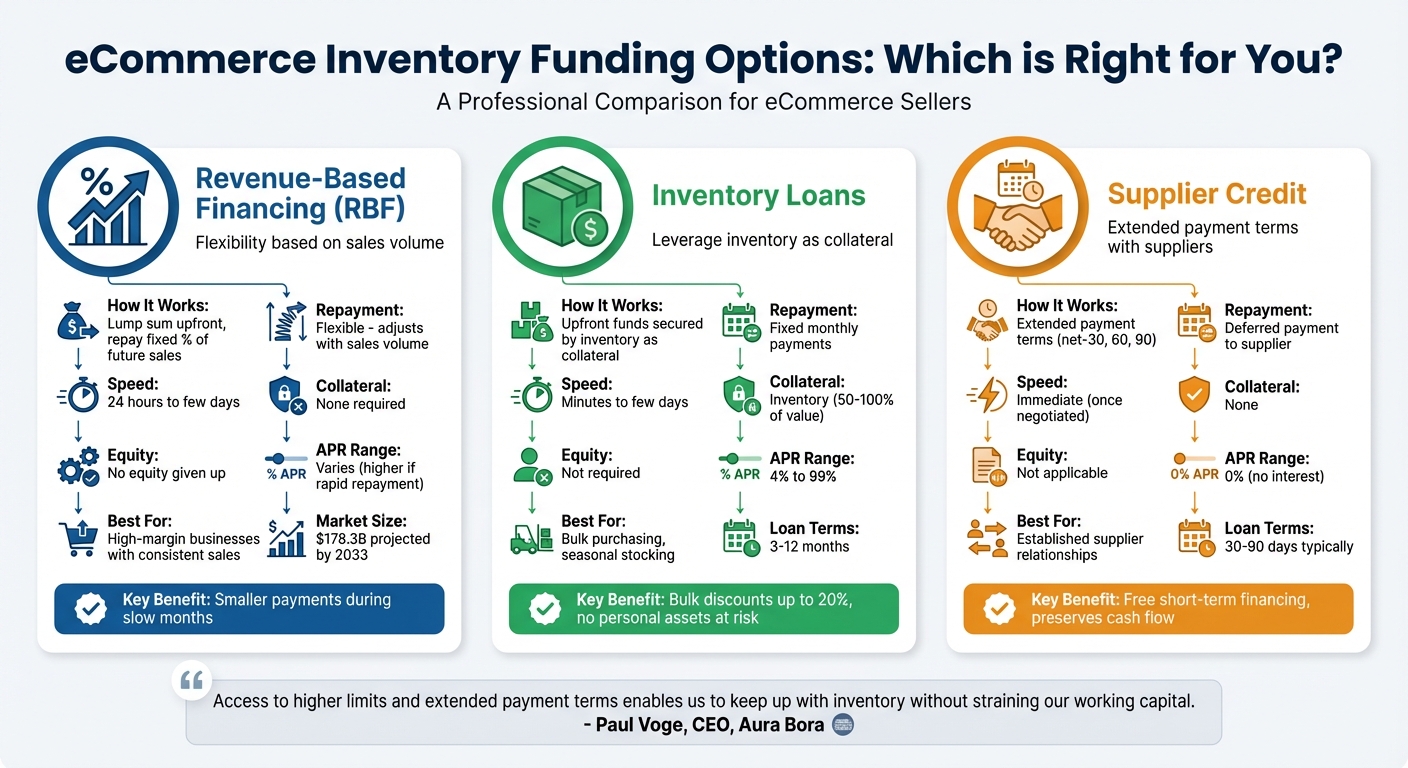
Finding the right funding can be the difference between growing your business smoothly and running into cash flow issues. Unlike traditional bank loans with rigid repayment schedules, some financing options are designed to align with your sales cycles. This means you can access capital when you need it most, without added pressure during slower months. Let’s break down a few funding models that work alongside your sales.
Revenue-Based Financing
Revenue-based financing (RBF) gives you a lump sum upfront in exchange for a fixed percentage of your future sales until the loan and a flat fee are fully repaid [3]. What makes this option appealing is its flexibility - payments adjust based on your sales. Slower months mean smaller payments, which helps ease cash flow concerns, and there’s no need to give up equity or provide personal guarantees [3][4][5][1].
This type of funding relies on real-time sales data, often integrating directly with platforms like Shopify or Amazon. That integration allows for quick funding - sometimes within 24 hours to a few days [3][4]. The RBF market is growing fast, with projections reaching $178.3 billion by 2033 [1].
However, it’s important to calculate the effective cost carefully. If your sales grow quickly, you’ll repay the loan faster, which could result in a higher effective annual percentage rate (APR) [3][5]. RBF is ideal for businesses with high margins that can handle the percentage-of-sales deduction without disrupting operations [3][4]. To improve your chances of approval and secure better terms, ensure your sales data is well-organized, including refund logs and advertising performance metrics [4].
Inventory Loans
Inventory loans provide upfront funding specifically for purchasing stock, with the inventory itself acting as collateral [1][2]. This setup removes the need to risk personal assets and helps bridge the gap between paying suppliers and receiving revenue from customers, typically over 30–90 days [3][5].
These loans can help you take advantage of bulk discounts - sometimes as high as 20% - on large orders, boosting profit margins and lowering per-unit costs [2][3]. Modern fintech platforms make the process even faster, with approvals and funding often completed in minutes to a few days [1][2][4]. Typically, inventory loans cover 50% to 80% of your inventory’s value, though some lenders may offer up to 100% [1][2].
"Access to higher limits and extended payment terms enables us to keep up with inventory without straining our working capital."
– Paul Voge, Co-founder and CEO, Aura Bora [3]
Interest rates for these loans can vary significantly, with APRs ranging from 4% to 99%, depending on the lender and your business’s creditworthiness [2][4]. Loan terms usually last between 3 and 12 months, with fixed monthly payments [2]. Before applying, use sales forecasting tools to predict demand accurately - over-ordering can lead to high storage costs and unnecessary debt if inventory doesn’t sell [1][2]. Always weigh the total cost of the loan against your expected profit margins to ensure it’s a smart financial move.
Supplier Credit and Payment Terms
Flexible supplier arrangements are another way to manage inventory costs. Instead of taking out loans, you can negotiate payment terms like net-30, net-60, or even net-90, allowing you to defer payments and conserve cash flow. This essentially acts as short-term financing, giving you time to sell your products before payment is due.
Building strong relationships with suppliers is essential here. Consistent order volumes and a reliable payment history can help you secure better terms over time. If you’re just starting out or working with new suppliers, you might only get limited terms initially. Start small, prove your reliability, and then renegotiate for more favorable terms as your relationship develops. To make this strategy work, it’s crucial to forecast demand accurately so you’re ordering the right quantities at the right time.
Inventory Management Techniques to Avoid Overstocking
Securing funding is just the beginning - the real challenge lies in ordering the right amount of stock at the right time. Without proper inventory management, even the best financing can result in cash being tied up in unsold products. Here's how to keep your inventory lean and your profits healthy.
Demand Forecasting and Analytics
Forecasting is all about aligning your stock purchases with actual customer demand, helping you avoid both overstocking and running out of popular items. The trick is to go beyond overall sales numbers and dive into SKU-level performance. Which products are flying off the shelves? Which ones are just sitting there? This deeper analysis allows for smarter allocation of your capital [6].
Using integrated data from platforms like Shopify or Amazon can give you a clearer picture of trends. Don’t forget to account for lead times - sometimes you’ll need to place multiple freight orders before your first batch even starts selling [2][4]. The aim here is to avoid tying up your funds in slow-moving inventory, which can rack up unnecessary storage and warehousing costs [2][6].
Once you’ve nailed your forecasting, it’s time to focus on fine-tuning your ordering strategies to keep inventory levels optimized.
Just-In-Time (JIT) Inventory
The Just-In-Time (JIT) method involves ordering stock only as you need it, which helps reduce the risk of overstocking. Instead of filling your warehouse with months’ worth of inventory, you maintain smaller quantities and reorder based on actual sales trends. This approach keeps storage costs down and frees up cash for other priorities [7].
However, JIT isn’t without its challenges. It requires strong relationships with reliable suppliers who can quickly fulfill your orders. Any delays could lead to stockouts, which not only hurt sales but can also damage your marketplace rankings. To mitigate this, consider keeping a small buffer of safety stock for your best-selling items [7].
There’s a trade-off to manage: while JIT minimizes storage costs, it does increase the risk of running out of stock [7]. Keeping a close eye on sales velocity is critical. If sales dip unexpectedly, you could face cash flow issues, which ties back to the importance of proactive financing. As Michael Keenan from Shopify puts it:
"Your goal is to rotate inventory as much as possible to maximize profits. If you have older products that are low sellers, run a sale on them and discontinue the line after it's sold out" [7].
Inventory Turnover Ratios
To complement forecasting and JIT practices, tracking your inventory turnover ratio offers another way to optimize stock management.
This ratio measures how often you sell and replace your inventory over a specific period. A higher turnover ratio means your products are moving quickly, which is exactly what you want.
Regularly calculating this metric helps you identify which products are performing well and which are becoming dead weight. If certain SKUs have low turnover, they’re tying up cash that could be better spent elsewhere. Use this data to adjust your purchasing strategy - order more of what’s selling and scale back on underperformers [6][7].
Pair turnover analysis with your cash conversion cycle, which tracks the time between paying your suppliers and receiving payments from customers. Shortening this cycle can improve liquidity and reduce your dependence on external financing [3][5]. Don’t forget to monitor unit economics as well, ensuring that each product’s profit margin covers costs like storage, financing fees, and other expenses [6][4].
Tools and Platforms for Inventory and Cash Flow Management
Once your inventory strategy is in place, the right tools can streamline stock tracking and financial planning, giving you more time to focus on scaling your business.
Inventory Management Software
Shopify's built-in inventory system provides real-time tracking across all sales channels, seamlessly integrating online and in-store operations. This unified system helps prevent overselling and ensures you have a single, reliable source for inventory data [8].
For businesses managing multiple channels, this kind of integration can be a game-changer. Take Oak + Fort, for example. In August 2025, the apparel brand used Shopify's inventory system to unify its retail operations. The results? They saved 50 labor hours per week and reduced operating costs by 47%. Guillaume Jaillet, their Chief Omnichannel Officer, explained the challenge they overcame:
"It was hard to reliably and accurately represent which stores had certain items in stock to our digital customers when they wanted to try something on" [8].
Similarly, Allbirds adopted Shopify POS and Shopify Plus to build an omnichannel system. According to Travis Boyce, their Head of Global Retail Operations:
"With Shopify Plus, we have our point-of-sale and ecommerce systems under one umbrella, which serves our ultimate purpose of being an omnichannel retailer" [8].
Modern inventory tools like Predik or QuickBooks Enterprise go beyond basic tracking, offering features like automated low-stock alerts and demand forecasting [3][8]. You can even use Shopify Flow to automate tasks, such as triggering purchase orders or sending Slack notifications when inventory reaches a critical level [8].
Cash Flow Management Tools
Managing inventory is only one side of the equation - you also need a clear view of your cash flow. Tools like Brex and Mercury cater specifically to eCommerce businesses, offering features like automated bill payments and high-limit corporate cards. These tools bridge the gap between supplier payments and customer receipts [3].
For instance, Aura Bora, a beverage company led by Co-founder and CEO Paul Voge, leveraged Brex's corporate cards to secure credit limits 30 to 40 times higher than traditional banks like Chase or Amex. This allowed them to fund production runs without straining their working capital. As Voge explained:
"Access to higher limits and extended payment terms enables us to keep up with inventory without straining our working capital" [3].
Mercury provides similar benefits, including working capital loans and the "IO" business credit card, which offers spend management tools designed for growing eCommerce startups [5]. These platforms give you real-time insights into expenses and help you anticipate cash flow needs before they become critical.
Onramp Funds: Tailored Financing for eCommerce Sellers

When you need fast access to capital, Onramp Funds offers a solution built specifically for eCommerce businesses. The platform connects directly to marketplaces like Amazon, Walmart, and Shopify, analyzing your real-time sales data, order volume, and SKU performance to make funding decisions based on your business metrics rather than traditional credit scores [4].
The approval process is quick - often within 24 hours - and repayment is flexible. Payments adjust as a percentage of your sales, decreasing during slower months and scaling up during peak seasons. This revenue-aligned approach eliminates the pressure of fixed monthly loan payments [4].
Onramp Funds also provides equity-free financing, so you retain full ownership of your business while accessing the capital you need to restock popular items or expand into new product lines. Designed for marketplace sellers, it helps you act swiftly on inventory opportunities without tying up cash in slow-moving stock.
Conclusion
Key Takeaways for Sellers
Managing inventory effectively and choosing smart financing options can make a huge difference in scaling your business. Revenue-based financing offers repayment flexibility tied to your sales performance, while inventory loans provide quick access to funds secured by your stock. Supplier credit helps by extending payment terms, which can keep your cash flow healthy [9][13].
On the inventory side, demand forecasting can cut overstock by up to 25%, and Just-in-Time ordering can reduce holding costs by as much as 50%. Keeping an eye on your inventory turnover ratio - ideally between 4 and 6 times annually - helps you spot slow-moving products early [9][12]. Together, these strategies ensure smoother cash flow and create room for faster growth.
The right tools can make these strategies even more effective. Inventory management software offers real-time tracking and automated alerts, while cash flow platforms help you anticipate potential shortfalls. For example, Onramp Funds integrates directly with platforms like Amazon, Shopify, and Walmart, providing financing based on your actual sales data. They offer approvals in just 24 hours and repayments that adjust based on your revenue [4]. Use these tools and insights to guide your next steps confidently.
Next Steps for Scaling Your Business
Turn these strategies into action with clear, measurable steps. Start by auditing your current inventory turnover and using analytics tools to forecast demand. Consider applying for Onramp Funds' revenue-based loans, which range from $10,000 to $500,000. Negotiate 60-day payment terms with key suppliers and adopt Just-in-Time ordering to better manage stock [10][11].
Monitor these key metrics every month:
- Inventory turnover ratio: Aim for 4-6 times per year
- Days sales of inventory: Keep it under 60 days
- Overstock percentage: Maintain less than 10% of your total inventory
One seller saw their inventory turnover improve from 2.5 to 5.2 times in Q1, freeing up $75,000 in capital [9][13]. By taking these steps, your business could grow by 30% or more without tying up cash in excess inventory. Onramp Funds can provide the flexible financing you need to support this kind of sustainable growth.
FAQs
Which funding option fits my sales cycle best?
The best funding choice for your sales cycle hinges on your cash flow and how quickly you turn over inventory. If your sales cycle is short and you need to restock quickly, revenue-based funding could be a good fit since repayments adjust according to your sales. On the other hand, if your cycle is longer, term loans or lines of credit might be more appropriate, offering upfront capital with set repayment terms. Take a close look at your cash flow and sales cycle to determine which option aligns best with your needs.
How do I avoid stockouts with Just-In-Time ordering?
To avoid stockouts when using Just-In-Time (JIT) ordering, prioritize accurate demand forecasting and strong communication with suppliers. Accurate forecasting helps you order the right quantities, minimizing the chances of running out of stock or over-ordering.
Keep an open line of communication with your suppliers and set up consistent delivery schedules to ensure your inventory arrives exactly when needed. Additionally, monitor key metrics like Days Inventory Outstanding (DIO) and analyze demand trends regularly. This allows you to adjust your JIT strategy and keep up with customer demands efficiently.
What metrics should I track to prevent overstock?
Tracking key metrics such as Days Inventory Outstanding (DIO), Days Payables Outstanding (DPO), and Days Sales Outstanding (DSO) is essential for keeping your business operations on track. These metrics offer valuable insights into different aspects of your financial and operational health:
- DIO helps you understand how efficiently your inventory is moving. It shows how long your stock sits before being sold, ensuring you avoid overstocking or running out of products.
- DPO tracks how long you take to pay your suppliers. Managing this timeline effectively can improve cash flow and maintain good supplier relationships.
- DSO measures the average time it takes to collect payment from customers, giving you a clear picture of your sales efficiency and cash collection process.
By monitoring these indicators, you can strike a balance between maintaining adequate inventory, meeting payment obligations, and ensuring smooth cash flow.
Related Blog Posts
Onramp Funds
Funding built around your sales
Connect your store and see what you qualify for. Repay as a percentage of sales, with no personal credit check.
Funding in as little as 24 hours.
