

Platform policies are shifting fast in 2026, and sellers face rising costs, tighter cash flow, and stricter compliance rules. Here's what you need to know:
- Amazon: Increased storage fees ($0.57/cubic foot in the West), tighter inventory limits, and discontinued prep services mean higher costs and more hands-on management.
- Shopify: Subscription and fulfillment fees are up, with added surcharges for non-Shopify Payments users. This impacts profit margins and payment processing choices.
- TikTok Shop: Delayed payouts tied to performance metrics disrupt cash flow, while logistics changes demand upfront investments.
To navigate these challenges, sellers must focus on:
- Cash Flow Management: Use scenario-based models to predict timing gaps and secure funding.
- Diversification: Spread risk across multiple platforms and suppliers.
- Reserves: Maintain 3–6 months of operating expenses for unexpected costs.
- Flexible Financing: Consider revenue-based options that adjust with sales.
Staying ahead requires planning for volatility, monitoring policy updates, and adjusting financial strategies to avoid disruptions.
Recent Platform Policy Changes Affecting Sellers
Shopify Fee Structure Updates

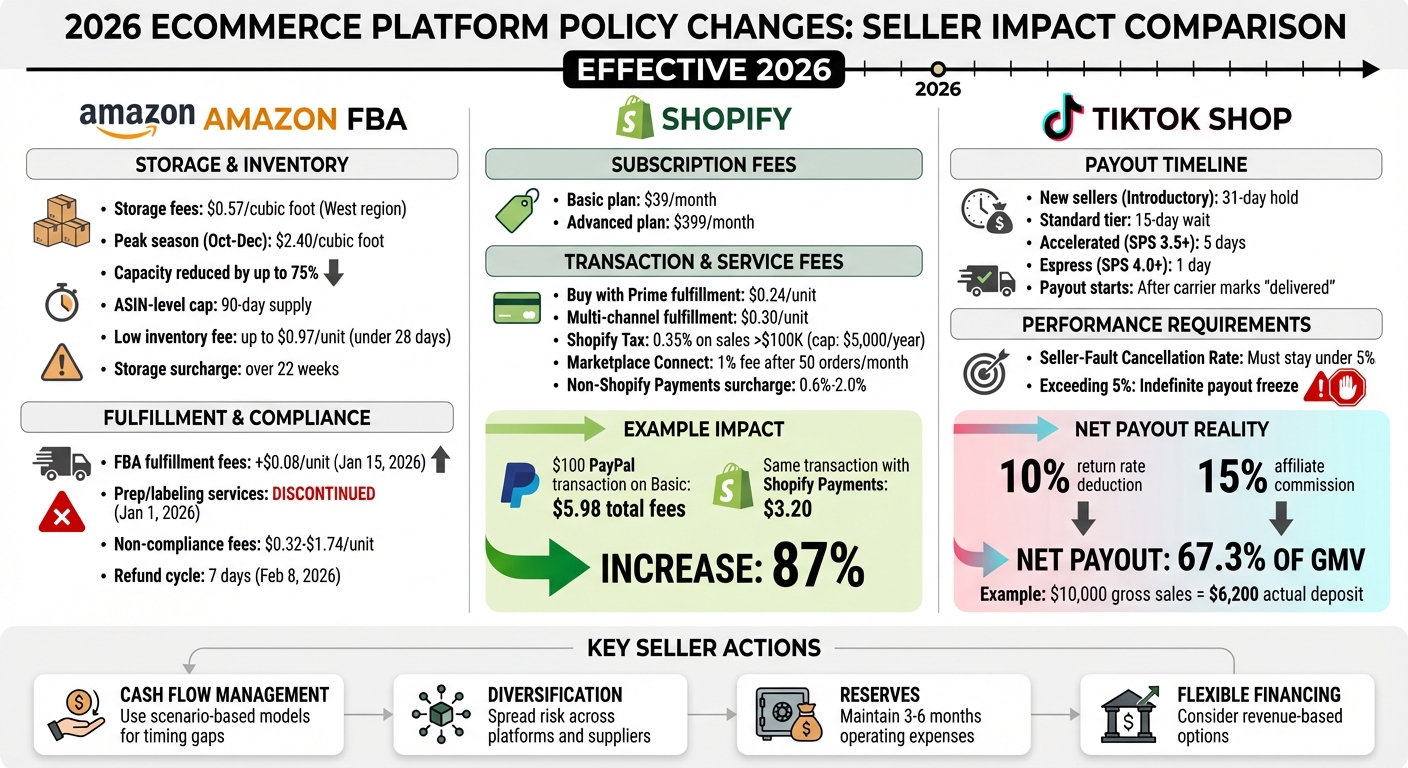
Shopify's updated pricing has put additional pressure on sellers' budgets. The Basic plan now costs $39/month, while the Advanced plan has risen to $399/month [5][6].
Starting January 2026, fulfillment fees have also increased - $0.24 per unit for Buy with Prime and $0.30 per unit for Multi-channel. On top of that, Shopify Tax now applies a 0.35% fee on sales exceeding $100,000, capped at $5,000 annually [1][6]. Sellers using the "Marketplace Connect" feature face a 1% fee on order value after their first 50 orders each month [6].
For those not using Shopify Payments, the platform surcharge of 0.6% to 2.0% adds a significant cost burden [5]. For example, a merchant on the Basic plan processing a $100 PayPal transaction now pays $5.98 in total fees, which is an 87% increase compared to the $3.20 fee for Shopify Payments [5]. This "double-fee" setup forces sellers to either switch payment processors or absorb thinner profit margins.
"The break-even between Basic and Grow sits around $10,000/month in revenue. Below that, Basic wins on total cost because the lower subscription offsets the higher per-transaction rate." - Lasse Lung, CEO & Co-Founder, Qualimero [5]
These changes require sellers to reassess their financial strategies to address rising costs effectively.
Amazon FBA Inventory Restrictions
Amazon has also introduced tighter inventory rules, adding complexity for sellers. In May 2025, Amazon reduced FBA storage capacity by up to 75%, shifting calculations from 6 months to 5 months of projected sales [8]. Additionally, ASIN-level restock limits are back, capping individual products at a 90-day supply, regardless of your overall account capacity [8].
Sellers now face a tricky balancing act. Keeping less than 28 days of inventory triggers Low Inventory Level Fees (up to $0.97 per unit sold), while exceeding 22 weeks results in Storage Utilization Surcharges [8]. As of January 1, 2026, Amazon has also discontinued all FBA prep and labeling services, leaving sellers to handle tasks like FNSKU labeling and poly-bagging themselves or outsource them to third-party providers [9][10].
Non-compliance fees for inbound shipments have spiked, now ranging from $0.32 to $1.74 per unit for standard items [9][11]. A single labeling mistake on a large shipment could easily wipe out a month's profits. During the peak season (October–December), storage fees have climbed to $2.40 per cubic foot, and FBA fulfillment fees increased by an average of $0.08 per unit starting January 15, 2026 [10][11].
"The 'set it and forget it' era of Amazon FBA is over. To thrive in 2026, you need to be an operational expert." - Sellify Documentation [10]
These updates demand a more hands-on approach to inventory and operational management.
TikTok Shop Payout Delays

TikTok Shop's new settlement policies are creating cash flow challenges for sellers. The payout clock doesn’t start at checkout but only when a carrier marks an order as "delivered" [12]. New sellers face an initial 31-day "Introductory Period" hold, while established sellers typically wait 15 days under the "Standard" tier [12][13].
Payout speed is tied directly to your Shop Performance Score (SPS). Sellers with an SPS of 3.5 or higher qualify for 5-day "Accelerated" settlements, while elite sellers (SPS 4.0+) can access 1-day "Express" payouts [12]. However, if your Seller-Fault Cancellation Rate exceeds 5%, your payouts can be frozen indefinitely [12].
Another challenge is the "zero-dollar payout trap", where TikTok deducts refund deficits from future settlements. If you experience a high-return week following strong sales, the platform can claw back your entire balance, leaving you with a $0 deposit despite ongoing sales [12]. After accounting for a 10% return rate and 15% affiliate commission, sellers often see net payouts drop to just 67.3% of Gross Merchandise Value [12].
"If your TikTok Shop dashboard shows $10,000 in gross sales and your bank receives $6,200... You are experiencing the platform's standard settlement architecture." - Yaroslav Lugovatsky, Co-Founder, Dashboardly [12]
These payout changes require sellers to carefully monitor their performance metrics and plan for delayed cash flow.
sbb-itb-d7b5115
Main Challenges for Capital Planning
Disrupted Cash Flow Forecasting
Extended payout cycles create a mismatch between supplier payments and incoming sales revenue, making cash flow forecasting less reliable. This disrupts the Cash Conversion Cycle (Days Inventory Outstanding + Days Sales Outstanding – Days Payables Outstanding) and leaves businesses grappling with financial uncertainty [4].
Adding to the challenge, marketplace algorithms now incorporate operational metrics - like refund rates and backorder frequency - into search rankings [3]. If these algorithms change unexpectedly, your demand and revenue can take a sudden hit, rendering sales forecasts useless. On top of this, Merchant Cash Advances (MCAs) with variable repayment terms can push effective APRs to over 50% [4]. These fluctuations in cash flow only intensify the pressure from rising operational costs.
Higher Inventory Holding Costs
Tighter inventory restrictions are forcing businesses to invest more capital in stock, which drives up storage costs. The removal of the $800 de minimis exemption on August 29, 2025, means low-value imports now require formal customs entry and duties, significantly increasing the landed cost of inventory before it even reaches your warehouse [3].
Using platform fulfillment centers adds another layer of financial complexity. For example, storing products in Amazon warehouses across various states can trigger sales tax nexus, creating tax obligations in those states [2]. These unexpected tax liabilities not only disrupt cash flow but also inflate inventory costs. Additionally, the move toward regional warehousing and nearshoring - driven by the need for faster deliveries - raises fixed holding costs and operational complexity [2][3].
"The operational cost of slow or stale data is finally visible on the balance sheet." - Lance Owide, Vice President and General Manager of B2B, BigCommerce [3]
Funding Gaps from Compliance Changes
Compliance shifts bring yet another layer of financial strain, creating sudden funding gaps. For instance, Amazon’s Prepaid Return Label program, effective February 8, 2026, halves refund cycles from 14 to 7 days [7]. This means businesses must issue refunds twice as quickly, even though marketplace payouts still take over 30 days - leading to accelerated cash outflows.
Platform-mandated logistics changes also demand additional capital. TikTok Shop, for example, is phasing out independent seller shipping in favor of platform-managed logistics like FBT and CBT [7]. This transition eliminates negotiated third-party shipping rates, increasing operational costs just as businesses need to fund the switch. Sellers in high-value categories have reported needing to raise prices by 10% just to sustain margins after Amazon’s return policy adjustments [7].
Meanwhile, compliance with data privacy laws like GDPR and CCPA requires significant investment in secure data systems and first-party data collection [2]. These costs aren’t optional - noncompliance risks steep legal penalties. Yet, such expenses often hit unexpectedly, straining liquidity and complicating capital planning. Navigating these rapid policy changes requires nimble financial strategies to stay afloat.
How to Adjust Your Financial Planning
Buffer Stock and Multiple Sales Channels
Selling across multiple platforms like Amazon, Shopify, and TikTok Shop can help stabilize your business in the face of sudden platform changes. Keeping additional inventory, or "buffer stock", is another way to protect against unexpected disruptions. Pair this with nearshoring your manufacturing to reduce supply chain delays. Together, these strategies can safeguard your cash flow when platforms alter storage limits or fulfillment policies. By diversifying both your sales channels and supplier network, you create multiple layers of financial security to weather unpredictable shifts.
Scenario-Based Cash Flow Modeling
Once you've diversified your sales channels, the next step is to anticipate cash flow fluctuations through scenario-based modeling. This involves creating financial projections that account for different potential outcomes, helping you stay prepared for sudden platform updates. A key part of this process is calculating your Cash Conversion Cycle (CCC). This metric - Days Inventory Outstanding + Days Sales Outstanding - Days Payables Outstanding - shows how long your cash is tied up between paying suppliers and receiving payouts [4].
"Understanding your timing gaps will help you determine how much working capital you need and how quickly you need access to it." - Warren Brown, Head of Product, Settle [4]
For example, platforms like TikTok Shop may extend payout cycles, which can create cash flow challenges. To stay ahead, use real-time data from tools that sync with eCommerce platforms and accounting software. These tools can help you monitor payables and identify funding needs before they become urgent [4]. If you need external funding, choose options with fixed monthly payments rather than percentage-of-sales models. This makes cash flow forecasting more reliable [4].
Building Contingency Reserves
Having a contingency reserve is crucial for managing unexpected cash demands. Many eCommerce businesses aim to keep reserves equal to 3–6 months of operating expenses. This reserve can cover essentials like inventory, marketing, and overhead costs [4]. It’s especially helpful for bridging the gap between paying suppliers upfront and waiting for marketplace payouts, which can sometimes take over 30 days.
To determine the right reserve size for your business, map out your cash flow timing. Identify when money leaves your business (e.g., supplier payments) and when it returns (e.g., platform payouts). By addressing these timing gaps proactively, you can ensure you have enough funds on hand to avoid scrambling for emergency financing when unexpected policy changes disrupt your cash flow.
E-Commerce Cash Flow Forecasting: How to Model Inventory Timing & Avoid Cash Shortfalls
Using Revenue-Based Financing for Flexibility
Revenue-based financing can be a game-changer when you need to adapt to unpredictable sales patterns. By tying repayments to your actual revenue, it offers a flexible alternative to traditional fixed payment structures, helping you navigate challenges like payout delays or inventory restrictions.
When policies shift or sales dip, fixed monthly payments can put a strain on your cash flow. Revenue-based financing, however, adjusts with your sales performance, ensuring you’re not locked into payments that don’t match your current income.
Benefits of Revenue-Based Financing
One of the biggest advantages of revenue-based financing is its ability to scale repayments with your sales volume. If revenue drops due to a policy change or seasonal slowdown, your payments automatically decrease. And as your sales pick up again, repayments scale up proportionally. This flexibility ensures you can manage your cash flow without unnecessary stress.
Take Onramp Funds, for example. They offer equity-free financing that can be deployed in as little as 24 hours. This speed is critical when you need to act fast, whether it’s due to new tariff rules or shifting payment cycles. Onramp integrates directly with platforms like Amazon, Shopify, and TikTok Shop, deducting a percentage of your sales automatically - no personal guarantees or equity dilution required.
Fixed vs. Revenue-Based Financing
Choosing between fixed monthly payments and revenue-based financing depends on your business model and revenue predictability. Here's a quick comparison:
This flexibility is particularly valuable for maintaining supplier relationships and keeping inventory moving, even when payout cycles are extended. Revenue-based financing ensures your business can stay agile in the face of changing circumstances.
Building Capital Plans for Long-Term Growth
Once you've made short-term adjustments to manage cash flow and funding, it's time to think ahead. A long-term financial plan strengthens your ability to adapt to changes, especially as platform policies continue to shift. Developing a framework that anticipates these changes and adjusts your funding strategies accordingly is key to staying resilient.
Policy Monitoring and Alerts
Start by setting up automated dashboards to track your sales performance alongside platform announcements in real time. By integrating financial tools with platforms like Shopify, Amazon, and TikTok Shop, you can gain instant visibility into changes in cash flow, payout schedules, and inventory needs. This setup helps you spot early signs of policy changes that could impact your finances.
Keep a close eye on your Cash Conversion Cycle (CCC) - a critical metric that measures the time it takes to convert investments in inventory into cash. Since marketplace payouts can often take more than 30 days, your CCC can highlight how these delays affect your working capital needs [4]. When payout schedules change, this metric becomes a reliable guide for understanding their immediate financial impact.
These real-time insights provide the foundation for regular quarterly reviews, helping you fine-tune your long-term capital strategy.
Quarterly Capital Planning Reviews
Building on the insights from proactive monitoring, schedule quarterly financial reviews to reassess your CCC and update your capital stack. These sessions allow you to respond quickly to unexpected challenges, like tax nexus obligations that arise from storing inventory in Amazon warehouses across multiple states [2]. They also enable you to reallocate resources, such as adjusting marketing budgets when acquisition costs rise on platforms like TikTok Shop or Instagram [2].
During these reviews, evaluate whether your current financing model aligns with your sales cycles. If you've noticed longer payout delays or stricter inventory controls, it might be time to explore alternative funding options.
"When managed well, strong working capital ensures your cash isn't tied up in slow-moving inventory or delayed customer payments" [4].
These quarterly reviews ensure your capital strategy stays flexible and aligned with platform changes, keeping you on track for long-term growth.
Conclusion
Platform policy changes are inevitable, and waiting to adjust your finances could put your business in jeopardy. Successful sellers plan ahead, securing funding before demand surges, instead of scrambling to cover costs at the last minute [14]. By taking a proactive approach to capital planning, you're not just reacting to Shopify's new fees or Amazon's inventory limitations - you’re creating a system that withstands disruptions and supports growth.
The challenge in eCommerce is clear: you need to pay for inventory and ads upfront, but revenue trickles in slowly due to delayed platform payouts [14]. That’s why understanding your Cash Conversion Cycle and having access to flexible financing options is so important. Rigid funding models can lead to effective APRs exceeding 50% during high-performing sales periods, adding unnecessary pressure when scaling [4].
Industry leaders emphasize this point:
"If you're still planning your capital strategy around when revenue arrives rather than demand, you may be unintentionally capping your business growth." - Karra Barron, Clearco [14]
To stay ahead, real-time financial monitoring and quarterly reviews are essential. The most effective capital strategies align funding with actual sales cycles and adapt to platform changes. Leveraging tools that integrate directly with Shopify, Amazon, and your accounting software provides the visibility you need to make quick, informed decisions [4][15]. Combine this with revenue-based financing that adjusts with your sales, and you’ll have the flexibility to navigate policy changes without disrupting growth.
Ultimately, businesses that prioritize financial adaptability are better equipped to handle platform shifts. Thoughtful planning creates a capital structure that’s ready for whatever comes next.
FAQs
How do I estimate the cash gap from longer payout times?
To figure out the cash gap, you'll need to calculate how much money is tied up in inventory due to the longer lead time. Here's how you can do it:
- Step 1: Divide your annual cost of goods sold (COGS) by 365 to determine your daily COGS.
- Step 2: Multiply the daily COGS by the number of days in your lead time.
For instance, say your annual COGS is $500,000, and your lead time is 60 days. The calculation would look like this:
$500,000 ÷ 365 × 60 ≈ $82,200
This means approximately $82,200 of your capital is tied up in inventory during that lead time.
What inventory level avoids both low-inventory and storage surcharges?
To steer clear of low-inventory surcharges and high storage fees, try to keep enough stock on hand to cover 30 to 60 days of sales. This approach strikes a balance: you'll have enough inventory to meet customer demand without racking up unnecessary storage costs.
How much cash reserve should I keep for policy-driven surprises?
Maintaining a cash reserve that covers 2–3 months of operating expenses is a smart way to protect your business from unexpected policy changes, such as stricter inventory limits or shifts in reimbursement rules. This financial cushion can help ensure steady cash flow and keep your profitability intact when platform rules suddenly change.
Related Blog Posts
Onramp Funds
Funding built around your sales
Connect your store and see what you qualify for. Repay as a percentage of sales, with no personal credit check.
Funding in as little as 24 hours.
