


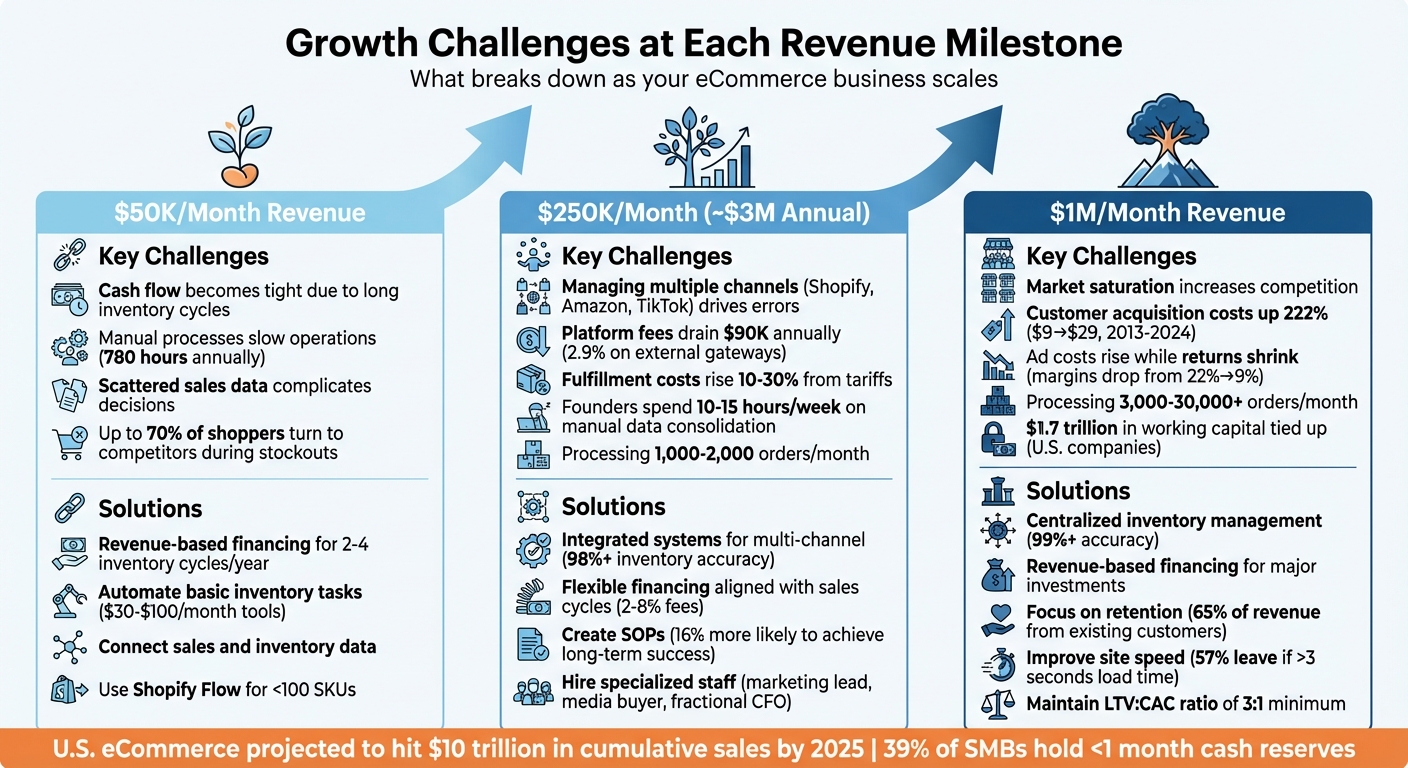
Scaling an eCommerce business is challenging because each revenue milestone - $50K, $250K, and $1M per month - brings new problems. What worked before often breaks down, requiring new systems, strategies, and resources to maintain growth. Here's a quick breakdown:
- At $50K/month: Cash flow becomes tight due to long inventory cycles, manual processes slow operations, and scattered sales data complicates decisions.
- At $250K/month: Managing multiple sales channels creates errors, rising fulfillment and shipping costs strain margins, and hiring specialized staff becomes unavoidable.
- At $1M/month: Market saturation increases competition, ad costs rise while returns shrink, and balancing new projects with daily operations becomes overwhelming.
Solutions include revenue-based financing for cash flow, automation to reduce manual work, integrating sales and inventory data, and focusing on customer retention to improve profitability. Each stage requires targeted strategies to overcome bottlenecks and scale effectively.
The Harsh Truth About Scaling Ecommerce Nobody Warned You About
sbb-itb-d7b5115
Challenges at $50K Monthly Revenue
Hitting $50,000 in monthly revenue is an exciting milestone, but it often comes with growing pains. Systems and processes that worked perfectly fine at smaller scales can start to buckle under the pressure of increased volume. Octavian Contis, founder of oContis Studio, describes this stage as a "structural plateau", where the cracks in your business infrastructure become all too visible as revenue grows [2]. Here’s a closer look at the challenges that tend to surface at this stage.
Cash Flow Issues and Inventory Headaches
When sales take off, cash flow can quickly become a headache. A sudden spike in demand often leads to inventory shortages, forcing businesses to restock faster than their cash reserves allow. This can mean turning to debt or accepting less-than-ideal credit terms just to keep up [1]. Founders might even dip into personal credit or put off critical expenses to stay afloat. To make matters worse, rising customer acquisition costs can eat into already tight margins, amplifying the financial strain [1] [2].
Manual Processes Become Bottlenecks
The manual systems that once supported your business can start to work against it. Tasks like order processing, inventory tracking, and fulfillment grow in direct proportion to sales volume, creating what Contis calls the "manual work trap" [2]. This inefficiency not only slows down operations but also adds to the stress of managing cash flow. Teams often find themselves drowning in spreadsheets, reconciling data by hand, and struggling to keep up during peak periods [3].
Scattered Sales Data Complicates Decisions
For businesses selling on platforms like Amazon and Shopify, data fragmentation is a real challenge. Sales information ends up scattered across multiple dashboards, making it hard to get a clear picture of your performance. This lack of a unified view leads to delays in decision-making, often causing marketing budgets to be misallocated and revenue opportunities to slip through the cracks - a phenomenon sometimes called "decision lag" [2] [3]. As Contis explains:
"At $50k/month, volume exposes weaknesses in systems, data, and decision-making. What once felt like momentum becomes fragility" [2].
How to Solve Problems at $50K Monthly Revenue
At the $50K monthly revenue mark, businesses often face growing pains like cash flow issues, labor-intensive processes, and disconnected data systems. Tackling these challenges with financing options, automation, and data integration early can save you from headaches down the line.
Revenue-Based Financing for Cash Flow
Cash flow problems are common at this stage, but revenue-based financing can help. This funding model is tied to your sales performance, with repayments based on a percentage of your revenue. Companies like Onramp Funds provide funding within hours by analyzing your Shopify or Amazon sales data. Unlike traditional bank loans, this approach doesn’t require credit checks, collateral, or personal guarantees. Plus, repayments adjust to your sales cycles - decreasing during slow months and increasing during busy periods. This keeps your cash flow steady without giving up equity. As Onramp Funds explains:
"In contrast to equity financing or lines of credit, revenue-based financing keeps your full control intact while still offering flexible capital."
Typically, this type of financing supports 2–4 inventory cycles per year, aligning with the operational needs of eCommerce businesses [4]. Once your cash flow is in check, it’s time to streamline your inventory management.
Automate Basic Inventory Tasks
Manually tracking inventory becomes a bottleneck as your order volume grows. Affordable automation tools can handle repetitive tasks like reorder alerts when stock runs low. Synchronizing inventory across sales channels is equally important. For example, in 2025, businesses like Channie’s reduced their monthly labor by 60 hours, while PartyMachines saved up to 16 hours per month by using integrated systems that automated inventory updates and eliminated manual data entry.
For smaller businesses handling fewer than 50 orders daily, basic inventory sync tools cost around $30–$100 per month. This is a small price to pay compared to the time lost on manual reconciliation, which can take 2–3 hours daily (adding up to 780 hours annually). Plus, stockouts - where up to 70% of shoppers may turn to competitors - can be avoided with automation [5]. Once inventory is under control, the next step is connecting your data systems.
Connect Sales and Inventory Data
Operating across multiple platforms often leads to fragmented data, which can obscure your business's overall performance. Integrating your sales and inventory data into a centralized system eliminates these blind spots. Tools that connect platforms like Shopify and Amazon with accounting software like QuickBooks or Xero can automatically sync orders, refunds, and fees, reducing manual errors [5] [8]. This gives you a clear view of inventory levels, profit margins, and channel performance, allowing for faster, data-driven decisions.
For single-channel stores with fewer than 100 SKUs, native tools like Shopify Flow can handle tasks like tagging and low-stock notifications for free. However, as your operations grow - processing 50+ orders daily or managing multiple sales channels - investing in a more integrated platform becomes crucial [5]. Yvette Zhou, Group Product Manager at Webgility, puts it best:
"Inventory accuracy is not just an operational task; it is a business lever. Brands that upgrade at the right moment unlock growth without adding headcount or complexity" [5].
Challenges at $250K Monthly Revenue
Hitting $250K in monthly revenue (around $3M annually) is a major milestone, but it comes with its own set of headaches. Outdated systems and manual processes that were manageable at lower volumes now create serious problems. What used to be minor errors can quickly snowball into strategic roadblocks as the business scales.
Managing Multiple Channels Drives Errors
Selling across platforms like Shopify, Amazon, and TikTok Shop sounds great in theory, but without the right tools, it’s a recipe for chaos. Lack of integration between systems means inventory discrepancies are almost inevitable, leading to overselling on one platform or missing out on opportunities on another [7][10]. Teams often spend hours manually reconciling orders and fixing errors - tasks that could be automated [3].
Arron Bennett, Strategic CFO at Bennett Financials, highlights the risks:
"One emergency air freight shipment can wipe out profit from dozens of orders" [10].
These so-called "phantom inventory" issues are a nightmare. They lead to costly last-minute fixes, and integration challenges remain the top problem for multichannel fulfillment worldwide [9]. The unpredictability of platforms like TikTok Shop only makes things worse, especially with social commerce in the U.S. projected to hit over $84 billion by 2025 [11]. All of this adds up to higher fulfillment and shipping costs, eating away at your margins.
Higher Fulfillment and Shipping Costs
When your order volume grows, so do your expenses - but sometimes those costs rise faster than your revenue. Platform fees, transaction costs, and infrastructure upgrades can quickly add up [12]. For example, a standard 2.9% fee on external payment gateways can drain nearly $90,000 annually at this revenue level [15].
The supply chain doesn’t make things any easier. Paying deposits for inventory before you’ve even realized revenue puts a huge strain on cash flow [14]. Tariff changes can also throw a wrench in your pricing strategy, with cost increases ranging from 10% to 30% [14]. On top of that, founders often find themselves spending 10–15 hours a week consolidating data manually, which takes valuable time away from growth-focused activities [13]. Meanwhile, fragmented operations chip away at already thinning margins.
Need for Specialized Staff
At this stage, the founder often becomes the bottleneck. With 1,000 to 2,000 orders per month, relying on centralized, manual systems just doesn’t cut it anymore [6]. Every decision and problem ends up on one person’s plate, which isn’t sustainable [18].
To break free, hiring specialized staff becomes a must. This might include a marketing lead, a media buyer to handle rising ad spend, and a graphic designer for creative assets. Jesse Pujji, Co-Founder and Chairman of GrowthAssistant, explains:
"The main goal is to ensure the team size aligns with the company's revenue stage, preventing bloated headcount before the business can sustain it" [16].
Financial expertise is equally important. While a full-time CFO with a $250,000 salary isn’t practical for a $3M business, a fractional CFO can be a game-changer [17]. They can help with cash flow analysis, rolling 13-week forecasts, and improving inventory turnover. For instance, increasing turnover from 3x to 5x could free up about 40% of tied-up cash [17]. This kind of financial insight is crucial for addressing the challenges of scaling operations and managing costs across multiple channels.
How to Solve Problems at $250K Monthly Revenue
When your business hits $250K in monthly revenue, challenges like multi-channel errors and rising costs become unavoidable. Tackling these issues requires efficient systems and thoughtful strategies to keep operations running smoothly.
Use Integrated Systems for Multiple Channels
Managing orders across platforms like Shopify, Amazon, and TikTok Shop can quickly turn into a logistical nightmare as sales grow. The solution? Shift from manual reconciliation to an order-level sync system. This approach captures every transaction with SKU and tax details, enabling real-time inventory tracking and SKU-level margin analysis. If you're handling 1,000 to 2,000 orders per month, this level of precision is a game-changer [20].
Take Epic Mens, for example. This apparel retailer scaled from 6,000 to 15,000 monthly orders across Shopify and Amazon between 2024 and 2025. By integrating Webgility with QuickBooks Enterprise, they automated their processes, saving over 80 hours weekly. This move not only boosted their order volume by 42% but also allowed them to shift from annual to weekly inventory counts [6].
Before diving into integration, clean up your SKU naming conventions. For instance, if "BLK-SHIRT-L" is labeled differently across platforms, it can lead to sync errors that ripple through your operations [19]. Middleware tools like Webgility or Workato can streamline data flows between storefronts and back-office systems, improving inventory accuracy to over 98% [19]. As your operations become more efficient, you'll need flexible financing to keep up with the growing demands.
Get Flexible Financing for Growth
At this revenue level, cash flow can feel the squeeze from rising platform fees, fulfillment costs, and the need for specialized staff. Traditional loans often come with rigid repayment terms that don't align with the fluctuating nature of eCommerce sales. Revenue-based financing offers a more adaptable solution by linking repayments to your sales performance. This means higher payments during strong months and lower ones during slower periods, helping preserve cash flow.
Onramp Funds provides funding tailored to your sales cycle, with quick approvals (within 24 hours) and transparent fees ranging from 2% to 8%. This flexibility is ideal for covering costs like integrating systems, hiring skilled staff, or paying for inventory deposits ahead of revenue. Unlike short-term loans that can erode margins, revenue-based financing scales with your sales, ensuring you can reinvest in inventory and marketing without jeopardizing stability.
Once financing is in place, the next step is to standardize processes for smoother operations and easier delegation.
Create Standard Operating Procedures
At $250K in monthly revenue, it’s impossible for the founder to oversee every detail. If your processes are inconsistent or chaotic, it’s time to implement standard operating procedures (SOPs). As Metacake explains:
"A business is an entity of systems and processes that take in capital and output more capital. People are there to run those systems and processes - not BE them" [21].
Start with departments that experience the most chaos, such as Marketing (promotions and launches), Fulfillment (shipping and returns), Customer Service (common queries and escalations), and Finances (reporting and payroll). Each SOP should clearly define the department's goals, success metrics (e.g., orders placed vs. orders shipped per day), necessary roles, time allocations, and step-by-step instructions [21].
Use high-pressure periods like Black Friday or Cyber Monday to identify "chaos points" - these are the areas where systems tend to break down and should be prioritized. Once created, SOPs capture the founder’s knowledge in a way that any team member can follow, streamlining delegation and scaling efforts. Businesses with documented plans are 16% more likely to achieve long-term success than those without [22].
Challenges at $1M Monthly Revenue
Reaching $1M in monthly revenue is a huge achievement, but it comes with its own set of hurdles. The strategies that worked to get here often fall short when it comes to scaling further. On top of that, the costs of growth can start to outpace the returns, leaving many sellers scrambling to adapt.
Market Saturation Across Multiple Channels
By the time you hit $1M in monthly revenue, the challenges shift from purely operational to more strategic. At this point, you've likely already converted your most accessible audiences. Platforms like Meta, Google, and Amazon, which were your go-to sources for growth, start to deliver diminishing returns. Increasing your ad spend might still grow revenue, but the costs rise just as fast - if not faster. This imbalance, sometimes referred to as the "success tax", includes platform fees and transaction costs that eat into your profits, making growth more expensive [25][12].
The failure rate for businesses spikes around the $5M annual revenue mark, largely because the systems and processes that worked at smaller scales can't handle the increased complexity. Manual workflows and basic tools struggle to keep up with higher order volumes, more inventory SKUs, and increased customer service demands. To push past this plateau, businesses often need to explore new markets, customer segments, or sales channels. But each of these expansions adds new layers of complexity that require better tools and systems to manage effectively [24].
Rising Ad Costs and Lower Returns
Customer acquisition costs have skyrocketed in recent years. Between 2013 and 2024, the average cost to acquire a customer jumped from $9 to $29 - a 222% increase [23]. For businesses generating $1M in monthly revenue, this trend becomes a serious challenge. Privacy changes, like those brought by iOS updates, have made ad targeting and attribution harder, forcing brands to spend more just to maintain the same results they used to achieve at lower volumes [26][27].
It’s also significantly more expensive to acquire new customers than to keep existing ones - 5 to 7 times more, in fact [23]. Many brands at this stage fall into what’s called the "linear scaling trap", where ad spend rises in direct proportion to revenue without improving customer lifetime value (LTV) [25]. This can shrink profit margins from 22% to as little as 9% [25]. A healthy LTV-to-CAC (Customer Acquisition Cost) ratio should be at least 3:1; anything below 2:1 signals unprofitable growth [25]. Retention becomes the key to sustainable growth, with repeat customers often accounting for 65% of a company’s revenue [23].
Balancing New Projects with Daily Operations
As your business grows, so does its complexity. Founders often find themselves stuck between two competing priorities: driving strategic growth through new initiatives or managing the day-to-day operational chaos.
At $1M in monthly revenue, manual processes can no longer keep up. Implementing systems like ERP software can cut operational labor costs by 20% to 40% in the first year, giving your team more time to focus on exceptions and strategic planning rather than routine tasks [28]. Without these systems, founders risk getting bogged down in daily crises instead of focusing on long-term growth.
Cash flow also becomes a pressing issue. Across the largest U.S. companies, about $1.7 trillion in working capital remains tied up due to inefficiencies [29]. For eCommerce businesses, this often means cash is stuck in slow-moving inventory or tied up in unfavorable payment terms. Optimizing your Cash Conversion Cycle - by reducing inventory holding times and renegotiating supplier terms - can unlock funds to invest in growth initiatives without taking on additional debt [29][30].
The next section will dive into specific strategies to address these challenges.
How to Solve Problems at $1M Monthly Revenue
When your business hits $1M in monthly revenue, the challenges you face become more complex. These strategies tackle the operational and financial hurdles that come with scaling to this level.
Improve Multichannel Logistics and Analytics
Managing inventory across multiple platforms becomes a logistical headache at this stage. Relying on spreadsheets and disconnected systems can lead to overselling, inaccurate reporting, and operational bottlenecks. The solution? Centralize your inventory data. Use an Inventory Management System to track everything - on-hand stock, sales orders, purchase orders, and returns - all in one place. This creates a reliable, single source of truth for your business.
"Inventory chaos is usually the bottleneck" for brands processing 3,000 to 30,000+ orders per month across multiple channels. [11]
To streamline operations, normalize your SKU data by assigning one master SKU for each product across all channels. This reduces errors like mis-picks and ensures your analytics are accurate. Define key stock moments (e.g., receiving, shipping, adjustments) to keep inventory updates consistent. Optimize your warehouse by placing high-volume items near packing stations and setting up one-way pick routes. Implement barcode scanning with a "scan location → scan item → confirm quantity" workflow to minimize human error.
For ongoing accuracy, rotate through one aisle weekly to maintain 99%+ inventory precision without disrupting daily operations. Keep an eye on aged inventory - products that haven’t moved in 60–120 days - and free up cash by running promotions or liquidating slow-moving stock. Before peak seasons, test your entire order workflow to ensure everything - from order imports to inventory decrements - functions seamlessly.
"Peak season and big promos don't create problems; they just expose the ones you already had." [11]
These logistical upgrades lay the groundwork for scaling efficiently and preparing for future growth.
Use Revenue-Based Financing for Major Investments
Traditional loans with fixed payments often don’t align with the unpredictable cash flow of eCommerce businesses. Revenue-based financing offers a more flexible solution, tying repayments to a percentage of your sales. This approach ensures you’re not overburdened during slow periods and can scale repayments during high-revenue months. Plus, you retain full ownership - there’s no need to give up equity or provide personal guarantees [4].
This type of financing is ideal for high-growth brands. Use it to fund inventory ahead of Q4 or Prime Day, test new sales channels like TikTok, or ramp up ad spend on platforms like Facebook and Google where upfront investment can lead to quick returns. Approval is based on real-time sales data from platforms you’re already using, making it accessible even if traditional banks wouldn’t approve you [4].
For example, Onramp Funds offers flexible repayment plans based on sales performance, with fees ranging from 2–8%. Businesses with at least $10,000 in monthly sales can connect platforms like Shopify, Amazon, or TikTok Shop to get tailored funding offers that align with their growth goals.
Once your logistics and financing are in place, the next step is to focus on retaining customers and refining internal processes.
Focus on Customer Retention and Process Improvement
Retaining customers is far more cost-effective than constantly acquiring new ones. In fact, existing customers drive 65% of revenue, and acquiring new ones can cost 5–7 times more [23]. The top-performing eCommerce stores average $343 in revenue per customer [32], largely because they focus on increasing customer lifetime value. Tools like email marketing, subscription services, and loyalty programs can help boost retention and lift net margins above 15% [32].
On the technical side, your website’s performance becomes critical. A slow or unstable site can cost you sales - 57% of customers will leave if a page takes more than three seconds to load, and 24% will abandon their cart if the site crashes during checkout [33]. Use tools like Google Analytics to pinpoint where customers drop off and focus on improving the mobile shopping experience. Display trusted payment logos and offer a shipping calculator early in the checkout process - 42% of shoppers are more likely to spend when multiple payment options are available, and 45% abandon carts due to dissatisfaction with delivery costs or timelines [33].
Internally, scaling your business requires streamlining processes and outsourcing repetitive tasks. Partnering with third-party logistics providers allows you to focus on high-level growth strategies instead of day-to-day operations [32]. Wanda Cadigan, SVP of Marketing at Cloudinary, sums it up well:
"Scaling from $1M to $100M+ ARR teaches you one thing fast: tools change, people don't." [31]
To maintain momentum, keep testing new products and running high-ROI ad campaigns. At the same time, refine your internal workflows to ensure your business runs smoothly. By aligning your financial, operational, and customer strategies, you can create a better experience for your customers while driving sustainable growth.
Conclusion
Scaling an eCommerce business comes with unique challenges at different revenue milestones: $50,000, $250,000, and $1,000,000 in monthly sales. At $50,000, cash flow struggles often arise due to inventory demands and outdated manual processes. By $250,000, juggling multiple sales channels can lead to operational missteps, higher fulfillment costs, and the need for specialized staff. At $1,000,000, issues like market saturation, rising ad costs, and balancing new initiatives with daily operations take center stage.
Fortunately, each stage has clear solutions. Flexible financing, process automation, streamlined standard operating procedures (SOPs), and focused customer retention strategies can help drive sustainable growth. Revenue-based financing, paired with automation and efficient systems, addresses cash flow and operational challenges at every level. By combining these operational improvements with strategic financing, businesses can stay on track for continued growth.
Access to the right capital is just as important as refining operations. With 39% of U.S. small and medium businesses holding less than a month’s worth of cash reserves [35], and U.S. eCommerce projected to hit $10 trillion in cumulative sales by 2025 [34], the stakes have never been higher. Financial limitations or operational inefficiencies can’t be allowed to derail progress. Onramp Funds provides flexible, equity-free financing that grows alongside your sales, delivering quick and scalable capital to support your business at every stage.
The tools to overcome these hurdles are within reach. Secure the financing you need, automate your workflows, and implement systems that set the foundation for confident growth. Now is the time to take action and position your business for long-term success.
FAQs
How do I know I’m truly at the $50K, $250K, or $1M “plateau”?
If your profit margins, cash flow, or operational efficiency have hit a standstill despite putting in more effort, you might be facing a revenue plateau. Some telltale signs include supply chain hiccups, escalating costs, or struggling to scale without incurring excessive expenses. Spotting these challenges early can give you the chance to tackle the root causes - whether it’s by streamlining processes through automation or finding smarter ways to manage cash flow - so you can push past the plateau and grow more effectively.
What should I automate first to unlock the next revenue stage?
Start by automating order management and inventory processes. This approach cuts down on repetitive manual tasks, reduces the chances of errors, and keeps operations running smoothly. By using systems designed to simplify workflows, you’ll not only improve accuracy but also create a solid foundation for scaling your business effectively.
When does revenue-based financing make sense for inventory and growth?
Revenue-based financing works well for businesses pulling in at least $10,000 in monthly revenue, especially when funding is needed for inventory or growth. Its repayment structure is tied to sales, offering flexibility during busy seasons or periods of fast growth. This option gives businesses quick access to funds without the need for fixed repayment schedules or collateral, making it a practical way to scale operations.
Related Blog Posts
Onramp Funds
Funding built around your sales
Connect your store and see what you qualify for. Repay as a percentage of sales, with no personal credit check.
Funding in as little as 24 hours.
