

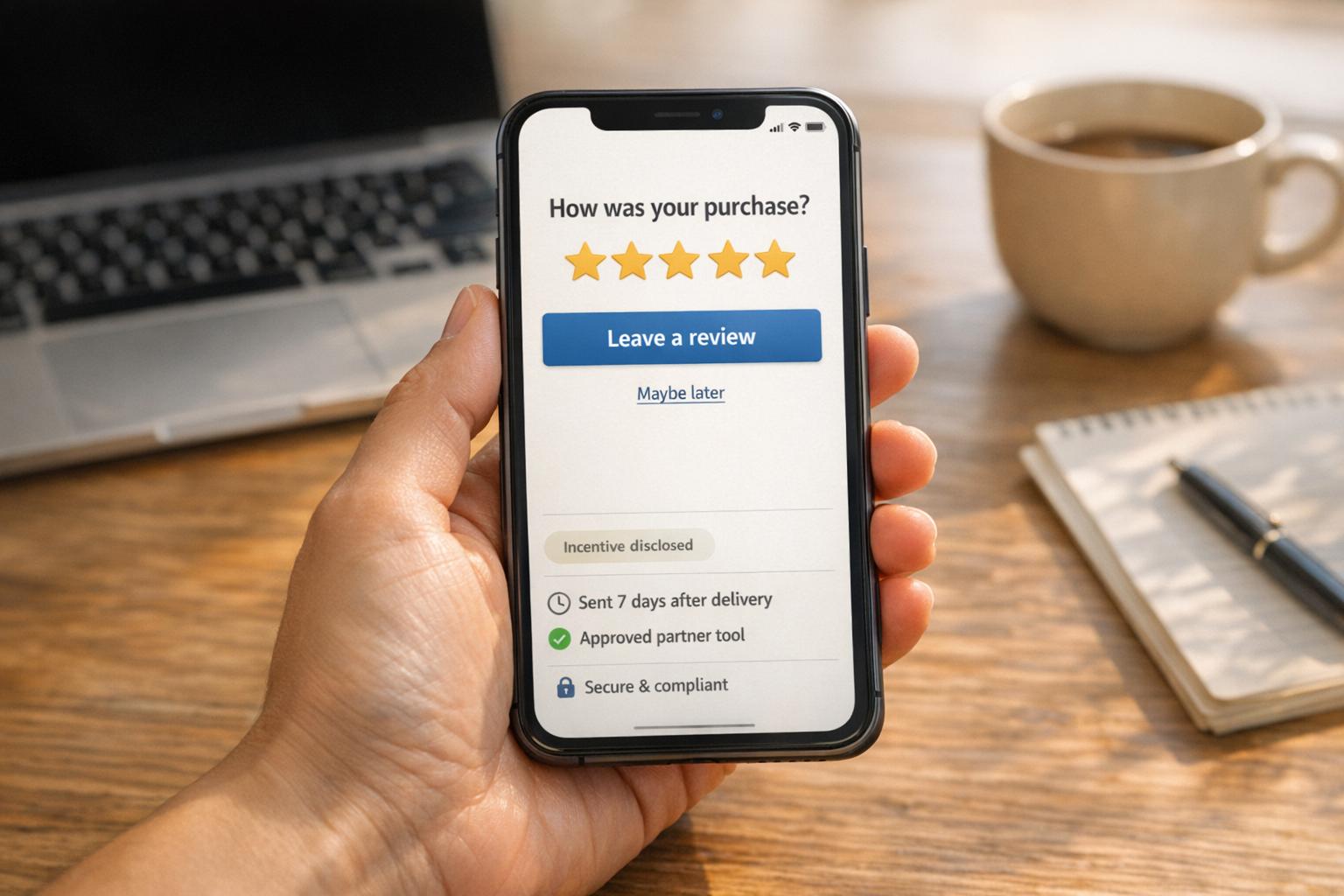
Want more customer reviews without risking penalties? Here's how to do it the right way:
- Understand the Rules: Platforms like Amazon, Google, and Yelp have strict policies against fake or incentivized reviews. Violations can lead to account suspensions, product delistings, or legal action.
- Automate Requests: Use tools to send review requests via email or SMS at the right time - typically 7–14 days after purchase.
- Avoid Violations: Never offer compensation, gate reviews, or solicit feedback from employees, friends, or family.
- Use Non-Monetary Incentives: On your website, you can offer loyalty points, sweepstakes entries, or early access, but disclose these incentives clearly.
- Leverage Third-Party Platforms: Tools like REVIEWS.io or Podium streamline the process and help manage feedback across channels.
- Respond to Reviews: Engage with all reviews - positive or negative - to build trust and improve customer satisfaction.
Key Tip: Always encourage honest feedback, not just positive reviews. This builds credibility and keeps you compliant with platform and FTC rules.
Let’s dive deeper into these strategies to help you grow your business responsibly.
Episode 9 - How to Ask for Reviews Ethically and Safely?
sbb-itb-d7b5115
Understanding Platform Review Policies
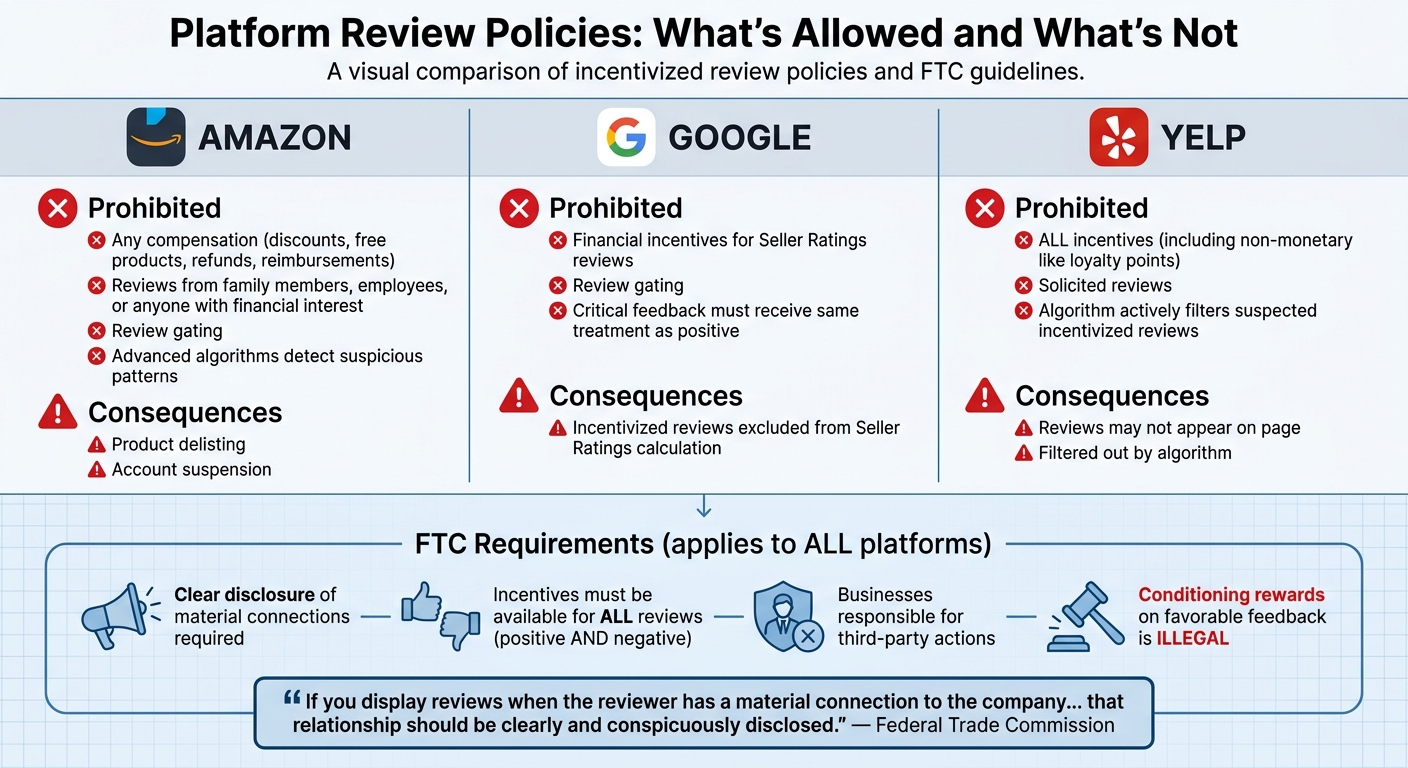
Before gathering feedback, it’s crucial to familiarize yourself with the review guidelines of each platform. Sites like Amazon, Google, and Yelp have unique rules, and what’s acceptable on one might lead to penalties on another. A key difference often lies in policies around incentives. For example, some platforms ban reviews from individuals who received an incentive or have a financial connection to the seller - regardless of whether that connection is disclosed. Others allow incentivized reviews, provided the reviewer openly states they received something in return [5].
One rule, however, is consistent across all major platforms and the FTC: "review gating" is prohibited. This means you can’t selectively ask for reviews from customers you believe will leave positive feedback while ignoring others [5] [1]. Let’s break down the specific policies of major platforms.
Rules for Amazon, Google, and Other Platforms
Amazon has strict rules against offering any kind of compensation - whether it’s discounts, free products, refunds, or reimbursements - in exchange for reviews. It also prohibits reviews from family members, employees, or anyone with a financial interest in the business. Amazon uses advanced algorithms to detect suspicious patterns, and violations can lead to severe consequences, including product delisting or account suspension.
Google enforces similar restrictions, especially within its Seller Ratings program. Financial incentives tied to reviews that contribute to Seller Ratings will be excluded from the calculation. Like Amazon, Google bans review gating, ensuring that critical feedback gets the same attention and treatment as positive comments [1].
Yelp takes one of the toughest stances on incentives, disallowing them entirely - even non-monetary rewards like loyalty points. The platform’s algorithm actively filters out reviews it suspects were solicited or incentivized. This means even legitimate reviews might not appear on your page if Yelp detects unusual activity.
FTC Disclosure Requirements
In addition to platform-specific rules, federal guidelines from the FTC demand full transparency. The Federal Trade Commission requires that any material connection between a reviewer and your business be clearly disclosed. This includes situations where a reviewer received a free product, a discount, or has a personal or financial relationship with your business [6] [1].
"If you display reviews when the reviewer has a material connection to the company offering the product or service... that relationship should be clearly and conspicuously disclosed." - Federal Trade Commission [1]
If you offer incentives for reviews, they must be available for all reviews - whether they are positive or negative. Conditioning rewards on receiving only favorable feedback is illegal [6]. Additionally, reviewers must disclose the incentive in their feedback. For instance, if you provide a customer with a $10 discount code for leaving a review, their review should clearly state that they received this incentive.
The FTC also holds businesses accountable for the actions of third-party companies they hire. If an SEO agency or reputation management firm posts fake reviews on your behalf, you are responsible - even if you were unaware of their methods [6]. To avoid penalties, carefully vet any partners and audit their practices to ensure they don’t engage in deceptive tactics like creating fake profiles or paying for positive reviews.
Using Automated Review Request Systems
Collecting reviews manually can be a hassle - not to mention inconsistent. Automated systems take the stress out of the process by syncing with your store daily, queuing up requests based on order data, and sending them at just the right time. For most products, the sweet spot is about 14 days after purchase, giving customers enough time to receive and try out the product. However, timing can vary depending on what you're selling. For instance, food and beverages might call for a request within 3–5 days, while skincare products may need 10–14 days for customers to see results.
These systems also come with built-in safeguards to prevent over-communication. For example, they limit emails to a maximum of 5 within 30 days and ensure that requests for the same product are spaced at least 12 months apart. This keeps you compliant with FTC guidelines and avoids annoying your customers. Plus, if you're offering incentives like loyalty points or discount codes, automated tools make sure these perks are available for all reviews - not just the glowing ones. By automating this process, you not only save time but also lay the groundwork for more sophisticated strategies.
"Trust is the cornerstone of any successful ecommerce business. Product reviews are a foundational element in building that trust. They function as social proof, demonstrating to potential buyers that real people have purchased your product and are willing to share their experiences." - Ben Salomon, Growth Marketing Manager, Yotpo [7]
Setting Up Post-Purchase Email and SMS Requests
The timing and simplicity of your review requests can make all the difference. For physical goods, aim to send the first email 7–14 days after delivery. If the customer doesn’t respond, a single follow-up reminder sent 7 days later can boost response rates by 3–4%. Just be sure to leave at least a 5-day gap between communications to avoid being flagged as spam.
Personalization is another game-changer. Address customers by name, include the product name and image, and use in-mail forms that let them submit reviews directly from their inbox. This eliminates extra steps, making it easier for customers to follow through. Even small tweaks, like optimizing your subject line, can have a big impact. For example, including your store name can increase conversions by 3.7%, while adding a question mark can boost rates by 15.7% [8].
SMS requests are another effective option, especially since text messages tend to have high open rates. That said, you’ll need explicit consent before sending texts. Use SMS for quick nudges, and if a customer has purchased multiple items, prioritize asking for reviews on the most expensive or least-reviewed product to maximize the value of their feedback.
Multi-Channel Review Collection Tools
Multi-channel platforms simplify the review collection process by handling email, SMS, and third-party review sites all at once. These tools can also syndicate reviews to platforms like Google Shopping, Facebook, and TikTok Shop, boosting your visibility without adding extra work.
Some advanced platforms even offer "2-in-1" requests, where customers are prompted to leave a site review immediately after submitting a product review. This approach helps grow your Google Seller Ratings without overwhelming customers with multiple requests. To make it easier for customers to leave detailed feedback, many tools include AI prompts that suggest topics like fit, quality, or performance [7].
When you first set up these tools, they can retrieve past orders - up to 180 days old - to generate an instant wave of reviews. This feature is especially helpful for businesses just starting to build their online reputation. Additionally, AI-driven moderation tools help maintain quality by filtering out profanity, spam, or inauthentic content before it gets published.
Next, we’ll explore how offering non-monetary incentives can complement these strategies while staying within platform guidelines.
Offering Non-Monetary Incentives
In the U.S., UK, EU, and Australia, incentivized reviews are allowed as long as you clearly disclose the reward and ensure it applies to any honest review - not just positive ones [2][9]. The goal is to encourage genuine feedback while maintaining transparency.
That said, platforms like Google and Amazon prohibit incentivized reviews, so these campaigns should be confined to your own website, email, or SMS channels [9][11]. To stay compliant, every incentivized review must include a clear disclosure, such as a badge reading “Submitted in exchange for a reward” [2][9]. Many automated tools can help tag these reviews, making compliance easier without adding extra manual steps.
Acceptable Incentive Types
Non-monetary incentives can work alongside automated review requests to boost engagement on your owned channels. Here are some options that work well:
- Loyalty points: These are a favorite because they keep customers within your brand’s ecosystem and encourage repeat purchases. For instance, Pots for Tots, a meal delivery service, ran an A/B test in August 2025 using REVIEWS.io and saw a 589% increase in review conversions when offering 500 loyalty points compared to no incentive [2].
- Early access: Offering exclusive previews of new products or VIP experiences fosters a sense of belonging without direct costs.
- Sweepstakes entries: This approach can quickly generate a high volume of reviews at a low cost, though it may attract participants more interested in prizes than thoughtful feedback.
- Free samples: Ideal for new product launches, free samples often lead to detailed reviews, but shipping and logistics can increase costs.
- Social recognition: Featuring reviewers on your website or social media appeals to brand advocates but may not resonate with all customers [2][10][11].
It’s essential to reward participation rather than specific ratings. Your communication should make it clear that the incentive is for submitting an honest review, whether it’s glowing or critical. As Tim Khud from Growave puts it:
"Incentivize honesty, not positivity. Make it clear that feedback - positive or negative - is welcome. That reduces bias and increases credibility" [11].
Additionally, any material connection between your brand and the reviewer - created by the incentive - must be disclosed, as Ben Salomon from Yotpo explains [12].
Comparing Different Incentive Approaches
Timing is another key factor. For fast-use items like cosmetics or clothing, send incentivized requests 3–7 days after delivery. For products that require more time to evaluate, like tech gadgets or supplements, wait 10–20 days to allow customers to form a solid opinion [2][10].
Working with Third-Party Review Platforms
Using third-party review platforms can make collecting and managing customer feedback much easier. These platforms simplify the process by generating official review links and QR codes, which direct customers straight to legitimate rating pages. This eliminates the common issue of customers having to search for your business, which is often why review requests fall through [14][17].
Anti-gating functionality is a must-have feature. This ensures that all customers are asked for feedback equally, without pre-screening for likely positive reviews. Platforms that allow pre-filtering or incentivize reviews violate FTC and Google policies, which can lead to penalties [14][17].
Key Features of Review Platforms
When choosing a third-party tool, look for options that automate multi-channel review requests via SMS and email. Studies show that SMS requests have a 20% response rate within 1–4 hours, while emails see about a 15% response rate within 2–6 hours. Combining both methods can push response rates to around 26% [18]. Make sure your messaging asks for an honest review rather than explicitly requesting a "5-star review" to stay compliant with anti-pressure policies [17].
Another crucial feature is a centralized dashboard for managing responses. Tools like Semrush Local, Podium, Birdeye, and GatherUp allow you to view and reply to reviews from multiple platforms - Google, travel websites, and local directories - all in one place. This setup helps you respond quickly and professionally. Avoid tools with "review station" or kiosk features that allow multiple reviews from the same device or IP address, as these can trigger spam filters [14].
Using QR codes is another effective tactic. Place them on receipts, business cards, checkout counters, or packaging to encourage immediate feedback, including photo-rich reviews. This matters because over 50% of consumers prefer reviews with photos when deciding on a local business [18].
With these tools in place, the next step is to actively engage with the feedback you receive.
How to Respond to Customer Reviews
Replying to reviews is critical for building trust and encouraging customers to update their ratings. Google typically posts review replies within 10 minutes, but delays of up to 30 days can happen [16]. Personalizing each response with the reviewer’s name and their specific feedback makes a big difference [13][15]. As Backlinko puts it:
"A 5-star review left unanswered is wasted potential" [18].
For negative reviews, start with a professional apology and offer to move the conversation offline by providing a phone number or email address. This approach can help resolve issues privately. For example, the jewelry brand Collective Hearts turned a 1-star review into a positive outcome by having the owner personally respond with contact details. The customer later upgraded their rating and praised the resolution [18]. Avoid using replies as an opportunity to promote new deals - focus solely on addressing the customer’s experience [13][15].
When prioritizing your responses, start with negative reviews to resolve problems first. Then, move on to high-value reviews that provide key insights, and finally, reinforce your brand’s reputation by responding to positive feedback [18]. Before replying to any reviews on Google, ensure your Business Profile is verified. Keep in mind that Google may also highlight reviews from trusted non-Google sources, like local or travel review sites [16].
Avoiding Rule Violations and Following Best Practices
When collecting reviews, it's just as important to know what not to do as it is to follow compliant methods. Platforms like Amazon, Google, and Shopify have strict rules, and breaking them can lead to serious consequences like account suspension, product delisting, or the removal of all your reviews [19][3].
Practices That Break Platform Rules
First and foremost, offering any kind of compensation for reviews is strictly against the rules. This includes cash, discounts, free products, or refunds. Shopify’s Help Center puts it plainly:
"You shouldn't offer compensation in exchange for reviews. This includes money, discounts, free products, or refunds." [19]
Another clear violation is review gating - only asking satisfied customers for reviews while avoiding requests from others. This practice is explicitly banned, as explained in the earlier section on platform review policies [4][2].
Affiliated reviews are also a no-go. This means store owners, employees, family members, or friends should not leave reviews for products they are connected to [19]. Additionally, pressuring customers to change or delete their reviews is prohibited. Shopify emphasizes:
"If a customer has already left a review, then you shouldn't incentivize the customer to change or remove that review." [19]
Other violations include generating fake reviews through bots, asking for only positive feedback (like 5-star reviews), and allowing multiple reviews from the same device or IP address [19][3][4].
Strategies for Consistent Review Collection
To collect reviews effectively while staying compliant, neutral automated outreach is key. Many platforms offer built-in tools to help with this. For instance, Amazon’s "Request a Review" button sends a standardized email that adheres to the platform’s terms of service and typically achieves a 5–10% review rate [4]. For new product launches, Amazon’s Vine program can also be useful. This service costs about $200 per ASIN and can generate up to 30 verified reviews from "Vine Voices" [4].
Timing is everything. For fast-use products like clothing or cosmetics, send review requests 3–7 days after delivery. For items that take longer to evaluate, such as electronics or supplements, wait 10–20 days [2]. This gives customers enough time to use the product before sharing their thoughts.
Always keep your messaging neutral. For example, saying "We’d love to hear your feedback" works far better - and is more compliant - than asking for "a 5-star review" [4]. Including one-click review links in emails or SMS messages can also make the process easier for customers. Generally, products need around 15–25 reviews with a rating of 4 stars or higher to build trust. Conversion rates improve most dramatically when moving from 0 to 10 reviews [4].
If you’re running a loyalty program that rewards points for reviews, make sure the incentives are neutral and clearly disclosed. For example, Pots for Tots, a meal delivery service, saw a 589% boost in review conversion rates by offering 500 loyalty points. However, they ensured the program complied with FTC and DMCC Act regulations by properly tagging and disclosing the incentives [2].
Conclusion
Gathering reviews while staying within the rules is entirely doable. The strategies outlined here - like automated review requests, neutral messaging, transparent incentives, and using approved tools - equip you to build trust and credibility the right way. As REVIEWS.io's Alla Avgustinov explains:
"The aim isn't to buy positive opinions, but to encourage more customers to share their honest experience" [2].
Staying compliant is more important than ever, especially as platforms like Amazon ramp up enforcement with advanced detection systems [4]. Meanwhile, global regulations across the US, UK, EU, and Australia are cracking down on fake or misleading reviews [2]. Ignoring these rules could lead to severe consequences, including account suspensions, product removals, or even legal action [3][4].
But compliance isn't just about avoiding penalties - it’s a chance to gain valuable insights to improve your products and services. This approach fosters long-term growth instead of relying on short-term manipulative tactics [3][4]. Plus, products with more authentic reviews tend to convert better, rank higher in search results, and secure the Buy Box more frequently [4]. Providing excellent service and high-quality products naturally encourages the kind of honest feedback that shoppers trust.
By sticking to these compliant strategies, you align with the core principle of building genuine social proof. Make use of programs like Amazon Vine, time your automated review requests appropriately, and always disclose any incentives clearly [2]. As one expert wisely puts it:
"The key to success lies in fostering genuine relationships with customers and delivering exceptional value" [3].
FAQs
What’s the safest way to ask for reviews on Amazon or Google?
The best way to ask for reviews on Amazon is to stick with Amazon's own tools, like the "Request a Review" button in Seller Central. This approach follows their terms of service, keeping you on the right side of their rules.
For Google, you can reach out to customers directly through email or messaging. Just make sure to avoid offering incentives or pushing too hard. Keeping it simple and honest ensures you stay within Google's guidelines while protecting your account from potential penalties.
How can I use incentives without violating FTC or platform rules?
To align with FTC guidelines and platform rules, it's crucial that incentives for reviews are not linked to positive feedback. Any rewards should be offered to everyone and must clearly state they are for submitting a review, regardless of whether it's positive, negative, or neutral. Avoid tying rewards to specific types of feedback or requiring favorable opinions. Instead, focus on encouraging genuine and honest reviews. This not only ensures compliance but also supports transparency and fairness in the process.
What should I do if a review platform or agency flags me for fake reviews?
If your account gets flagged for fake reviews, the first step is to immediately halt any manipulative practices. Review platforms treat fake reviews as a serious offense, and continuing such activities could result in penalties or even a permanent ban.
Instead, focus on legitimate and policy-compliant methods to gather reviews. For example, Amazon sellers can use the "Request a Review" button available in Amazon Seller Central. This tool ensures you're following platform guidelines while encouraging genuine feedback from customers.
Steer clear of risky tactics like offering incentives for reviews or using methods like review gating (only asking satisfied customers for reviews). These practices not only violate policies but could also lead to stricter penalties.
Related Blog Posts
Onramp Funds
Funding built around your sales
Connect your store and see what you qualify for. Repay as a percentage of sales, with no personal credit check.
Funding in as little as 24 hours.
