


Paid media can drive sales and visibility for eCommerce businesses, but it often creates a cash flow gap. Here’s why: you pay upfront for ads, but revenue takes days or weeks to arrive. This delay puts financial pressure on small businesses, with 82% of failures linked to poor cash flow management. Seasonal spikes, like the holiday season, make things even tougher, requiring significant upfront investments in marketing and inventory.
Key solutions to manage this gap include:
- Revenue-Based Financing: Flexible repayments tied to sales performance, like Onramp Funds, which offers quick funding and repayment terms that adjust with revenue.
- Short-Term Loans: Provide lump sums but come with fixed repayment schedules, which can strain cash flow during slower periods.
- Credit Lines: Offer flexibility by charging fees only on the amount used, though they often require a strong credit history.
Cash flow management tips:
- Align ad spend with sales cycles to avoid overextending budgets.
- Negotiate longer vendor payment terms (e.g., Net-60 instead of Net-30).
- Use tools like funding calculators to plan ad budgets based on sales data.
How Much to Spend on Paid Media in Ecommerce
sbb-itb-d7b5115
Cash Flow Challenges in Paid Media for eCommerce
Understanding these challenges highlights why smart financing and cash flow management are so important.
Why Paid Media Strains Cash Flow
Paid media creates a tricky timing issue. Here's why: you pay for ads upfront, but the revenue they generate often takes time to hit your account. This delay, known as the cash conversion gap, can put a serious strain on your finances.
When someone clicks on an ad, it doesn’t immediately translate into cash in your pocket. Sales take time to process, and payment processors typically take 2–7 business days to transfer funds. For sellers on platforms like Amazon, payouts can take even longer - sometimes several weeks [2]. During this waiting period, ad invoices still need to be paid, and you also have to keep your inventory stocked to handle growing demand.
Seasonal spikes, like those during Q4, make things even harder. Retailers often have to pour significant money into marketing well before the busy season begins, relying on projected (but not guaranteed) sales. Unfortunately, traditional lenders often shy away from funding these marketing costs because they see them as riskier than other business expenses [1].
This mismatch between spending and revenue can create serious financial pressure if ad budgets aren’t carefully managed.
Financial Risks of Overextending Ad Spend
The cash conversion gap becomes even more dangerous when ad spend grows too quickly. Without proper planning, scaling your ad budget can lead to tough choices - like deciding between funding marketing or restocking inventory. If too much capital is tied up in ads, there might not be enough left to keep your shelves stocked [3].
On top of that, traditional financing options often come with fixed monthly repayment terms. These payments don’t adjust for slower sales periods, which can drain your cash reserves during off-seasons. Even a healthy business can face a liquidity crunch if it’s not prepared to handle these fixed obligations [3].
Revenue-Based Financing with Onramp Funds
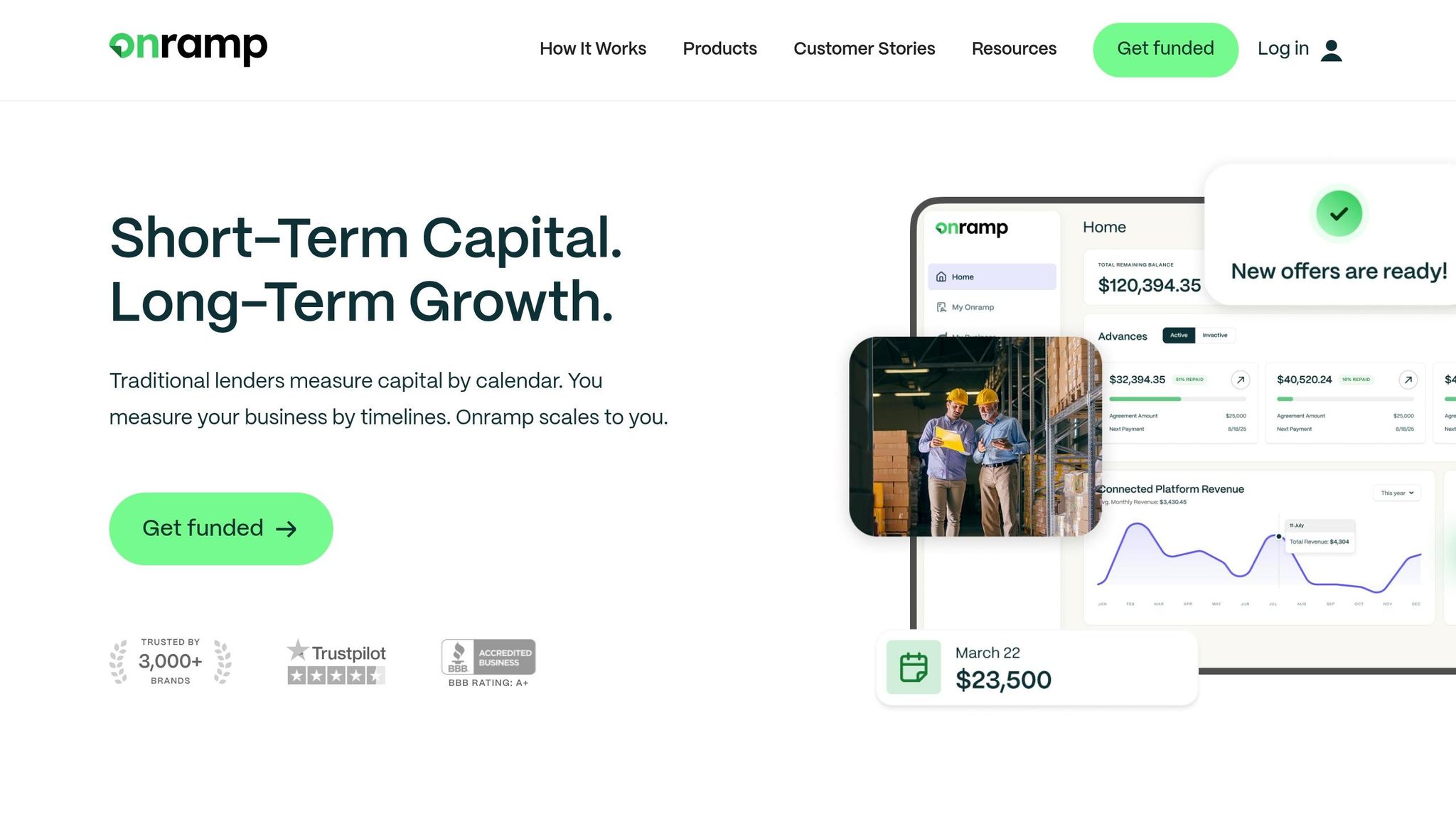
Revenue-based financing is a smart way to fund paid media campaigns without the stress of cash flow problems. Instead of rigid monthly payments, this approach ties repayments directly to your sales performance. As your revenue grows, so does your funding, making it a flexible option for scaling your business.
How Onramp Funds Supports Paid Media Campaigns
Onramp Funds offers financing tailored for eCommerce sellers aiming to scale their advertising efforts. Here’s how it works: connect your Shopify, Amazon, or TikTok Shop sales data, and you can access funding in as little as 24 hours. They offer up to $500,000 to fuel campaigns on platforms like Google Ads and Meta. Repayments are based on a percentage of daily sales (usually 5–10%), automatically adjusting to your business performance. For example, if your campaign generates $100,000 in monthly sales, repayments decrease during slower periods, helping you maintain healthy cash flow.
Nick James, CEO of Rockless Table, shared his experience:
"Applied, got our offer, and had cash in our bank account within 24 hours. Their Austin, TX based team was very professional and helped me deploy the cash to effectively grow our business." [3]
Onramp integrates seamlessly with major eCommerce platforms such as Amazon, Shopify, TikTok Shop, Walmart, WooCommerce, BigCommerce, and Squarespace. To qualify, businesses need to show at least $10,000 in average monthly sales, making it an accessible option for growing companies ready to invest in paid advertising.
This repayment model not only supports scaling but also safeguards cash flow, allowing businesses to grow sustainably.
Benefits of Revenue-Based Financing
Revenue-based financing helps tackle the cash flow challenges that often come with expanding ad spend. One standout advantage is its flexibility during fluctuating revenue periods. Take this example: a Shopify apparel brand with $2 million in annual revenue used $250,000 from Onramp Funds to ramp up Google Shopping ads before Black Friday. With repayments set at 7% of sales, the brand maintained over $100,000 in monthly ad spend, achieving a 4.5x return on ad spend and generating $1.2 million in additional revenue. After the holiday rush, repayments dropped by 30%, avoiding any cash flow strain.
Industry trends show that businesses using revenue-based financing often grow their ad spend 2–5 times faster. Plus, repayment terms aligned with revenue help keep default rates low - under 5%, compared to 12% for traditional loans [3].
Here are a few other benefits:
- Simple, transparent fees: No hidden charges or compounding interest.
- No personal credit checks: Approval is based entirely on business performance.
- Automated repayments: Payments sync with sales deposits, making it a hassle-free process.
- Flexible funding options: Choose from Variable (revenue-based), Fixed (predictable), or Rolling Cash Lines (revolving credit).
With an A+ Better Business Bureau rating and 5/5 stars from 226 reviews, Onramp Funds has supported over 3,000 eCommerce sellers. By offering equity-free financing, they help businesses grow without sacrificing ownership or putting unnecessary strain on cash reserves. [3]
Short-Term Loans and Credit Lines for Ad Spend

How to Use Short-Term Loans
Short-term loans are a great way to secure a lump sum for targeted ad campaigns. But here's the catch: they come with fixed weekly or bi-weekly payments, regardless of how your sales are performing at the time [3].
This repayment structure can become a headache during slower sales periods or if marketplace payouts are delayed. Even when cash flow dips, those payments don’t stop. Considering that 32% of eCommerce businesses fail due to running out of cash [2], this rigidity can pose a serious risk. Plus, many short-term loans require collateral or a solid credit history - two things that newer eCommerce businesses might not have [1].
Credit Lines for eCommerce Sellers
Credit lines, on the other hand, are designed for flexibility. They provide revolving capital, which makes them ideal for ongoing ad spend. The best part? You’re only charged fees on the amount you actually use. For example, if you have a $100,000 credit line but only use $30,000 for a campaign, you’ll only pay fees on that $30,000 [3].
That said, setting up a credit line isn’t always instant. Approvals can take 1–2 weeks and often require a strong credit history. The good news is that modern eCommerce-focused lenders now consider real-time sales data alongside traditional credit metrics, making it easier for growing businesses to qualify [1][3]. Experts recommend setting up a credit line proactively so you're not scrambling for emergency funding when you need it [1].
Comparing Financing Options
Here’s a quick breakdown of how these financing options stack up:
The main difference lies in how repayments align with your revenue. Short-term loans charge interest on the entire principal from day one, with fixed payments that don’t adjust to sales fluctuations. Credit lines, on the other hand, only charge fees on the amount you use but often require a stronger credit profile. Meanwhile, revenue-based financing stands out by adjusting repayments to your actual sales deposits, making it a safer choice during slower months [3].
Selecting the right financing option can help eCommerce sellers maintain their ad spend without straining cash flow.
Cash Flow Management Techniques for Ad Spend
Aligning Ad Spend with Sales Cycles
Timing your ad campaigns to align with your sales cycles is a smart way to avoid cash flow issues. In eCommerce, seasonal spikes are common, with some businesses pulling in 30% to 50% of their annual revenue during the holiday season alone [1].
A solid 12-month cash flow forecast can help you spot peak sales periods and potential slowdowns. This allows you to strategically adjust your ad spend - ramping up when sales are high and pulling back during quieter months. Tools like revenue-based financing can make this process smoother by syncing repayments with your sales performance. Repayments increase during busy seasons and decrease during slower ones, giving you more breathing room. If cash is tied up for 30–60 days due to fund holds, invoice factoring can release up to 90% of your sales value for immediate reinvestment in ad campaigns [4].
Let’s look at another way to improve cash flow: extending vendor payment terms.
Extending Vendor Payment Terms
Stretching out payment terms with your suppliers can keep more cash in your business, which you can then use for ad campaigns. For instance, switching from Net-30 to Net-60 terms creates an extra 30-day cushion before payments are due [5].
To make this happen, regularly review your vendor contracts. Many suppliers are willing to extend terms to keep loyal, long-term clients. You can also consolidate orders or join a Group Purchasing Organization to strengthen your negotiating power and secure better payment terms [5].
Financial Planning Tips for Scaling Paid Media
Using Funding Calculators to Plan Ad Budgets
A funding calculator can be a game-changer when it comes to planning your ad budget. By analyzing your actual sales data, these tools provide a capital estimate that aligns with your cash flow. Take Onramp Funds' funding calculator, for instance. It connects directly to platforms like Amazon, Shopify, or Walmart through read-only access and generates a personalized cash offer based on your business performance - not just your credit score. This means your ad budget is rooted in real numbers, not guesswork.
The calculator also highlights different funding options tailored to your needs. These include:
- Variable offers: Payments tied to your revenue, offering flexibility.
- Fixed offers: Predictable payments for easier budgeting.
- Rolling Cash Line: A revolving credit line for ongoing borrowing needs.
With over 3,000 eCommerce loans funded through Onramp and the ability to access capital in under 24 hours, you can act swiftly on marketing opportunities [3]. These tools not only help you scale your ad spend but also ensure you avoid cash flow issues along the way.
Once your ad budget is set, it’s time to prepare for seasonal fluctuations.
Planning for Seasonal Peaks
For many eCommerce businesses, the holiday season accounts for 30%–50% of their annual revenue. To make the most of this critical period, you need to secure enough capital well in advance [1]. Start by building a safety net that covers 3 to 6 months of operating expenses, and create a 12-month cash flow forecast to strategically time your ad spend [2].
Conclusion
Scaling your paid media efforts can be done sensibly without straining your cash reserves or putting your business in a vulnerable position. One way to achieve this is through revenue-based financing with Onramp Funds. This method ensures repayment terms that flex with your revenue - higher payments during strong sales periods and lower payments when sales slow down. This flexibility helps you sidestep the cash flow challenges that come with fixed monthly payments.
To stay ahead, pair this financing model with sound cash flow management strategies. For example, keep a cash buffer of 3–6 months, align your ad spend with your cash conversion cycle, and rely on data-driven forecasting before increasing your budgets. Onramp Funds, backed by an A+ rating from the Better Business Bureau and a history of funding over 3,000 eCommerce loans [3], provides a trusted option tailored specifically for sellers.
The benefits of this approach are clear in real-world examples. Jeremy from Kindfolk Yoga shared his experience:
"Onramp offered the perfect solution with revenue-based financing to secure the capital we needed to invest in inventory and pay it back at a reasonable time frame once we made sales" [3].
This strategy, focused on aligning repayments with sales and strengthening cash flow, has proven effective for many eCommerce sellers. It’s a practical way to scale while keeping your business financially secure.
FAQs
How much ad spend can I safely fund without hurting cash flow?
When deciding how much to allocate for ad spend, it's crucial to consider your revenue cycle, cash flow stability, and financing options. Your ad budget should align with the timing of incoming sales deposits to avoid straining your cash reserves. Overextending your cash flow can lead to unnecessary financial stress.
One helpful option is flexible financing, such as revenue-based funding. This approach adjusts your payment amounts based on your actual sales, making it easier to manage risks and maintain financial stability. Taking a conservative route - keeping ad spend within the limits of predictable revenue - can help ensure steady cash flow and avoid liquidity challenges that many eCommerce businesses face.
What sales data is required to qualify for revenue-based financing?
To be eligible for revenue-based financing, you’ll need to share key sales data like your gross merchandise volume (GMV) or total sales revenue. Lenders use this data to evaluate your business's financial health and determine if you meet their funding criteria.
When should I use a short-term loan vs. a credit line for ads?
When you need quick cash for ad campaigns or other short-term projects and can handle fixed repayments over a few months, a short-term loan can be a smart choice. It’s especially useful for plans aimed at generating revenue quickly.
On the other hand, a credit line offers more flexibility. It’s great for handling unpredictable or seasonal cash flow, giving you the option to draw funds as needed and repay on your own schedule, without being tied to fixed repayment terms.
Related Blog Posts
Onramp Funds
Funding built around your sales
Connect your store and see what you qualify for. Repay as a percentage of sales, with no personal credit check.
Funding in as little as 24 hours.
