


Scaling an eCommerce business is tough. Rising costs, cash flow gaps, and operational inefficiencies can stall growth. Here's how Onramp Funds helps solve these challenges:
- Cash Flow Gaps: eCommerce businesses often pay suppliers upfront but wait weeks for revenue. Onramp provides quick funding to bridge this gap.
- Flexible Repayments: Payments adjust based on daily sales, reducing pressure during slow periods.
- Inventory Financing: Avoid stockouts or overstocking by accessing funds tailored to your sales data.
- Growth Without Equity Loss: Get funding without giving up ownership or providing collateral.
Onramp’s funding products - Variable, Fixed, and Rolling Cash Line - offer tailored solutions for inventory, marketing, and operational upgrades. Businesses using Onramp often see revenue growth of 60% and improved efficiency across supply chains and fulfillment.
Quick Comparison:
| Feature | Variable Funding | Fixed Funding | Rolling Cash Line |
|---|---|---|---|
| Repayment Type | Revenue-based (varies) | Fixed, predictable | Fixed or revenue-based |
| Best For | Short-term needs | Stability and growth | Revolving credit needs |
| Term Length | 1-6 months | 1-6 months | 1-6 months |
With funding in as little as 24 hours, Onramp Funds empowers eCommerce sellers to scale efficiently and stay competitive.
eCommerce Financing Options to Scale Your Business - eCom Week LA 2021
sbb-itb-d7b5115
What Onramp Funds Offers eCommerce Businesses
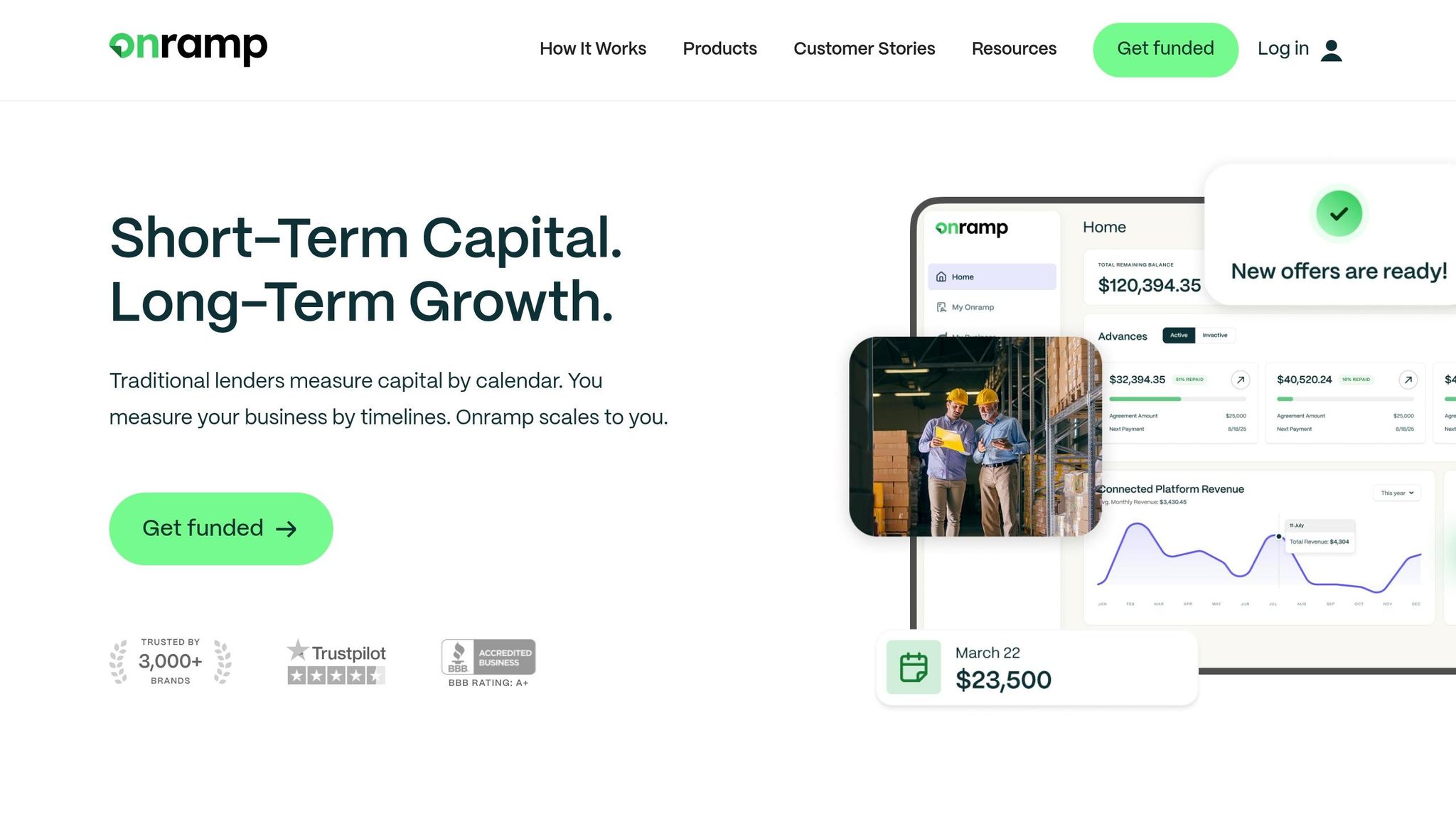
Onramp Funds provides working capital specifically designed for marketplace sellers on platforms like Amazon, Shopify, Walmart, and others [1]. It helps eCommerce businesses bridge cash flow gaps, allowing them to pay manufacturers on time without giving up equity.
With Onramp, merchants can get a funding estimate in just one minute, connect their store in five minutes, and receive funds within 24 hours [4]. The platform integrates directly with your store, analyzing real-time performance data to create funding offers based on actual sales trends instead of traditional credit scores.
"Traditional financing was never made for the cash flow cycles of eCommerce businesses. That's where Onramp funding comes in." - Onramp Funds [4]
One of the standout features is its revenue-based repayment structure. Payments adjust automatically based on daily sales - rising during busy periods and decreasing when sales slow down [1]. Repayment for variable offers can be as low as 1% of daily sales [4]. The fee structure is straightforward, typically ranging from 2% to 8% of the funded amount. All funding is unsecured and equity-free, with terms generally lasting from one to six months [4].
Core Features of Onramp Funds
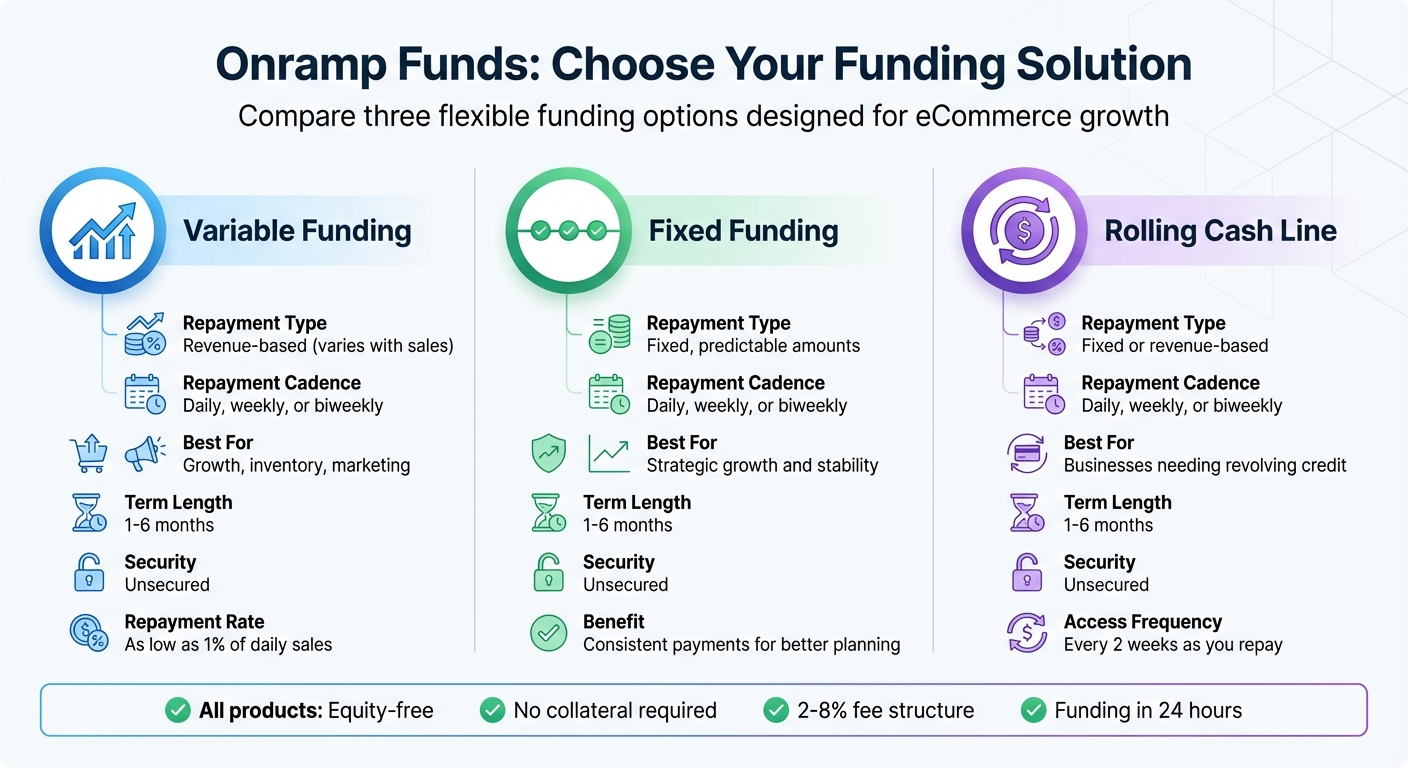
Onramp offers three distinct funding products to meet various business needs:
- Variable Funding: Repayments fluctuate with daily sales, making it ideal for short-term growth needs like inventory restocking or marketing.
- Fixed Funding: Provides consistent repayment amounts, offering stability for businesses focused on strategic expansion.
- Rolling Cash Line: A revolving credit option that grows with your sales, allowing you to access funds as often as every two weeks [3][4].
| Feature | Variable Funding | Fixed Funding | Rolling Cash Line |
|---|---|---|---|
| Repayment Type | Revenue-based (varies) | Fixed, predictable | Fixed or revenue-based |
| Best For | Growth, inventory, marketing | Strategic growth and stability | Businesses needing revolving credit |
| Term Length | 1-6 months | 1-6 months | 1-6 months |
| Repayment Cadence | Daily, weekly, or biweekly | Daily, weekly, or biweekly | Daily, weekly, or biweekly |
| Security | Unsecured | Unsecured | Unsecured |
"Each [product is] designed for a different phase of your business, and all built to support how real ecommerce operators grow, plan inventory, and deploy capital." - Onramp Funds [3]
Onramp Funds has earned an "Excellent" rating from 225 reviews, with customers highlighting the smooth process and the advantage of working with real people rather than an entirely automated system [4]. On average, businesses see a 60% increase in revenue after receiving funding, and 75% of customers return for additional funding [4]. The Austin-based team offers personalized support to help merchants select the best option for their business cycle [4].
These funding solutions not only support growth but also tackle critical eCommerce challenges.
How Onramp Funds Addresses Common eCommerce Challenges
Onramp Funds goes beyond providing capital by addressing key operational hurdles for eCommerce businesses. By offering flexible funding, it helps merchants improve inventory management, streamline supply chains, and expand marketing budgets - solving issues like delayed revenue cycles without requiring collateral or personal guarantees [1][2].
"Onramp has been the bridge when it came to quick capital for additional inventory..." - Ashunta, Verified Customer [4]
For supply chain improvements, Onramp funding allows businesses to negotiate bulk discounts, diversify shipping options, and enhance fulfillment operations. The repayment flexibility - adjusting with daily sales - reduces financial strain during slower periods. Plus, the platform’s secure store connection ensures that funding offers are based on real-time data, accurately reflecting each business's unique performance.
How to Use Funding to Improve Operations and Scale
Funding can be a game-changer when it comes to solving operational challenges. By addressing issues like supply chain delays, inventory shortages, and platform limitations, businesses can create the infrastructure they need to grow without overextending themselves. Let’s dive into how strategic funding can help optimize operations and set the stage for scaling up.
Improving Supply Chains with Working Capital Loans
Working capital loans can completely reshape how you handle supplier payments and cash flow. For example, a mid-sized eCommerce business with $200 million in annual purchases could extend its Days Payables Outstanding (DPO) from 45 to 75 days. This adjustment alone could unlock $16 million in cash, which can then be reinvested into inventory, marketing, or fulfillment improvements - without jeopardizing supplier relationships [5].
Onramp Funds offers a practical solution here. By using their working capital to pay suppliers promptly while extending internal payment terms, you can reduce the risk of production delays caused by cash-strapped vendors. For suppliers, shortening their Days Sales Outstanding (DSO) from 75 days to just 5 days on $20 million in annual sales can free up $3.8 million in working capital, making them more dependable partners for your business [5].
"A well‑designed SCF program aims to lengthen DPO without damaging supply stability while giving suppliers tools to shorten DSO, so that aggregate liquidity in the chain improves rather than simply being shifted downstream." - François Masquelier, CEO of Simply Treasury [5]
To make this work, start by setting clear DPO extension goals and calculating how much cash you’ll free up. Get your procurement, treasury, and operations teams on the same page to ensure smooth execution. Keep track of metrics like the Cash Conversion Cycle (CCC), funding utilization rates, and invoice dispute rates to measure how well your financing strategy is working.
| Metric | Impact | Benefit to eCommerce Business |
|---|---|---|
| Days Payables Outstanding (DPO) | Increases | Frees up internal cash flow for inventory or marketing |
| Days Sales Outstanding (DSO) | Decreases (for suppliers) | Reduces the risk of supplier disruption |
| Cash Conversion Cycle (CCC) | Shortens | Enhances liquidity and scalability |
| Supplier Financing Cost | Decreases | Lowers costs by leveraging optimized buyer credit |
By freeing up cash that’s tied up in payment cycles, you can scale operations while maintaining strong supplier relationships. Once your supply chain is solid, the next step is to align your inventory with demand.
Managing Inventory with Inventory Financing
Inventory financing solves a common problem: needing to purchase stock before you’ve received cash from previous sales. Onramp Funds offers a funding model that uses real-time storefront data to customize funding amounts, helping businesses avoid stockouts during busy seasons or the cash drain of overstocking slower-moving items.
Here’s how it works: Businesses with at least $10,000 in monthly sales can access funding within 24 hours. Repayment is automatically adjusted based on daily sales, typically ranging from 5% to 20%, depending on the funding product. The terms are unsecured - no collateral or personal guarantees required - and fees are transparent, usually between 2% and 8%.
This kind of financing ensures you have inventory ready when demand spikes, without tying up working capital. It’s especially useful during peak periods when manufacturers often require payment 30 or more days before you see revenue from those sales. By bridging this gap, you can sidestep one of the biggest operational challenges for growing eCommerce businesses.
Using Revenue-Based Financing for Platform Growth
Revenue-based financing (RBF) provides upfront capital for growth initiatives without the need to give up equity or commit to rigid monthly payments. With global eCommerce sales expected to surpass $8.1 trillion annually by 2026 [7], and traditional D2C funding down 97% from its 2021 peak [7], RBF offers a flexible alternative for scaling your operations.
Onramp Funds' revenue-based model takes a fixed percentage of future sales, with repayments scaling up during busy periods and down during slower months. This flexibility makes it ideal for funding initiatives like major marketing campaigns, expanding into new markets, or upgrading your platform. Plus, their AI-driven underwriting process tailors funding offers to your specific revenue patterns by analyzing real-time sales data, customer demographics, and order volumes.
"The ecommerce businesses I see scale quickly, and profitably, usually have one thing in common. They stopped waiting until it felt 'comfortable' and started using capital with intention." - Aaron Shahrabany [6]
Before pursuing revenue-based financing, make sure your unit economics are solid. Businesses with high revenue but low gross margins may struggle with this repayment structure. Keeping clean sales reports, refund logs, and advertising performance metrics is essential. Integrating tools like QuickBooks or Xero with your eCommerce platform can also provide lenders with a complete financial picture.
| Funding Plan Type | Key Features | Pricing/Structure | Best For |
|---|---|---|---|
| Custom Funding Offers | Tailored based on real‑time platform data | Variable, based on performance metrics | Businesses needing flexible, data‑driven funding |
| Fixed Fee Structure | Predictable total cost with no hidden interest | One‑time flat fee (2–8%) added to principal | Sellers prioritizing payment stability |
| Revenue‑Based Financing | Repayments adjust with daily/monthly sales volume | Fixed percentage of future revenue | High‑margin businesses with fluctuating sales cycles |
This approach allows businesses to invest heavily in inventory and marketing during peak times like Black Friday or Cyber Monday. With funding in place, you can seize growth opportunities without depleting your cash reserves, breaking through the barriers that often limit expansion potential.
How to Implement Funding Strategies for Better Efficiency
Start by thoroughly mapping out your operations - this includes fulfillment, inventory, and customer service. Doing so ensures that every dollar of funding is directed toward areas that enhance efficiency and scalability. This step helps pinpoint where capital can have the most meaningful impact [8].
Once you've mapped your operations, focus on identifying key bottlenecks. These could be in areas like fulfillment, inventory management, supply chains, or customer service. For example, if your support team takes 24 hours to respond to customers while competitors reply within two hours, you're likely losing repeat business. In such cases, allocating funding to improve customer support could deliver quick returns [9].
After identifying inefficiencies, align them with specific funding goals. For instance, if you need to prepare for a seasonal inventory surge, inventory financing might be the best option. On the other hand, if you're scaling ad campaigns with uncertain outcomes, revenue-based financing could be a better fit since repayments adjust based on sales performance. Brands with high margins and rapid growth might lean toward revenue-based financing, while lower-margin or B2B operations may find term loans with fixed monthly payments more suitable [1].
Shifting focus from customer acquisition to retention can also boost capital efficiency. Retention strategies like push notifications often generate significantly more revenue from loyal customers compared to traditional advertising methods [8]. Ron Shah, Co-founder and CEO of Obvi, underscores this point:
"If we're having a rough day on Shopify and the ads have been tricky, then boom, we can just send [a push notification] and get what we need" [8].
Mobile apps with push notifications can generate up to 2.5 times more revenue from loyal customers than other channels, making this a smarter investment than constantly chasing new customers through costly ad campaigns [8].
Finally, use funding to negotiate better terms with manufacturers. With extra capital, you can place larger orders and gain leverage to lower your Cost of Goods Sold (COGS). Ron Shah suggests:
"Whether it's a 1% discount or a 50%, go back to manufacturers quarterly or even monthly to negotiate. Tell them you've got a bigger order coming up - could they offer you better pricing?" [8].
This approach not only resolves operational bottlenecks but also improves profit margins over time.
How to Measure the Results of Funded Improvements
To gauge the impact of funded improvements, start by tracking key operational metrics. One of the most telling is the inventory turnover ratio, which reflects how efficiently you’re turning stock into sales. If your funding was used to upgrade inventory, a higher turnover ratio signals quicker product movement through your warehouse [10][11].
Next, assess order fulfillment time, which measures the time from order placement to delivery. Shorter fulfillment times mean customers receive their products faster, often leading to higher repeat purchase rates [10][11]. Additionally, monitor the perfect order rate, which tracks the percentage of on-time, complete, and damage-free deliveries. Top-performing businesses achieve rates between 97% and 99%, but even increasing from 90% to 95% can boost customer retention by 2% to 3% [12].
Operational improvements should also deliver financial results. A key metric here is ROI, calculated as:
[(Net profit – Investment cost) / Investment cost] x 100 [13].
In eCommerce, a strong benchmark is generating $2 to $3 in revenue for every $1 spent, equating to a 200% to 300% ROI [13]. Keep an eye on your operating margin each month to ensure that operational upgrades are driving profitability, not just higher sales [11].
Customer metrics are just as important. For example, the LTV:CAC ratio (Lifetime Value to Customer Acquisition Cost) is a critical measure for scaling businesses. A healthy ratio is 3:1, meaning each customer brings in three times the cost of acquiring them [12]. If your funding went toward improvements like a streamlined checkout process or mobile optimization, track your conversion rate. Desktop typically converts at 3.5%, while mobile lags at 2.1%, so narrowing this gap can indicate success [12].
To stay on top of performance, establish a structured review schedule. Operations teams should monitor tactical KPIs - like conversion rates, site traffic, and fulfillment times - every week. Meanwhile, executives should focus on strategic metrics, such as unit economics and cash flow, on a monthly basis [12]. This consistent rhythm helps you spot and address issues early, preventing small concerns from escalating into costly problems.
Conclusion
Growing an eCommerce business takes determination and smart financial solutions to bridge cash flow challenges. Tools like working capital loans streamline supply chains, inventory financing helps avoid stock shortages, and revenue-based financing supports platform growth without giving up equity. These strategies lead to tangible results - lower costs, faster inventory turnover, and improved profitability, all measurable through metrics like ROI and LTV:CAC ratios.
Onramp Funds simplifies funding for U.S.-based eCommerce sellers. With quick access to funds in just 24 hours, equity-free financing, and repayment plans that adjust based on your sales, you can secure the capital you need without the restrictions of traditional loans. Whether your business operates on platforms like Amazon, Shopify, TikTok Shop, or Walmart Marketplace, Onramp seamlessly connects to provide funding solutions for sellers with monthly sales starting at $10,000.
Take the next step toward scaling your business. Visit Onramp Funds to pre-qualify in minutes and access the funding that supports your growth.
FAQs
Which Onramp funding product should I choose?
The best Onramp funding product depends on what your business needs and where you are in your growth journey. If you're looking for flexible funding tied to your revenue, there are options tailored for inventory, marketing, or operations. For larger businesses requiring quick access to significant capital, products offering up to $2 million within 24 hours could be a great match. To ensure you choose the right solution, reach out to Onramp's team - they can help customize a plan that aligns with your goals.
What happens to repayments if my sales decrease?
If your sales take a dip, repayments for dynamic credit lines often adjust in line with your actual revenue. This means your payments could decrease - or even pause - during slower times, giving you more breathing room to manage your cash flow.
What metrics prove funding improved my ops?
Key performance indicators that reflect better operations include cash flow stability, inventory turnover rates, and sales trends. For instance, fewer cash flow gaps and faster inventory turnover highlight improved stock management and operational efficiency. On top of that, monitoring metrics like revenue growth and return on ad spend (ROAS) can validate that funding efforts are translating into higher sales and profitability. Together, these metrics ensure that financial resources are effectively supporting business growth and operational objectives.
Related Blog Posts
Onramp Funds
Funding built around your sales
Connect your store and see what you qualify for. Repay as a percentage of sales, with no personal credit check.
Funding in as little as 24 hours.
