


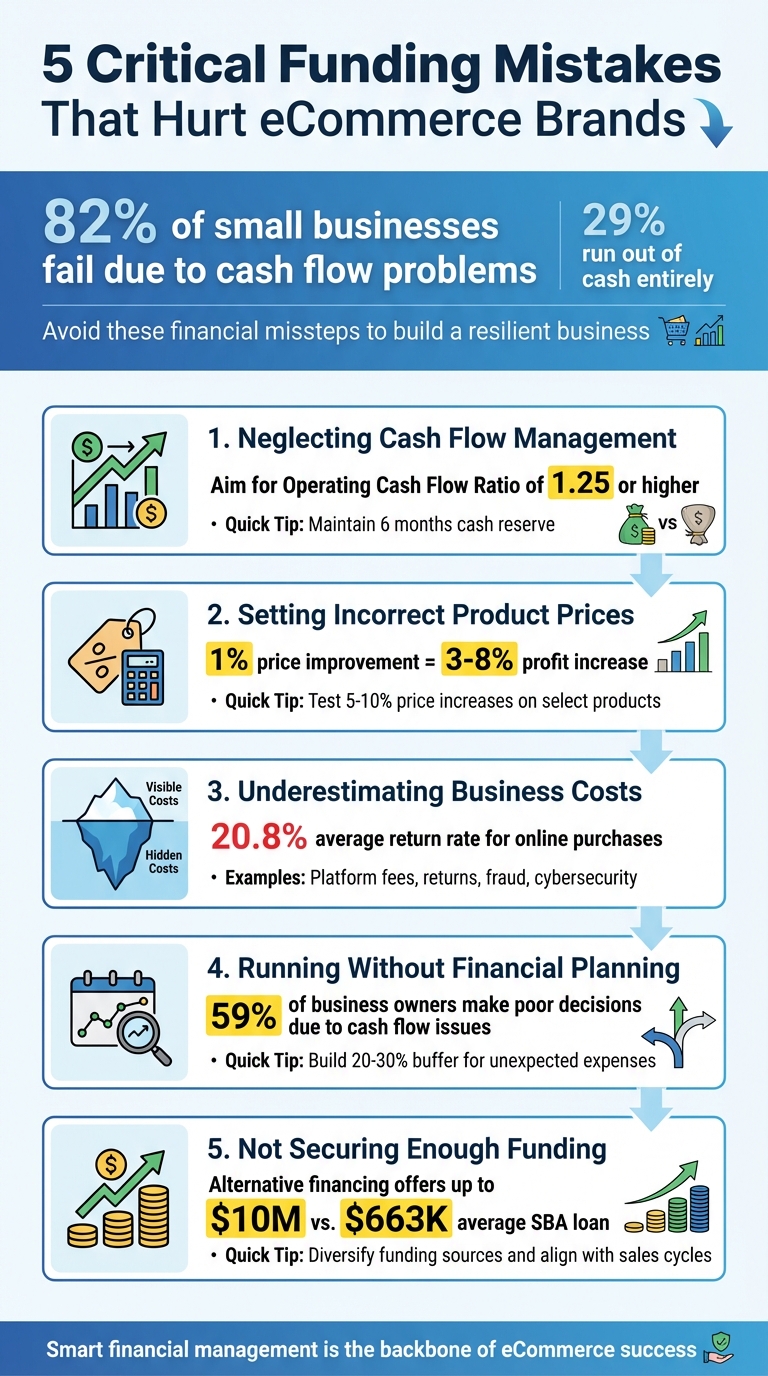
When it comes to running a successful eCommerce business, strong sales and great products aren’t enough. Financial missteps - especially with funding - can derail even the most promising brands. Research shows that 82% of small businesses fail due to cash flow problems, and 29% run out of cash entirely. Mismanaging cash flow, underestimating costs, or securing the wrong type of funding can lead to mounting debt, missed opportunities, and operational challenges.
Here’s a quick breakdown of the most common funding mistakes and how to avoid them:
- Neglecting Cash Flow Management: Strong revenue doesn’t always mean enough cash on hand. Monitor your Operating Cash Flow Ratio (aim for 1.25 or higher) and reconcile accounts regularly to avoid liquidity issues.
- Incorrect Product Pricing: Mispricing eats into profits. Account for all costs - inventory, shipping, advertising, and more - when setting prices, and regularly review your pricing strategy.
- Underestimating Business Costs: Hidden expenses like platform fees, returns, and fraud can quietly drain profits. Conduct thorough cost analyses and automate processes where possible.
- Lack of Financial Planning: Without clear budgets and forecasts, businesses risk poor decisions and cash shortages. Use rolling 12-month projections and scenario planning to stay prepared.
- Not Securing Enough Funding: Insufficient capital can halt growth. Diversify funding sources and align financing with your business needs to maintain flexibility.
Bottom Line: Smart financial management is the backbone of eCommerce success. Avoid these mistakes by keeping a close eye on cash flow, pricing, costs, and funding strategies. With the right approach, you can build a resilient, profitable business.
eCommerce Funding Secrets Every Seller Should Know
sbb-itb-d7b5115
Mistake 1: Neglecting Cash Flow Management
Your sales numbers might look impressive, but don’t let that fool you - strong revenue doesn’t always mean you’ll have cash on hand when it’s time to pay the bills. This disconnect between profitability and liquidity is one of the riskiest traps for eCommerce brands. You could have thousands tied up in pending orders, yet still struggle to pay suppliers or employees. That’s why keeping a close eye on cash flow is critical to avoid running into financial trouble.
Why Revenue Growth Can Mask Cash Flow Issues
The root of the problem often lies in how your cash is tied up. For instance, if you’ve sunk funds into inventory sitting in a warehouse or offered customers extended payment terms (like 30 or 90 days), your bank account might be empty even though your profit-and-loss statement says otherwise. This gap between spending money and actually collecting it can leave your business in a liquidity crunch [4].
A key metric to watch is the Operating Cash Flow Ratio (OCFR). If it’s below 1.0, it means you don’t have enough cash to cover your current obligations, even if your business looks profitable on paper [4]. Ideally, eCommerce businesses should aim for a ratio of 1.25 or higher [4]. The challenge becomes even greater during periods of rapid growth, when increased spending on inventory, staffing, and marketing outpaces the cash coming in [3]. Recognizing these hidden risks is the first step toward managing your cash flow effectively.
"Cash is so tight for everyone, especially for entrepreneurs, because they're risk takers. So if you know how much cash is coming in, how much cash is going out, then you'll know what you need."
– Armine Alajian, CPA and Founder, Alajian Group [3]
How to Keep Your Cash Flow in Check
Start by reconciling your bank accounts regularly - weekly or monthly - to catch errors like missing, duplicate, or overstated transactions. A simple cash tracker, even a basic spreadsheet, can help you monitor daily or weekly inflows and outflows, giving you a clear picture of your actual cash position.
"You have this data coming in from different sources. And if you don't reconcile, you don't know if something is missing, something is overstated, or something has been duplicated."
– Armine Alajian, CPA and Founder, Alajian Group [3]
To speed up cash inflows, consider automating your invoicing process and offering early payment discounts. For example, a 2% discount for payments within 10 days can encourage customers to pay sooner [3]. On the flip side, stretch out your payables by scheduling vendor payments closer to their due dates, keeping cash in your business longer without straining relationships with suppliers [3]. Experts also suggest maintaining a cash reserve that covers at least six months of expenses. This safety net can help you navigate unexpected challenges or seasonal dips [3].
Mistake 2: Setting Incorrect Product Prices
Just as managing cash flow keeps your business afloat, setting the right prices safeguards your profit margins. Mispricing can eat away at profits even if your sales are strong. Many eCommerce sellers rely on gut feelings or simply mimic competitors' prices without considering the actual costs of running their business. This can lead to leaving money on the table or, worse, creating a false sense of profitability while profits quietly disappear. Poor pricing practices often lead to cash flow issues and operational instability.
Pricing Errors eCommerce Sellers Make
One of the biggest mistakes sellers make is failing to account for the full range of operational costs when pricing their products. Rising supplier costs, manufacturing expenses, shipping delays, platform fees, credit card processing charges, and software subscriptions are often overlooked. These hidden costs can chip away at your profit margins if they’re not factored into your pricing strategy from the outset[1][5]. Another common error is ignoring the rising cost of advertising. As competition heats up, running ads on social media or PPC platforms becomes more expensive. If you don’t adjust your prices to reflect these higher customer acquisition costs, your marketing efforts could end up losing money[1]. Additionally, failing to properly track metrics like Cost of Goods Sold (COGS) and Customer Acquisition Cost (CAC) makes it nearly impossible to know if each sale is actually profitable[1].
"As a retailer, you may need to increase your prices to maintain profit margins. However, higher prices could lead customers to seek more affordable alternatives, resulting in decreased sales and lower ROI." – Onramp Funds[1]
Using Cost-Based and Competitive Pricing Methods
To avoid these pitfalls, consider blending cost-based and competitive pricing strategies. Start by calculating your cost per unit: take your total fixed and variable costs and divide them by the number of units produced[6]. From there, determine your target price by dividing the cost per unit by one minus your desired profit margin (as a decimal)[6]. For instance, if your cost per unit is $20 and your goal is a 40% margin, the formula would look like this: $20 ÷ (1 - 0.40) = $33.33.
Beyond costs, study your competitors’ pricing, marketing tactics, refund policies, and shipping fees[6]. Experiment with small price increases - around 5% to 10% - on select products to gauge their impact on sales. Keep in mind that even a 1% improvement in price can increase operating profit by 3% to 8%[6]. Regularly reviewing and adjusting your pricing is one of the most effective ways to protect and grow your bottom line.
Mistake 3: Underestimating Business Costs
Overlooking operational costs can be just as damaging to your business as cash flow or pricing errors. Even with strong sales and pricing strategies, hidden expenses can quietly erode profits. Many eCommerce sellers focus on obvious costs like inventory, shipping, and advertising but fail to account for smaller, less visible charges that quickly add up. This underestimation can create a false sense of financial stability, leaving businesses vulnerable when unexpected expenses arise.
Hidden Expenses That Can Drain Your Budget
Marketplace and transaction fees can be more complicated than they seem. For example, payouts from platforms like Amazon, Shopify, or Etsy often combine sales, fees, taxes, and refunds, making it easy to lose track of costs. Etsy, for instance, charges a $0.20 listing fee and a 6.5% transaction fee on the total sale amount (including shipping and gift wrapping). If you participate in offsite ads, that adds another 15% fee[8]. Similarly, Square charges 2.9% plus $0.30 per transaction, while WooCommerce’s Eway charges 1.9% plus $0.25[8]. These small percentages may seem negligible, but across hundreds or thousands of orders, they can significantly impact your bottom line.
Returns and fraud are another area where costs can spiral. In 2021, the average return rate for online purchases was 20.8%, with over 10% of those returns being fraudulent[8]. Beyond shipping labels, returns often lead to extra labor costs and potential write-offs. On top of that, cybersecurity expenses like firewalls and antivirus programs are increasingly necessary, as 58% of small businesses reported at least one security breach[8].
Operational inefficiencies can also drain resources without being immediately obvious. Manual reconciliation of marketplace data, for example, might seem minor but can lead to significant errors over time. Financial technology provider Settle highlights this issue:
"Miscategorized or missed data is a recipe for flawed reporting. It only takes one small mistake to snowball. A $2 fee miscategorized across 1,000 transactions? That's $2,000 in hidden error"[7].
Even major companies like JPMorgan Chase have tackled inefficiencies by adopting automation. Their COIN (Contract Intelligence) software replaced 360,000 hours of manual legal document reviews annually, showcasing how automation can save both time and money[9].
Recognizing these hidden expenses is the first step toward creating a budget that accounts for surprises and keeps your business on solid ground.
Building Budgets That Account for the Unexpected
To build a realistic budget, start by evaluating the total cost of ownership (TCO). This means factoring in not just supplier costs but also shipping, tariffs, packaging, and handling fees[9]. A detailed spend analysis can help identify areas for savings, such as consolidating suppliers or negotiating volume discounts. For instance, General Electric saved over $12 billion in five years by applying Six Sigma methodologies to reduce waste from defects and overproduction[9].
Automation is another key to avoiding costly errors. Tools like A2X and Settle can break down marketplace payouts into sales, fees, and taxes automatically, minimizing the risk of manual data entry mistakes[7]. For businesses with physical locations, energy and space audits can uncover inefficiencies. Aetna, for example, consolidated operations from 13 buildings into a single headquarters, saving an estimated $30 million annually on occupancy and maintenance costs[9].
Lastly, set aside a reserve fund specifically for unplanned professional services. Unexpected expenses like legal consultations, emergency tech support, or seasonal tax preparation can strain your finances if you’re unprepared. By maintaining a safety margin, you can protect your cash flow and keep your business stable, even when faced with multiple surprises at once[8].
Mistake 4: Running Your Business Without Financial Planning
Just like managing cash flow, having a solid financial plan is essential to keep your eCommerce business on track. Without it, even a profitable business on paper can run into trouble. For example, a Profit & Loss statement might show you're making money, but that doesn't mean you have enough cash to pay suppliers or restock inventory. In fact, 59% of small business owners admit that cash flow issues have led them to make poor decisions[12]. Often, these mistakes come from reacting to problems instead of planning ahead.
One common issue is failing to align large purchase orders with revenue cycles. Even if sales are strong, this mismatch can create sudden cash shortages. Plus, businesses that lack clear financial projections may struggle to secure favorable terms from suppliers or credit from financial institutions. The good news? With the right approach, you can create monthly budgets and forecasts to avoid these pitfalls.
The Problems with Making Financial Decisions on the Fly
When decisions are based on wishful thinking rather than hard data, the gap between expectations and reality can become a major problem. Casandra Campbell from Shopify explains it perfectly:
"Budgets tell you what you want to happen. They're wishful thinking... Cash flow projections tell you what is actually happening so you can deal with it - even if it's not what you planned at the beginning of the year." [11]
Without a structured financial plan, businesses may hesitate to invest in growth - whether that's hiring new staff or ramping up marketing - because they lack clarity about their available cash. This hesitation can be costly. Consider this: 17% of small businesses would be forced to shut down if they experienced just a two-month revenue loss[12]. That statistic underscores how critical financial visibility is to survival.
Setting Up Monthly Budgets and Financial Forecasts
A proactive financial plan can help you avoid the chaos of reactionary decision-making. Start by creating a rolling 12-month financial view. Update it monthly by replacing projections with actual data from your accounting system. This allows you to monitor key metrics like Customer Acquisition Cost (CAC) and Average Order Value (AOV), so you can spot potential problems early.
Dan Kang, CFO at Mercury, emphasizes the importance of this process:
"Forecasts aren't about getting every number right, they're about thinking through how your business works and what it needs to grow - plus how you can do that with fewer surprises and greater visibility." [10]
Scenario planning is another powerful tool. Develop "Base", "Stretch", and "Conservative" forecasts to see how your business might perform under different conditions, such as a sudden drop in sales or a spike in advertising costs. Also, sync your inventory planning with sales projections. This way, you can avoid tying up cash in excess stock while ensuring you have enough inventory to meet demand.
Experts also suggest building a buffer of 20–30% into your budget for unexpected expenses[12]. This cushion can give you the flexibility to handle surprises or take advantage of new opportunities without throwing your finances into disarray.
Mistake 5: Not Securing Enough Funding
Mismanaging cash flow and setting incorrect prices are common pitfalls, but running out of funding can be just as damaging - even for businesses that appear profitable. For eCommerce brands, lacking sufficient capital can halt progress, no matter how strong their products or strategies are. Without enough funding, businesses face limitations that prevent them from staying competitive.
When cash is tight, brands are forced to cut corners. This might mean delaying inventory purchases, scaling back marketing efforts, or passing on growth opportunities - all because the initial funding wasn’t enough. eCommerce businesses, in particular, require significant upfront investment and often experience delays in receiving sales payouts[13].
These funding gaps can lead to a ripple effect of operational challenges.
What Happens When You Don't Have Enough Capital
A lack of funding doesn’t just slow things down - it creates a cascade of problems. For example, brands may face stockouts, which not only hurt search rankings but also damage customer trust, especially on platforms like Amazon. On the flip side, overstocking ties up cash that could be used elsewhere[15].
Underfunded businesses are also vulnerable to market fluctuations. If supplier costs rise, shipping becomes more expensive, or advertising becomes highly competitive, there’s no financial buffer to absorb the shock. Fixed-payment loans can make things worse by draining cash during slower sales periods.
Asking for too little funding can be just as harmful as overborrowing. Investors and lenders often see inadequate funding requests as a sign of poor planning. It signals that the business hasn’t properly assessed its needs, making the funding round seem like "a bridge to nowhere"[16]. This lack of foresight can deter potential backers.
Recognizing these risks is the first step toward smarter capital planning.
How to Plan for the Right Amount of Funding
Start by conducting a thorough financial analysis. This includes aligning inventory purchases with customer payment cycles[13][14]. Calculate the timing gap between when you pay for inventory and when you receive customer payments, ensuring you have enough funds to cover that period[13].
It’s also wise to diversify your funding sources. Use short-term financing for quick-turnover needs like inventory and marketing, and reserve long-term loans for larger investments, such as infrastructure. This “capital stack” approach helps avoid mismatches, like using costly short-term loans for long-term projects or locking up long-term capital in inventory that cycles every few months.
For eCommerce sellers with just six months of sales history, alternative financing options can provide up to $10 million - far exceeding the average SBA loan of $663,000[14]. While traditional lenders often require lengthy approval processes and may offer insufficient amounts, modern revenue-based financing solutions are quicker and more flexible. These options adjust repayment terms based on your sales performance, meaning payments decrease if revenue slows, offering a safety net that traditional loans lack.
Conclusion
For thriving eCommerce brands, financial discipline isn't optional - it's the backbone of success. Managing cash flow effectively, setting the right prices, creating realistic budgets, and planning finances carefully aren't just good habits - they're essential for staying in business. Consider this: 82% of small businesses fail due to cash flow issues, and 29% go under because they run out of cash [2]. These numbers highlight the real struggles faced by businesses with great products but weak financial management.
However, these hurdles can be tackled with a disciplined approach. Keeping a cash flow ratio of at least 1.25 [4], making data-driven decisions, and aligning funding with sales cycles can provide stability. This strategy helps avoid stockouts and ensures there's enough capital to navigate slower seasons while still planning for growth. It's about building a solid foundation that supports long-term resilience.
"In the world of commerce, 'debt' isn't the bad word some people think it is. Done right, it can lead to increased sales and a stronger, more resilient online business." - SellersFi [17]
The most successful eCommerce brands don't just rely on great products - they pair them with smart financial strategies. By carefully managing costs and seizing opportunities, disciplined planning, and well-thought-out funding strategies, your eCommerce business can achieve steady, profitable growth.
FAQs
What are the best ways to manage cash flow and avoid running into liquidity problems?
Managing your cash flow is crucial for keeping your business financially stable. One of the best ways to stay on top of it is by creating regular cash flow forecasts. These forecasts can help you predict when cash might be tight or abundant, especially during seasonal highs and lows. With this insight, you can plan ahead and avoid any unpleasant financial surprises.
To improve your cash inflows, consider automating your collections process and offering early payment discounts to your customers. These steps can encourage faster payments and keep money moving into your business. On the flip side, try negotiating longer payment terms with your suppliers. This can give you a bit more flexibility and breathing room. Another smart move is to build up cash reserves during your high-revenue months. These savings can act as a safety net during slower periods.
If you find yourself needing extra funds to cover short-term gaps, explore flexible funding options like revenue-based financing. This approach can provide a temporary boost without adding a heavy debt burden. By using these strategies, you can keep your business steady and stay focused on achieving long-term growth.
What’s the best way to price products effectively in eCommerce?
Pricing your products effectively is one of the most crucial steps to staying competitive and profitable in eCommerce. Start by diving into some market research. Look at what your target audience is willing to pay and compare that to how competitors price similar products. This helps you set prices that match the value customers associate with your products.
From there, break down all your costs - manufacturing, shipping, marketing, and any other expenses - to determine the lowest price you can charge while still covering costs and hitting your profit goals. You might also consider dynamic pricing strategies. These allow you to adjust prices based on factors like demand, inventory levels, or market trends, helping you boost revenue while maintaining customer trust.
Lastly, keep a close eye on your sales data and listen to customer feedback. Regularly tweaking your pricing strategy ensures your prices stay competitive, reflect market conditions, and support both your short-term and long-term growth.
How do I figure out the right amount of funding for my eCommerce business?
To figure out how much funding your eCommerce business needs, start by drafting a solid financial plan. This plan should factor in your operational expenses, growth objectives, and cash flow requirements. A helpful guideline is to aim for a working capital ratio between 1.5:1 and 2:1. This ensures you have enough cash on hand to cover essentials like inventory, marketing efforts, and platform fees.
Look ahead and estimate your expenses for the next 12 to 18 months. Include key costs like inventory, advertising, and overhead, and be sure to add a 10–20% buffer for any unexpected expenses. This approach helps you avoid the pitfalls of underfunding, which can stunt growth, or overfunding, which might lead to careless spending.
Additionally, align your funding strategy with your sales cycle and cash flow forecasts. Negotiating better payment terms with suppliers and tightening up receivables can help you secure just the right amount of funding. This way, you can support steady growth without stretching your business too thin.
Related Blog Posts
Onramp Funds
Funding built around your sales
Connect your store and see what you qualify for. Repay as a percentage of sales, with no personal credit check.
Funding in as little as 24 hours.
