


Running an eCommerce business is tough, especially when cash flow is unpredictable. Fixed loan payments can make it harder to manage expenses like inventory and advertising during slow sales periods. The good news? Flexible financing options - like revenue-based financing, merchant cash advances, and pay-as-you-go funding - can solve this problem by aligning repayments with your sales.
Key Takeaways:
- Revenue-Based Financing: Pay a percentage of your sales instead of fixed amounts. Payments adjust based on performance, offering relief during slower months.
- Merchant Cash Advances: Get upfront capital in exchange for a share of future sales. Quick approval but often higher costs.
- Pay-As-You-Go Funding: Access funds when needed without fixed fees, paying interest only on what you use.
These solutions help eCommerce sellers fund inventory and ads without the stress of rigid payments. Platforms like Onramp Funds simplify the process by analyzing your sales data and offering tailored repayment plans. Whether you're preparing for peak seasons or managing slow periods, these tools can keep your business running smoothly.
eCommerce Funding Secrets Every Seller Should Know
sbb-itb-d7b5115
Cash Flow Problems in eCommerce
Running an eCommerce business often means facing tough cash flow challenges, especially when expenses hit long before any revenue comes in. Imagine spending $50,000–$100,000 on inventory and another $10,000–$50,000 each month on advertising, all before making a single sale[5]. These upfront costs tie up your capital, creating financial strain from the start.
Revenue streams in eCommerce are anything but smooth. Seasonal ups and downs, as discussed earlier, are just one part of the problem. For businesses that rely on card sales - often making up 40–50% of their revenue - these fluctuations can feel even more intense[4]. On top of that, unexpected changes like supply chain delays, competitor price adjustments, or shifts in algorithms on platforms like Amazon can slash sales by 20–30% overnight[3]. This kind of unpredictability makes it even harder to manage fixed financial commitments.
Why Fixed Payments Are a Struggle
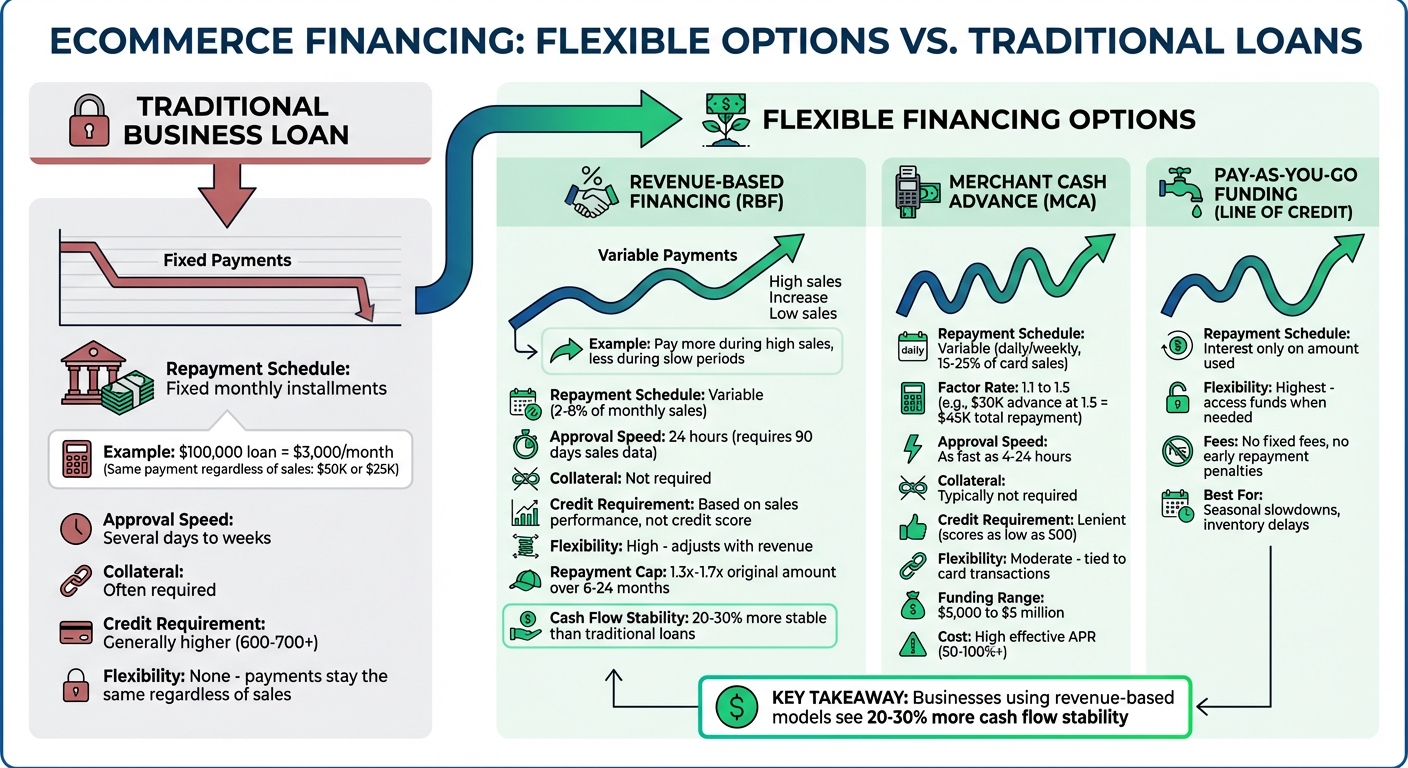
Traditional loans don’t adapt to the highs and lows of your business. Let’s say you take out a $100,000 loan with $3,000 monthly payments. That payment stays the same whether your sales are booming at $50,000 or plummeting to $25,000 per month[5]. During slower periods, this rigidity forces tough choices: Do you pay the loan, restock inventory, or keep your ads running?
"It's more expensive to launch products, advertising is going up, and when you add up all of these costs, you won't have enough cash to restock and launch new products at a consistent rate." – Onramp Funds[2]
When sales unexpectedly drop, fixed payments can drain your cash reserves even further. This often leads to missed payments, penalties, and mounting financial stress.
Why Flexible Repayment Models Work Better
Flexible repayment models offer a way to align payments with your revenue. Instead of fixed amounts, you pay a percentage of your monthly sales - usually between 2–8% - or a portion of daily card sales, typically 15–25%[8,9,10]. This means when sales are strong, you pay more, and when sales slow down, you pay less, helping to maintain cash flow during lean periods while still making progress on repayment.
Businesses that switch to revenue-based repayment models often see 20–30% more stability in their cash flow compared to traditional loans[5]. These models also include a repayment cap - usually 1.3x–1.7x the original funding amount over 6–24 months[9,10]. This balance between flexibility and predictability allows eCommerce sellers to invest in inventory and advertising without the fear that a slower month will throw everything off track.
Flexible Financing Options for eCommerce
eCommerce sellers often face cash flow challenges, especially when managing inventory and advertising expenses. Fortunately, there are several financing options designed to align with the unique revenue cycles of online businesses. These options provide flexibility by adjusting repayment terms based on sales performance, eliminating the burden of fixed payments.
Revenue-Based Financing Explained
Revenue-based financing (RBF) adjusts repayments according to your sales. Instead of a fixed monthly payment, you pay a percentage of your revenue. This means higher payments during strong sales periods and lower payments when sales slow down. The approval process is streamlined, using platforms like Shopify, Amazon, or Walmart to analyze real-time sales data. With just 90 days of sales data required, funds can be approved in as little as 24 hours[2].
RBF is especially helpful for short-term needs, such as restocking inventory or boosting advertising campaigns. Its flexibility makes it a favorite among eCommerce sellers.
"Revenue-based financing (RBF) is typically the best fit. It allows you to use capital for any business need - inventory, marketing, or fulfillment - and repayment flexes with your sales." – Onramp Funds[1]
Merchant Cash Advances
A merchant cash advance (MCA) provides a lump sum upfront in exchange for a share of your future sales. Repayments are automatically deducted daily or weekly based on your credit or debit card transactions. Instead of traditional interest rates, MCAs use a factor rate - ranging from 1.1 to 1.5 - to calculate costs. For example, a $30,000 advance at a 1.5 factor rate would require a total repayment of $45,000[6].
While MCAs can lead to high effective annual percentage rates (sometimes exceeding 50% to 100%), they are valued for their speed and accessibility. Applications can be approved in as little as four hours, and credit score requirements are lenient, with some providers accepting scores as low as 500[6]. Advance amounts typically range from $5,000 to $5 million, making MCAs a quick option for businesses needing immediate capital.
| Feature | Merchant Cash Advance (MCA) | Traditional Business Loan |
|---|---|---|
| Repayment Schedule | Variable (daily/weekly) | Fixed monthly installments |
| Approval Speed | As fast as 24 hours | Several days to weeks |
| Collateral | Typically not required | Often required |
| Credit Requirement | Lenient (scores as low as 500) | Generally higher (600-700+) |
If a lump sum isn't the right fit, other options like pay-as-you-go funding may offer even more flexibility.
Pay-As-You-Go Funding
Pay-as-you-go funding works as a line of credit, allowing you to access funds when needed without committing to fixed fees. You only pay interest on the amount you use, and there are no penalties for early repayment. This approach is particularly useful during seasonal slowdowns or when dealing with inventory delays. It enables businesses to reinvest in advertising and inventory without waiting for lengthy payout cycles[2].
"Lines of credit offer quick access to funding without requiring fixed fees or long-term commitments." – Onramp Funds[2]
These flexible financing solutions are ideal for scaling inventory and advertising simultaneously, especially during high-demand periods like Q4 or Prime Day. Many providers base approvals on sales data and business performance rather than personal credit scores, making them accessible even for sellers with less-than-perfect credit histories.
How Onramp Funds Works
Onramp Funds provides eCommerce sellers with revenue-based financing, offering fast access to capital without the hassle of fixed monthly payments. By directly integrating with platforms like Amazon, Shopify, TikTok Shop, and Walmart, Onramp analyzes real-time sales data instead of relying on outdated credit scores or tax returns [2].
Main Features of Onramp Funds
Onramp Funds stands out for its speed. You can get an estimate in just one minute, connect your store in five, and, in many cases, receive funding the same day. This quick turnaround is especially valuable for restocking inventory or ramping up advertising during high-demand periods [7].
The platform offers two repayment structures designed to fit the unique rhythms of eCommerce businesses:
- Variable Repayments: Payments are tied to a percentage of daily sales, starting as low as 1%. This means payments naturally adjust with sales cycles - lower during slower periods and higher when business picks up.
- Fixed Repayments: For sellers who prefer consistency, this option provides predictable, fixed payment amounts, ideal for stable budgeting [7].
"Our funding is tailored to the ups and downs of eCommerce businesses, where no two days are alike." – Onramp Funds [7]
Onramp’s system integrates seamlessly with major eCommerce platforms, automatically pulling sales data. This eliminates the need for manual reports and enables data-driven underwriting that focuses on metrics like revenue growth, sales channels, and inventory trends. The results speak for themselves: Onramp customers see an average revenue growth of 60% after receiving funding, and 75% return for additional financing [7].
Requirements and Fee Structure
Qualifying for Onramp Funds is straightforward. Businesses need to show at least $10,000 in monthly sales, making it accessible to smaller sellers. Unlike traditional banks, which focus on credit scores and tax returns, Onramp evaluates eligibility using modern performance metrics like sales trends and revenue forecasts [2].
The fees are clear and range between 2% and 8% of the funded amount, with no hidden charges or monthly minimums. For the variable repayment option, the daily remittance rate can be as low as 1% of sales, ensuring payments scale down when revenue slows [7].
"Traditional financing was never made for the cash flow cycles of eCommerce businesses. That's where Onramp funding comes in." – Onramp Funds [7]
Onramp’s approach also means no equity requirements or personal guarantees, so you retain full control of your business. Offers are crafted based on your actual sales performance, not outdated financial documents [7].
Onramp Funds Repayment Options Compared
The repayment plans are designed to align with the cash flow challenges of eCommerce businesses. Here’s a side-by-side comparison:
| Feature | Variable Repayment | Fixed Repayment |
|---|---|---|
| Payment Amount | Percentage of daily sales (as low as 1%) | Consistent, fixed dollar amount |
| Fee Structure | 2–8% flat fee | 2–8% flat fee |
| Flexibility | High; adjusts with sales fluctuations | Low; same amount every payment |
| Predictability | Varies based on performance | High; exact same amount each time |
| Monthly Minimums | None | N/A |
| Best Use Case | Seasonal businesses or volatile cash flow | Predictable budgeting needs |
The variable repayment option is ideal for businesses with fluctuating sales, such as during holiday rushes or seasonal slowdowns, as payments automatically adjust to match revenue. On the other hand, the fixed repayment option is better for sellers who value consistent budgeting with predictable payments.
Both options allow you to use the funds however you need - whether for inventory, advertising, or other business expenses. Additionally, Onramp charges fees based on the remaining balance for credit lines, and these fees decrease as the balance is paid down. There are no penalties for early repayment, giving you the flexibility to clear your balance whenever it suits your cash flow [7, 24].
How to Get Funding from Onramp Funds
Onramp Funds provides quick access to capital, with approvals in minutes and funds deposited into your U.S. bank account within 24 hours [8]. Their process is designed to address the cash flow hurdles of eCommerce businesses, offering financing for inventory and advertising without rigid payment schedules.
Connect Your Store
The first step is connecting your eCommerce store to Onramp Funds. They support platforms like Amazon, Shopify, BigCommerce, WooCommerce, Squarespace, Walmart Marketplace, and TikTok Shop. Simply log into the Onramp dashboard, select "Connect Store", and complete the secure OAuth process. This takes just a few clicks and grants Onramp read-only access to your sales and revenue data from the past three to six months. By analyzing this real-time performance data, Onramp can evaluate your business and determine your funding eligibility. The connection process takes about five minutes.
Once your store is linked, you’ll immediately see how much funding is available to you.
Use the Funding Calculator
Onramp’s AI-powered calculator uses your historical sales data to create a tailored funding estimate. Input your average monthly revenue, and the system will calculate an estimate based on your revenue over the past 12 months, cash flow, and debt profile. For instance, a store earning $50,000 per month might qualify for funding between $20,000 and $100,000. Fees typically range from 2% to 8%, with repayment periods lasting six to 24 months. To simplify things further, Onramp also offers a Lending Cost Calculator that converts fees into a single APR metric, making it easier to understand the overall cost of funding.
"Analyzing business metrics by plugging into your selling platform lets you find the perfect loan amount and repayment schedule to fulfill business needs and keep overall fees low." – Onramp Funds [2]
After reviewing your funding offer, the next step is to activate and manage your funds.
Receive and Manage Your Funds
Once you accept the funding offer, the money is deposited into your U.S. bank account within 24 hours. Repayments automatically adjust based on your daily or weekly sales performance. If you choose the variable repayment plan, Onramp deducts a fixed percentage of your sales - usually 15–25% - until you’ve repaid the agreed-upon cap, which typically ranges from 1.35x to 1.7x of the funded amount. During slower sales periods, payments decrease accordingly to help maintain your cash flow. The Onramp dashboard provides real-time updates, allowing you to track your balance, repayment progress, and other key metrics.
"Applied, got our offer, and had cash in our bank account within 24 hours." – Nick James, CEO, Rockless Table [8]
Growing Your Business with Flexible Financing
Once you've secured funding, flexible financing can become a powerful tool to drive growth. It allows you to allocate capital strategically, scaling your business without the pressure of fixed payments - especially during slower periods.
Smart Inventory and Advertising Investments
Using flexible financing, you can invest in inventory and advertising simultaneously to fuel growth. With revenue-based financing, for instance, you can take advantage of supplier discounts of 20–30% during off-peak times while also funding targeted advertising campaigns on platforms like Google Ads or Facebook Ads.
Imagine an eCommerce store securing $50,000 in funding: $30,000 could go toward discounted inventory, while $20,000 supports high-ROI ad campaigns. This approach not only boosts sales by 2–3× but also preserves cash flow since repayments scale with revenue.
"Inventory and marketing are the twin engines of eCommerce growth. Whether you're running ads to drive new traffic or scaling inventory ahead of peak season, having enough capital on hand makes all the difference." – Onramp Funds
One eCommerce business leveraged $100,000 in revenue-based financing to fund inventory and marketing. By purchasing bulk stock at discounted rates and running targeted ads, they achieved a 50% increase in sales. Importantly, repayments were tied to revenue, ensuring they remained manageable - below 25% of revenue - while maintaining healthy profit margins.
Handling Seasonal Demand
For seasonal businesses, securing capital ahead of busy periods like Q4 or Prime Day is crucial. However, fixed payments during slower months can strain cash flow. Flexible financing aligns with your revenue cycles, automatically adjusting payments based on sales. For example, a retailer could secure funding with retrieval rates between 15–25%, allowing them to stock up and prepare for peak demand without overextending during quieter seasons.
Keeping Cash Flow Healthy
To ensure long-term growth, it's essential to monitor sales and cash flow closely. Tools like QuickBooks or Shopify Analytics can help you forecast repayments and track spending. Setting alerts for revenue thresholds ensures financing obligations stay within 10–15% of gross revenue. Experts recommend maintaining 3–6 months of cash reserves and choosing financing options that match your business model - whether it's revenue-based financing for steady sales or merchant cash advances for card-heavy operations.
Conclusion
Fixed payment plans can leave eCommerce businesses vulnerable when sales fluctuate. Revenue-based financing offers a smarter alternative by linking repayments to your actual sales performance. This means you pay more during high-sales periods and less when business slows, helping to maintain cash flow during seasonal downturns while still providing the funds needed for inventory and advertising.
To recap, this flexible financing option aligns repayments with your sales cycle, giving you the ability to invest strategically during both peak and slower times. With approval often granted in under 24 hours, you can quickly respond to inventory demands or launch time-sensitive ad campaigns.
This repayment model supports a growth strategy tailored to your business needs. By using your store's actual sales data instead of personal credit scores, the platform ensures accessibility - even if traditional lenders have declined you. It’s a practical way to stock up on inventory, roll out new products with confidence, and scale your advertising efforts without worrying about cash flow limitations.
FAQs
Which financing option fits my sales volatility best?
Revenue-based financing (RBF) works well for eCommerce sellers dealing with fluctuating sales. With RBF, your repayments are tied to your revenue - when sales are strong, you pay more; during slower months, you pay less. This setup makes managing cash flow easier, especially for seasonal businesses, as repayments align with your income. Unlike loans with fixed payments, RBF minimizes financial pressure and allows you to grow without worrying about cash shortages during quieter periods.
How much of my daily sales is safe to repay?
When repaying a percentage of your daily sales, a safe range typically falls between 2% and 8%, depending on how much your revenue fluctuates and the terms of your financing. A more common range, though, is 4% to 6%. This approach adjusts with your sales: when business is slower, you pay less, and on high-sales days, repayment speeds up. Choosing the right percentage ensures you can manage your cash flow without added stress. Always align this with your sales patterns and financing terms to keep your finances in balance.
What store data does Onramp Funds need to approve me?
To qualify for funding with Onramp Funds, you'll need to provide specific store data. This includes details about your platform integration (like Amazon, Shopify, or WooCommerce), your sales performance, and at least 6–12 months of operational history. Additionally, your business must have a minimum monthly revenue of $10,000, along with the necessary business documentation. These factors are used to evaluate your eligibility.
Related Blog Posts
Onramp Funds
Funding built around your sales
Connect your store and see what you qualify for. Repay as a percentage of sales, with no personal credit check.
Funding in as little as 24 hours.
