


When running an eCommerce business, choosing the right funding approach is critical. Should you focus on stability funding to maintain operations, or acceleration funding to fuel growth? Here’s a quick breakdown:
- Stability Funding: Helps cover essential expenses like inventory, warehousing, and cash flow gaps. Payments often adjust with sales, making it ideal for navigating slow periods or seasonal dips.
- Acceleration Funding: Designed for growth initiatives like marketing, product expansion, or entering new markets. Payments are tied to revenue, offering flexibility as your business scales.
Both funding types serve unique purposes and can be tailored to your business stage. Stability funding ensures smooth day-to-day operations, while acceleration funding supports ambitious growth strategies. The key is aligning your funding choice with current business needs.
Quick Comparison:
Choosing the right funding type can help you stay financially secure or seize growth opportunities effectively.

eCommerce Funding Secrets Every Seller Should Know
What is Stability Funding?
Stability funding is a financial solution designed to help eCommerce businesses maintain smooth operations. Rather than focusing on expansion, it addresses cash flow issues that arise during inventory cycles [2]. Typically, this type of funding aligns with the natural rhythm of eCommerce, turning over every 60–120 days [2].
The main goal here is to ensure your business stays sustainable. It acts as a bridge between the upfront costs of purchasing inventory and the delayed payments from customers [2]. Without this, businesses risk running out of stock, which not only leads to missed sales but can also hurt search rankings due to poor inventory management [2].
"82% of small businesses fail because of cash flow problems, and 29% run out of cash." - U.S. Bank Study [2]
Unlike traditional bank loans, which come with fixed monthly payments, stability funding often uses a revenue-based repayment model. Payments adjust according to your sales - sometimes as low as 1% of daily revenue [5]. This means during slower months, you pay less, and when sales increase, payments rise proportionally. If you have no sales, there’s no deduction. This flexibility is especially helpful for businesses dealing with seasonal changes or unexpected downturns.
Another advantage is speed. While traditional bank loans can take two to three months for approval [2], stability funding tailored for eCommerce businesses can be accessed in under 24 hours [5]. This quick turnaround is essential for meeting supplier deadlines and handling unforeseen expenses.
What is Acceleration Funding?
Acceleration funding is a type of financing aimed at helping businesses grow quickly. Unlike stability funding, which focuses on maintaining daily operations, this funding is specifically designed for ambitious growth projects. These might include expanding marketing efforts, launching new products, or entering new sales channels - all initiatives that can significantly scale your business [3]. What sets acceleration funding apart is its rapid availability and repayment flexibility, often tied to your revenue performance [4].
"VC funding provides ecommerce brands with the capital injection they need to rapidly scale operations, including inventory, logistics, and marketing efforts." - Kimberly Burghardt [3]
In today's competitive landscape, securing growth funding can be a game-changer. Although global startup funding dropped to $285 billion in 2023 - a five-year low - and Direct-to-Consumer funding fell 97% from its 2021 high [3][4], eCommerce sales are still expected to surpass $8.1 trillion annually by 2026 [4]. For brands that secure the right funding, the opportunity to capture a larger slice of this growing market is immense. Here's how acceleration funding differs from other financing options.
Main Characteristics of Acceleration Funding
Acceleration funding typically involves larger sums aimed at fueling growth. These amounts can range from tens of thousands to several million dollars, with some specialized lenders offering limits up to $10 million. Even more impressive? Approvals can happen in as little as 48 hours [6].
The repayment model is designed to align with your business's growth. For example, borrowing $100,000 might come with a total repayment of about $112,000, as typical costs range between 6% and 12% of the borrowed amount [7]. Payments are often calculated as a percentage of monthly revenue - usually between 5% and 25% - so they scale with your sales. This approach, combined with AI-based assessments that focus on current sales rather than credit scores, offers businesses the flexibility to grow without the rigid constraints of traditional loans or the need for personal collateral [4]. These features make acceleration funding an ideal choice for businesses pursuing high-growth opportunities.
Common Scenarios for Acceleration Funding
- Scaling Advertising Campaigns: For example, the fashion brand Hedoine used $50,000 in revenue-based funding to launch Instagram and Facebook marketing campaigns. The result? A staggering 1,106% increase in sales during the first quarter [7].
- Expanding to New Sales Channels: Moving operations, such as transitioning from Amazon UK to Amazon US, involves managing international suppliers, cross-border logistics, and localized storefronts. Acceleration funding can make this leap smoother [6].
- Enhancing Payment Options: Diamond Whites Aligners, a dental care brand, used flexible funding to introduce "buy now, pay later" options. This eliminated purchase barriers and led to a 110% growth rate [6].
- Developing New Product Lines: During the pandemic, Cath Kidston, a lifestyle brand, used flexible financing to shift to a digital-first model. This change resulted in 85% of its global sales coming from online channels [6].
Onramp Funds supports these types of growth initiatives with tailored funding solutions. Their repayment rates, which can be as low as 1% of daily sales, adjust based on your business's actual performance, giving you the flexibility to focus on scaling [5].
Main Differences Between Stability and Acceleration Funding
Understanding the distinctions between stability and acceleration funding is key to choosing the right option for your business needs. Each type of funding serves a unique purpose and comes with its own repayment structure, making them suited for different scenarios.
Stability funding involves fixed, regular payments, which makes it easier to plan your budget. On the other hand, acceleration funding ties repayments to your daily sales. This means if your revenue takes a dip, your payments automatically decrease as well, helping to safeguard your cash flow. This flexibility is critical, as cash flow issues are a leading cause of failure for 82% of small businesses [2].
The two funding options also cater to different business goals. Stability funding works best for established brands in steady growth phases, where predictable finances are key. Meanwhile, acceleration funding is ideal for businesses looking to seize time-sensitive opportunities, like stocking up for Black Friday or launching a major marketing push.
The cost structures differ significantly. Stability funding typically charges a flat fee ranging from 2% to 8% of the funded amount, which remains constant throughout the term. Acceleration funding uses a remittance rate, often as low as 1% of daily sales, meaning the total cost adjusts based on how quickly you repay the advance. To put this into perspective, a $100,000 advance through eCommerce-specific funding might incur fees of about $5,000, compared to approximately $6,618 for a traditional bank loan with a 12% APR [1].
Comparison Table: Stability vs. Acceleration Funding
sbb-itb-d7b5115
When to Use Stability Funding
Stability funding is a practical solution for eCommerce businesses dealing with short-term financial pressures that could disrupt daily operations. Let’s break down the key scenarios where this type of funding can help:
Cash flow gaps are a common headache in eCommerce. Payment processor delays and inconsistent sales patterns often leave businesses waiting for funds, even during high-sales periods. Meanwhile, suppliers expect prompt payments. Revenue-based financing can step in here, syncing repayments with daily revenue to help manage these gaps - a frequent challenge for eCommerce businesses.
Operational expenses like payroll, shipping, and supplier payments don’t stop just because sales fluctuate. Flexible short-term financing can cover these essential costs without requiring you to give up equity or provide collateral. This keeps your operations running smoothly, even during tough times.
Stability funding also proves essential during seasonal slowdowns. For example, the post-holiday dip or off-peak months can hit revenues hard, while fixed expenses like rent and utilities remain constant. Solutions like merchant cash advances, which adjust repayments based on sales volume, can help you weather these periods. Payments decrease during slow months and ramp up as sales recover, helping you maintain healthy margins.
Onramp Funds offers a tailored approach to stability funding, providing access to funds in under 24 hours. Using real-time sales data, they offer a transparent flat-fee structure (typically 2%–8%) with no hidden charges [5]. Whether you prefer predictable fixed payments or flexible revenue-based repayments that adjust with your sales, Onramp focuses on your actual performance rather than traditional credit scores. This eCommerce-specific approach ensures your core operations stay supported until you're ready to scale further.
When to Use Acceleration Funding
Acceleration funding is ideal for eCommerce businesses that are ready to take advantage of growth opportunities. Unlike stability funding, which focuses on maintaining day-to-day operations, acceleration funding is all about fueling initiatives that drive expansion. Here are some key ways businesses can use it to scale.
Scaling marketing is one of the most common reasons to seek acceleration funding. If you’ve already identified profitable customer acquisition channels - whether through PPC campaigns, influencer marketing, or SMS outreach - you’ll need extra capital to double down on those strategies. For example, in 2025, the ramen brand immi leveraged Shopify Collabs to recruit over 400 ambassadors for an influencer-led campaign, resulting in $200,000 in sales [9]. And according to Google, PPC advertising can deliver an impressive $8 return for every $1 spent [9].
Expanding product offerings is another area where acceleration funding plays a crucial role. Whether it’s launching new product lines, negotiating bulk discounts, or testing demand through pre-sales, these initiatives often require significant upfront investment. Take the fashion brand Rebecca Minkoff, for instance. The company invested in 3D modeling and augmented reality for its product pages, and co-founder Uri Minkoff noted that customers were 65% more likely to make a purchase after engaging with the interactive experience [9]. Beyond product expansion, funding can also support broader business improvements, like AI-driven personalization or website speed enhancements, both of which can significantly boost conversion rates.
The best time to pursue acceleration funding is when your sales are steady, and you have a clear growth strategy in place. For example, Onramp customers often see a 60% increase in revenue, with 75% returning to borrow again to maintain their momentum [5]. Onramp offers flexible options like the Variable plan, which features revenue-based repayments as low as 1% of daily sales - perfect for managing cash flow during slower periods. Meanwhile, their Rolling Cash Line provides revolving credit that grows alongside your business performance [5].
"Revenue-based financing aligns repayments with revenue, offering flexibility and reducing financial strain during low turnover periods." - Clear Skies Capital [8]
How Onramp Funds Supports Both Funding Types
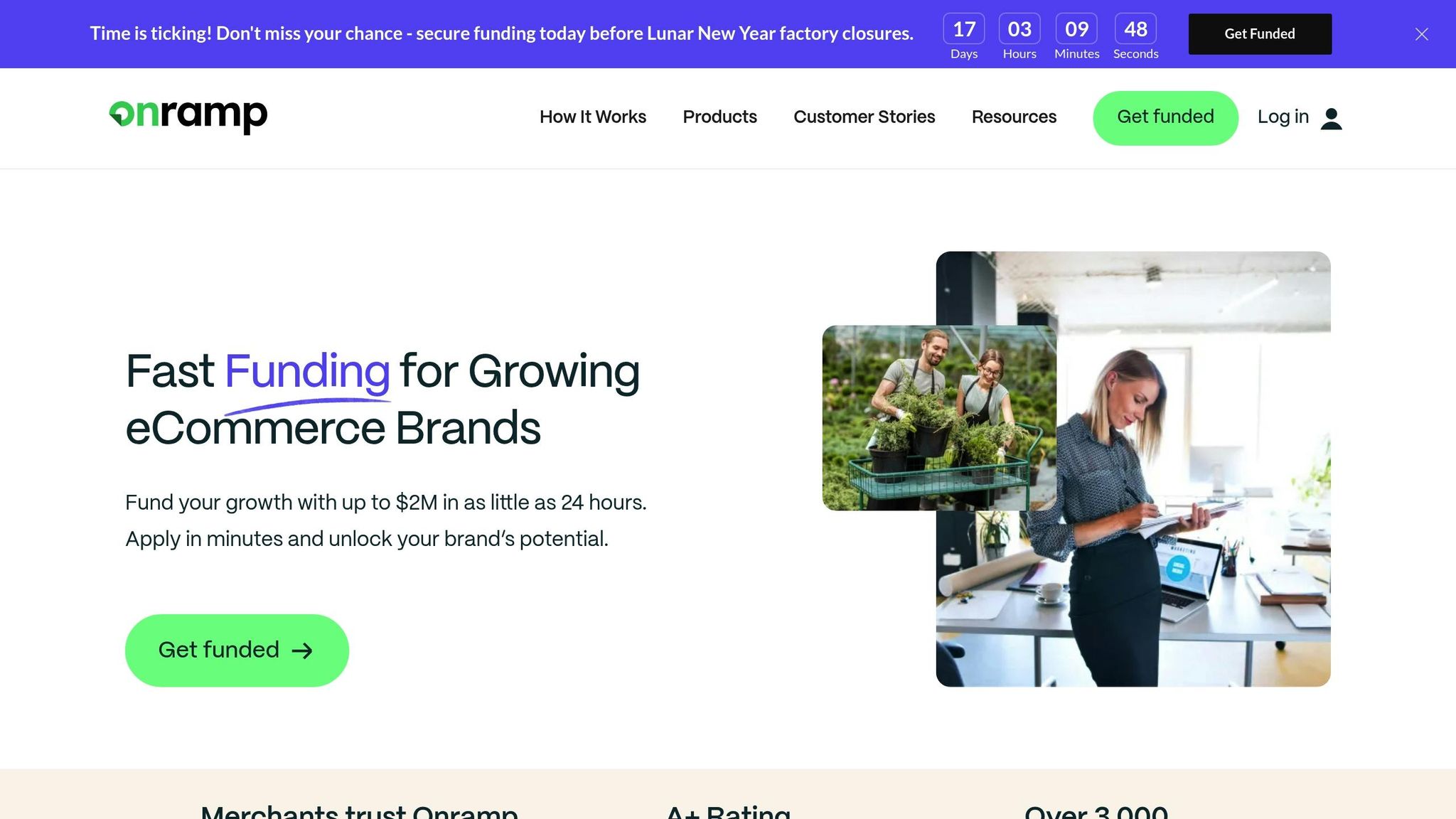
Onramp Funds offers flexible capital solutions designed to meet the unique needs of businesses at various stages. With three distinct products - Variable, Fixed, and Rolling Cash Line - they address a range of operational challenges. Whether you're navigating a slow season or seizing a growth opportunity, there's a plan to match your goals.
For businesses focusing on growth, the Variable plan stands out. It uses revenue-based repayments, which adjust automatically with your sales volume. This makes it a great choice for scaling marketing efforts or boosting inventory. When sales slow, repayments decrease, helping to protect your cash flow. Onramp customers using this plan see an average revenue increase of 60%, and 75% of them return for additional funding to keep the momentum going [5].
If your priority is steady cash flow, the Fixed plan is a solid option. With consistent repayment amounts, it simplifies budgeting and is ideal for businesses in a strategic growth phase. This plan supports clear financial planning and operational stability. As Onramp Funds explains:
"With our fixed payment option, find stability in consistent repayments... providing predictability and ease in managing your finances" [5].
The Rolling Cash Line offers the best of both worlds. This revolving credit option grows with your sales, giving you access to funds as often as every two weeks. You can choose between fixed or revenue-based repayments, and you only pay fees on the capital you actually use. It's a flexible solution for established businesses with ongoing funding needs.
All three plans share features that make them especially suited for eCommerce businesses. These include quick approvals, seamless integration with platforms like Shopify, Amazon, and Walmart Marketplace, and competitive costs. For instance, a $100,000 advance with Onramp incurs a fee of around $5,000 - significantly lower than the $6,600 fee for a traditional bank loan with a 12% APR [1].
Onramp Funds Plans Comparison Table
These options ensure that no matter your business goals - whether maintaining stability or driving growth - Onramp Funds has a tailored solution to support your needs effectively.
Conclusion
Deciding between stability funding and acceleration funding comes down to what your business needs most right now. Stability funding works well for managing cash flow gaps, restocking inventory, or weathering seasonal slowdowns. Its repayment terms are flexible, adjusting with your sales. On the other hand, acceleration funding is all about growth - whether that’s scaling marketing efforts, expanding product offerings, or taking advantage of bulk inventory deals.
The key is aligning your funding choice with your business stage. If you’re dealing with operational hurdles or erratic revenue streams, stability funding can provide the breathing room to keep things running smoothly. But if your sales are strong and you’re ready to scale, acceleration funding is built to help you seize that momentum. Many eCommerce brands use stability funding to handle day-to-day operations and acceleration funding for growth-focused initiatives. As outlined earlier, picking the right funding type is essential to meet your current challenges or capitalize on new opportunities.
Onramp Funds offers tailored options to meet these needs - Variable for growth, Fixed for predictability, and Rolling Cash Line for ongoing access. With funds often available within 24 hours and no equity required, you can move quickly without giving up control. Transparent fees, typically between 2% and 8%, and repayment rates as low as 1% of daily sales [5], make these solutions both practical and manageable.
With the right funding partner, you can stay agile in the face of market shifts - whether it’s maintaining cash flow during slow periods or doubling down on strategies that are working. Onramp Funds' integration with platforms like Amazon, Shopify, and Walmart Marketplace ensures that funding offers are tailored to your real-time sales data. This gives you access to the capital you need, exactly when you need it, keeping your eCommerce business stable and ready to grow.
FAQs
How can I choose between funding for stability and funding for growth in my eCommerce business?
When deciding between stability funding and growth funding, it all comes down to your business's current priorities and financial goals.
Stability funding focuses on keeping your business running smoothly. It’s perfect for covering everyday needs like managing cash flow, addressing inventory shortages, or paying routine expenses. This type of funding acts as a safety net, helping your business stay on track during tough times or periods of steady, predictable growth.
On the other hand, growth funding is all about expansion. Whether it’s ramping up marketing efforts, launching a new product, or breaking into a new market, this funding is tailored for businesses looking to grow. It’s best suited for companies that are already stable and ready to invest in strategies that drive revenue. Plus, repayment terms for growth funding often adapt to your sales performance, giving you added flexibility.
When making your choice, think about your immediate priorities. If your goal is to maintain smooth operations, stability funding is the way to go. But if you’re ready to scale and have a clear plan to increase revenue, growth funding can provide the boost you need to take your business to the next level.
What are the advantages of choosing revenue-based repayment for eCommerce funding?
Revenue-based repayment models adjust your payments based on your sales, offering a way to better manage cash flow, especially during seasonal shifts or times of growth. This means payments stay manageable even when sales slow down, giving businesses breathing room when they need it most.
Another advantage is the quick access to funds. Revenue-based financing often provides funding in just a few days, making it ideal for urgent needs like restocking inventory or ramping up marketing efforts. Plus, there’s no requirement for collateral or equity, so you can secure the funds you need without sacrificing ownership or control of your business.
How fast can I get funding to grow my eCommerce business?
Accessing funding for growth in the eCommerce world can happen fast - sometimes in as little as 24 hours. Options like revenue-based financing are tailored to deliver quick capital, using your sales performance as the foundation.
This approach lets you channel funds into scaling efforts, like ramping up marketing campaigns or broadening your product range, without the hassle of drawn-out applications or delays. It’s a smart choice when timing and adaptability are critical for hitting your growth targets.
Related Blog Posts
Onramp Funds
Funding built around your sales
Connect your store and see what you qualify for. Repay as a percentage of sales, with no personal credit check.
Funding in as little as 24 hours.
