


eCommerce businesses often face unpredictable sales, jumping between highs and lows due to ad performance, seasonal trends, or competition. These swings make it tough to manage cash flow, restock inventory, or fund marketing.
Key takeaway: Revenue-based financing adjusts repayments to your sales, offering flexibility during slow weeks and scaling up during busy periods. Onramp Funds provides funding within 24 hours, linking directly to your eCommerce platform to analyze sales and tailor repayment amounts.
Highlights:
- Problem: Inconsistent revenue disrupts growth (e.g., cash tied in overstock or lost in stockouts).
- Solution: Flexible funding tied to sales performance, avoiding fixed loan payments.
- How it works: Connect your store, get funding, and repay based on sales.
- Eligibility: $10,000+ monthly sales on platforms like Shopify or Amazon.
This approach ensures steady cash flow, allowing you to focus on inventory, marketing, and growth - even when revenue fluctuates.
How Weekly Revenue Changes Affect eCommerce Businesses
What Causes Weekly Revenue to Change
Weekly revenue in eCommerce can feel like a rollercoaster, driven by factors often outside your control. For instance, platform algorithms, such as Amazon's A9, constantly adjust product rankings. A drop in visibility can cut sales by 30–50%, while a boost can send them soaring.
Customer behavior also plays a big role. Payday cycles, viral trends, and limited-time promotions like flash sales can lead to short-lived revenue spikes. However, these gains often fade quickly. On top of that, seasonal shopping habits add another layer of unpredictability.
Then there’s competition. If a rival launches a discount campaign or slashes prices during a busy shopping period, your revenue might dip by 15–25%. On the flip side, if they run out of stock, you could scoop up some of their sales. External factors like supply chain issues, paused marketing efforts, or even unexpected events like severe weather or economic changes add to the uncertainty.
Understanding these shifts is crucial for accurately predicting your funding needs and managing your business effectively.
Why Inconsistent Revenue Makes Growth Harder
Fluctuating revenue creates significant challenges for eCommerce businesses, especially when it comes to planning and growth. For starters, inconsistent income complicates inventory management. Stockouts during high-demand weeks can lead to a 10–20% revenue loss, while overstocking during slower periods can tie up 30–50% of your cash in unsold products. This disrupts your cash conversion cycle, making it harder to maintain growth momentum.
Marketing efforts also take a hit. If you have to pause ad campaigns mid-week due to a lack of funds, your return on investment (ROI) could drop by 25–40%. Erratic ad spending can also exhaust your target audience, reducing future engagement. Moreover, committing to fixed expenses like hiring or expanding into new markets becomes a gamble when you can’t predict if next week’s revenue will cover your costs.
Traditional loans with fixed payments only add to the pressure. Imagine owing $5,000 every week, regardless of how much you earn. During low-revenue weeks, this can strain your cash flow and increase the risk of default.
These challenges highlight why it’s essential to have a solid understanding of your cash flow and a funding strategy that can adapt to the ups and downs of eCommerce.
sbb-itb-d7b5115
How to Assess Your Cash Flow and Funding Needs
Analyzing Your Weekly Revenue Patterns
To get started, connect your selling platforms - whether it's Amazon, Shopify, Walmart, or TikTok Shop - to tools that provide real-time data. This method moves away from relying on outdated credit models or tax returns and instead focuses on what truly matters: your top-line sales, revenue growth, and performance across sales channels[1]. It’s a much clearer way to gauge your business’s health.
Look for patterns in your weekly sales history. Are there consistent spikes or drops? Seasonal trends can be especially useful here, as they help you anticipate when you’ll have extra cash on hand or when you might need additional capital to keep things running smoothly[1].
Also, keep a close watch on how your PPC (pay-per-click) advertising costs align with your weekly sales. If you’re spending more on ads but not seeing a proportional boost in revenue, it could create hidden cash flow issues[1].
These insights are essential for understanding and measuring your cash conversion cycle.
Determining Your Cash Conversion Cycle
Once you’ve analyzed your revenue patterns, the next step is to assess your cash conversion cycle. This metric shows how long it takes to turn your investments - like inventory, advertising, and packaging - into cash from sales. It’s in this time gap that funding needs often arise[1]. The upfront costs of running your business can drain your cash reserves long before you see revenue from those expenses.
Start by calculating how much capital is tied up in your inventory. Review your current stock levels alongside your sales velocity to get a clearer picture[1]. Then, compare your cash flow to the combined costs of restocking existing products and launching new ones. If your reserves aren’t enough to cover these costs, you’ve pinpointed your “restock gap” - the amount of working capital you’ll need to sustain your growth[1].
To ensure your business is on solid footing, calculate your gross profit margin using this formula:
(Total Revenue - Cost of Goods Sold) / Total Revenue × 100.
A margin above 30% is generally enough to cover operational costs and funding fees[3][4]. If your margin falls below this level, it might be time to rethink your pricing strategy or find ways to cut costs before seeking additional funding.
The Easiest Way to Predict Your eCommerce Cash Flow || 13 Week Cash Flow Model (Free Template!)
Funding Options from Onramp Funds
Once you've pinpointed gaps in your cash flow, the next step is finding a financing partner that understands the ups and downs of eCommerce. Onramp Funds provides funding solutions tailored to your sales performance, rather than relying on outdated credit scores. By connecting directly to your selling platforms, Onramp assesses your business in real-time, allowing you to secure funding within 24 hours of integration. This approach ensures repayment terms that adjust to your business's unique needs, as outlined below. [1]
Onramp Funds offers two main financing options: revenue-based financing and fixed-fee plans. Both structures are designed to provide flexibility without requiring you to give up equity in your business. You only pay fees on the credit you actually use, with clear costs ranging from 2% to 8%, depending on your business profile. To qualify, you need at least $10,000 in monthly sales and a connection to a supported eCommerce platform. Onramp evaluates factors like revenue growth, sales history, and forecasts to determine your funding amount, rather than focusing on personal financial details. [1]
Revenue-Based Financing: Pay as You Earn
Onramp Funds' revenue-based financing gives you access to upfront capital, with repayments tied directly to your sales. This structure is a great fit for businesses with unpredictable revenue because payment amounts automatically adjust based on your performance. During high-sales periods, payments increase; during slower times, they decrease proportionally. This eliminates the stress of fixed monthly payments and helps maintain smoother cash flow. [1]
Custom Funding Offers for Your Business
Onramp Funds also offers tailored funding solutions that align with your business's growth trajectory. Unlike rigid financing limits, these offers are based on your revenue patterns and growth potential, allowing you to receive funds in as little as one day.
Here’s what you can expect from these custom offers:
| Feature | Benefit | Limitation |
|---|---|---|
| Fast Funding | Access capital within 24 hours | Requires integration with platforms |
| Flexible Repayment | Payments scale with sales performance | Limited to supported platforms |
| Transparent Fees | Fixed 2-8% fees, no surprises | $10,000 minimum monthly sales |
The funds can be used for any growth-related purpose, whether it's restocking inventory, launching new products, running PPC campaigns, or expanding into new marketplaces. You have complete control over how you allocate the capital. [1]
Fixed Fee vs. Revenue-Based Plans
Deciding between Onramp Funds' financing options depends on your revenue stability and repayment preferences. Both offer 24-hour access to funds and clear pricing, but they cater to different needs.
| Plan | Features | Best For |
|---|---|---|
| Fixed Fee Structure | Predictable 2-8% fees, stable payments | Businesses with steady revenue |
| Revenue-Based Financing | Payments linked to sales performance | Businesses with fluctuating revenue |
Fixed-fee plans operate much like a line of credit, with predictable costs. You pay a percentage fee on your remaining balance, which decreases as you repay the principal. This option works well for businesses with consistent weekly revenue and a preference for stable, forecastable payments - often without early repayment penalties.
On the other hand, revenue-based financing adjusts to your sales performance, making it ideal for businesses with irregular cash flow or seasonal variations. For steady growth, fixed-fee plans provide predictability, while revenue-based financing offers flexibility for businesses navigating revenue volatility. [1]
How to Get Funding from Onramp Funds
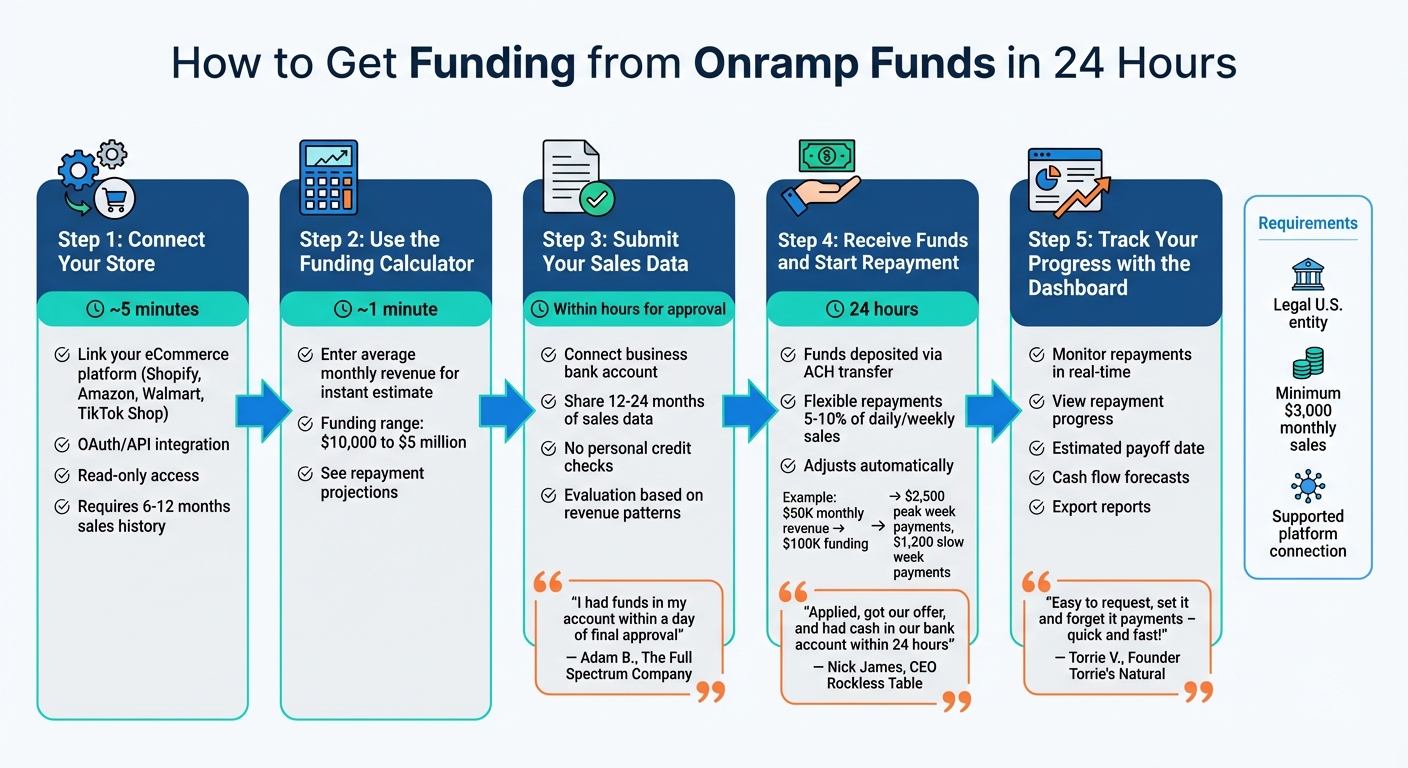
Onramp Funds makes securing funding quick and straightforward. From connecting your store to receiving funds, the entire process often takes less than 24 hours [6]. To qualify, your business must operate as a legal U.S. entity and generate at least $10,000 in monthly sales on a supported platform. Here's a step-by-step guide to help you secure and manage your funding.
Step 1: Connect Your Store
Begin by linking your eCommerce platform to Onramp’s secure dashboard. This step, which uses OAuth or API integration, takes just about 5 minutes. It grants Onramp read-only access to your sales data, ensuring your information is safe and private [5]. Simply log in, choose your platform, and authorize the connection. Onramp verifies everything within minutes, so you won’t need to manually upload sales records. Typically, eligibility requires 6–12 months of sales history on the connected platform.
Step 2: Use the Funding Calculator
After connecting your store, you can use the funding calculator to get a quick estimate of how much you might qualify for. Enter your average monthly revenue, and in about a minute, you’ll see an estimated funding range [5]. The tool analyzes your sales patterns - peaks and slow periods included - and offers funding amounts from $10,000 to $5 million [7]. You can adjust the desired amount or set growth goals, and the calculator will show repayment projections that adapt to your revenue fluctuations. This helps you understand how funding will impact your cash flow.
Step 3: Submit Your Sales Data
With your funding estimate in hand, the next step is to verify your eligibility by submitting your sales data. Connect your business bank account to automatically share 12–24 months of encrypted sales information, including metrics like GMV, transaction volume, and revenue trends [7]. Onramp evaluates your business’s revenue consistency, growth patterns, and cash flow needs - without requiring personal credit checks. Once reviewed, you’ll receive a tailored funding offer within hours. As Adam B. from The Full Spectrum Company shared:
Onramp's process is very straightforward and easy to navigate. I had funds in my account within a day of final approval. [6]
Step 4: Receive Funds and Start Repayment
After you’ve selected and approved an offer, the funds are deposited directly into your business bank account via ACH transfer [6]. Nick James, CEO of Rockless Table, described his experience:
Applied, got our offer, and had cash in our bank account within 24 hours.
Repayments are flexible, typically ranging from 5–10% of your daily or weekly sales. They adjust automatically based on your revenue. For instance, a Shopify seller with $50,000 in monthly revenue (fluctuating by 30% week-to-week) received $100,000 in funding. Their repayments varied with sales, from $2,500 during peak weeks to $1,200 during slower periods [7].
Step 5: Track Your Progress with the Dashboard
Onramp’s dashboard helps you stay on top of your funding and repayments. It provides real-time updates on repayment progress, including the percentage completed, estimated payoff date, and graphs showing how sales correlate with repayments. You can also access cash flow forecasts and use the "next funding" simulator to explore scenarios like how a 20% revenue increase might affect repayments. Reports can be exported in standard U.S. formats (e.g., $1,234.56) for accounting convenience. Torrie V., Founder of Torrie’s Natural, highlighted this feature:
Onramp has simplified cash flow by automating everything: easy to request, set it and forget it payments – quick and fast!
The dashboard integrates seamlessly with platforms like Shopify, Amazon, Walmart Marketplace, and TikTok Shop, keeping your data updated automatically without manual input.
Conclusion
When your eCommerce revenue fluctuates from week to week, revenue-based financing from Onramp Funds helps keep your growth steady without the burden of fixed payments. Repayments automatically adjust based on your sales - dropping to as little as 5% during slower periods and increasing during peak weeks. This approach ensures your cash flow remains stable, allowing you to focus on key investments like inventory, marketing, or launching new products - even during challenging times[2].
Onramp Funds provides funding in just 24 hours, skipping the hassle of lengthy applications or credit checks. You won’t need to give up equity either - just straightforward financing that aligns with your business’s performance. It integrates seamlessly with platforms like Shopify, Amazon, Walmart Marketplace, and TikTok Shop, making it easy to manage.
Whether you’re navigating seasonal shifts or responding to unpredictable demand, Onramp Funds gives you the liquidity you need to scale effectively. Their user-friendly dashboard lets you track repayments and forecast cash flow in real time, so you’re always in control. With funding options ranging from $10,000 to $5 million and repayment terms tailored to match your revenue, you can meet immediate liquidity needs while staying focused on long-term growth - turning revenue fluctuations into opportunities to expand.
FAQs
How do repayments change when my sales drop?
With revenue-based financing, your repayments automatically align with your sales. Because payments are calculated as a percentage of your revenue, they shrink during slower sales periods. This setup helps ease cash flow management and reduces financial pressure during weeks when sales take a dip.
How much funding can I qualify for with $10,000/month in sales?
If your business brings in $10,000 in monthly sales, you might be eligible for revenue-based funding. The amount you can access usually depends on your sales figures and the specific criteria set by the provider. In many cases, the funding amount is a multiple of your monthly revenue. For instance, you could qualify for anywhere between $3,000 and $10,000 or even more. When it comes to repayment, the total owed typically falls between 1.2x and 1.6x of the advance, based on the agreed terms.
Will connecting my store share sensitive data or allow account access?
Connecting your store for funding usually requires sharing sales and financial data, but it doesn’t mean handing over full access to sensitive account details. This approach ensures that the information shared is used exclusively for funding purposes, keeping your account secure in the process.
Related Blog Posts
Onramp Funds
Funding built around your sales
Connect your store and see what you qualify for. Repay as a percentage of sales, with no personal credit check.
Funding in as little as 24 hours.
