


Flexible repayment models sync loan payments with your sales, making them perfect for eCommerce businesses dealing with fluctuating revenue. Instead of fixed monthly payments, you repay a percentage of your revenue, which adjusts based on sales performance. Here's why they work:
- Payments Scale with Revenue: Pay more during high-sales months and less during slow periods.
- No Collateral Required: Many options don't need assets, making them accessible.
- Dynamic Repayment Caps: You repay a set multiple (e.g., 1.2x to 1.6x) of the loan amount.
- Cash Flow Flexibility: Helps cover inventory and marketing costs without financial strain.
For example, a $50,000 loan with a 10% revenue share means $3,000 repayment on $30,000 sales, or $1,500 on $15,000 sales. This model ensures you can manage cash flow effectively while growing your business.
Quick Comparison:
| Feature | Traditional Loans | Flexible Repayment Models |
|---|---|---|
| Payment Amount | Fixed monthly payment | Percentage of revenue |
| Payment Schedule | Same date every month | Adjusts with sales cycles |
| Total Cost | Interest over time | Predetermined multiple |
| Early Payoff | May include penalties | No penalties |
Flexible repayment models are changing how eCommerce businesses secure funding, offering a practical way to manage cash flow and scale effectively.
1 Refused A Business Loan? Alternative business finance for e-commerce/online Seller. Merchant cash
How Flexible Repayment Models Work
Flexible repayment models are designed to align loan payments with the natural ebbs and flows of eCommerce revenue. Instead of sticking to rigid monthly payments, these models adjust repayment amounts based on your actual sales performance.
Repayment Based on Revenue
With this approach, loan payments are tied directly to your sales. Instead of a fixed monthly fee, you pay a set percentage of your revenue. For instance, if you take out a $50,000 loan with a 10% revenue share, you'd pay $3,000 on $30,000 in sales. During slower months, if sales drop to $15,000, your payment would scale down to $1,500. Typically, repayment fees range between 6% and 12% of revenue [5].
Payments are often made daily or weekly, syncing closely with your sales patterns [2]. This flexibility is particularly helpful for businesses with seasonal or irregular revenue streams.
The repayment process continues until you hit a cap - usually 1.2x to 1.6x the original loan amount. For example, a $50,000 loan might require total repayments of $60,000 to $80,000 [8].
Key Parts of a Flexible Repayment Plan
Several elements define how flexible repayment plans work:
- Revenue Percentage: This is the cornerstone of the repayment model. Typically, it ranges from 5% to 25% of your monthly gross revenue [8]. The exact percentage depends on factors like your sales history, financial health, and the lender's risk evaluation.
- Factor Rate or Multiple: Instead of traditional interest calculations, you agree upfront to repay a specific multiple of the borrowed amount. This simplifies the process by giving you a clear understanding of your total repayment obligation, including all costs and fees [7].
- Repayment Cap: This sets the limit on how much you'll repay. Once you've met the agreed-upon multiple of your original loan, the repayment ends. Strong sales months can help you pay off the loan more quickly [8].
- Payment Frequency: Payments can be tailored to your cash flow. Whether you prefer steady monthly payments or more frequent adjustments based on real-time sales data, the schedule adapts to your business's needs [2].
Here's a quick comparison of traditional loans versus flexible repayment models:
| Component | Traditional Loans | Flexible Repayment Models |
|---|---|---|
| Payment Amount | Fixed monthly payment | Percentage of actual revenue |
| Payment Schedule | Same date every month | Adjusts to business cycles |
| Total Cost | Interest rate over time | Predetermined multiple/factor rate |
| Early Payoff | May include penalties | Often structured without penalties |
Flexible repayment models rely on automated systems that use real-time data - like current sales figures and advertising expenses [2] - to calculate payments. This means there are no penalties during slower months [8], as the structure naturally adjusts to your business's performance.
Benefits of Flexible Repayment Models
Flexible repayment models go beyond simply adjusting payments - they create a financing approach that aligns with your business's financial flow. Here's how these models directly benefit eCommerce operations:
Payments Adjust to Sales Performance
One of the standout advantages is that repayments scale with your revenue. For example, if your sales hit $40,000 in a month and you're set at a 10% repayment rate, your payment would be $4,000. But if sales dip to $20,000, your payment adjusts to $2,000. This flexibility ensures that during high-revenue months, you can repay more, while slower months leave you with enough cash to cover essential expenses like inventory or marketing. This is especially valuable for seasonal businesses or those with fluctuating growth patterns. In fact, businesses using flexible payment systems have reported a 40% boost in sales conversion rates and a 60% increase in average order sizes for B2B eCommerce sellers [3]. These results highlight how such repayment models can directly fuel growth and operational efficiency.
Improved Cash Flow Management
Fixed monthly payments from traditional loans can create financial strain, especially during slower sales periods. Flexible repayment models, however, ease this pressure by tying payments to your revenue. For instance, one retailer significantly improved their operational efficiency and reduced costs after switching to a flexible repayment plan [9]. Another advantage is that revenue-based financing often comes with dynamic credit limits, which grow as your business expands. This eliminates the hassle of frequent reapplication processes and provides additional funds for critical needs like marketing or inventory [2]. By aligning payments with income, businesses can manage their cash flow more effectively and maintain operational stability.
Freedom from Fixed Monthly Payments
With no rigid monthly payment structure, flexible repayment models let eCommerce businesses adapt to market changes seamlessly. Unlike traditional financing, which locks you into predetermined amounts and dates, these models adjust based on your business's performance. This adaptability allows you to focus on scaling your operations without the stress of fixed obligations. The appeal of such financing is evident in the numbers: the global revenue-based financing market was valued at $901.41 million in 2019 and is projected to soar to $42.3 billion by 2027, growing at a compound annual growth rate of 61.8% [4]. This rapid growth underscores how more businesses are turning to financing options that align with their operational needs, supporting long-term expansion and resilience.
Challenges and Considerations
Flexible repayment models can be a game-changer for eCommerce businesses, but they come with their own set of challenges. It's essential to weigh these factors carefully before diving into this financing option.
Cost Implications
Revenue-based financing often ends up costing more in the long run [2]. Businesses repay a percentage of their revenue until they hit a pre-agreed multiple of the original funding. For high-growth companies, this can mean paying back significantly more than they borrowed. For example, if you receive $100,000 with a 1.5x repayment cap, you'll need to pay back $150,000. If your business grows quickly, you'll hit that repayment cap faster, effectively increasing the cost of the loan. This dynamic means that fast-growing companies face higher effective rates due to accelerated repayment schedules [4].
To manage these costs, it's crucial to calculate an effective APR based on your revenue projections, fees, and the agreed revenue share. Investing the funds into activities with a high return on investment can also help offset these expenses. However, the fluctuating nature of repayments can still create challenges for cash flow management.
Changing Repayment Amounts
One of the trickiest aspects of flexible repayment models is the variability in payment amounts. While tying repayments to revenue can ease the burden during slower months, it also means payments surge during peak seasons. This variability can strain cash flow, especially if your business operates on thin margins or faces inconsistent revenue cycles [4].
For instance, a sudden revenue spike might lead to a significant repayment, while a downturn could extend the repayment term. These fluctuations make financial planning and forecasting essential. Businesses need well-organized financials and a solid scaling strategy to navigate these ups and downs effectively [8]. Without careful planning, this variability can quickly become a major hurdle.
Eligibility Requirements
Not all eCommerce businesses qualify for flexible repayment models. Lenders typically require a track record of steady revenue, often at least six months of operation [10]. Some lenders set minimum annual revenue thresholds, ranging from $100,000 to $250,000 [10]. If your business is pre-revenue, this type of financing isn't an option.
Lenders also look for a credit score of at least 650 and require financial documents like bank statements, tax returns, and revenue reports [2]. Additionally, maintaining healthy gross margins is critical to ensure repayments don't overwhelm your business's cash flow [4]. Meeting these criteria is essential to qualify and to keep repayments manageable within your revenue cycle.
How Flexible Repayment Models Support eCommerce Growth
Flexible repayment models play a key role in driving eCommerce growth by providing businesses with the financial agility they need to scale. Unlike traditional loans with fixed payment schedules, these models adjust repayments based on your sales performance. When sales are strong, repayments increase; during slower periods, they decrease. This ensures businesses can manage cash flow effectively while pursuing growth initiatives [2]. Let's explore how this approach supports inventory expansion and marketing efforts.
Funding for Inventory Expansion
Inventory is often the largest cash flow challenge for eCommerce businesses, but it's also essential for growth. Flexible funding models provide quick access to capital - ranging from $10,000 to $5,000,000, often within 24 hours - at costs between 6% and 12% [12]. This allows businesses to seize supplier discounts, stock up for seasonal demand, or handle unexpected supply chain disruptions [6][11]. For instance, purchasing larger quantities at discounted rates can lower unit costs, giving businesses a competitive edge.
Additionally, for companies looking to expand into new markets, this type of funding can support initiatives like website localization, targeted marketing, and managing international logistics [6]. Whether it's maintaining stable inventory levels or preparing for growth opportunities, flexible funding ensures businesses can act quickly when it matters most.
Investing in Marketing Campaigns
Marketing often requires significant upfront investment, and flexible funding makes it easier to take bold steps without overextending resources. By tying repayments to revenue, businesses can reduce financial risk while investing in strategies that drive growth. A great example is the fashion brand Hedoine, which used $50,000 in revenue-based funding in 2019 to launch Instagram and Facebook campaigns. The result? A staggering 1,106% increase in sales during Q1 2020 [12].
This repayment model allows businesses to allocate more funds during high-performance periods and conserve cash during slower times. It also enables companies to act quickly on trends, whether through paid ads, influencer collaborations, or fresh content creation. By aligning repayment obligations with campaign success, businesses can ensure their marketing investments generate returns that outweigh the cost of financing.
Onramp Funds: A Solution for eCommerce Businesses
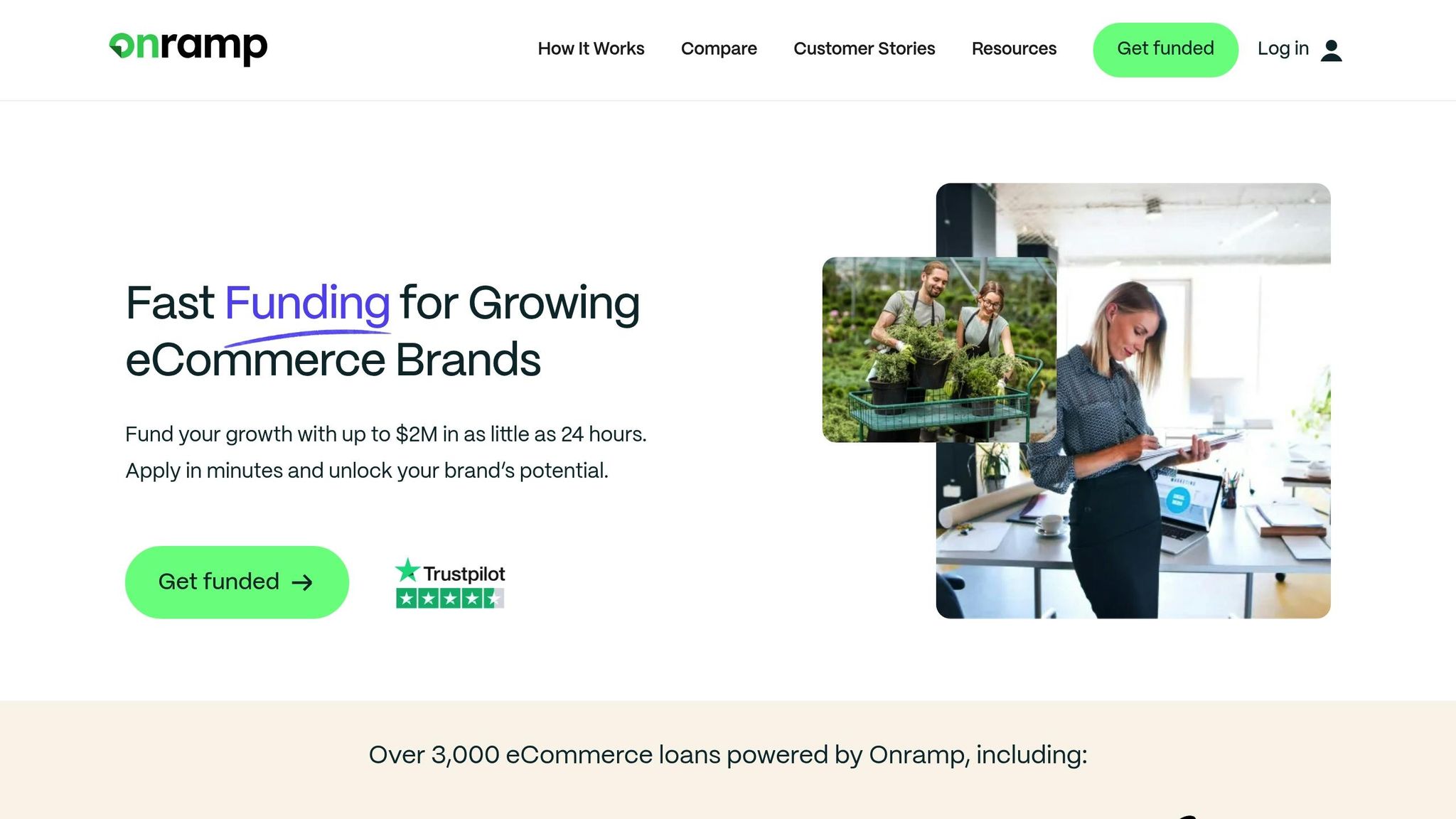
Onramp Funds offers a straightforward way for eCommerce businesses to access funding that aligns with their revenue. Founded by Eric Youngstrom, the platform was inspired by a key observation:
"Merchants had good orders coming in but couldn't even afford the shipping labels" [15].
This realization led to a funding model that uses real-time sales data to provide merchants with the capital they need, exactly when they need it. It builds on the idea of flexible repayment, adapting to each business's unique circumstances.
What Onramp Funds Offers
Onramp Funds provides equity-free financing with approvals often completed in as little as 24 hours. Repayments are revenue-based, starting at just 1% of sales [14]. According to Youngstrom, merchants have seen impressive results, with some experiencing up to 75% growth in just six months [15], and others tripling their sales within two years. A key feature of their approach is dynamic underwriting:
"We re-underwrite the merchant every night, so the offer is always ready" [15].
This real-time adjustment ensures that funding scales with a merchant's performance, offering unparalleled flexibility.
The platform also simplifies the funding process by taking on much of the administrative burden [15]. With the help of transparent AI and machine learning tools, Onramp Funds ensures merchants understand exactly how funding decisions are made, creating a more user-friendly experience.
Integration with Major eCommerce Platforms
Onramp Funds integrates seamlessly with major eCommerce platforms like Amazon, Shopify, BigCommerce, WooCommerce, Squarespace, Walmart Marketplace, and TikTok Shop [14]. By linking their online stores, merchants allow Onramp Funds to analyze sales history and predict growth potential. The integration process is simple: merchants connect their stores, enabling real-time evaluation of sales data. Using the platform's funding calculator, they can receive pre-qualification estimates [17]. Once pre-qualified and after linking a bank account, funding is delivered quickly.
The platform is designed for eCommerce businesses generating at least $10,000 in average monthly sales [16], making it accessible to a wide range of merchants looking to grow.
Clear and Flexible Financial Solutions
Onramp Funds takes the stress out of financing with transparent pricing and predictable costs. Merchants can choose from a variety of repayment options, including a fixed fee structure ranging from 2–8% for those who prefer stability, or revenue-based financing that adjusts to match sales performance.
This flexibility is especially useful for businesses with seasonal or fluctuating sales patterns. By evaluating real-time sales data, Onramp Funds ensures that funding aligns with current needs. Decisions are typically made within 24–48 hours [18], allowing merchants to quickly invest in growth opportunities like boosting inventory or launching marketing campaigns - all without requiring personal guarantees. This fast and flexible approach reduces financial risk while empowering merchants to focus on scaling their businesses.
Conclusion: Making the Most of Flexible Repayment Models
Key Takeaways
Flexible repayment models are reshaping how eCommerce businesses approach funding. These models sync repayment schedules with your actual sales performance, offering a more natural fit for cash flow compared to traditional loans with fixed monthly payments. This alignment helps businesses manage finances more effectively, especially during periods of fluctuating sales.
For B2B eCommerce sellers, offering flexible payment options has proven to boost both conversion rates and order sizes [3]. On the flip side, 29% of B2B buyers have abandoned purchases due to limited payment options [3]. This highlights a clear opportunity for businesses to stand out by adopting flexible repayment strategies.
Revenue-based financing, in particular, adjusts credit limits dynamically as your business grows. This flexibility is especially helpful for businesses with seasonal or inconsistent sales, as it avoids the strain of fixed repayment schedules [2].
The fintech lending market reflects this shift, growing from $200 billion in 2022 to a projected $1.8 trillion by 2032 [19]. This surge underscores the demand for financing solutions tailored to the needs of modern eCommerce businesses.
Next Steps for eCommerce Business Owners
Start by evaluating your financial needs. Key metrics to review include gross margin, customer acquisition cost, customer lifetime value, and average order size [20]. Businesses generating at least $10,000 in monthly sales often qualify for flexible financing options, such as those provided by Onramp Funds.
When comparing providers, focus on transparency and integration capabilities. Opt for solutions that clearly outline costs, fees, and repayment structures [19]. Platforms that integrate smoothly with your existing eCommerce tools - like Amazon, Shopify, or BigCommerce - can streamline both setup and ongoing management.
"When it comes to payments, flexibility is your best strategy. The more options available at checkout, the easier it will be for you to make a sale." – Yotpo [13]
This idea extends to business financing. Flexible options protect your equity while delivering the capital you need to grow [1]. Unlike traditional loans or venture capital, which often come with personal guarantees or collateral requirements, revenue-based financing adjusts repayments based on your success.
Use online calculators to explore your financing potential and choose a provider that aligns with your goals. With global eCommerce sales expected to hit $8 trillion by 2028 [1], businesses that embrace flexible repayment models will be better positioned to capitalize on growth opportunities. Providers like Onramp Funds make it easier to invest in inventory and marketing, fueling long-term success.
FAQs
How do flexible repayment options help eCommerce businesses manage seasonal sales fluctuations?
Flexible repayment options, like revenue-based financing, offer a smart solution for eCommerce businesses that experience seasonal sales fluctuations. With this approach, repayment amounts are tied directly to your sales performance - when sales are booming, you pay more; during slower periods, you pay less. This eliminates the strain of fixed monthly payments during off-peak times.
By syncing repayments with revenue, businesses can keep cash flow steady and focus on essential investments, such as stocking up on inventory or launching marketing campaigns at the right moments. This approach helps eCommerce sellers better manage the ups and downs of seasonal sales and positions them for steady growth.
What challenges should I consider before using flexible repayment models for eCommerce loans?
Flexible repayment models, such as revenue-based financing (RBF), can provide some breathing room, but they're not without their hurdles. One major factor to weigh is the total cost. Since repayments are tied to a percentage of your revenue, a surge in sales could mean you end up paying more over time compared to a traditional loan.
Another potential issue is seasonal sales dips. If your business has slower months, lower revenues can make it tricky to juggle cash flow while keeping up with repayments. This unpredictability can complicate financial planning and put extra pressure on your resources during off-peak periods.
By carefully evaluating these aspects, you can determine whether a flexible repayment model fits your business's financial rhythm and long-term goals.
What are the qualifications for an eCommerce business to get a loan with flexible repayment options?
To secure a flexible repayment loan, eCommerce businesses typically need to meet a few important requirements:
- Time in Business: Lenders usually look for businesses that have been operating for at least 6 to 12 months.
- Revenue Levels: A steady monthly revenue is crucial - most lenders expect at least $10,000 in monthly sales. Providers like Onramp Funds use real-time sales data to determine eligibility.
- Credit Score: A personal credit score of 600 or higher is commonly required, along with a solid business credit history.
- Financial Health: Lenders assess factors like cash flow, sales patterns, and current debts to ensure the business can manage repayments.
Meeting these criteria can boost your chances of approval. Flexible repayment loans adjust to your sales trends, offering a repayment structure that works well for growing eCommerce businesses.
Related Blog Posts
Onramp Funds
Funding built around your sales
Connect your store and see what you qualify for. Repay as a percentage of sales, with no personal credit check.
Funding in as little as 24 hours.
