

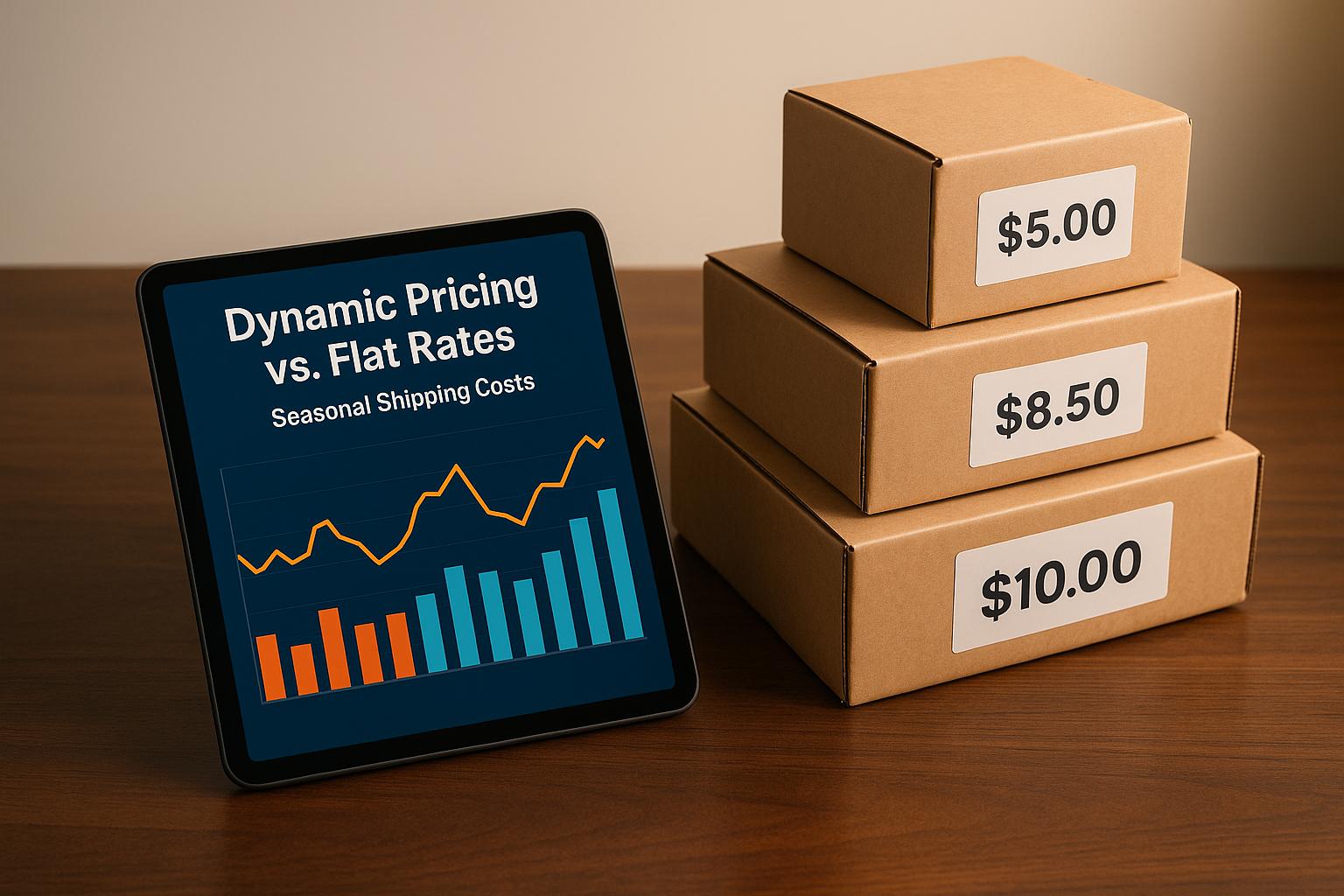
Shipping costs spike during the holiday season, and how you charge customers - dynamic pricing or flat rates - can make or break your profits. Here's what you need to know:
- Dynamic Pricing adjusts in real-time based on package weight, distance, and surcharges. It ensures accurate cost recovery but can lead to cart abandonment (67%) due to unexpected fees.
- Flat-Rate Shipping offers a fixed fee (e.g., $9.99) regardless of variables. It simplifies checkout, reduces cart abandonment (58%), but may shrink margins during peak seasons if not carefully priced.
- Hybrid Approach: Many businesses use flat rates for standard shipping and dynamic pricing for expedited or oversized orders, balancing simplicity and cost control.
Quick Comparison
Key Takeaway: Flat rates are customer-friendly and predictable, while dynamic pricing is precise but complex. Analyze your shipping data and test both models to find the best fit for your business.

What Is Dynamic Shipping Pricing?
Dynamic shipping pricing calculates shipping costs in real time by connecting to carrier APIs like UPS, USPS, FedEx, and DHL[3][5]. This system takes into account factors such as your package's weight and size, the distance between your warehouse and the customer, the shipping method (e.g., ground, 2-day, overnight), and any extra fees like fuel surcharges, residential delivery charges, or insurance[3][5]. Because of this, two customers ordering the same product could see different shipping costs based on their location and delivery speed preferences. This real-time approach ensures shipping rates align with current conditions, laying the groundwork for adapting to seasonal demand.
How Dynamic Pricing Adjusts for Seasonal Demand
Dynamic pricing automatically shifts as market conditions change. During peak seasons - particularly November and December - carriers raise base rates and add seasonal surcharges[1][5]. For instance, shipping a 3-pound package from New York to Los Angeles via UPS 2nd Day Air might cost $12.12 during the holiday rush but could drop by 20–30% during slower months when carriers lower prices to attract more business[3][5]. Freightera highlights that dynamic freight quotes often expire within 3–5 days since demand and availability can fluctuate quickly, helping carriers avoid over-commitments during busy periods[1]. This automatic adjustment ensures your checkout reflects current market conditions without requiring manual updates.
What You Need for Dynamic Pricing
To implement dynamic pricing, you'll need reliable carrier integrations. It's crucial to have accurate dimensions for each SKU to avoid losing margins[3][5]. Your eCommerce platform - whether it's Shopify, WooCommerce, BigCommerce, or another - must support real-time carrier API connections. These integrations are often available through plugins or apps that fetch live rates during checkout[3][5]. You'll also need to decide if you'll charge customers the exact carrier rates or add a 10–20% markup to cover handling and packaging costs[3][5]. Once set up, the system automatically updates rates, including seasonal surcharges and fuel fees, so you won't need to manually adjust prices during busy times.
What Is Flat-Rate Shipping?
Flat-rate shipping means charging a single fee per order, no matter the weight, size, or destination within a specific area. It’s all about keeping things simple and predictable for both the business and the customer[3]. For example, you might charge $9.99 for ground shipping anywhere in the contiguous U.S., as long as the order meets certain criteria like staying under a specific weight limit[3]. The idea is to balance the costs over time - you might take a small hit on heavier packages heading to remote areas, but you’ll make up for it with lighter shipments traveling shorter distances[3]. This consistent pricing helps avoid surprising customers at checkout, which can encourage more sales, especially during high-traffic shopping seasons when buyers are comparing multiple options[3].
How Flat-Rate Shipping Helps Manage Costs
Flat-rate shipping allows businesses to spread out shipping expenses over the year, creating more predictable costs per order and simplifying budgeting[3]. By sticking to a single domestic rate - or a few rates based on zones or order values - you avoid constantly adjusting prices when carriers introduce temporary fees like fuel surcharges or holiday-related increases[1][3]. For instance, during the holiday season, when carriers typically add extra charges, your flat rate absorbs those costs, sparing customers from sudden price hikes[1][3].
To protect your margins when shipping costs exceed your flat rate, many businesses build in a 15–20% buffer to their average costs[3]. On the flip side, if carrier rates drop or you secure better discounts, your flat rate remains the same, so you benefit from the savings without needing to lower prices for customers[1].
Steps to Set Up a Flat-Rate Shipping Model
To create a flat-rate shipping plan, start by reviewing 3–12 months of shipping data from your carrier invoices or shipping software[3]. Calculate the average shipping cost per order, factoring in surcharges, residential delivery fees, and packaging costs[3]. For example, if your average cost is $8.20, you might set a flat rate of $9.99 to account for occasional spikes and maintain a small buffer[3]. Be sure to exclude extreme outliers, like the most expensive 1–5% of shipments, or create separate rules for oversized items[3].
Many businesses in the U.S. structure flat rates based on order value, region, or delivery speed to strike a balance between simplicity and cost management[3][4]. Some common strategies include charging $5.99 for orders under $50 and offering free shipping for orders over $50 to encourage larger purchases. Another option is to set one flat rate for the contiguous U.S. and a higher rate for Alaska, Hawaii, and U.S. territories[3][4]. Popular price points like $4.99, $7.99, or $9.99 often align with customer expectations and psychological pricing thresholds[3].
Once you’ve finalized your flat-rate rules, configure them in your eCommerce platform. Tools like Shopify, BigCommerce, and WooCommerce allow you to set up "shipping profiles" or "zones" for this purpose. Test your setup with sample addresses to ensure the correct rates appear for different states and order values[3][4]. Lastly, revisit and recalculate your rates quarterly or at least once a year to keep them aligned with updated carrier contracts and seasonal trends[3]. Next, we’ll explore how these models perform during peak seasons to refine your strategy further.
Dynamic Pricing vs. Flat Rates: Seasonal Cost Comparison
Main Comparison Factors
Choosing between dynamic and flat-rate shipping boils down to four key factors: cost control, margin stability, customer experience, and operational complexity. Dynamic pricing adjusts with real-time carrier rates, meaning your shipping costs climb during peak seasons like November and December but drop in slower months when carriers compete for business[1][5]. Flat rates, on the other hand, remain steady throughout the year. While this shields customers from seasonal spikes, it also means you absorb those higher costs during busy periods but benefit from savings when carrier rates dip in quieter months like January or February[1][3].
Margin stability varies significantly between these models. Flat rates provide consistent markups by averaging costs across many orders, making budgeting and forecasting more predictable[3]. Dynamic pricing, however, ensures you recover the exact cost on each shipment, but your overall profitability can fluctuate with seasonal rate changes[3][5]. Interestingly, cart abandonment rates are higher with dynamic pricing - 67% compared to 58% for flat rates - because shoppers dislike unexpected fees at checkout[3]. While dynamic pricing offers transparency by showing multiple carrier options, it can hurt conversions if high rates appear late in the checkout process[3][5]. These differences directly influence essential eCommerce metrics, as outlined below.
Operational complexity is another major consideration. Dynamic pricing requires integrating carrier APIs, accurately tracking product weights and dimensions, and constantly monitoring markup rules to ensure costs are covered as fuel prices and demand shift[3][5]. Flat rates are much simpler: you calculate an average based on past invoices, set your price, and revisit it periodically[3]. For smaller teams or businesses preparing for their first holiday rush, flat rates often feel less daunting and easier to manage[3]. These operational and cost differences also ripple through critical eCommerce performance metrics, as discussed in the next section.
Effects on eCommerce Metrics
The choice between dynamic and flat-rate pricing significantly impacts eCommerce performance metrics. With dynamic pricing, your gross margin per shipment closely tracks carrier costs. While this ensures you rarely lose money on individual orders, your overall margin percentage can swing by 5–10 points between slow and busy seasons as carrier rates fluctuate[3][5]. By passing peak costs to buyers and capturing off-peak savings, dynamic pricing stabilizes margins on a per-shipment basis[1][5]. Flat-rate shipping, however, smooths margins over time when rates are set using solid historical data. But during high-demand periods, margins may shrink if carrier costs exceed your flat fee, and in low-demand periods, they may grow when actual costs fall below your fixed rate[3].
Average order value (AOV) and cart behavior also shift depending on the pricing model. Flat rates tend to support higher AOV because shoppers know their shipping cost upfront, encouraging them to add more items. You can also use thresholds - like free shipping for orders over $50 - to incentivize larger purchases, especially during holiday sales[3][4]. With dynamic pricing, AOV becomes more sensitive to cart composition and destination. Customers may hesitate to add items if shipping costs rise sharply in real time, particularly during peak weeks when rates are higher[3][5]. Both models can incorporate threshold offers to drive larger baskets, but calculating profitable thresholds is simpler with flat rates since costs are already averaged[3][4].
Customer satisfaction also varies. According to eShipper's analysis of over 10,000 North American merchants, 82% of shoppers prefer flat-rate shipping, compared to 76% for dynamic pricing[3]. The predictability of flat rates plays a big role here - customers appreciate knowing their total cost early, which reduces cart abandonment and complaints about unexpected fees[3]. While dynamic pricing can build trust by offering multiple options and clear delivery estimates, it risks alienating customers if live quotes appear late in the checkout process, especially during peak seasons when prices are higher[3][5].
sbb-itb-d7b5115
How to Choose the Right Model for Your Business
Assess Your Business Requirements
To determine the best shipping model for your business, start by evaluating your specific needs and metrics. Begin with your monthly order volume. If you're handling fewer than 500 orders per month, flat-rate shipping might be the simplest solution. However, if you're processing over 500 orders, dynamic pricing can better align shipping costs with actual expenses [3].
Next, consider the weight and size of your products. If most of your packages weigh less than 5 pounds and are shipped to similar zones, flat rates can keep things straightforward without causing major discrepancies in cost. But if your product range includes both lightweight items and bulky goods, dynamic pricing is likely to provide a more accurate reflection of shipping costs [3].
Geography also matters. If most of your orders come from a concentrated area, flat rates are easier to manage. On the other hand, if your orders are spread across remote locations, Alaska, Hawaii, or even international destinations, dynamic pricing offers more flexibility [1] [3]. Lastly, review your profit margins by product category. Low-margin items often benefit from dynamic pricing to recover costs more precisely, while high-margin items allow room to use shipping promotions, like flat rates or free shipping, as a tool to drive sales [3]. Use your historical sales and shipping data to pinpoint the approach that makes the most sense for your business.
Test Models with Your Data
To make informed decisions, analyze 6–12 months of shipment data, including peak holiday seasons like November and December. Gather details such as shipment dates, service levels, zones, weights, dimensions, and actual carrier costs. Combine this with order-level data, including order value, items per order, and destination states [2] [3]. By calculating shipping costs as a percentage of revenue across different seasons, you can identify whether your current approach is over- or under-recovering costs [3].
Then, simulate historical shipping costs by segmenting your shipments: light parcels under 2 pounds, midweight parcels between 2–10 pounds, and heavy parcels over 10 pounds. Break these down further by zones, such as 2–4 and 5–8. Based on these insights, propose flat rates that cover 90–95% of past costs, adding a 15–20% buffer to account for Q4 surcharges [1] [3]. At the same time, set up dynamic rate calculations using carrier APIs or a shipping platform. Conduct an A/B test by showing half your site visitors a flat rate (e.g., $7.99 for shipping anywhere in the continental U.S.) and the other half dynamic rates. Track metrics like conversion rates, average order values, and shipping margins for each group [3] [7].
Finally, overlay last year’s Q4 order mix onto both models. This step lets you compare total shipping costs, margin impacts, and how many orders would have been over- or under-charged under each approach [1] [3]. This thorough analysis will guide you toward the right shipping model for your business.
Funding Support for Seasonal Changes
Switching shipping models often requires upfront investments, whether for system upgrades, additional inventory, or marketing efforts. To manage these costs, consider securing funding to bridge the seasonal expense gap. Onramp Funds offers fast, revenue-based financing, allowing you to test and scale shipping models without draining your cash flow [6]. With funding available in under 24 hours, you can secure the capital you need without sacrificing equity [6].
Repayment is tied to your sales as a percentage of revenue, which is particularly helpful when testing new models during slower periods. For example, if you're piloting dynamic pricing in early Q1 before ramping up for the holiday season, this flexible repayment structure ensures you're not locked into fixed payments when sales are lower [6]. Onramp Funds has supported over 3,000 eCommerce businesses, with borrowers seeing an average of 73% revenue growth within 180 days of receiving funding. Additionally, 75% of their customers return for additional loans [6]. As one customer shared, the funding provided the critical boost needed to scale their operations effectively [6].
How to Implement and Improve Your Shipping Model
Test Peak Season Performance
Start by identifying your busiest times of the year using historical data. For many businesses, this includes the holiday season from November to December, or other high-demand periods like back-to-school shopping or Prime Day. Plan your testing strategy well in advance - ideally 4–6 weeks before these peak periods [3].
Begin with a pilot program, applying your new shipping strategy to 10–20% of orders before launching it fully. Focus on high-demand routes for dynamic pricing experiments, and for flat-rate shipping, ensure your fixed fee (e.g., $9.99) is enough to cover average peak costs without exceeding 10–15% of the order value. Always have fallback rate options ready [1][3].
To measure success, compare your results with previous seasons. Look at key metrics like total shipping costs, cart abandonment rates, and revenue per order. For instance, eShipper data reveals that businesses using flat-rate shipping reduced cart abandonment by 9% with straightforward, cost-covering rates [3]. Meanwhile, sellers testing dynamic pricing saved 20% during off-peak times and improved margins by 8% after adjusting their peak pricing caps based on Q4 data [1][3]. Use tools like Google Analytics or your eCommerce platform’s reporting features to track these changes and refine your approach accordingly.
Once your initial testing delivers reliable results, focus on monitoring and tweaking your shipping strategy over time.
Monitor and Adjust Shipping Performance
After your testing phase, shift to continuously improving your shipping strategy using real-time data. Keep an eye on shipping costs as a percentage of revenue, aiming for under 10–15%. Break this down by season, shipping zone, and method. Monitor cart abandonment rates closely - if dynamic pricing causes abandonment to climb above 67%, consider capping price surges at 20% or switching low-volume routes to flat rates [3][5].
Flat-rate shipping tends to perform better at checkout, averaging 2.3 minutes versus 3.1 minutes for dynamic pricing. Customer satisfaction also reflects this preference, with flat rates scoring 82% compared to 76% for dynamic pricing [3]. If you notice customers abandoning their carts during the shipping selection step, simplify your options or improve messaging about delivery costs and timeframes.
Adjust your pricing based on performance data. If losses on flat-rate orders exceed 5%, consider raising the fee (e.g., from $9.99 to $12.99) to align with cost averages [1][3]. For dynamic pricing, refine your markup rules to account for real-time variables like fuel costs, and use A/B testing to optimize these adjustments. eShipper reports that businesses often see a 5–10% improvement in margins when they fine-tune their dynamic pricing strategies over time [3]. You can also introduce minor handling fees for unusual shipments to offset additional costs [5].
If you’re planning major changes - like more competitive flat rates or free shipping thresholds during peak seasons - consider using Onramp Funds to access flexible, revenue-based capital. This can help you scale and test your strategies without straining your cash flow.
"As the owner of your business, you know your business best. Use your funds on inventory, shipping and logistics, marketing spend, or anything else that would help grow your business. We are always happy to strategize with you!"
– Onramp [6]
Conclusion
Deciding between dynamic pricing and flat-rate shipping comes down to aligning the approach with your business needs and seasonal demands. Each method offers distinct advantages for managing margins. Dynamic pricing adjusts in real time to reflect carrier costs and peak surcharges, while flat-rate shipping delivers simplicity and predictability. However, dynamic pricing can introduce complexity and unexpected rate spikes at checkout, potentially deterring customers. On the other hand, flat-rate shipping is often favored by shoppers for its straightforwardness, leading to lower cart abandonment and higher satisfaction rates [3]. That said, flat rates can erode margins during peak seasons if they aren’t carefully calibrated to account for rising carrier costs or added fees.
Many U.S. sellers find success with a hybrid strategy. For standard domestic orders, flat rates help maintain strong conversion rates, while dynamic pricing is reserved for heavier, expedited, or remote shipments [3]. This approach strikes a balance, offering a smooth checkout process while safeguarding profits on orders that fall outside the norm.
To optimize your shipping strategy, data analysis plays a critical role. Track metrics like shipping costs as a percentage of revenue, cart abandonment rates by pricing model, and margins per order across multiple seasons. Use A/B testing to refine your approach, adjusting flat fees or dynamic markups based on real-world shipping invoices and performance data [3]. These insights ensure you’re prepared to adapt ahead of each peak season.
When seasonal surges require larger inventory investments or drive up fulfillment costs, Onramp Funds provides flexible financing to keep operations running smoothly. With repayments tied to your sales, you can invest confidently in the right shipping strategy - whether that means subsidizing flat rates during the holidays or negotiating better carrier contracts - while preserving cash flow for other growth initiatives.
FAQs
What’s the best way to choose between dynamic pricing and flat-rate shipping for your business?
To select the best shipping model for your business, begin by examining your seasonal sales patterns, order volumes, and cost structures. Dynamic pricing can adapt to changing demand, offering flexibility, while flat rates provide stability and predictability. Trying out both methods during peak seasons can help identify which one boosts profits and improves customer experience.
Digging into sales data and collecting customer feedback are essential steps to refine your approach. On top of that, having access to flexible funding options can be a game-changer. It allows you to manage inventory and shipping expenses effectively during high-demand periods, keeping your operations smooth even when orders surge.
What are the advantages of combining flat-rate and dynamic pricing for shipping?
Using a hybrid shipping strategy combines the consistency of flat-rate pricing with the adaptability of dynamic pricing, offering sellers a balanced solution. This method helps you keep shipping costs manageable during high-demand periods while maintaining predictable expenses throughout the year.
By integrating these two pricing models, you can maintain better control over your cash flow, adjust to changing shipping rates, and create a more seamless experience for your customers. It's an especially smart move for eCommerce businesses aiming to stay competitive during peak shopping seasons.
How does dynamic pricing impact customer satisfaction and shopping cart abandonment?
Dynamic pricing has the potential to improve customer satisfaction by providing rates that adjust to market conditions, making them more competitive and flexible. But here's the catch - if prices shift too frequently or appear unreasonably high, customers might feel like they're dealing with a guessing game. This unpredictability can lead to frustration and even result in abandoned shopping carts.
The key to avoiding this pitfall lies in transparency. Clearly communicating pricing changes helps build trust and ensures customers feel informed rather than blindsided. This approach becomes especially important during seasonal demand surges when pricing adjustments are more common.
Related Blog Posts
Onramp Funds
Funding built around your sales
Connect your store and see what you qualify for. Repay as a percentage of sales, with no personal credit check.
Funding in as little as 24 hours.
