


Dynamic credit lines are reshaping how eCommerce businesses manage cash flow and scale operations. Unlike traditional loans, these lines provide flexible, revolving access to funds based on real-time sales performance. You only pay interest on what you use, and repayment adjusts with your revenue. This approach helps sellers handle inventory, marketing, and seasonal spikes without the rigid terms of conventional financing.
Key Takeaways:
- Quick Access to Funds: Approvals often take just 24–48 hours, offering immediate capital for inventory or ads.
- Flexible Repayment: Payments align with sales, reducing financial stress during slower months.
- Scalability: Credit limits grow automatically as your sales increase, removing the need for reapplications.
- Cost Efficiency: Interest applies only to drawn amounts, with no penalties for early repayment.
Platforms like Onramp Funds simplify this process by connecting directly to eCommerce stores (e.g., Amazon, Shopify) and using live sales data to customize funding offers. Whether you’re preparing for peak seasons or expanding operations, dynamic credit lines give you the financial flexibility to grow your business confidently.
What Are Dynamic Credit Lines?
Definition and Core Features
A dynamic credit line is a flexible financing option where your credit limit and terms adjust in real time based on factors like your business's sales performance, transaction history, and financial health [4][6]. Unlike traditional loans, these credit lines work as revolving funds, which means your available credit replenishes as you repay [4][7].
These credit lines connect directly to your eCommerce platforms - such as Amazon, Shopify, TikTok Shop, or WooCommerce - to track live sales data and inventory levels. Based on this data, algorithms automatically adjust your credit limit, increasing it when sales are strong and reducing it during slower periods [6].
You only incur costs on the funds you actually use, not your total approved limit. Typical interest rates range from 8% to 24% APR, with origination fees between 1% and 3% of the credit limit. Some lenders may also charge $10 to $25 per transaction draw [7].
Let’s dive into how these credit lines operate in real time to meet your business needs.
How Dynamic Credit Lines Work
Lenders use real-time access to your sales data, inventory, and transaction history [1]. By doing so, they replace traditional underwriting methods - like relying on tax returns or personal credit scores - with a more dynamic approach. Metrics such as monthly revenue and platform activity are used to calculate your eligible credit amount [1][2].
Once approved, often within 24 to 48 hours, you can draw funds as needed. The credit line continuously adjusts based on your business performance. For example, in June 2025, Inc Tablet, an eCommerce retailer founded by Adam Hamdoud, used a revolving credit facility from Lenkie to restock popular products. By consistently using the credit line to replenish inventory, the company grew its sales from $400,000–$800,000 to an anticipated $2.4 million [4].
"Using the facility on loop normally provides the most benefit since you get to consistently compound the inventory."
– Adam Hamdoud, Founder, Inc Tablet
Repayment terms are designed to be just as flexible. Many lenders offer interest-only periods for the first 6 to 12 months, followed by minimum monthly payments of 2% to 3% of your outstanding balance [7]. Payments can also be tied directly to your sales, with a percentage of daily revenue automatically deducted. This ensures that repayments adjust naturally with your business's cash flow [1][3].
sbb-itb-d7b5115
The Complete Guide to Business Lines of Credit
Benefits of Dynamic Credit Lines for eCommerce Sellers
Better Cash Flow Management
Dynamic credit lines provide quick access to funds exactly when you need them. Whether it’s restocking inventory, covering operational expenses, or jumping on a timely marketing opportunity, you can draw funds without waiting for the lengthy approval process of traditional loans. Lenders evaluate your business on platforms like Amazon, Shopify, and Walmart, enabling immediate financing.
This on-demand access means you don’t have to reapply every time there’s a cash flow gap. For instance, about 64% of online shoppers will abandon their purchase or opt for a competitor if a product is out of stock [5]. With dynamic credit lines, you can avoid such situations by keeping inventory levels steady. During slow periods or shipping delays, some providers even allow you to pay just the interest, helping you conserve cash until sales pick up or inventory arrives.
The best part? These credit lines grow alongside your business, adapting to your needs as you scale.
Scalability for High-Volume Sellers
Dynamic credit lines automatically increase your credit limit as your sales rise. Unlike traditional loans, which require fresh applications for additional funding, these lines adjust in real-time based on your business performance. As you repay your balance, the credit becomes available again, creating a revolving safety net.
This feature is especially useful during peak shopping seasons. For example, nearly 40% of online sales in some regions occur in the last three months of the year [5]. High-volume sellers can quickly respond to flash sales or supplier discounts by purchasing bulk inventory when prices are favorable.
"Even though you might pay three months of interest on your line of credit, you might get a better break from buying in bulk from your supplier. That's more than the interest that you would pay... so you might come out ahead."
– Bill D'Alessandro, eCommerce entrepreneur [5]
Flexible Repayment Terms
With dynamic credit lines, repayment terms adapt to your sales performance instead of following a rigid schedule. In revenue-based models, if sales slow down, your minimum payment decreases proportionally. This flexibility ensures that you’re never overwhelmed by debt obligations during quieter periods.
Rather than being tied to fixed monthly payments, you can prioritize cash flow for essentials like inventory and advertising. Many providers also allow early payoff without penalties, saving you on fees if you experience a cash surplus.
For example, during the 2025 Lazada campaign, Qisahn.com, a video game store owned by Soon Qishan, generated approximately $132,000 in revenue over just three days - 25 times their usual daily volume [5]. A dynamic credit line allowed them to handle surging inventory and marketing needs while aligning repayment with their revenue spike.
Dynamic Credit Lines vs. Traditional Loans
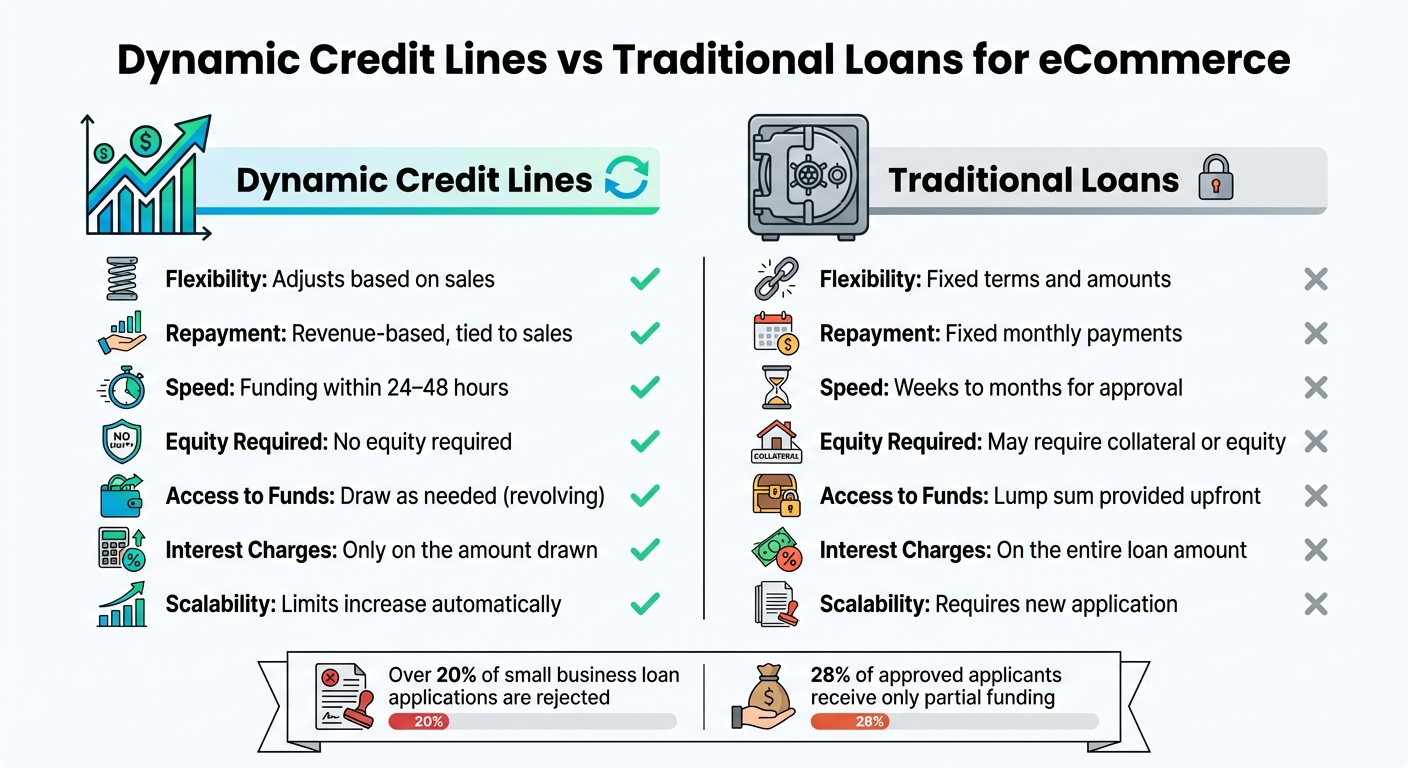
For fast-paced eCommerce businesses, dynamic credit lines offer clear advantages over traditional loans:
| Feature | Dynamic Credit Lines | Traditional Loans |
|---|---|---|
| Flexibility | Adjusts based on sales | Fixed terms and amounts |
| Repayment | Revenue-based, tied to sales | Fixed monthly payments |
| Speed | Funding within 24–48 hours | Weeks to months for approval |
| Equity Required | No equity required | May require collateral or equity |
| Access to Funds | Draw as needed (revolving) | Lump sum provided upfront |
| Interest Charges | Only on the amount drawn | On the entire loan amount |
| Scalability | Limits increase automatically | Requires new application |
Traditional loans often fall short for eCommerce sellers. Over 20% of small business loan applications are rejected, and 28% of approved applicants receive only partial funding [8]. On top of that, traditional loans charge interest on the full loan amount starting from day one, even if you don’t use all the funds. Dynamic credit lines, on the other hand, only charge for the amount you actually draw, making them a more flexible and cost-effective solution for growing businesses.
Onramp Funds: Dynamic Credit Lines for eCommerce
Onramp Funds provides a fast and straightforward way for eCommerce businesses to access funding without giving up equity. Instead of relying on traditional credit scores or collateral, the platform evaluates your store’s real-time sales data, with a focus on monthly revenue. This performance-based model ensures funding decisions are grounded in your actual business results. Here’s how Onramp Funds helps simplify financing and boost growth for your eCommerce venture.
Key Features of Onramp Funds
Onramp Funds offers rapid funding - approved businesses can receive capital within 24 hours, making it possible to seize inventory or marketing opportunities without delay. Even businesses generating as little as $10,000 in monthly sales can apply, with the entire process taking just 5–10 minutes. Funding amounts range from $25,000 to $500,000, depending on your store’s sales performance.
The platform provides three financing options tailored to different business growth stages:
- Variable Advances: Ideal for businesses in early growth, with repayments that adjust based on sales performance.
- Fixed Advances: Designed for scaling businesses, offering predictable repayments that make inventory planning easier.
- Rolling Cash Line: Perfect for established sellers, providing a revolving credit line where you’re only charged for the funds you use.
Supported Platforms and Integration
Onramp Funds connects directly to popular eCommerce platforms, making it easy to integrate and manage. Supported platforms include Amazon, Shopify, BigCommerce, WooCommerce, Squarespace, Walmart Marketplace, and TikTok Shop. Using secure API connections, the system pulls real-time sales data from your store to assess your credit eligibility and adjust available funding as your business grows. This automated process ensures your financing evolves alongside your success.
Pricing and Repayment Options
Onramp Funds charges a fixed fee of 2–8% on the funds you draw, determined by factors like sales volume, business age, and financial health. There are no hidden fees or penalties for early repayment. Repayments are based on a percentage of your sales, typically 5–15%, and are automatically deducted on a schedule you choose - daily, weekly, or biweekly. This flexible, revenue-based repayment model means your payments decrease if sales slow, allowing you to focus on reinvesting in your business.
How to Use Dynamic Credit Lines to Scale Your eCommerce Business
Here’s how you can make the most of a dynamic credit line to fuel your eCommerce growth.
Step 1: Check Eligibility and Determine Your Funding Needs
Start by completing Onramp Funds' quick 5–10 minute online application. You'll need to connect your eCommerce platforms, bank account, and payment processors. This process uses real-time data - like monthly revenue, platform metrics, and ad spend ROI - instead of traditional credit scores to evaluate eligibility [2].
To improve the accuracy of your funding offer, link additional accounts such as Meta and Google advertising platforms, as well as accounting software like QuickBooks. This gives a clearer picture of your marketing ROI, revenue trends, and even seasonal fluctuations [2]. Funding amounts usually range between $25,000 and $500,000, with approvals happening quickly [2].
Step 2: Connect Your Store and Receive a Custom Offer
Once your platforms are linked, Onramp Funds evaluates key metrics like sales velocity, inventory turnover, and revenue quality to create a tailored funding offer. The automated approval process is based entirely on your store's performance metrics, bypassing outdated methods like tax returns or personal credit scores. This is a game-changer for eCommerce sellers who may not meet traditional lending standards [1].
With your personalized offer, you’ll have the flexibility to invest in areas that yield the highest returns for your business.
Step 3: Invest in High-Impact Areas
Put your funds to work in areas that deliver the best ROI. For example, restocking inventory ahead of busy seasons can help you avoid stockouts, which are a common cause of cart abandonment [9]. You can also use the capital to amplify high-performing ad campaigns on platforms like Meta, TikTok, and Google, where real-time data can guide your strategy.
Beyond ads and inventory, consider using the funds for operational needs - such as hiring freelancers, managing packaging expenses, or expanding into new sales channels. To maximize returns, focus on your "growth engines" - products that combine strong margins with fast sales cycles. This strategy can also help you repay the credit line more quickly [9].
Keep an eye on performance metrics to ensure your investments align with your business goals and that your credit line keeps pace with your growth.
Step 4: Monitor Sales and Credit Adjustments
Dynamic credit lines automatically adjust based on your real-time sales. Repayments are typically tied to a percentage of daily sales - around 10% - so payments decrease during slower periods [2]. Aim for a debt coverage ratio of 1.25x; for instance, if you owe $2,000, your revenue should be at least $2,500 [7].
Set up automated transfers for repayments based on a fixed percentage of incoming revenue, and monitor your product fill rates - targeting 85% to 95% - to avoid missed sales opportunities during growth. As your business scales, your credit limit can grow too, giving you ongoing access to capital without the hassle of reapplying.
Conclusion
Dynamic credit lines offer eCommerce sellers a faster, more adaptable way to access funding compared to traditional loans. Instead of dealing with lengthy approval processes or rigid monthly payment schedules, sellers can secure capital in just 24 to 48 hours [2]. Plus, repayments align with actual sales performance, making it easier to manage cash flow during slower periods. This flexibility allows businesses to restock inventory before peak seasons, ramp up successful ad campaigns, or take advantage of bulk purchasing opportunities without overextending their finances.
Here’s the key advantage: repayments scale with your revenue [2]. If sales slow down, payments decrease, eliminating the stress of fixed obligations. For instance, one retailer used this model to efficiently manage stock and fuel growth. As your sales increase, your access to capital grows too, providing a funding solution that evolves alongside your business.
Onramp Funds is specifically designed for this purpose. The platform connects directly with major eCommerce platforms like Amazon, Shopify, Walmart Marketplace, and TikTok Shop, using real-time performance data instead of outdated credit scores or tax returns. With funding options ranging from $25,000 to $500,000, a quick 5- to 10-minute application process [2], and personalized support from their Austin-based team, Onramp Funds simplifies financing for online sellers. This seamless integration supports flexible repayments and scalable funding tailored to your business needs.
Whether you’re navigating seasonal sales shifts, boosting marketing returns, or exploring new sales channels, dynamic credit lines provide the resources to grow strategically without jeopardizing your working capital. Onramp Funds’ revenue-based repayment system means you only pay when you earn, giving you the confidence to scale while staying in control of your business.
Ready to grow your eCommerce business? Check your eligibility with Onramp Funds at https://onrampfunds.com for a personalized funding offer tailored to your store’s performance and growth goals.
FAQs
Will my credit limit drop if sales dip?
If your sales take a dip, your credit limit could shrink as well. Many short-term credit lines and revenue-based financing options are designed to adjust your available credit based on how your sales are performing. This approach helps ensure that repayments stay manageable and in line with your business's revenue, offering some breathing room during slower times.
What store data does Onramp Funds access to set my offer?
Onramp Funds connects to your online store using a secure, read-only API. This allows access to your store's order, sales, fulfillment, and inventory data, ensuring funding offers are customized to match your business's performance.
How do I avoid overborrowing with revenue-based repayments?
To keep your finances in check and avoid taking on too much debt, make sure your revenue can handle the repayment percentage without putting unnecessary pressure on your cash flow. Start by analyzing your sales trends and setting a repayment limit - something like 1.2x to 3x of the borrowed amount can work as a guideline. Keep a close eye on your revenue over time to ensure you're staying on track. Tools like Onramp Funds can be incredibly useful, as they allow you to choose funding amounts based on your sales history. This approach helps align repayments with your income, making it less likely you'll borrow more than you can manage.
Related Blog Posts
Onramp Funds
Funding built around your sales
Connect your store and see what you qualify for. Repay as a percentage of sales, with no personal credit check.
Funding in as little as 24 hours.
