

Selling internationally? Customs duties and tariffs can eat into your profits. Here's what you need to know to navigate these challenges in 2025:
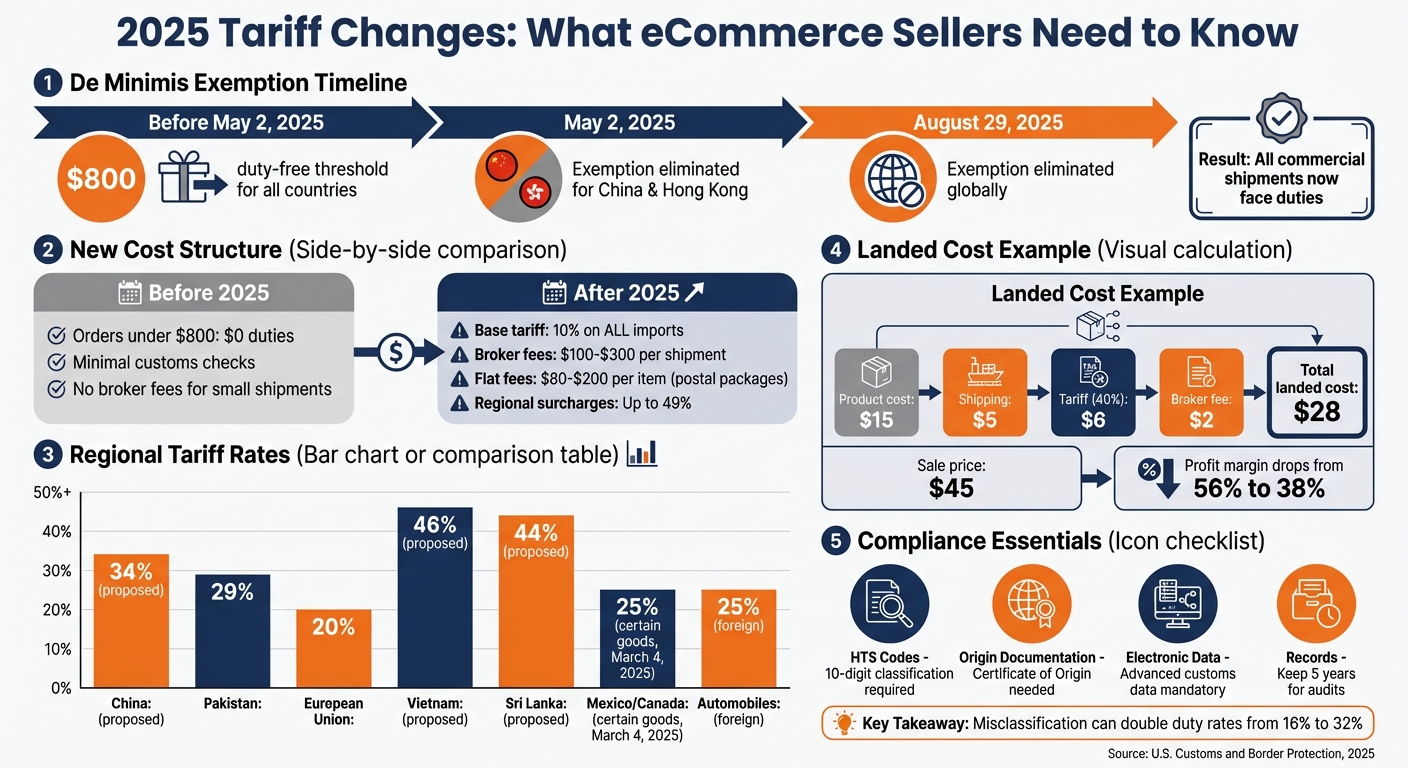
- De Minimis Exemption Eliminated: The U.S. removed the $800 duty-free threshold globally, meaning all shipments now face duties and customs checks.
- Higher Costs: Expect duties, broker fees ($100–$300 per shipment), and potential flat fees ($80–$200 per item). New tariffs include a 10% baseline on all imports and surcharges up to 49% for some regions.
- Compliance Is Key: Proper classification (HTS codes), origin documentation, and accurate invoices are critical to avoid fines, delays, or shipment seizures.
- Landed Costs Matter: Understand total costs (product price + shipping + duties) to protect margins.
- Stay Updated: Regularly review tariff changes, monitor high-risk SKUs, and adjust supply chains to minimize costs.
With these steps, you can manage risks, maintain profitability, and ensure smooth customs clearance.
How e-commerce brands can adapt to the 2025 tariff upheaval
Pre-Shipment Preparation Checklist
Before your products leave the warehouse, it's crucial to confirm four key details. These steps will help you understand your customs duty obligations and ensure your shipments clear smoothly.
Verify Product Classification Using HTS Codes
Every product entering the U.S. needs a 10-digit Harmonized Tariff Schedule (HTS) code. This code identifies the item you're importing and determines the duty rate. You can use the U.S. International Trade Commission's HTS Search Tool to find the correct code by entering a product description or keyword. For example, searching "cotton t-shirt" might return the code 6109.10.00. Misclassifying your product can lead to higher duty costs or even shipment delays and seizures[1].
A common error is misclassifying smartwatches as regular watches (HTS 9102), which may have a low duty rate, instead of as electronics (HTS 8517), which could include Section 301 tariffs. Similarly, incorrectly labeling apparel as "knit" instead of "woven" can double the duty rate from 16% to 32%. If you're unsure, consult an expert, especially for high-volume SKUs. It's also a good idea to review your HTS codes annually[4].
Once you've confirmed the codes, the next step is to determine the product's origin.
Determine Country of Origin
The country of origin is where the product undergoes its final substantial transformation - where its name, character, or use changes due to assembly or processing. This is not necessarily the country it ships from. Correctly identifying the origin is critical, as it affects tariff rates and compliance with marking requirements under 19 CFR Part 134[4].
To confirm the origin, document your supply chain thoroughly. For products assembled in multiple countries, keep detailed records like bills of materials and production logs. Mistakes in determining the origin can lead to higher duties or disqualification from preferential trade agreements[2].
Calculate Landed Costs
Knowing your landed costs is essential to protect your profit margins. Landed costs include the product price, shipping fees, duties, broker fees (typically $100–$300 per shipment), and handling charges.
For example, if a product costs $15, shipping is $5, and a 40% tariff applies, duties add $6, making the total landed cost $26. If you sell the item for $45, your margin drops from $25 (56%) to $19 (42%), reducing your profit by 14 percentage points[3].
Review Trade Agreements for Lower Rates
Trade agreements like USMCA (which replaced NAFTA) can help lower or eliminate tariffs if your products meet specific origin criteria. Check the U.S. Trade Representative's website or the HTS notes to see if your products qualify. For example, Mexican-sourced apparel under HTS 6109 might qualify for duty-free treatment instead of the standard 16% rate.
To claim these benefits, you'll need a Certificate of Origin showing that your product meets regional value content requirements - typically 60% to 75% for items like automotive parts - and that it ships directly from a partner country. If you're sourcing from regions with higher tariffs, consider adjusting your supply chain to include USMCA-eligible suppliers. This could offset higher production costs with duty savings.
Finally, double-check tariff rate details to ensure all charges are applied correctly.
Tariff Rate Lookup and Calculation Checklist
After confirming your HTS codes and the country of origin for your products, the next step is determining the exact duty rates that apply. This involves identifying the base rates, checking for additional tariffs, and staying updated on policy changes that could impact your costs.
Identify Base Tariff Rates
Start by using your 10-digit HTS code to access the U.S. Harmonized Tariff Schedule, available at usitc.gov or trade.gov. Navigate to your product's chapter and heading to locate the general duty rate for imports from the specified country of origin. Record this rate alongside your HTS code for future reference.
For example, if you're importing 1,000 units of a product priced at $15 each, and the base tariff is 10%, your total duties would amount to $1,500. Combine these duties with your product cost and shipping expenses to calculate the complete landed cost in U.S. dollars.
Once you've documented the base rates, move on to identifying any additional surcharges.
Check for Additional Tariffs or Policy Changes
Base HTS rates are just part of the picture. You also need to account for any additional tariffs or surcharges that may apply. These could include Section 301 tariffs on certain imports from China or other targeted economies, as well as specific charges on items like steel, aluminum, or automobiles. For instance, effective tariffs on Chinese imports can climb to around 40% when these extra charges are factored in, while certain steel and aluminum products may face rates as high as 41.2%.
To stay informed about changes, subscribe to Federal Register email alerts for tariff updates. Additionally, U.S. Customs and Border Protection and the Commerce Department provide online resources with guidance and links to relevant legal texts. It’s a good idea to establish a regular compliance review - monthly or quarterly - and assign a team member or customs broker to monitor how new tariff notices might affect your SKUs.
Account for Recent and Upcoming Changes
After reviewing your tariffs and surcharges, update your calculations to reflect the latest policy changes. Recent developments in 2025 have significantly impacted duty calculations:
- As of May 2, 2025, the U.S. eliminated the $800 de minimis exemption for China and Hong Kong, extending this to all countries by August 29, 2025. Now, nearly all commercial shipments are subject to import duties.
- Postal packages are no longer exempt and are charged either the standard HTS duty rate or flat fees ranging from $80 to $200 per item, depending on the applicable rate bracket. For small, low-margin orders, these fees can quickly erode profitability. It’s critical to factor duty estimates into your checkout pricing, shipping models, or Delivered Duty Paid (DDP) strategies, and reassess the viability of lower-priced items under these new rules.
Proposed 2025 tariffs introduce a 10% baseline duty on all imports, with higher rates for specific regions - 34% for China, 20% for the European Union, 29% for Pakistan, and 25% for foreign automobiles. While these figures are still under negotiation, running multiple tariff scenarios can help you stress-test your margins and refine your pricing strategies accordingly.
Documentation and Compliance Checklist
Getting your paperwork in order is more important than ever. With the removal of the $800 de minimis exemption, almost all commercial shipments entering the U.S. now require proper classification, valuation, and documentation - even small orders may face duties. Missing or incorrect documents can lead to shipment holds, manual inspections, and penalties, all of which can eat into your profits. Following these documentation steps can help ensure smooth customs clearance.
Prepare Accurate Commercial Invoices
Your commercial invoices need to be spot-on. These should include seller and buyer details, product descriptions, HTS codes, unit prices, total value in U.S. dollars, country of origin, freight and insurance costs, and sales terms (like FOB or CIF). Mistakes can cause delays, penalties, or even seizure of goods by U.S. Customs and Border Protection (CBP).
Be specific when describing products. For instance, instead of saying "clothing", write something like "men's cotton T-shirt, knit, 100% cotton." Vague descriptions are a common reason shipments get flagged for manual inspections, which adds both time and cost. Also, double-check that invoice values match your electronic records, packing lists, and airway bills. Any mismatch can result in shipment reviews.
You’ll also need to secure proper evidence of origin to take advantage of preferential tariff rates.
Include Certificates of Origin
Certificates of Origin (COs) are essential if you want to claim reduced or zero duties under trade agreements. These documents prove where your product was made and are required to qualify for preferential treatment. Without a CO, shipments will default to higher Most-Favored-Nation (MFN) tariff rates. For example, upcoming 2025 tariff hikes on Chinese goods could reach as high as 34%. A valid CO from a non-China source could save you a significant amount.
Make sure your COs come from authorized sources and include all necessary details, such as product descriptions, HTS codes, and origin declarations.
Generate Electronic Product Data
U.S. Customs now requires advanced electronic customs data for all shipments. This includes HS codes, product value, quantity, country of origin, and consignee details. Major carriers like USPS, UPS, FedEx, and DHL rely on this information to process shipments through CBP’s automated systems. If this data isn’t provided, shipments may be held, manually processed, fined, or even denied entry. This is especially critical after the August 29, 2025, global de minimis exemption ends, which will affect low-value parcels.
To stay compliant, ensure your eCommerce platform automatically generates accurate electronic customs data. For postal packages, some carriers may apply either the specific tariff rate for the product or flat import fees ranging from $80 to $200 per item.
Maintain Recordkeeping for Audits
CBP requires importers to keep all customs-related records for at least five years for potential audits. This includes commercial invoices, certificates of origin, HTS classifications, entry summaries, payment proofs, and shipping manifests. Digital storage is highly recommended, as it reduces the risk of losing critical documents and avoids penalties that could equal the domestic value of your goods.
Set up a centralized digital archive, organizing records by SKU or shipment. Conduct quarterly checks on a sample of shipments to ensure your documentation and electronic data align. Proper recordkeeping also opens the door to duty drawback programs, which allow you to recover up to 99% of duties paid on imported goods that are later exported. However, this is only possible if you maintain complete and linked import/export records.
sbb-itb-d7b5115
Risk Mitigation and Cost Management Checklist
With tariff rules evolving at a rapid pace, the financial stakes for eCommerce sellers are high. The removal of the $800 de minimis exemption, new baseline tariffs of 10% on all imports, and country-specific surcharges that can climb as high as 49% are just a few challenges sellers face. Add broker fees to the mix, and unprepared businesses risk seeing their profitability take a hit. To safeguard margins and cash flow, sellers need a solid plan. These measures complement earlier recommendations on pre-shipment processes and documentation, creating a more comprehensive approach to risk management.
Monitor Tariff and Policy Updates
Stay ahead of tariff changes by setting up a system to regularly monitor updates from trusted sources like U.S. Customs and Border Protection (CBP) and the U.S. International Trade Administration. Subscribing to newsletters from freight forwarders or customs brokers can also provide timely alerts on tariff rate adjustments or changes to HS/HTS codes. Make it a habit to review high-risk SKUs quarterly, updating HS codes, origin details, and landed cost calculations as needed. For example, when new tariffs - such as the 25% tariffs on certain goods from Mexico and Canada announced for March 4, 2025 - are introduced, quickly identify affected SKUs, recalculate margins, and run pricing scenarios to adapt.
Diversify Suppliers
Relying on a single supplier or region can leave you vulnerable to sudden tariff hikes. Start by mapping out each SKU’s origin and its associated tariff rate. Then, explore alternative suppliers in regions with lower duties or favorable trade agreements with the U.S. For instance, some businesses have shifted production from China, where effective rates hover around 40%, to countries like Vietnam or India. However, keep an eye on proposed 2025 tariffs, which include surcharges of 46% on Vietnam and 44% on Sri Lanka. Before making any supplier changes, calculate the full landed cost - including shipping, duties, broker fees, and quality control - and test pilot shipments to ensure compliance and maintain product quality. Diversifying your supplier base across multiple regions can help spread risk and reduce exposure to tariff changes in any single country.
Develop Contingency Plans
To safeguard profitability, it’s essential to have contingency plans in place. Set clear duty thresholds that will trigger actions like adjusting prices, cutting back on spending, or temporarily pausing sales. If tariff increases are on the horizon, consider accelerating shipments to lock in lower rates, but factor in storage capacity and working capital. Maintain relationships with several carriers and customs brokers to avoid disruptions tied to specific ports or shipping lanes. Document processes for checking updated rates, recalibrating pricing, and adjusting purchase orders when policies shift. Keep an eye on key metrics - such as duties as a percentage of cost of goods sold and gross margins by country of origin - to evaluate whether your strategies are working before profitability takes a hit.
How Onramp Funds Can Help eCommerce Sellers
Flexible Financing for Customs Duties
Dealing with upfront tariffs - ranging from a 10% baseline to as high as 49% - plus customs broker fees of $100–$300, can seriously impact your cash flow before you even start generating revenue. Onramp Funds offers a quick solution with equity-free, revenue-based financing, delivered in under 24 hours, to cover these expenses. This includes duties, broker fees, and other import-related costs[5]. It’s a fast way to get the funding you need and transition seamlessly into their broader support system.
"Onramp offered the perfect solution with revenue-based financing to secure the capital we needed to invest in inventory and pay it back at a reasonable time frame once we made sales. The process was quick, easy, and the support was great." - Jeremy, Founder and Owner of Kindfolk Yoga[5]
Personalized Support for Scaling Operations
Fast funding is just the beginning - scaling a business effectively also requires a partner who truly understands your needs. Onramp Funds connects with leading eCommerce platforms to analyze your real sales data. This allows them to create funding offers that match your performance, ensuring the support you receive fits your business goals[5]. Their team of experts is ready to help you put this capital to good use, whether that means stocking up on inventory ahead of policy shifts or diversifying suppliers to minimize tariff risks. With over 3,000 eCommerce loans already issued and clients reporting a 73% revenue increase within 180 days of funding, Onramp Funds has a proven track record of helping sellers navigate the challenges of cross-border trade[5].
Revenue-Based Repayment Options
When duties fluctuate, flexibility in repayment becomes essential. Onramp Funds integrates this flexibility into their model by automatically collecting repayments as 5–15% of your daily or weekly sales[2][3]. This system adjusts with your business, making payments easier during slower periods and scaling naturally as your sales grow. It’s a practical approach that helps you manage cash flow without adding stress.
"Onramp has simplified cash flow by automating everything: easy to request, set it and forget it payments - quick and fast!" - Torrie V., Founder and Owner of Torrie's Natural[5]
Conclusion
Managing customs and tariffs effectively requires careful planning, strict compliance with regulations, and proactive risk management. Accurate documentation and well-calculated costs are your best defenses against penalties, delays, and surprise expenses that can eat into your profits.
With the removal of the $800 de minimis exemption and new tariffs - reaching up to 34% for certain products - every shipment now faces closer scrutiny. These changes can strain cash flow and reduce competitiveness if not handled properly. Following the steps outlined earlier, from verifying HS codes to creating contingency plans, strengthens your business against these challenges.
Sellers are adapting by staying updated on policy changes, diversifying their supplier base, and leveraging duty drawback claims to recover 5–15% of paid duties. Tools like customs brokers and landed cost calculators have become essential for maintaining margins in this complex landscape.
However, upfront duty payments can create cash flow challenges. Flexible financing solutions, like those offered by Onramp Funds, provide a lifeline. With fast, equity-free, revenue-based funding, sellers can cover customs duties, inventory, and operational costs without rigid repayment terms. Having issued over 3,000 eCommerce loans and helping clients achieve a 73% revenue boost within 180 days of funding[5], Onramp Funds has proven to be a valuable resource for navigating the evolving tariff environment.
FAQs
How can eCommerce sellers classify their products correctly to avoid customs delays or penalties?
To ensure your products are classified correctly and avoid customs problems, start by giving clear and precise product descriptions. Pair these descriptions with the correct Harmonized System (HS) codes, which are crucial for identifying goods in global trade. You can locate these codes through official customs resources or by consulting a trade professional if necessary.
Getting the classification right isn’t just about following customs rules - it also helps you steer clear of expensive delays or penalties. Investing the effort upfront can save both time and money down the line.
How can eCommerce sellers handle higher costs after the de minimis exemption is removed?
To handle the rising costs resulting from the removal of the de minimis exemption, it's important to rethink your approach. Start by evaluating your pricing strategy - small adjustments can help offset these expenses. Look at your operations too; finding ways to streamline processes can cut down unnecessary costs. On top of that, focus on improving inventory management to strike the right balance and avoid issues like overstocking or running out of key items.
Another smart move is to expand your sales channels. By tapping into multiple platforms, you can spread out costs and open up new revenue streams.
For financial flexibility, consider revenue-based financing. This option provides the cash flow needed to cover tariffs and fund growth initiatives. The repayment structure adapts to your sales, offering a more manageable way to scale your business while navigating financial hurdles.
How can eCommerce sellers use trade agreements to lower tariffs on imports?
Trade agreements offer a valuable opportunity for eCommerce sellers to cut costs on imported goods. These agreements, like the USMCA or various bilateral trade deals, often include reduced or even eliminated tariffs on certain products. The result? Lower import costs and better profit margins.
To benefit from these agreements, it’s essential to ensure your products meet the required eligibility standards. This might involve adhering to rules of origin or providing specific documentation. By navigating these requirements effectively, you can lower expenses and strengthen your position in a competitive market.
Related Blog Posts
Onramp Funds
Funding built around your sales
Connect your store and see what you qualify for. Repay as a percentage of sales, with no personal credit check.
Funding in as little as 24 hours.
