


Applying for an SBA loan can feel daunting, but preparation is the key to success. Here's what you need to know:
- SBA Loans Overview: SBA loans, like the 7(a) program, offer funding up to $5.5 million with favorable terms for small businesses, including eCommerce sellers. Options include Express Loans for faster access and Microloans for smaller needs.
- Eligibility: Your business must operate for profit, meet size standards, and be based in the U.S. Personal guarantees, creditworthiness, and proof of need for SBA terms are required.
- Required Documents: Gather personal and business records, such as tax returns, financial statements, SBA forms, and a detailed business plan with financial projections.
- Submission Process: Work with an SBA-approved lender to submit your application via the E-Tran portal. Stay proactive and organized to address any lender questions promptly.
- Common Mistakes: Avoid inconsistent financial records, generic business plans, or missing documents. Be transparent about risks and ensure all submissions are well-organized.
- Alternative Funding: If SBA loans take too long, consider options like Onramp Funds, which provide same-day funding tailored to eCommerce businesses without requiring personal credit checks.
2025 Ultimate SBA Application Checklist (Free!)
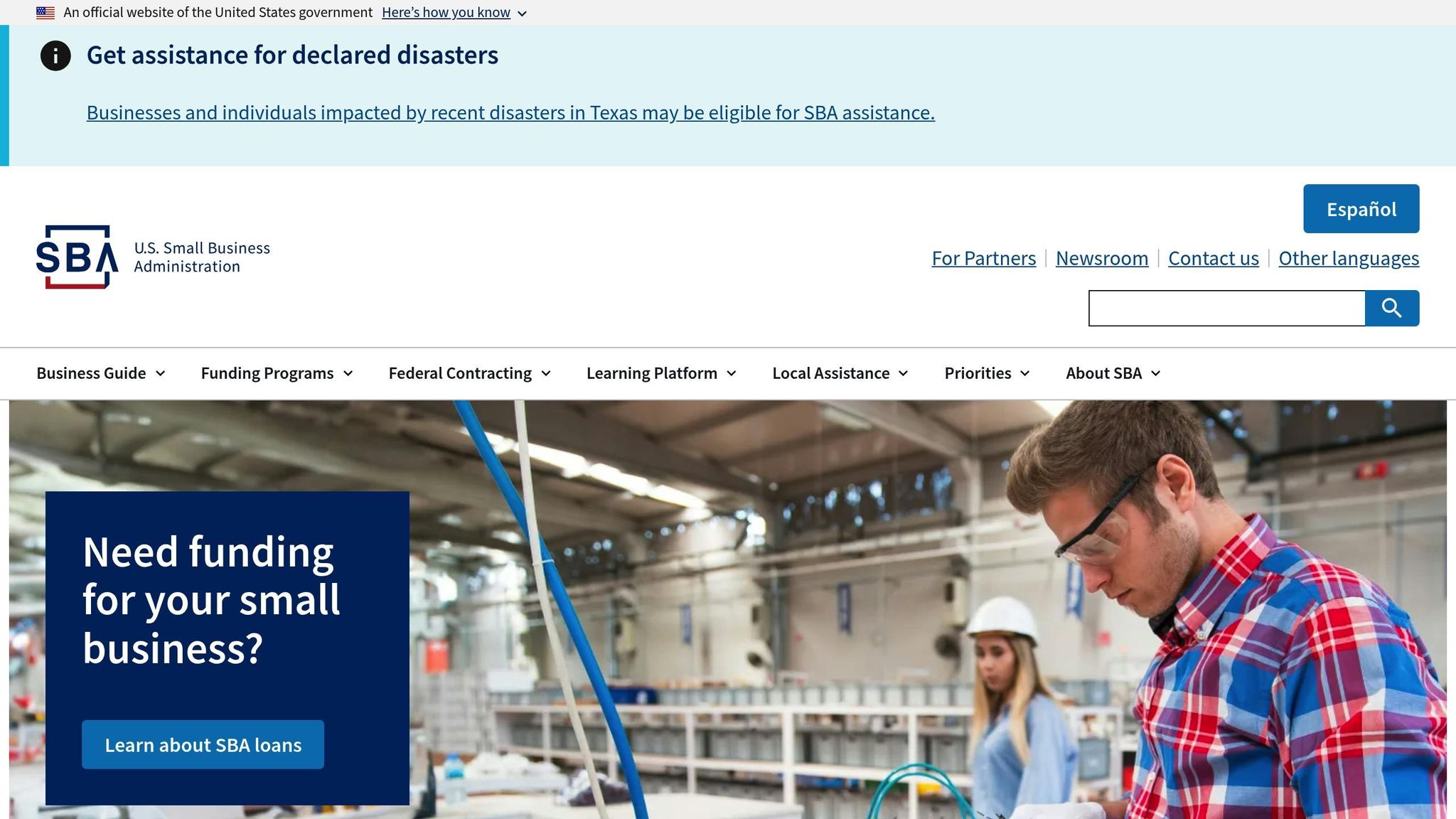
SBA Loan Types and Eligibility Requirements
Understanding your loan options and eligibility criteria can make the SBA application process much smoother. The first step? Identify the best SBA loan for your needs and confirm your eligibility.
SBA Loan Types for eCommerce Businesses
Here are some of the SBA loan options tailored for eCommerce businesses:
SBA 7(a) Loans are a favorite among online retailers. These loans range from $50,000 to $5.5 million and offer a lot of flexibility. You can use them for working capital, buying inventory, upgrading equipment, launching marketing campaigns, or acquiring long-term assets. In fiscal year 2025, over $28 billion in SBA 7(a) loans were approved, showing how widely they're used[1][5].
If you're in a hurry, SBA Express Loans might be a better fit. They provide up to $500,000 with faster approval times, making them perfect for time-sensitive needs like stocking up on seasonal inventory[2].
For smaller funding needs, SBA Microloans are a solid option. These loans go up to $50,000 and are especially useful for startups or businesses looking for funds to improve their website, buy initial inventory, or test marketing strategies. They also tend to have more flexible credit requirements[1].
If your eCommerce business sells internationally, Export Loans could be the way to go. The Export Express program offers streamlined approval and higher guarantees for smaller export-related loans, while the Export Working Capital program provides larger funding to support international sales[2].
| Loan Type | Maximum Amount | Best For |
|---|---|---|
| SBA 7(a) Standard | $5.5 million | Business expansion |
| SBA Express | $500,000 | Quick access to funding |
| Microloans | $50,000 | Startups and small projects |
| Export Express | Varies | International sales |
SBA Loan Eligibility Requirements
To qualify for an SBA loan, your eCommerce business must meet several key criteria.
Business size is one of the main factors. Your business must operate for profit, have fewer than 500 employees, and be based in the United States or its territories. The SBA provides an online Size Standards Tool to help you confirm eligibility, as requirements can vary by industry[3][1][4].
Personal guarantees are another requirement. If you own 20% or more of the business, you'll need to personally guarantee the loan, meaning you'll be held responsible if the business can't repay it[3].
You'll also need to demonstrate creditworthiness and repayment ability. While each lender has its own minimum credit score requirements, businesses with less-than-perfect credit may still qualify, especially for startup funding. It's worth checking with several lenders to find the best fit[3][4].
Additionally, the SBA requires proof that the loan isn't available on reasonable terms from non-government sources. This doesn't mean you need to be rejected by a bank first - it simply means SBA financing may offer more accessible or favorable terms than private loans[1][4].
Some businesses are automatically ineligible for SBA loans. For example, businesses primarily involved in lending, life insurance companies, or those earning more than a third of their revenue from gambling won't qualify[3].
Lastly, keep in mind that SBA loans aren't issued directly by the government. They're provided by SBA-approved lenders, who may have their own additional criteria. In fiscal year 2023, the SBA backed over 57,300 loans, proving that many businesses successfully meet these requirements[3].
Up next: a breakdown of the documents you'll need to prepare for your application.
Required Documents Checklist
Getting your paperwork in order is one of the most critical steps in the SBA loan application process. Success often hinges on being fully prepared with the right documents. Here's a detailed breakdown of what you'll need to gather.
Personal Documents Required
If you own 20% or more of the business, you'll need to provide personal documentation to support your guarantee. Start with a government-issued ID - make sure it's valid, unexpired, and includes high-quality images of both the front and back, as per the updated guidelines introduced by NEWITY on May 28, 2025, for SBA 7(a) loan applications [6].
For non-U.S. citizens who are lawful permanent residents, additional paperwork is necessary. This includes Form I-9, a copy of your Permanent Resident Card (front and back), and a USCIS Verification and Authorization Letter.
You'll also need to complete SBA Form 912, which provides a detailed account of your personal history. This form requires information such as past addresses, aliases, any criminal records (if applicable), and your educational background.
SBA Form 413 is another essential document, summarizing your personal financial situation, including assets, liabilities, and income. This form must be completed by all owners with 20% or more ownership, their spouses, and any guarantors.
Gather your personal tax returns from the past two to three years. If you're behind on filings, include proof of an extension along with an explanation. A professional resume showcasing your business experience and industry expertise is also required. Lastly, obtain personal credit reports from Experian, Equifax, and TransUnion. Review these reports carefully for errors and address any inaccuracies before submitting your application.
Business Documents Checklist
Your business documents should provide a clear picture of your company's financial health and potential. Begin with SBA Form 1919, which captures key details about your business, including its structure, loan specifics, existing debts, key personnel, and any prior government financing.
You'll need to provide licenses, articles of incorporation, and operating agreements to confirm your business's legal standing. Business tax returns and up-to-date financial statements - such as balance sheets and profit and loss statements - are also required. Ensure these financial statements are updated within 60 days of your application.
A comprehensive business plan is a must. Include detailed financial projections (covering sales, cash flow, and profit margins) alongside qualitative goals like your mission, values, and overall vision for the business.
Prepare a debt schedule that outlines all current business obligations, including loan amounts, payment terms, and remaining balances. Additionally, include bank statements from the past 12 months to verify financial activity. Consistent and healthy bank records can make a strong impression on lenders. Finally, provide any relevant legal documents, such as commercial lease agreements, equipment financing contracts, franchise agreements, or supplier contracts, to give lenders a full picture of your business operations.
Document Organization and Verification
Proper organization of your documents is key to a smooth application process. Take the time to thoroughly prepare and present your materials.
Cross-check your tax returns, financial statements, and bank records to ensure there are no discrepancies. It's a good idea to have your accountant or banker review your documents for accuracy and completeness.
Create a digital folder system with clearly labeled categories, so both original copies and high-quality scans are easy to access. Respond quickly to any lender requests for additional information - having backup documentation on hand can help clear up questions without delays.
Address any financial issues upfront to avoid the risk of misrepresentation.
Investing time in organizing and verifying your documents will not only speed up the approval process but may also help you secure better loan terms. Once everything is in order, you'll be ready to move on to the application submission phase.
SBA Loan Application Process
Now that your documents are in order, it's time to focus on submitting your application and staying on top of follow-ups. This phase demands a sharp eye for detail and good timing to give your application the best chance of approval.
Document Preparation
Start by double-checking all your documents for consistency. Make sure your tax returns, financial statements, and debt schedules align. Any mismatch - like discrepancies between your profit and loss statements and tax filings - could raise questions during the underwriting process.
Update your business plan to reflect the current market landscape and clearly explain why you're seeking the loan. Your plan should detail how you'll use the funds and outline your repayment strategy. Include a three-year cash flow forecast that offers realistic projections based on past performance and current trends.
Create a debt schedule that lists all your existing financial obligations. This should include loan amounts, payment terms, and outstanding balances. Lenders use this to assess your debt-to-income ratio and overall financial health.
Convert all documents into high-quality PDFs and organize them into clearly labeled folders. Having both digital and physical copies on hand will make it easier to respond quickly to any additional requests from your lender.
Once your documents are finalized and neatly arranged, you're ready to submit your application.
Application Submission
The way you submit your application will depend on your lender, but most now use digital platforms to simplify the process. For SBA 7(a) loans, you'll likely work with a bank that has an established system for handling SBA applications.
Your lender will collect all the necessary information and submit it to the SBA through the E-Tran portal. This system provides real-time updates on your application status and helps ensure everything complies with SBA guidelines, minimizing errors during submission.
"The Sageworks SBA Lending product promotes efficiency by creating the required 1919 and 1920 PDF forms, and promotes accuracy by using the interface with E-Tran."
– Tareasa Harrell, Managing Director of Government Guaranteed Lending, Signature Bank of Georgia [7]
Lenders can send loan packages to E-Tran either through XML format using specialized software or by uploading them directly on the E-Tran webpage. Additionally, some platforms allow you to submit documents online, which can save a lot of time.
Working with a lender experienced in SBA processes can make the application smoother. For instance, BayFirst managed to process 9,000 additional applications in just four months by leveraging efficient digital systems [7].
Once the application is submitted, staying proactive is essential to keep things moving.
Application Follow-Up
After submission, staying in touch with your lender is critical to ensure progress. In fiscal 2024, banks approved 59,833 SBA 7(a) loans - a 53% increase from 2020 [7] - highlighting the competitive nature of the process.
Check in with your lender regularly and keep a record of all communications. Having your backup documents ready and easily accessible will allow you to respond to any requests within 24–48 hours.
Set up a dedicated email folder and maintain a timeline for all loan-related communications. This level of organization will be extremely helpful if questions arise later.
If any issues come up during underwriting - like the need for additional collateral, clarification on financial projections, or explanations for unusual transactions in your bank statements - address them immediately. Tackling these concerns promptly not only prevents delays but also shows lenders that you're well-prepared and serious about your business.
sbb-itb-d7b5115
Application Tips and Common Mistakes
When preparing your SBA loan application, getting it right the first time can save you from unnecessary delays and setbacks. These tips will help you fine-tune your application while steering clear of common mistakes.
Accuracy and Complete Documentation
Consistency in financial records is key to securing SBA loan approval. Your tax returns, profit and loss statements, and bank records must align perfectly. Any discrepancies can raise red flags during underwriting and may result in rejection.
To stay on top of this, use cloud-based accounting tools like QuickBooks or Xero to keep your records organized year-round. Partnering with a certified public accountant (CPA) for regular reconciliations ensures your financial documents remain consistent and ready for audits.
Uniformity in entity information across all documents is equally important. Your business name, management structure, and state of registration must match on your articles of incorporation, operating agreements, and loan application forms. Even minor mismatches can slow down the process.
Catherine Arik, Eastern Idaho Region President at Zions Bank, underscores the importance of thoroughness:
"It's better to provide more information than less... The business plan is really the nuts and bolts of your application. It's also an opportunity to tell your story" [10].
Creating a detailed document checklist can help ensure you submit a complete application.
Common Errors and How to Fix Them
Weak or generic business plans are a common reason for SBA loan rejections. Avoid using templates or cookie-cutter language. Instead, tailor your business plan to meet SBA requirements and address the specific needs of your eCommerce niche [8][9].
Include realistic financial projections backed by industry data and your business's historical performance. Overly optimistic sales forecasts that don't align with market conditions can hurt your chances [9]. Use charts and tables to make your projections clear and easy to understand.
Ignoring risk factors is another frequent misstep. Acknowledge potential challenges like seasonal sales dips, supply chain issues, or increased competition, and outline your contingency plans [9]. Lenders value applicants who demonstrate a realistic and proactive approach to managing risks.
Disorganized submissions can create delays and leave a poor impression. Keep your documents neatly organized in labeled folders, and for more complex applications, include a table of contents [8].
Equity injection requirements often catch applicants off guard. Be ready with proof of funds and clearly document the source of your equity contribution, whether it's from personal savings, asset sales, or investor funding [8].
Choosing the wrong lender can derail even the most well-prepared application. Opt for a Certified Development Company (CDC) or bank experienced in working with eCommerce businesses and familiar with the challenges of your industry [8].
Showing Business Readiness
Prove your business is ready to succeed by highlighting your expertise, management skills, and understanding of the eCommerce landscape. Show lenders that you know your target market, understand industry trends, and have a solid plan to navigate the competitive environment [11].
Personal financial strength matters, too. Keep your personal finances in order and prepare detailed financial statements. If your credit or income history isn't ideal, consider adding a qualified co-signer to strengthen your application [11].
Transparency builds trust. Kyle Fawcett, a former SBA loan officer with nearly seven years of experience, advises:
"Lenders appreciate honesty and thoroughness in loan applications and if they feel like they actually understand and trust your forthcomingness and situation, then they are more likely to go to bat for you with underwriting or loan committee reviews" [11].
Be upfront about past credit issues and emphasize the steps you've taken to improve. This shows maturity and helps prevent surprises during underwriting.
When presenting your marketing strategy, go beyond generic statements. Break down customer acquisition costs, lifetime value, conversion rates, and the specific channels driving your sales [9]. A well-thought-out strategy that demonstrates your understanding of eCommerce growth can set you apart.
Finally, ensure financial projections are grounded in reality and based on solid assumptions. Use visuals like charts and tables to clearly present historical performance and future trends. Be prepared to defend your assumptions during lender discussions.
As Kyle Fawcett puts it:
"Approach the SBA loan process as an opportunity to thoroughly assess and present the strengths of your business. By doing so, you not only improve your chances of loan approval but also lay a robust foundation for your business's future success" [11].
Alternative Funding Solutions for eCommerce Businesses
SBA loans are known for their favorable terms, but the lengthy approval process - sometimes taking 30 to 90 days - can be a poor fit for the fast-moving world of eCommerce. That's where alternative funding options, like revenue-based financing, come into play.
Onramp Funds offers a solution tailored specifically to the cash flow needs of eCommerce businesses. Unlike traditional loans, Onramp's repayment system adjusts to your daily revenue, taking as little as 1% of daily sales. There are no monthly minimums or rigid schedules, making it a flexible option for businesses with fluctuating income.
One of the standout benefits? Speed. While SBA loans can take weeks, Onramp provides funding offers on the same day you apply. Nick James, CEO of Rockless Table, shared his experience:
"Applied, got our offer, and had cash in our bank account within 24 hours. Their Austin, TX based team was very professional and helped me deploy the cash to effectively grow our business." [14]
Onramp integrates seamlessly with major eCommerce platforms like Amazon, Shopify, TikTok Shop, WooCommerce, BigCommerce, Squarespace, and Shopline. This integration allows them to create a customized cash offer without requiring personal credit checks or piles of documentation.
Transparent Costs and Savings
Onramp is upfront about its fees, charging flat rates between 2% and 8%, with no hidden costs. For example, on a $100,000 advance, fees average around $5,000 - significantly lower than traditional bank loans at 12% APR (about $6,618) or merchant cash advances with a 1.1 factor rate (approximately $10,000) [13].
This flexible funding model has proven effective, with customers reporting an average revenue increase of 60%. Additionally, 75% of Onramp's clients return for more funding [12]. Jeremy, Founder and Owner of Kindfolk Yoga, highlighted how this approach helped his business:
"Onramp offered the perfect solution with revenue-based financing to secure the capital we needed to invest in inventory and pay it back at a reasonable time frame once we made sales. The process was quick, easy, and the support was great." [14]
Designed for eCommerce Growth
Onramp's approval process doesn't require personal guarantees or collateral. Instead, they focus on your sales performance and growth potential. If your eCommerce business generates at least $10,000 in monthly sales, Onramp can provide the working capital you need for inventory, marketing, or expansion - all without the headaches of traditional SBA loans.
Their online funding calculator makes it easy to pre-qualify in minutes with no commitment, helping you explore your options quickly and confidently. For eCommerce businesses that need agile, flexible funding, Onramp offers a practical and efficient alternative.
Conclusion
Navigating the SBA loan application process requires thoughtful preparation and well-organized documentation. Ensuring you have all the necessary paperwork ready can help streamline the process and minimize the chances of delays or rejection[15][16][17]. Double-checking for accuracy and completeness is crucial - one final review can prevent errors that might disrupt your funding timeline[18]. With recent rules mandating lenders to list at least 81% of beneficial owners in their systems, paying attention to detail has become even more important[15].
While thorough documentation improves your chances of approval, SBA loans aren't always the right fit for every eCommerce business. These loans come with attractive terms - over $25 billion is approved annually for small businesses, with the average SBA 7(a) loan amount hovering around $500,000[16]. However, the drawn-out approval process can clash with the fast-moving demands of eCommerce.
For businesses in need of quick, flexible funding, exploring alternative options is a smart move. Whether you're gearing up for an SBA loan or seeking immediate capital for inventory or marketing, having a diverse funding strategy ensures you're ready to seize growth opportunities as they arise.
Given the slower pace of SBA approvals, many eCommerce businesses turn to faster solutions. Onramp Funds provides a practical alternative, offering same-day funding with repayment terms tailored to sales. With transparent fees between 2% and 8% and no hidden charges, Onramp Funds is designed to match the cash flow needs of eCommerce businesses. Their online funding calculator makes it simple to evaluate your options and choose the best fit for your goals.
FAQs
What are the main differences between SBA 7(a) Loans, Express Loans, and Microloans for eCommerce businesses?
SBA Loan Options for eCommerce Businesses
SBA 7(a) Loans offer funding up to $5 million, making them the go-to choice for established eCommerce businesses with big plans. Whether you're looking to expand operations, invest in inventory, or purchase equipment, these loans come with flexible terms to suit a variety of needs.
SBA Express Loans are all about speed. With a maximum loan amount of $350,000, they're perfect for businesses that need funds quickly and with fewer collateral requirements. If time is of the essence, this option can help bridge the gap without the lengthy approval process.
Microloans are tailored for smaller needs, offering up to $50,000. They're ideal for startups or businesses looking to make smaller-scale improvements. While they come with shorter repayment terms and slightly higher interest rates, they're a practical option for newer eCommerce ventures aiming to establish or modestly grow their operations.
What steps should I take to ensure my SBA loan application is complete and error-free?
To get your SBA loan application right, it's crucial to take your time and ensure everything is accurate and complete. Start by carefully reviewing all required documents, making sure every form is filled out properly. Pay special attention to your financial statements - avoid inflating numbers or leaving out important details.
Begin the process by checking your credit report for any errors and resolving them if needed. Include all essential documents, like your business plan, tax returns, and financial projections. Rushing through the application or submitting incomplete or incorrect information could result in delays or even rejection.
By putting in the effort to prepare thoroughly, you'll not only boost your chances of approval but also show lenders that you're serious and professional.
What can I do if the SBA loan process is too slow for my eCommerce business?
If your SBA loan process is dragging on longer than expected, don't worry - there are other funding options designed specifically for eCommerce businesses. These include revenue-based financing, merchant cash advances, and business lines of credit, which can often get you the funds you need much faster. Depending on your business model and goals, you might also consider grants, crowdfunding, or even angel investors.
For a quicker and more adaptable option, revenue-based financing could be a game-changer. With this method, you repay the loan as a percentage of your sales. This setup not only supports your cash flow but also allows you to focus on scaling your business without the pressure of fixed monthly payments. Take the time to evaluate which option best suits your operational needs and growth strategy.
Related Blog Posts
Onramp Funds
Funding built around your sales
Connect your store and see what you qualify for. Repay as a percentage of sales, with no personal credit check.
Funding in as little as 24 hours.
