

The Cash Conversion Cycle (CCC) is a key metric that shows how efficiently your business turns investments in inventory into cash from sales. For online sellers, this cycle includes the time it takes to pay suppliers, sell inventory, and receive payments from customers. Managing CCC effectively can help you avoid cash flow issues, reduce reliance on expensive financing, and reinvest in growth opportunities.
Key Takeaways:
- CCC Formula: CCC = DIO (Days Inventory Outstanding) + DSO (Days Sales Outstanding) - DPO (Days Payables Outstanding).
- DIO: Measures how long inventory remains unsold. Lower DIO means faster inventory turnover.
- DSO: Tracks how quickly you collect payments from customers. A shorter DSO improves cash flow.
- DPO: Indicates how long you can delay payments to suppliers. Extending DPO retains cash longer.
Example Calculation:
For a business with $700,000 revenue, $400,000 COGS, $70,000 inventory, $110,000 receivables, and $60,000 payables:
- DIO = 63.9 days
- DSO = 57.4 days
- DPO = 54.8 days
- CCC = 66.5 days (cash tied up for ~67 days).
Why It Matters:
A shorter CCC means quicker access to cash, enabling inventory restocks, marketing, and scaling without external funding. Companies like Amazon achieve a negative CCC, collecting customer payments before paying suppliers, which fuels growth without debt.
Quick Tips to Improve CCC:
- Lower DIO: Use just-in-time inventory, forecast demand accurately, and clear slow-moving stock.
- Shorten DSO: Offer early payment incentives, automate invoicing, or use tools like Shopify Balance for faster payouts.
- Extend DPO: Negotiate longer payment terms with suppliers or use trade credit.
Understanding and optimizing your CCC helps you maintain smooth operations, manage cash flow efficiently, and grow your eCommerce business sustainably.
Mastering the Cash Conversion Cycle in eCommerce (with Valentin)
Understanding the Cash Conversion Cycle Components
The Cash Conversion Cycle (CCC) is a financial metric that tracks how efficiently your cash moves through your business. It measures the time between paying for inventory and receiving payment from customers, offering a clear view of your cash flow timeline.
The CCC Formula Explained
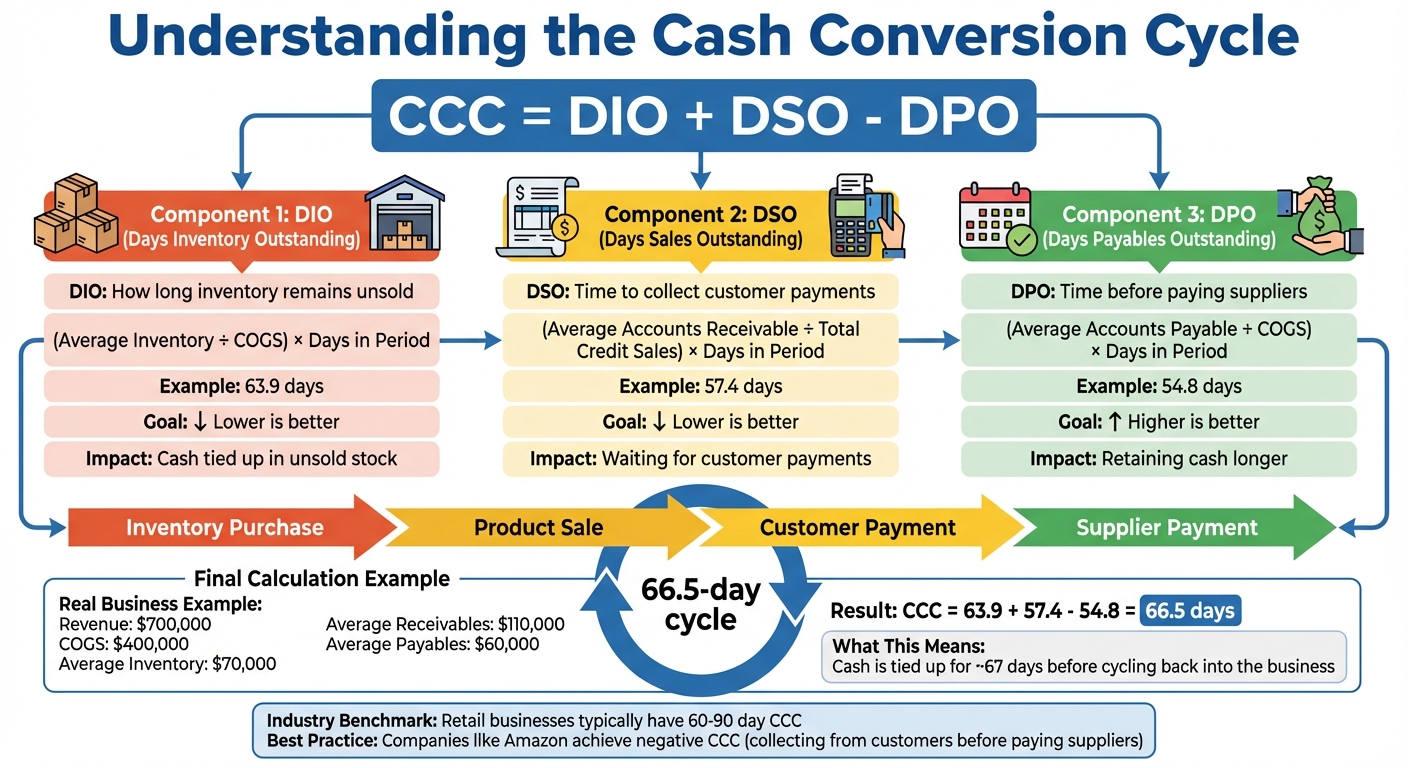
The formula for CCC is CCC = DIO + DSO - DPO. Each component represents a different stage where cash is tied up or released:
- DIO (Days Inventory Outstanding): Reflects how long cash is tied up in unsold inventory.
- DSO (Days Sales Outstanding): Shows the time it takes to collect payments from customers.
- DPO (Days Payables Outstanding): Indicates how long you can delay payments to suppliers.
This formula provides the net number of days your cash is actively engaged in the operating cycle.
Days Inventory Outstanding (DIO)
DIO calculates the average number of days your inventory remains unsold. The formula is:
(Average Inventory / Cost of Goods Sold) x Days in Period
For eCommerce businesses, a high DIO might hint at problems like overstocking, poor demand forecasting, or pricing missteps. For instance, in 2010, Abercrombie & Fitch reported a DIO of 124.7 days - more than double that of American Eagle Outfitters, which had a DIO of 61.4 days. This meant Abercrombie's cash was locked in inventory for significantly longer.[5]
Days Sales Outstanding (DSO)
DSO measures how quickly your business collects cash after a sale. The formula is:
(Average Accounts Receivable / Total Credit Sales) x Days in Period
For online sellers, delayed marketplace payouts can extend DSO. However, in 2010, American Eagle Outfitters achieved a DSO of just 4.7 days, showcasing their efficiency in collecting payments.[5] A lower DSO ensures faster access to cash, which is crucial for meeting operational needs.
Days Payables Outstanding (DPO)
DPO tracks how long your business takes to pay suppliers after receiving invoices. The formula is:
(Average Accounts Payable / Cost of Goods Sold) x Days in Period
A higher DPO means you can hold onto cash longer, essentially using it as short-term, interest-free financing.[2][6] For example, in 2010, American Eagle Outfitters had a DPO of 30.9 days, giving them over a month to use cash for other investments before settling supplier payments.[5] Extending payment terms can help improve your working capital position significantly.
Next, we’ll dive into how to calculate your CCC and apply these insights to your business operations.
How to Calculate Your CCC
To calculate your Cash Conversion Cycle (CCC), you'll need data from your Income Statement (specifically Revenue and COGS) and Balance Sheet (Inventory, Accounts Receivable, and Accounts Payable). Make sure to gather both the beginning and ending balances for the period you’re analyzing - usually a quarter (90 days) or a full year (365 days).
Start by determining the average balances for inventory, receivables, and payables. This is done by adding the beginning and ending balances for each account and dividing by two. Using averages helps to account for any fluctuations during the period. Once you have these averages, you can calculate the three components of the CCC: Days Inventory Outstanding (DIO), Days Sales Outstanding (DSO), and Days Payable Outstanding (DPO).
Let’s break it down with an example: Imagine a business with an annual revenue of $700,000, COGS of $400,000, an average inventory of $70,000, average accounts receivable of $110,000, and average accounts payable of $60,000.
For a 365-day period, here’s how the calculations look:
- DIO = ($70,000 ÷ $400,000) × 365 = 63.9 days
- DSO = ($110,000 ÷ $700,000) × 365 = 57.4 days
- DPO = ($60,000 ÷ $400,000) × 365 = 54.8 days
Finally, calculate the CCC:
CCC = DIO + DSO – DPO
CCC = 63.9 + 57.4 – 54.8 = 66.5 days
In this case, your cash is tied up in operations for about 67 days before it cycles back into your business. This figure falls within the typical range for retail businesses (60–90 days) and highlights areas for improvement. For instance, you could aim to reduce DIO or DSO, or explore ways to extend DPO to improve cash flow efficiency. [7]
Why CCC Matters for Your eCommerce Business
Your cash conversion cycle (CCC) plays a crucial role in how quickly you can reinvest in growth opportunities. It measures how fast your inventory investments turn into cash - cash that can fuel marketing efforts, new product launches, or expansion into additional sales channels [2].
When your CCC is running efficiently, cash becomes available sooner. This allows you to act swiftly on market opportunities, giving you an edge over competitors whose funds are tied up [1].
On the flip side, a lengthy CCC can create operational challenges. You’re often paying for inventory upfront while waiting for marketplace disbursements. This gap can force many sellers to rely on costly external financing just to keep operations afloat. Those interest fees chip away at your profits and leave less capital for strategic investments [4].
Your CCC also sends a strong message to lenders and investors. A long cycle might signal slow inventory turnover or inefficient collections, making it harder to secure growth capital [3]. In contrast, a streamlined CCC highlights efficient operations and strong financial management, positioning your business as a lower-risk, more attractive investment. Next, we’ll compare positive and negative cycles to see how they impact cash flow and operations.
Positive vs. Negative CCC: What's the Difference?
Most eCommerce businesses operate with a positive CCC, meaning cash is tied up for a certain number of days while waiting to collect payments from customers. The longer this number, the longer your funds are locked and unavailable for reinvestment [3].
A negative CCC, however, turns this model upside down. Companies like Amazon and Dell are known for operating with negative CCCs, where customer payments are collected before they pay their suppliers. This creates a built-in source of short-term financing, enabling rapid growth without relying on outside capital [2][8]. While achieving a negative CCC is challenging for many online sellers, it’s the gold standard for efficient cash flow management.
Businesses using drop-shipping models often achieve lower or even negative CCCs. Since they receive customer payments before paying suppliers for inventory, they gain immediate access to working capital. This allows them to reinvest quickly in marketing, product development, or market expansion without waiting for traditional payout cycles [3]. Understanding these differences can help you better manage your cash flow and adapt to time-sensitive demands.
Managing Seasonal Cash Flow Challenges
Once you have a clear understanding of your CCC, you can use it to tackle seasonal cash flow challenges. Monitoring your CCC helps you anticipate periods of tight cash flow and plan ahead, avoiding situations where you’re short on working capital during slower times [4].
Knowing your cycle length also helps you time inventory purchases more effectively. For example, if you’re aware of your average CCC, you can plan inventory orders well in advance of demand spikes. This ensures you have the cash to place large orders, reducing the risk of stockouts during peak sales periods - a problem that can hurt both your product rankings and customer satisfaction [1].
Seasonal businesses face even more intense cash flow pressures since they often need to invest in inventory months before revenue comes in. By keeping a close eye on your CCC, you can negotiate better payment terms with suppliers during slower months or secure financing early, avoiding last-minute scrambles for emergency funds during high-demand periods.
sbb-itb-d7b5115
How to Improve Your Cash Conversion Cycle
If you want to free up cash for immediate reinvestment, shortening your cash conversion cycle (CCC) is key. To do this, focus on three main areas: inventory management, payment collection, and supplier payment timing. For instance, adopting a just-in-time (JIT) ordering system can minimize cash tied up in inventory, while negotiating extended payment terms with suppliers gives you more time before funds leave your account [2][6].
That said, it’s essential to strike a balance between efficiency and maintaining strong relationships. Cutting inventory too aggressively can lead to stockouts, which can hurt your customer satisfaction and rankings. Similarly, delaying payments to suppliers for too long might strain critical supply chain partnerships. Here are some actionable strategies to improve inventory management, speed up collections, and optimize payment timing.
How to Reduce Days Inventory Outstanding (DIO)
Lowering your DIO helps free up cash that would otherwise be stuck in unsold inventory. One effective approach is using just-in-time (JIT) inventory systems, where goods are delivered only as they’re needed. This reduces the need to store large quantities of stock and works well if you have dependable suppliers who can deliver quickly, keeping your inventory lean [2][6].
Another important tactic is accurate demand forecasting, which ensures you stock enough of your best-selling items while avoiding overstocking slower-moving products. This not only prevents cash from being tied up in unsold goods but also minimizes the risk of losing sales due to stockouts [2]. For items that aren’t selling, consider bundling them with popular products to clear them out while generating cash flow [1].
Working closely with suppliers can also make a big difference. Collaborate to optimize logistics and reduce lead times. For example, negotiating more frequent deliveries allows you to place smaller orders more often, keeping your inventory levels manageable and your cash flow more fluid [2].
How to Shorten Days Sales Outstanding (DSO)
Speeding up cash collection is another way to improve your CCC. Tools like Shopify Balance can help by allowing sellers to receive payouts up to seven days earlier than standard schedules, which significantly reduces DSO [2]. If you’re selling on multiple platforms, prioritize those with faster payout cycles or negotiate for more frequent disbursements with marketplaces like Amazon [1].
For wholesale or B2B transactions, offering early payment incentives - such as "2/10 net 30" terms - can encourage customers to pay sooner. Automating invoicing and sending payment reminders can also streamline the process [2][7].
Another effective strategy is using pre-order campaigns. By collecting payments upfront for products that haven’t yet been shipped or paid for, you can fund inventory purchases directly with customer cash. This is especially useful for new product launches or seasonal items [9]. If immediate cash is needed, revenue-based financing from providers like Onramp Funds can offer upfront capital, which is repaid as a percentage of daily sales, giving you liquidity without waiting for marketplace payouts.
How to Extend Days Payables Outstanding (DPO)
Extending your DPO gives you more time to turn inventory into cash before paying suppliers. Start by building trust through a history of reliable payments - suppliers are more likely to offer better terms to businesses they trust [2]. Once you’ve established credibility, propose arrangements that benefit both sides, such as committing to larger or more consistent order volumes in exchange for extended payment terms.
Trade credit is another powerful tool. For example, you can ask advertising or technology partners for Net 30 payment terms, which essentially provides interest-free financing and helps extend your DPO without impacting your inventory suppliers [9]. For larger suppliers, platforms like Melio can pay them immediately while giving you up to 90 days to settle the payment, keeping your cash flow intact [9].
If suppliers are hesitant to grant extended terms, consider offering a small fee (1-2%) in exchange for flexibility. This approach keeps relationships intact while giving you more breathing room. A great example of this strategy is Gymshark, which has achieved a negative cash conversion cycle of -101 days by managing payables and inventory effectively. This demonstrates how extending DPO can fuel growth when done strategically [9].
Tools to Track and Monitor Your CCC
Keeping tabs on your cash conversion cycle (CCC) doesn't have to be a complicated task. Many eCommerce platforms and financial tools already gather the data you need, saving you from the hassle of manual calculations or complex spreadsheets.
Using Platform Analytics
If you're a Shopify seller, you’re in luck. Shopify Payments consolidates orders and payments into a single dashboard, giving you a clear picture of when cash flows into your business. This makes calculating your Days Sales Outstanding (DSO) much simpler. Plus, if you use Shopify Balance, you can get payouts up to seven days earlier than the standard schedule. This not only shortens your DSO but also enhances your overall CCC performance [2].
For those selling on Amazon or Walmart, your seller dashboards are a goldmine of information. Walmart typically disburses payments every 14 days [1], while Amazon’s payouts depend on factors like account performance. Knowing these payout schedules helps you anticipate cash flow gaps and plan ahead. Additionally, these platforms often include inventory reports that highlight turnover rates and aging stock. Reviewing these reports can help you maintain efficient stock levels and avoid overstocking or stockouts. These foundational insights can be further enhanced with advanced tools that automate CCC tracking.
Financial Calculators and Tracking Tools
If you’re looking for more automation, specialized financial tools can do the heavy lifting for you. For example, Ramp uses AI to process invoices automatically, syncing seamlessly with ERP systems to provide real-time cash flow insights [7]. Brandon Zell, Chief Accounting Officer at Notion, shared that Ramp "handles multiple currencies seamlessly" and integrates with all of their accounting systems, making it a comprehensive solution for global operations [7].
For smaller businesses, FreshBooks offers user-friendly accounting and invoicing features that simplify liquidity tracking and help you monitor the key components of your CCC [10].
Some tools go a step further by aligning funding with your sales metrics. Onramp Funds, for instance, connects directly to your eCommerce store and bank via read-only APIs. This setup automates deposits and repayments, giving you real-time visibility into how funding impacts inventory purchases and customer payments [1].
The key to success is choosing tools that integrate smoothly with your existing platforms. This eliminates the need for manual data entry and ensures you always have up-to-date snapshots of your CCC metrics. By leveraging these tools, you can make quicker, data-driven decisions that not only improve your CCC but also drive business growth.
Conclusion
Grasping your cash conversion cycle (CCC) is more than just crunching numbers - it’s about understanding how effectively your business turns inventory investments into cash on hand. The formula - CCC = DIO + DSO – DPO - serves as a roadmap: shorten the time inventory sits in storage (DIO), speed up customer payments (DSO), and negotiate longer terms with suppliers (DPO). These steps can unlock cash for reinvesting in growth and other strategic priorities, giving your business a solid foundation for success in today’s eCommerce landscape.
Even small adjustments in these areas can make a noticeable difference in your working capital. For eCommerce businesses, the challenge of marketplace disbursements - where inventory costs are incurred weeks before sales revenue is received - makes managing your CCC a critical factor in maintaining smooth operations without depending heavily on expensive external funding.
Pairing these strategies with flexible financing options can further improve cash flow. For example, Onramp Funds offers a solution tailored to eCommerce sellers, providing equity-free funding with repayment terms linked directly to your sales performance. This means lower payments during slow months and the ability to maintain inventory levels during peak seasons. With quick access to funds and transparent fees ranging from 2-8%, it’s designed to meet the unique demands of eCommerce businesses [1].
Optimizing your cash conversion cycle isn’t just a financial exercise - it’s a key driver of growth. By tracking your CCC, refining your cash flow strategies, and leveraging tools designed for your business model, you can take control of your financial future. Whether you’re selling on platforms like Shopify, Amazon, or TikTok Shop, mastering your cash cycle ensures you’re set up for sustainable and scalable growth.
FAQs
How can I create a negative cash conversion cycle like Amazon?
To achieve a negative cash conversion cycle, focus on three practical strategies. First, work on negotiating longer payment terms with your suppliers. This means extending your days payable outstanding (DPO) so that it surpasses the time it takes to sell your inventory and collect payments from customers.
Second, speed up customer payments by offering convenient options like credit card payments or marketplace payouts. These methods encourage quicker transactions, ensuring you receive funds faster.
Lastly, keep inventory costs low by adopting methods like just-in-time (JIT) inventory management or drop-shipping. These approaches allow you to generate revenue before you’re required to pay your suppliers.
By combining these strategies, you can improve cash flow and streamline operations, much like Amazon does with its financial cycles.
What are the most effective ways to lower my Days Inventory Outstanding (DIO)?
To lower your Days Inventory Outstanding (DIO), start by refining your demand forecasting and setting precise reorder points. This helps prevent overstocking and keeps inventory levels in check. You might also consider trimming safety stock levels and shortening lead times by leveraging strategies like just-in-time inventory management or drop-shipping.
Another effective approach is narrowing your product catalog to concentrate on high-performing SKUs, which reduces excess inventory. For slow-moving items, targeted promotions or strategic price changes can help clear them out faster. These adjustments not only improve inventory turnover but also support healthier cash flow and smoother operations.
What are the benefits of extending Days Payable Outstanding (DPO) for my eCommerce business?
Extending your Days Payable Outstanding (DPO) gives you the ability to keep cash on hand for a longer period, which can significantly improve short-term liquidity. This retained cash can be directed toward essential needs like covering operating expenses, purchasing inventory, or even fueling growth initiatives.
By increasing your DPO, you can also streamline your cash conversion cycle (CCC) by minimizing the time your cash remains tied up in the business. This not only helps maintain a steadier cash flow but also provides you with more flexibility to handle financial operations efficiently.
Related Blog Posts
Onramp Funds
Funding built around your sales
Connect your store and see what you qualify for. Repay as a percentage of sales, with no personal credit check.
Funding in as little as 24 hours.
