

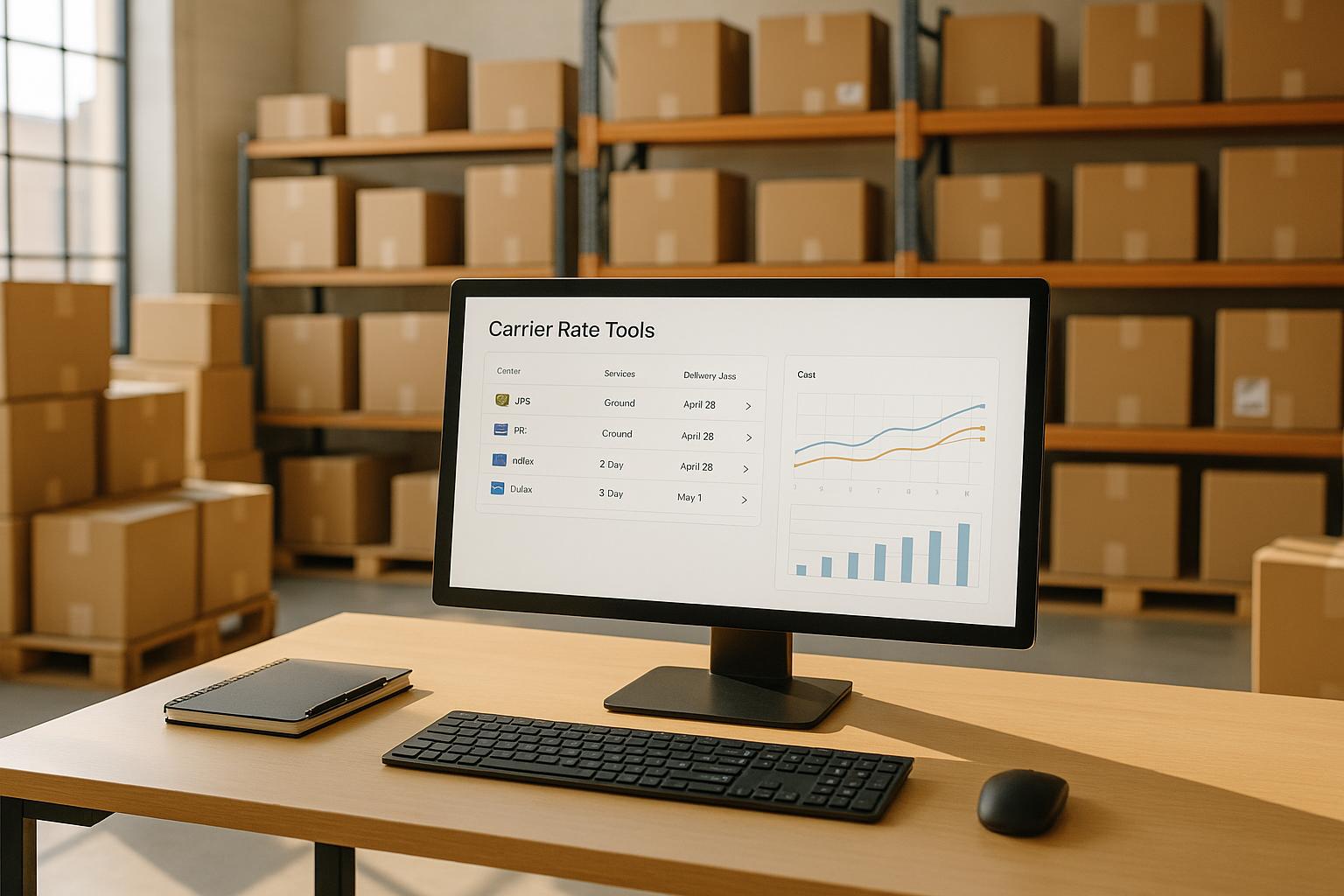
Carrier rate tools simplify shipping for eCommerce businesses by comparing live rates from carriers like USPS, UPS, FedEx, and DHL in one dashboard. Here's why they matter:
- Cost Savings: Automatically find the cheapest shipping option, saving up to 30% by leveraging discounts and commercial pricing.
- Efficiency: Automate tasks like label printing and carrier selection, cutting order processing times by up to 50%.
- Customer Satisfaction: Accurate shipping rates and delivery estimates reduce cart abandonment and build trust.
- Integration: Easily connect with platforms like Shopify, Amazon, and WooCommerce to streamline operations.
- Customization: Set rules to optimize carrier selection based on package weight, destination, or order value.
Main Benefits of Using Carrier Rate Tools
Cut Shipping Costs with Rate Comparisons
Carrier rate tools are a game-changer for businesses looking to save on shipping expenses. These tools automatically compare real-time rates from carriers like USPS, UPS, FedEx, and DHL, ensuring you find the most affordable option without the hassle of visiting each carrier's website individually [1][3][4].
Beyond just comparison, these tools often unlock access to commercial pricing and exclusive discounts typically reserved for high-volume shippers. For example, Stamps.com offers discounts on USPS and UPS rates, helping smaller businesses compete with larger players [4]. By consistently choosing the lowest rates and leveraging these discounts, businesses can slash shipping costs by as much as 30% [1][4]. For lightweight packages, the tool might recommend USPS, while heavier shipments could be routed through UPS or FedEx for better savings [4].
One mid-sized online retailer using ShipperHQ shared how they saved significantly by automatically presenting customers with the most cost-effective shipping options during checkout [3]. This streamlined rate selection not only saves money but also speeds up shipping decisions, making the entire process more efficient.
Make Informed Decisions with Live Rate Data
Carrier rate tools provide up-to-the-minute shipping rates, delivery times, and service options, eliminating the risks of relying on outdated information or guesswork [1][4][5]. This accuracy helps businesses avoid unexpected surcharges that can erode profits.
These tools use advanced algorithms to process a wide range of shipping options in mere milliseconds, ensuring no delays in order processing. Customers benefit too - seeing accurate shipping costs and delivery estimates at checkout builds trust and encourages them to complete their purchase [5]. For high-volume shippers, automated rate shopping and label printing can reduce order processing times by up to 50% [1][5].
The result? Faster decisions, happier customers, and a more efficient operation overall.
Seamless Integration with eCommerce Platforms
Carrier rate tools are designed to integrate effortlessly with popular eCommerce platforms like Shopify, Amazon, and WooCommerce [1][3][6]. These plug-and-play integrations or APIs sync directly with your existing setup, creating a unified shipping process that combines cost savings with data accuracy.
Once integrated, the tools automatically import orders, calculate the best shipping options, and even print labels on demand. Solutions like ShipStation and ShipperHQ offer robust integrations that handle batch processing and apply automated shipping rules, making your workflow smoother [1][3]. By presenting fewer, low-cost shipping options at checkout, businesses can reduce customer confusion and speed up decision-making - boosting conversion rates by as much as 20% [3].
For those concerned about upfront costs, Onramp Funds (https://onrampfunds.com) provides equity-free financing tailored to help businesses adopt these tools, enabling growth without straining cash flow. This support makes it easier to implement shipping optimization and scale operations effectively.
How to Set Up Carrier Rate Comparison Tools
Installing Carrier Rate Tools on Your eCommerce Platform
To get started, make sure you have active accounts and API access for major carriers like USPS, UPS, FedEx, or DHL. These accounts are essential for integrating carrier rate tools. Additionally, your eCommerce platform must support third-party shipping apps or plugins to enable seamless integration.
For platforms like Shopify, Amazon, and WooCommerce, the installation process is straightforward. If you're using Shopify, visit the Shopify App Store and search for a carrier rate tool like ShipStation or ShipperHQ. Once you find the right app, install it directly from the store and input your carrier account credentials or API keys during setup.
Amazon sellers need to follow a slightly different process. You'll need to use approved third-party shipping solutions that sync with your Seller Central account. This involves connecting your Amazon account to the shipping tool, which will then pull order data and manage fulfillment using your selected carriers.
For WooCommerce and similar platforms, you'll typically install a compatible plugin. The setup process involves entering your carrier credentials, and most tools provide detailed guides to walk you through each step. Even if you're not tech-savvy, these instructions make the process manageable. Once installed, configure the tool to ensure it calculates real-time shipping rates accurately.
Configuring Real-Time Shipping Rate Calculations
After installation, it's time to fine-tune the tool to provide real-time shipping rates. Start by inputting accurate package dimensions, weight, and shipping origin. These details are crucial since incorrect data can lead to inaccurate rate calculations.
The tool will use this information to update rates instantly as customers provide their delivery details during checkout. To avoid overwhelming your customers, create rules to display only the most relevant options, such as standard and expedited shipping. This streamlined checkout experience can reduce decision fatigue and improve conversion rates.
It's always a good idea to test your settings by placing sample orders with different destinations and package sizes. This helps ensure the rates align with current carrier pricing. Pay close attention to how the tool handles shipping zones, as rates can vary significantly between local, regional, and long-distance shipments.
Many tools also allow you to rename shipping methods for a more polished customer experience. For instance, instead of listing carrier-specific terms like "USPS Ground Advantage" or "UPS Ground", you can use simpler labels like "Standard Shipping" or "Express Delivery." This makes the checkout process clearer and more user-friendly.
Setting Up Shipping Rules to Lower Costs
Carrier rate tools can help automate and optimize your shipping strategy through customizable rules. These rules determine which carrier or service to use based on factors like package weight, order value, destination, or delivery speed.
For example, if USPS offers the best rates for packages under 4 lbs, you can create a rule that automatically selects USPS for those shipments. For heavier packages, the tool can switch to UPS or FedEx when their rates are more competitive.
You can also set rules based on order value. High-value orders might qualify for expedited shipping, while standard orders stick to the most cost-effective options. To control expenses, some businesses restrict overnight shipping to orders above a certain dollar amount, preventing customers from choosing high-cost options for low-value purchases.
If you’ve negotiated special rates with carriers for specific regions, you can program the tool to prioritize those carriers for eligible shipments. This ensures you maximize your savings without needing to manually adjust settings for each order.
For businesses looking to invest in shipping optimization tools, Onramp Funds (https://onrampfunds.com) offers equity-free financing. Their repayment model is tied to your sales performance, making it easier to adopt tools that improve shipping efficiency without straining your budget.
Best Practices for Reducing Shipping Costs
Review Historical Shipping Data
Take a close look at your past shipping data to uncover patterns that can help you save money. Analyzing just one month of data can reveal useful insights about average costs per order, shipping zones, package sizes, and how often surcharges occur[2].
Dive deeper than just your total spend - compare how different carriers perform on various routes. For instance, USPS might be a better choice for lightweight packages under 4 lbs, while UPS or FedEx could be more economical for heavier shipments. Many businesses also discover they’re spending unnecessarily on expedited shipping when standard ground services would work just as well, potentially saving thousands of dollars each year.
Don’t forget to evaluate your packaging choices. If oversized package fees are a recurring issue, it might be time to adjust your box sizes or consolidate shipments. By switching to appropriately sized packaging after reviewing your data, you can achieve noticeable savings. These insights are also invaluable for improving your negotiation and automation strategies.
Use Volume Discounts and Carrier Agreements
Once you’ve gathered solid shipping data, use it to negotiate better deals with carriers. Companies like USPS, UPS, and FedEx offer discounts based on shipping volume, but you’ll need to show consistent patterns to qualify for these savings.
Share details about your shipping volume, package sizes, and destinations during negotiations. For example, a mid-sized online retailer shipping over 500 packages per month was able to negotiate a custom rate with FedEx, cutting their shipping costs by 15% on average[4]. If direct negotiations aren’t an option, explore commercial pricing programs that offer discounted USPS and UPS rates.
Here’s a quick comparison of carrier discount options:
During negotiations, consider asking for custom rates based on your projected growth. Carriers are often willing to offer better deals to secure long-term commitments. Having historical data on hand also helps you set up automated systems for smarter decision-making.
Automate Carrier Selection with Business Rules
Manually choosing carriers for every shipment is time-consuming and often leads to higher costs. By automating carrier selection with preset business rules, you can ensure each package is shipped using the most cost-efficient option.
For example, create rules that automatically select USPS for lightweight packages and switch to FedEx for heavier ones. According to ShipperHQ, automation can save both time and money, especially since rising shipping costs are a growing concern for many businesses[3].
You can also refine these rules based on order value. High-value shipments could automatically qualify for expedited shipping with signature confirmation, while standard orders stick to the most economical methods. To keep your system effective, review and update these rules every quarter.
If you’re ready to take things to the next level, consider investing in advanced shipping optimization tools. For instance, Onramp Funds (https://onrampfunds.com) offers financing solutions tied to your sales performance, allowing you to adopt cost-saving technologies without putting extra strain on your cash flow.
sbb-itb-d7b5115
Conclusion
Key Takeaways
Carrier rate tools are a game-changer for cutting shipping costs and improving fulfillment efficiency. These automated systems provide real-time cost comparisons, ensuring you’re always getting the best deal on shipping[1][4].
The savings can add up fast. By automatically choosing the most cost-effective carrier - like using USPS for lightweight packages under 4 pounds and FedEx for heavier shipments - businesses can see significant reductions in monthly shipping expenses[4]. Plus, volume discounts and commercial pricing can stretch those savings even further.
But it’s not just about saving money. These tools also make fulfillment smoother. Features like batch order processing, automated label creation, and a simplified checkout process speed up operations and improve customer satisfaction. With automation in place, your team can handle more orders without adding extra labor costs - a recipe for sustainable growth.
To get the most out of these tools, dig into your shipping data regularly. Analyzing past shipping patterns, setting up automated carrier rules, and negotiating volume agreements can help you lock in the best rates consistently. This data-driven approach not only keeps you competitive in the U.S. market but also protects your profit margins. The savings you gain can be reinvested to fuel further growth.
How Onramp Funds Can Support Your Growth
On top of these savings, Onramp Funds offers a way to scale your shipping and operations without giving up equity. Implementing carrier rate comparison tools and other shipping technologies requires upfront investment, but the returns can be worth it. Onramp Funds provides flexible financing tailored for eCommerce businesses, letting you grow without straining your cash flow.
With Onramp Funds’ revenue-based financing, you can invest in essential tools now and repay as a percentage of your sales. This means you can start saving on shipping costs immediately while paying back the investment gradually and in a manageable way.
Whether you’re shipping 500 packages a month or 5,000, combining smart shipping tools with strategic financing lays a solid foundation for growth. By cutting shipping costs through automated rate comparisons and reinvesting those savings into your business, you can create a more profitable and competitive eCommerce operation.
BEST Shipping Rates Calculator for your Online Store in 2025
FAQs
How can carrier rate tools be integrated with eCommerce platforms like Shopify and Amazon, and what are the basic steps to set them up?
Carrier rate tools integrate effortlessly with eCommerce platforms like Shopify and Amazon, giving businesses the ability to compare shipping rates and cut down on costs. These tools typically connect through the platform’s app marketplace or via API integrations. This setup allows sellers to access real-time shipping rates and pick the most cost-effective option for each order.
Here’s how to get started:
- Choose a carrier rate tool that works with your eCommerce platform.
- Install or link the tool through the platform’s app store or API settings.
- Set up your shipping preferences, including carrier options, delivery speeds, and package sizes.
- Run a test to ensure rates are calculated correctly and everything runs smoothly.
By using carrier rate tools, you can simplify your shipping process, save money, and offer customers accurate and competitive delivery options.
How can carrier rate tools help eCommerce businesses save on shipping costs and secure better rates with carriers?
Carrier rate tools are a game-changer for cutting down shipping expenses. They let businesses compare rates from multiple carriers in real time, helping pinpoint the most budget-friendly options based on factors like package dimensions, weight, destination, and delivery speed. This way, businesses can make smarter choices and steer clear of unnecessary shipping costs.
On top of that, these tools offer data insights that can be a powerful bargaining chip. By analyzing shipping trends and volumes, businesses can approach carriers with a solid case for discounts or tailored pricing agreements. The result? Lower shipping costs and a boost to overall profitability.
How do carrier rate tools help reduce shipping costs and improve the checkout experience for customers?
Carrier rate tools give eCommerce businesses the ability to compare shipping rates from various carriers in real time. This helps them choose shipping options that are both cost-effective and efficient. By providing competitive shipping rates and quicker delivery options, businesses can improve customer satisfaction and lower the chances of cart abandonment at checkout.
These tools also simplify the order fulfillment process by integrating with eCommerce platforms to automate tasks like generating shipping labels and updating tracking information. This not only saves time but also minimizes errors. For businesses aiming to grow, these tools are essential for keeping costs under control while ensuring a smooth and reliable customer experience.
Related Blog Posts
Onramp Funds
Funding built around your sales
Connect your store and see what you qualify for. Repay as a percentage of sales, with no personal credit check.
Funding in as little as 24 hours.
