

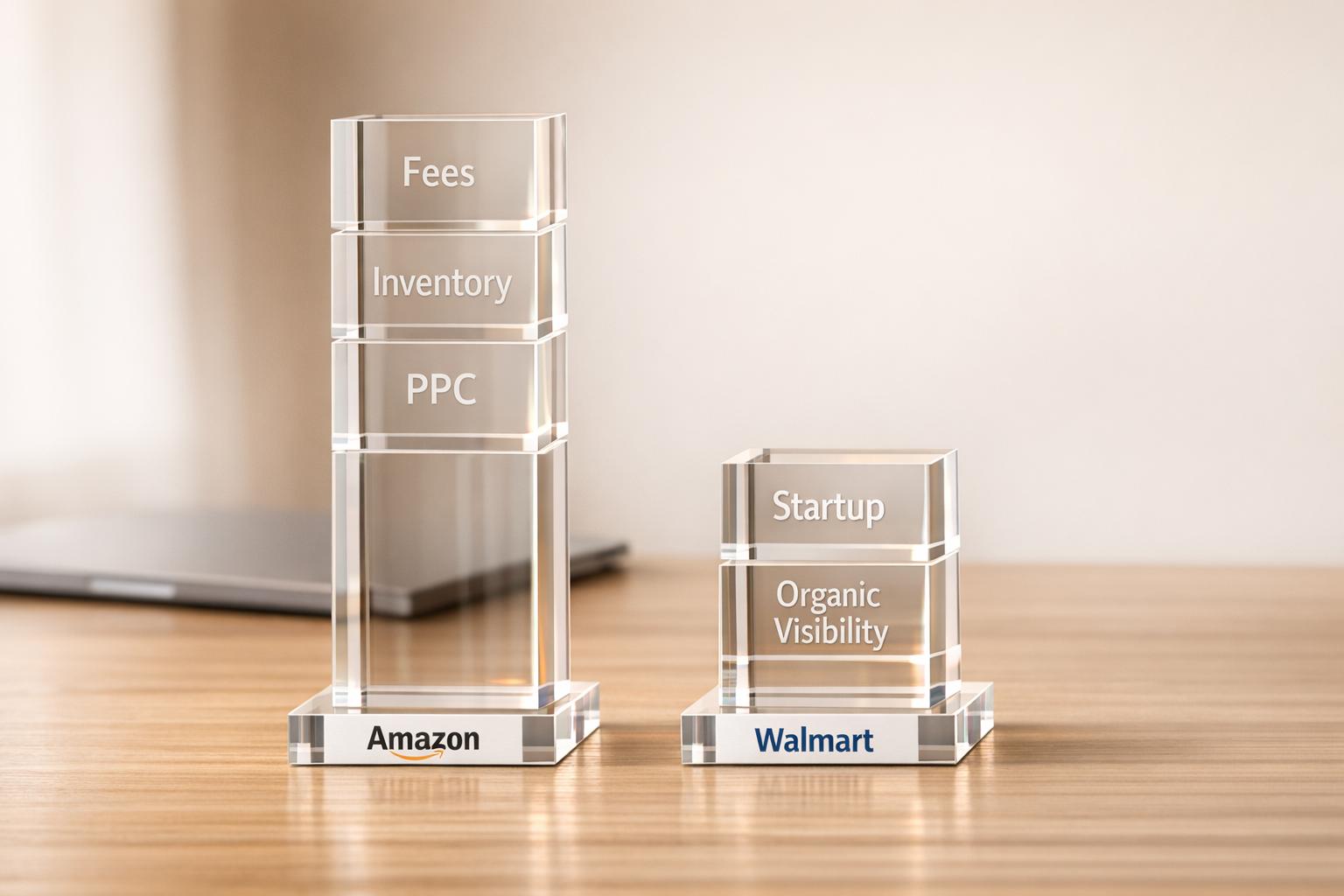
Selling on Amazon or Walmart requires different financial strategies. Here's the key takeaway: Amazon demands more upfront capital due to fees, advertising, and inventory costs, while Walmart offers a more budget-friendly entry with no monthly fees and simpler cost structures.
- Amazon:
- Monthly fee: $39.99 (Professional plan).
- Higher competition (9.7M sellers).
- Payment every 14 days.
- Complex fee structure with referral fees (8%-15%) and storage costs ($0.78–$2.40/cu ft).
- Heavy reliance on PPC ads (20%-40% of revenue).
- Walmart:
- No monthly fee.
- Lower competition (~150K sellers).
- Payment every 14 days.
- Referral fees (6%-15%) and storage costs at $0.75/cu ft (off-peak).
- Easier organic visibility with less ad spend.
Quick Comparison:
Bottom Line:
If you're starting with limited funds, Walmart’s lower costs make it a safer choice. For sellers with more resources, Amazon’s larger audience offers higher growth potential. Many sellers balance both platforms to diversify revenue and manage risks.

1. Amazon Sellers
Fee Structure
Selling on Amazon comes with a complex fee system that can significantly cut into profits. For starters, the Professional plan costs $39.99 per month, while the Individual plan charges $0.99 per item if you sell fewer than 40 units monthly [5]. On top of that, Amazon takes referral fees - usually between 8% and 15% of the sale price [5]. If you're using Fulfillment by Amazon (FBA), fees depend on your product's size and weight, with additional charges for storing slow-moving inventory. Advertising costs, particularly for pay-per-click (PPC) campaigns, often consume 20–40% of revenue. When you add it all up - subscription fees, referral percentages, fulfillment charges, storage costs, and advertising spend - a $10 item might leave you with just $6 to $7 in profit [5].
And that's not all. Amazon's payment schedule creates additional financial strain.
Cash Flow Cycles
Amazon's payment system can make managing cash flow tricky. Sellers only get paid every 14 days after fulfilling orders [5]. Meanwhile, suppliers often require payment 30 to 90 days in advance, leaving sellers waiting months to see a return on their investment. As Onramp Funds put it:
"As access to cash is essentially held hostage every two weeks, Amazon sellers cannot operate at the real-time speeds eCommerce demands." – Onramp Funds [9]
FBA adds another layer of complexity. Inventory must be shipped to Amazon warehouses ahead of time, where it racks up storage fees until sold. This setup makes it crucial for sellers to have strong financing strategies to bridge the gap between paying suppliers and receiving revenue. It's worth noting that about 73% of Amazon sellers use FBA, making these challenges widespread [9].
These cash flow issues also ripple into inventory management, which has its own set of hurdles.
Inventory Management
While FBA takes care of logistics, it imposes strict inventory limits and performance standards. Sellers need to forecast demand accurately - stockouts can hurt rankings, while excess inventory leads to hefty storage fees [9]. Amazon may also penalize sellers for low inventory levels. One seller, for instance, faced $5,000 in monthly storage fees due to holiday overstock. By adopting demand forecasting tools, they cut excess inventory by 40%, shortened their cash-to-cash cycle from 90 to 45 days, and freed up $20,000 in working capital [8].
Break-Even Timelines
Break-even timelines vary based on fees and inventory turnover. For fast-selling items, sellers may break even in 2–4 weeks, while slower-moving products often take 30–90 days [5]. With fees typically eating up about 30% of revenue and advertising costs taking another 20–40%, sellers generally need their inventory to turn over four to six times a year to maintain healthy cash flow. Top-performing sellers manage to break even in about 45 days, but others may not reach that point until 75 days or more [5].
sbb-itb-d7b5115
2. Walmart Sellers
Fee Structure
Walmart Marketplace offers a seller-friendly fee structure that stands out by not requiring a monthly subscription fee. This is a big contrast to Amazon's $39.99 Professional plan, allowing sellers to allocate those funds toward inventory or product testing instead [10][11]. Referral fees range from 6% to 15%, but certain categories, like jewelry, can reach as high as 20% for items under $250. For jewelry priced above $250, the referral fee drops to 5%, encouraging sellers to focus on higher-priced items [11].
Walmart Fulfillment Services (WFS) also provides cost advantages, being approximately 15% cheaper than other fulfillment options. Standard fulfillment starts at $3.45 per unit, and storage fees are $0.75 per cubic foot during off-peak months. However, during the busy October–December period, storage fees jump to $2.25 per cubic foot for inventory held over 30 days [10][11]. Additionally, new sellers benefit from a 75% discount on referral fees during their first 90 days, which can significantly reduce the financial burden of starting out [10].
Cash Flow Cycles
Walmart's fee structure plays a key role in shaping cash flow cycles for sellers. The platform operates on a payout schedule of up to 14 days [2]. Since suppliers often require payment 30 to 90 days upfront, Walmart Marketplace Capital offers in-house financing to bridge this gap. These financing terms are based on historical sales rather than current performance. However, during slower sales periods, automatic deductions from the seller's bank account can tighten cash flow [1].
For lenders, the focus shifts to factors like "revenue quality" and fulfillment reliability, with a preference for sellers utilizing WFS. This is because WFS ensures smoother order fulfillment and delivery consistency [13]. That said, Walmart's internal financing evaluates performance strictly on its own platform, which might limit funding options for sellers with diversified revenue streams across platforms like Amazon or Shopify [1].
Inventory Management
Effective inventory management is essential to fully leverage Walmart's fee and financing benefits. Using WFS not only simplifies fulfillment but also boosts a seller’s credibility with lenders, as it reduces shipping risks and enhances delivery reliability [13]. Diversifying inventory across several SKUs instead of relying on a single product can also provide more stable revenue and improve financial planning [13]. Tools like the Walmart Seller Center's Catalog Dashboard help sellers identify trending products, making it easier to test new items with minimal risk [1][12].
Managing inventory during Q4 is particularly critical. Retailers often see 20% of their annual sales during the four weeks between Thanksgiving and Christmas [12]. To avoid the $2.25 per cubic foot storage surcharge, it's important to time inventory arrivals so that stock turns over within 30 days during the busy holiday season [11]. Lenders also keep an eye on operational metrics like refund rates, cancellations, and stockouts, as these can indicate potential issues with stability [13].
Break-Even Timelines
Walmart sellers often achieve break-even faster, thanks to the absence of subscription fees and the 75% referral fee discount during the first 90 days [10]. Fast-moving inventory can further speed up this process, while slower-selling products may take longer to offset initial investments. Key factors like category-specific fees and storage costs also influence the timeline. Sellers can cut fulfillment costs by optimizing packaging to reduce dimensional weight, which helps control expenses [11]. These strategies, combined with Walmart's fee structure, create opportunities for quicker profitability.
Pros and Cons of Selling on Walmart vs Amazon (Full Comparison)
Pros and Cons
When comparing Amazon and Walmart, their differences in fees, cash flow cycles, and inventory management create unique capital requirements for sellers. Amazon offers access to a massive global audience of over 300 million customers [7]. However, its $39.99/month Professional plan and seasonal storage fees - ranging from $0.78 to $2.40 per cubic foot - can lead to significant fixed and variable costs. These expenses may challenge sellers with limited working capital, especially those testing new products or operating at smaller scales [4].
In contrast, Walmart doesn’t charge monthly fees, which can save sellers around $480 annually. Its consistent storage costs of $0.75 per cubic foot year-round also provide more predictable expenses [4]. With a smaller seller base of about 150,000–160,000 active sellers (compared to Amazon's 9.7 million worldwide), Walmart often requires less advertising to achieve organic visibility. These factors make Walmart a more budget-friendly option for certain sellers.
The platforms also differ in growth potential and fulfillment systems. Amazon’s robust Fulfillment by Amazon (FBA) network supports fast shipping and Prime eligibility, which can boost inventory turnover and improve cash flow. On the other hand, Walmart’s more selective application process and U.S.-focused customer base may limit revenue potential but offer steadier profitability. Walmart Fulfillment Services, while improving, still lacks the scale and efficiency of FBA, leaving some sellers to manage logistics on their own [3].
For sellers with tighter budgets, Walmart’s lack of subscription fees and its 2025 New-Seller Savings program - which cuts referral fees by up to 75% (capped at $75,000 in savings) - provide a lower-risk way to enter the market [4]. On the flip side, established brands with more resources may find Amazon’s larger audience worth the higher costs. Many successful sellers choose to operate on both platforms, balancing Walmart’s cost savings with Amazon’s expansive reach to diversify revenue streams and maximize profitability.
Conclusion
Choosing the right marketplace strategy is all about aligning your approach with your resources and goals. Deciding between Amazon and Walmart largely depends on your capital and business priorities. For sellers with tighter budgets, Walmart's no-monthly fee structure and lower advertising costs offer a more accessible entry point. With only about 160,000 sellers on Walmart compared to Amazon’s 2 million-plus active sellers, gaining organic visibility on Walmart is often easier and less reliant on PPC campaigns [6][14]. As Zlata Golubeva points out:
"Walmart often has lower fulfillment fees and no monthly subscription fees, making it more cost-effective for testing products and maximizing margins" [6].
On the other hand, sellers with more capital to invest may benefit from Amazon’s broader reach. The platform’s massive customer base, advanced FBA infrastructure, sophisticated advertising tools, and Prime eligibility can justify its higher costs by enabling faster growth.
A hybrid approach can be particularly effective. Leveraging both platforms allows you to diversify revenue streams and optimize your investment. For instance, you can use Walmart to test new products at a lower risk, then scale successful ones on Amazon to tap into its larger audience. Just be mindful of pricing consistency - Walmart may suppress your listings if they find lower prices for your products on other platforms [15].
FAQs
How much startup cash do I need for Amazon vs. Walmart?
The initial investment to start selling on Amazon or Walmart varies based on factors like platform fees, inventory, and marketing. For Amazon, you'll need to account for a $39.99 monthly subscription fee, referral fees ranging from 8% to 15%, and fulfillment expenses, which can quickly add up. On the other hand, Walmart doesn’t charge a subscription fee, has comparable referral fees, and typically offers lower fulfillment costs.
Overall, startup budgets can range from a few thousand dollars to tens of thousands. However, Walmart often requires slightly less upfront investment because of its lower fee structure.
How do I cover inventory costs during the 14-day payout delay?
Managing inventory costs during Walmart's 14-day payout delay can be challenging, but there are practical ways to navigate this. One option is to explore financing solutions tailored for eCommerce sellers. For instance, Onramp Funds offers revenue-based financing, which helps bridge cash flow gaps and ensures you can purchase inventory on time.
Another smart move is to plan ahead by forecasting your sales and setting aside reserves. This proactive approach can help you stay prepared for any cash flow hiccups. Additionally, Walmart sellers have access to Walmart's own in-house financing options or can turn to third-party lenders for quick funding. Both options can help keep your operations running smoothly, even during payout delays.
When should I sell on both Amazon and Walmart?
Selling on both Amazon and Walmart works best when your business has consistent sales, dependable inventory management, and the capacity to meet each platform's unique requirements. Amazon is a great fit for high-volume sellers with well-established branding, while Walmart provides a less saturated marketplace and quicker payout timelines. By effectively navigating the differences in cash flow cycles and fee structures between the two, you can expand your revenue streams, connect with a broader audience, and create opportunities for steady growth.
Related Blog Posts
Onramp Funds
Funding built around your sales
Connect your store and see what you qualify for. Repay as a percentage of sales, with no personal credit check.
Funding in as little as 24 hours.
