

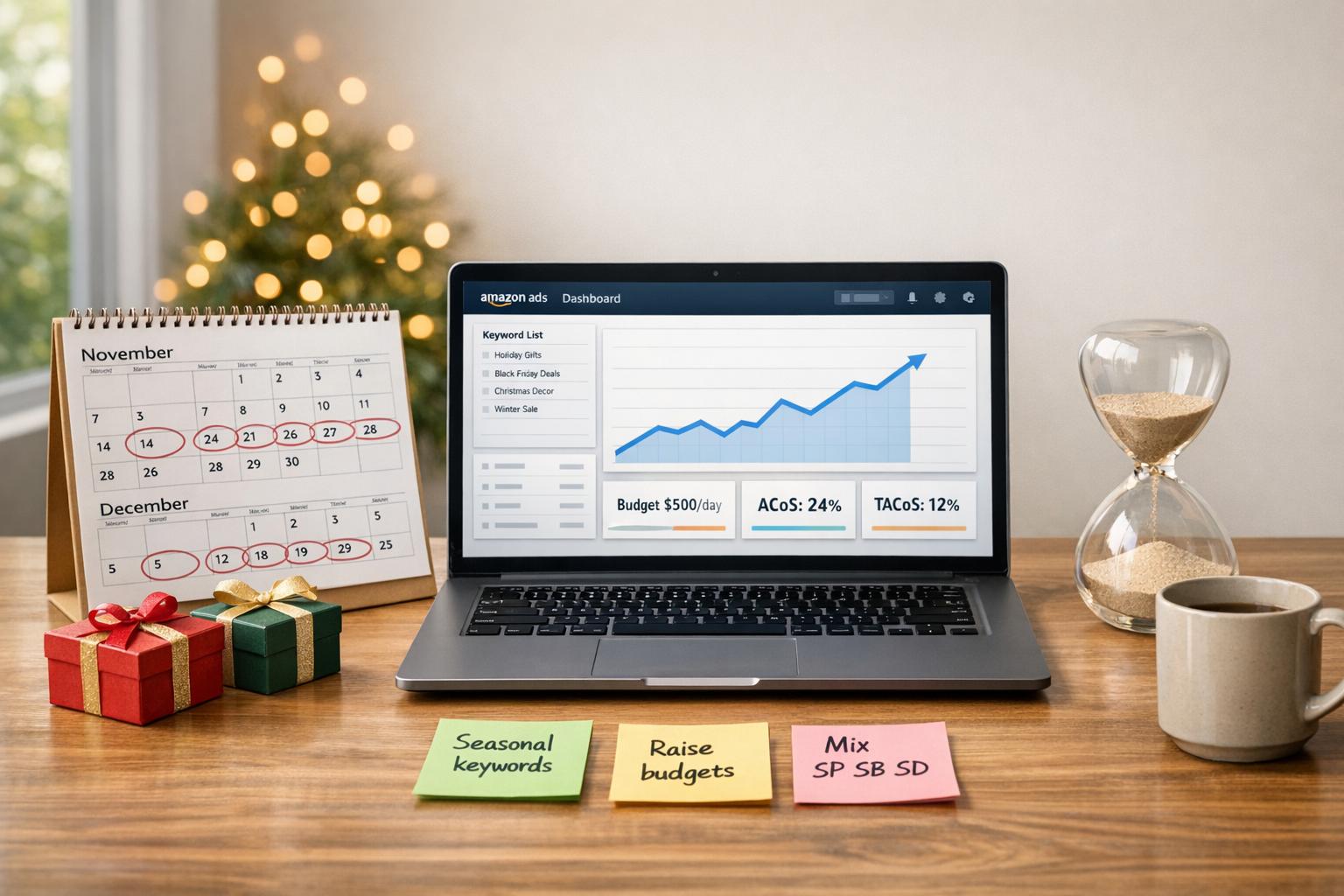
The holiday season is the busiest time for Amazon sellers, with increased traffic and higher conversion rates. To maximize sales, it's essential to prepare campaigns early, focus on holiday-specific keywords, and adjust bidding strategies. Here's what you need to know:
- Start Early: Launch campaigns 6–8 weeks before Black Friday to build performance history and gather data for optimization.
- Keyword Strategy: Use seasonal phrases like “Christmas gifts” and combine them with evergreen terms for broader reach.
- Bidding Adjustments: Leverage dynamic bidding options to capture high-intent shoppers and stay competitive.
- Budget Increases: Boost daily budgets by 20–50% to handle traffic spikes, especially during peak days like Black Friday.
- Promotions: Pair ads with coupons, Lightning Deals, or 7-Day Deals to attract price-conscious buyers.
- Ad Formats: Use a mix of Sponsored Products, Brands, and Display ads for better visibility and engagement.
- Track Metrics: Monitor ACoS and TACoS daily and adjust campaigns based on performance data.
Preparing Sponsored Product Campaigns in Advance
Start Early and Build Data
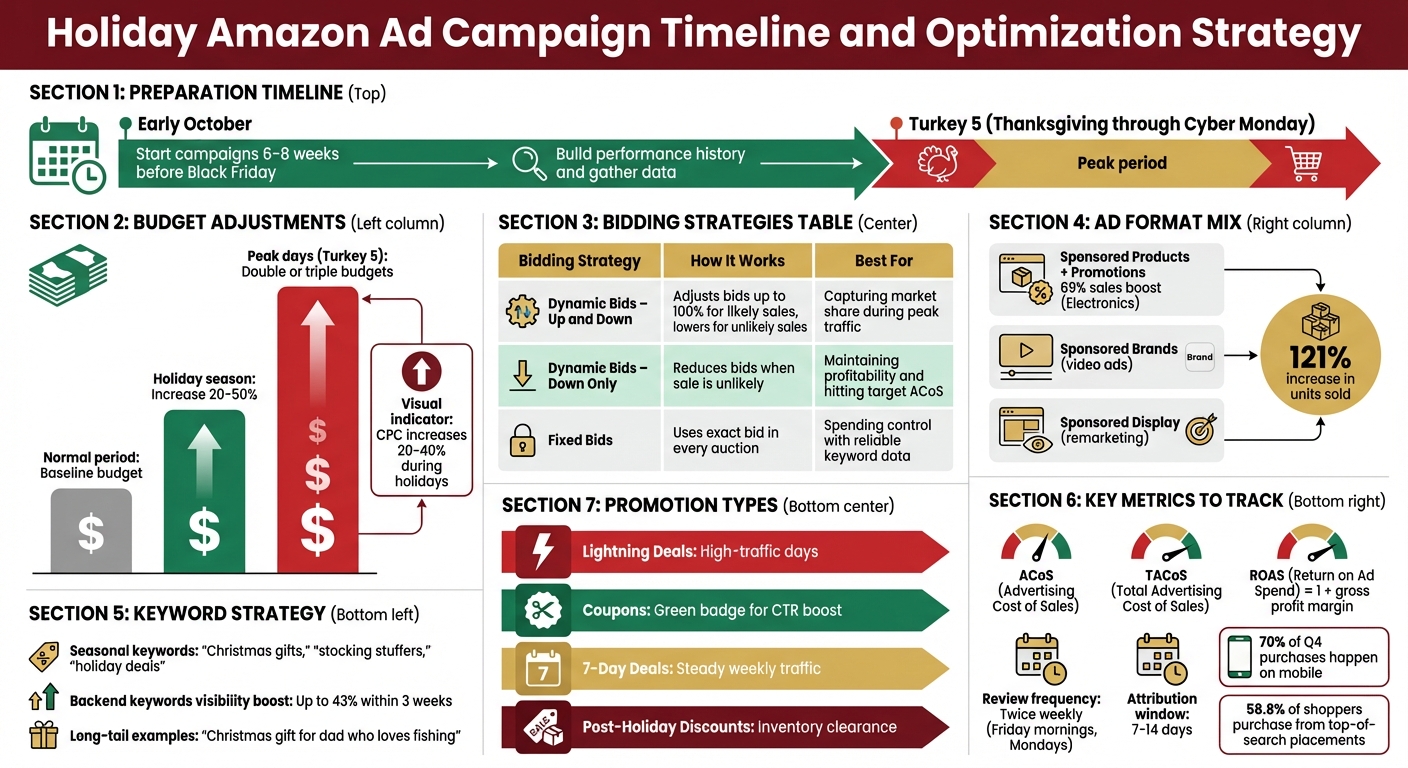
To get the best results from your holiday campaigns, start them 6–8 weeks before Black Friday. Why so early? Amazon's algorithm rewards ads with a performance history, and this early start helps establish a strong relevancy score. It also gives your campaigns time to identify the keywords that drive conversions[8][12]. By starting ahead of the rush, you’ll be in a better position than sellers who wait until the last minute.
"Begin planning and optimizing your campaigns well before the holiday season. Early preparation avoids last-minute issues and captures early customers."
- Joie Roberts, Amazon Seller and Coach [10]
Launching campaigns in early October also allows you to run top-of-funnel awareness ads. These ads help build retargeting pools, so you’re ready to engage high-intent shoppers in November[9]. Plus, early preparation ensures your ads are visible when it counts, as bid adjustments can take weeks to impact rankings[11].
Once you’ve gathered performance data, you can fine-tune your bidding strategies to make the most of the holiday traffic.
Adjust Bidding Strategies
Your bidding strategy should align with your goals for the holiday season. Amazon offers three main bidding options, each suited to different needs:
- Dynamic Bids – Up and Down: Amazon increases your bids by up to 100% when a sale seems likely, making it a great choice for capturing market share during high-traffic periods[4][9].
- Dynamic Bids – Down Only: This option lowers your bids when a sale is less likely, helping you stay within your target ACoS if profitability is your main focus[9].
- Fixed Bids: With this approach, Amazon sticks to your exact bid in every auction. It’s ideal when you have strong keyword data and need predictable ad spend.
Here’s a quick breakdown:
Getting your bids right is key, but don’t forget about your budgets - you’ll need to adjust those too.
Increase Budgets to Handle Traffic Spikes
Holiday shopping brings a surge in traffic, so increasing your daily ad budgets is essential. Francisco Valadez, VP of Brand Operations at My Amazon Guy, highlights the importance of this:
"If your daily ad budgets aren't increased two to three times their normal amount, your campaigns risk running out of funds by midday, missing the highest-converting hours."
[9]
As a rule of thumb, bump up your daily budgets by 20–50% during the holidays. For peak shopping days like the "Turkey 5" (Thanksgiving through Cyber Monday), consider doubling or even tripling your budgets[13][9].
To avoid depleting your funds too quickly, allocate separate budgets for specific holiday events. This ensures your ads stay active during the most crucial hours - like evenings and weekends - so you don’t miss out on valuable sales by running out of funds before the day is over.
sbb-itb-d7b5115
3 Amazon Advertising Strategies to Maximize Holiday Sales (2026 Guide)
Conducting Holiday-Specific Keyword Research
Fine-tuning your Sponsored Products with holiday-focused keywords ensures your ad budget connects with shoppers who are ready to buy. To stand out during the holiday season, aligning your keywords with seasonal search trends can make all the difference.
Use Seasonal Keywords
Holiday shoppers don’t search the same way they do the rest of the year. Instead of looking for "wireless earbuds", they’re more likely to search for phrases like "Christmas gifts for teens under $30" or "best holiday gift for dog lovers" [16].
Start by reviewing your past Q4 Brand Analytics to find high-performing seasonal keywords [11][16]. Use terms like "Christmas gifts", "stocking stuffers", "Hanukkah", and "holiday deals" in your backend search terms field. This field, capped at 250 bytes (spaces excluded), is ideal for adding synonyms, common misspellings, and seasonal variations without overloading your product title [15][16].
Sellers who make full use of backend keywords often see visibility jump by up to 43% within three weeks [16]. For example, if you sell power drills, combine core terms like "power drill" with holiday-specific phrases such as "gifts for dads who love DIY" or "holiday home improvement gifts."
Use Reverse ASIN Tools
Your competitors are already targeting valuable holiday keywords - you just need to uncover them. Reverse ASIN tools like Helium 10's Cerebro or Jungle Scout allow you to analyze the keywords your top competitors are ranking for [15][16].
Focus on gift-intent terms and long-tail phrases that show up repeatedly. Francisco Valadez, VP of Brand Operations at My Amazon Guy, highlights why these searches matter:
"The biggest conversion opportunities often come from long-tail searches like 'Christmas gift for dad who loves fishing.' While these keywords have lower volume, they capture precise buyer intent." [16]
To discover new seasonal search queries, start with automatic targeting campaigns early in the season. Once you identify high-performing terms, shift them into manual campaigns with precise bid adjustments [2][15]. This strategy helped the Japanese men's cosmetics brand NULL boost year-over-year sales by 1.7x between 2023 and 2024 by transitioning successful seasonal keywords from automatic to exact match campaigns [2].
Blend Year-Round and Seasonal Keywords
Don’t ditch your evergreen keywords during the holidays - combine them with seasonal terms to expand your reach. Separate campaigns for seasonal items (like Christmas ornaments) and year-round products (like table lamps) will give you better control over budgets and bidding [2].
For everyday products, use broad match for high-traffic seasonal terms like "holiday home decor" to attract shoppers in the awareness stage. Then, use exact match for evergreen products like "power tool gift sets" to target buyers with specific intent while keeping costs in check [2].
Optimizing Ad Copy and Targeting for Holiday Shoppers
Once you've nailed down your keywords and bidding strategies, the next step is turning those efforts into actual conversions. This is where your ad copy and targeting come into play. During the holidays, shoppers aren't just looking for products - they're hunting for gifts. Your ads need to reflect that mindset shift and highlight promotions that resonate with their seasonal needs.
Highlight Promotions in Ad Creatives
Holiday shoppers are drawn to savings like moths to a flame. For example, electronics with deals and coupons promoted via Sponsored Products saw a 69% sales boost [2]. The trick? Make those promotions stand out.
Use Responsive eCommerce Creatives (REC) to automatically showcase strike-through pricing and deal badges like "Lightning Deal" directly from your product pages [6]. This not only ensures accurate pricing but also keeps you compliant with platform rules. If you're advertising discounts like "up to 50% off", make sure at least 10% of the featured items actually offer that maximum discount [6].
For Sponsored Brands video ads, keep them short - 15 to 30 seconds is ideal - and focus on showing the product in action. A great example: "One holiday dress, three festive occasions." This helps shoppers imagine how they can use the product during the season [6][2]. Also, consider promoting multi-packs or bundles, as these offer better value and appeal to budget-conscious buyers [3].
While eye-catching creatives grab attention, effective targeting ensures those ads land in front of the right audience.
Target Holiday Audiences Effectively
During the holidays, top-of-search placements are gold. This is where 58.8% of U.S. shoppers are most likely to make purchases [1]. Allocate your budget here for maximum impact.
Use dynamic bidding to stay competitive during peak shopping hours without the hassle of constant manual adjustments. Additionally, broaden your reach by targeting related interests. For instance, if you sell blenders, consider targeting keywords like "kitchen mixer" or "meal prep tools" to connect with gift-seekers browsing similar products [3]. Advertisers who combined Sponsored Products, Sponsored Brands, and Sponsored Display ads saw a 121% increase in units sold during peak holiday events compared to average category growth [3].
Create Holiday-Themed Product Messaging
To truly engage holiday shoppers, tweak your product messaging to reflect the festive spirit. Simple changes can make a big difference. Instead of "Daily hydration", try "Gift-worthy glow." For home goods, swap generic descriptions for phrases like "Create holiday ambiance, anytime" [2][3]. This approach helps shoppers see your product as a thoughtful gift rather than just an everyday item.
Don’t forget about your Brand Store. Add seasonal features like "Gifts by Price" or "Gifts for Him/Her" to streamline the shopping experience [3]. Brand Stores updated within the last 90 days saw 10% higher attributed sales per visitor and a 9% increase in repeat visitors [5]. For Sponsored Brands video ads, consider showing the product being unboxed or presented as a gift to help shoppers imagine the gifting experience [17].
Lastly, make sure all ad text and video captions are easy to read on mobile devices, and that any pricing or savings claims match what’s on your landing page [6].
Using Promotions and Diversifying Ad Types
Once you've fine-tuned your ad copy and targeted campaigns, it's time to take things up a notch by diversifying your ad formats and integrating promotions. Why? Because running ads without promotions during the holidays means leaving money on the table. Pairing Sponsored Products with tools like coupons or Lightning Deals can make your ads stand out with attention-grabbing deal badges - think green badges or strike-through pricing that pop in crowded search results [6][18]. And the numbers back it up: In the Electronics category, combining Sponsored Products with promotions led to a 69% jump in sales and a 79% increase in units sold compared to ads without promotions [2].
Combine Sponsored Products with Promotions
Every promotion type has its moment to shine. Here's how they work:
- Lightning Deals: Perfect for high-traffic days like Black Friday, these deals create urgency with their time limits and get premium placement on Amazon's Deals page.
- Coupons: That green badge is a magnet for budget-conscious shoppers, making coupons an excellent tool for boosting click-through rates on search pages.
- 7-Day Deals: Need steady traffic throughout the week? These deals provide consistent visibility.
- Post-Holiday Discounts: After the holiday rush, these help clear out inventory while attracting gift card holders.
For display ads, consider using Responsive eCommerce Creatives (REC). These automatically pull in strike-through pricing and deal badges directly from your product pages, saving time and ensuring your ads stay visually appealing [18].
Add Sponsored Brands and Sponsored Display Ads
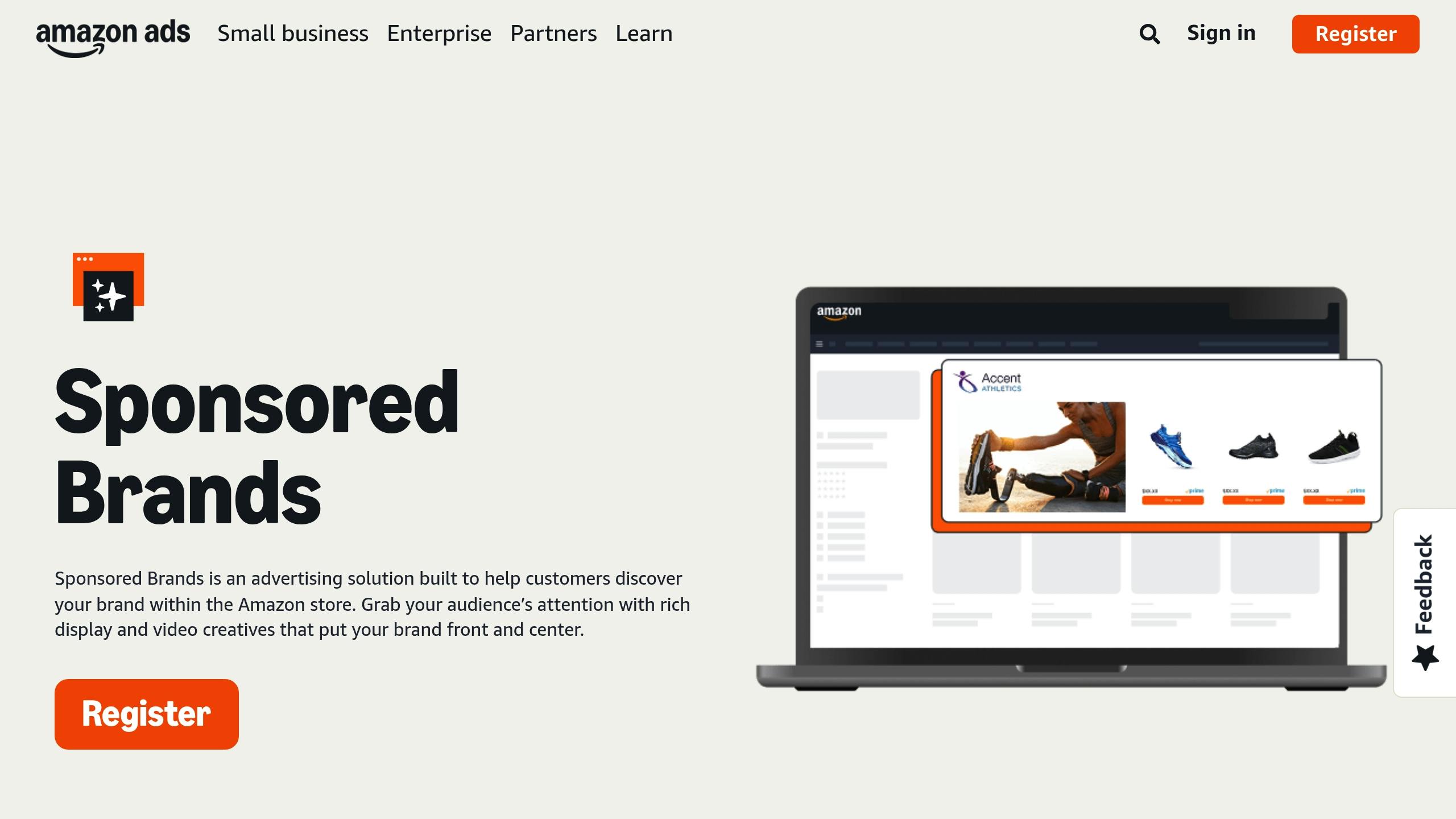
Relying solely on Sponsored Products might not cut it during peak holiday shopping. Here's why: On major deal days, the cost-per-click for Sponsored Products can spike by 11%, while other formats like Sponsored Brands and Sponsored Display ads see only a 5% increase [19]. As Joe Shelerud, CEO & Co-Founder of Ad Advance, puts it:
"Holiday shopping is a marathon relay - and to win it, you need a team. Sponsored Products are a strong anchor, but it may need a full lineup of ad solutions to make the handoffs that move shoppers from discovery to purchase" [5].
To build a well-rounded campaign, supplement your Sponsored Products with:
- Sponsored Brands Videos: These help build awareness. Just make sure your videos work without sound, as many mobile shoppers browse with their audio off [6].
- Sponsored Display Ads: Great for remarketing! Use these to re-engage shoppers who showed interest but didn’t complete a purchase [5][19].
The payoff? Advertisers who used all three formats - Sponsored Products, Sponsored Brands, and Sponsored Display - saw a 121% increase in units sold during peak holiday events [3].
Structure Campaigns for Better Control
To navigate the holiday rush effectively, structure your campaigns with precision. Instead of bundling everything into one campaign, break them down by intent:
- Defensive Campaigns: Protect your brand terms.
- Category Campaigns: Target broad, non-branded keywords.
- Product Targeting Campaigns: Focus on competitor pages.
- Holiday-Specific Campaigns: Use seasonal terms like "stocking stuffers" or "gifts under $50" [8].
This structure gives you better control over your budget, especially when ad costs can spike by 20% to 40% during peak season [8].
Lastly, concentrate your spending where it counts. Typically, 20% of your products generate 80% of your revenue, so focus your holiday budget on these top performers rather than spreading it across your entire catalog [8]. For your Brand Store, place the Featured Deals Widget at the very top. Stores updated within the past 90 days see 9% more repeat visitors and 10% higher attributed sales per visitor [5][18]. Linking your Sponsored Brands ads directly to these curated Store pages ensures shoppers land where your best deals are front and center.
Tracking and Adjusting Performance Metrics
Once you've optimized your ad content and targeting, the next step is to stay on top of performance tracking and make adjustments as needed. Running campaigns without monitoring key metrics can lead to unnecessary spending. During peak shopping seasons, cost-per-click (CPC) rates can jump by 2–3x compared to earlier quarters [13], making daily tracking a must to protect your budget and improve returns.
Keep an Eye on Key Metrics Daily
Start by calculating your break-even ROAS (Return on Ad Spend). This is as simple as dividing 1 by your gross profit margin. If your campaign ROAS is above this figure, you're turning a profit - even if your Advertising Cost of Sales (ACoS) seems high [20]. Alongside ACoS, monitor Total Advertising Cost of Sales (TACOS) for a broader view. As Adam Mellott from BTR Media points out:
"ACOS is just one piece of the profitability puzzle... When ACOS rises during high-traffic events, we don't immediately pull back. Instead, we look at TACOS - and often, we find it dropping." [5]
For best results, review campaigns twice a week - Friday mornings and Mondays are ideal. Track metrics like impressions, clicks, conversions, and click-through rates (CTR), but keep in mind that sales often occur 7–14 days after the initial click [5]. Use automated rules to adjust bids only after confirming a sustained ACoS increase over a 7–14 day period [5].
Dig Into Post-Holiday Data
January is the time to assess and refine your strategy. Download search term reports to pinpoint the keywords that drove conversions. Move top-performing terms from broad or phrase match into exact match campaigns to boost efficiency and cut costs [14][21]. On the flip side, seasonal terms like "stocking stuffer" should be added to your negative keyword list immediately after the holiday season to avoid wasting your budget.
Take a closer look at performance at the product level. Identify standout SKUs with growing conversion rates and create dedicated campaigns with protected budgets for these products [14]. Regularly removing underperforming search terms after the holidays can reduce wasted ad spend by 15% to 25% while improving conversion rates [14]. Also, adjust your bids - CPCs in Q4 are typically 20% to 40% higher than usual [14], so scaling them down in January is key to avoiding overspending as traffic returns to normal levels.
Expand with Flexible Funding
Scaling your ad budget during the holiday peak often requires quick access to capital, and traditional financing options can be too slow. Onramp Funds (https://onrampfunds.com) offers fast, equity-free financing tailored for eCommerce sellers on platforms like Amazon. With funds available in as little as 24 hours and repayment tied to a percentage of your sales, payments automatically adjust with your revenue.
This revenue-based financing model lets you invest confidently in high-performing campaigns during the holiday season without worrying about fixed monthly payments. With clear fees ranging from 2–8% and no hidden costs, you can accurately project the cost of scaling. Supported by a team based in Austin, Onramp Funds provides personalized guidance, helping you allocate capital strategically - whether that means boosting daily budgets on successful campaigns or venturing into Sponsored Brands and Sponsored Display ads to capture additional market share. By combining these strategies with flexible funding, you can maintain strong campaign performance both during and after the holiday rush.
Conclusion
To thrive during the holiday season, preparation, smart targeting, and close performance monitoring are key. Begin your campaigns 6–8 weeks ahead to gather historical data for optimization [8]. Allocate at least 50% more budget to high-performing campaigns, and use dynamic bidding to increase bids by up to 100% on placements that convert well [4][7]. Mix year-round keywords with seasonal phrases like "stocking stuffers" and "gifts for her" to attract both regular shoppers and holiday buyers [8][11].
Your ad creative is just as important as your targeting. Highlight promotions, update holiday-inspired A+ content, and ensure your ads are mobile-friendly - especially since 70% of Q4 purchases happen on mobile devices [8]. A full-funnel approach using Sponsored Products, Sponsored Brands, and Sponsored Display ads ensures you engage shoppers at every stage [1]. These strategies set you up for effective performance tracking.
Once your campaigns are live, monitor ACoS and TACoS daily to catch cost increases early, as CPCs tend to rise by 20% to 40% during the holidays [14]. After the season, move your top-performing keywords into exact match campaigns for continued success [14].
To support these efforts, having flexible funding can make all the difference. Onramp Funds (https://onrampfunds.com) provides fast, equity-free financing with repayments tied to your sales. With funds accessible in as little as 24 hours and fees ranging from 2–8%, you can invest in your best-performing campaigns without the burden of fixed monthly payments. By combining these tactics, you’ll create a dynamic holiday campaign strategy that delivers steady results.
FAQs
How do I pick holiday keywords that actually convert?
During the holiday season, shoppers often search for very specific gift ideas. Think phrases like “Christmas gifts for teens under $30” or “best holiday gift for dog lovers.” These are the kinds of terms you want to focus on in your campaigns.
Using Amazon’s keyword tools, you can uncover high-traffic seasonal keywords, including both broad terms and more detailed long-tail variations. For example, alongside general phrases like “holiday gifts,” you might find niche terms like “holiday gift sets” or “Christmas ornaments” that directly align with popular seasonal products.
By matching your campaigns to these keywords and promoting relevant products, you’re more likely to connect with shoppers who are ready to make a purchase.
When should I switch from automatic to manual targeting?
When you’ve gathered sufficient data from automatic campaigns, it’s time to switch to manual targeting. This approach lets you zero in on high-performing keywords and product targets, helping you fine-tune your strategy. The result? Better ad relevance and improved ROI.
During the holiday season, shopping patterns can change quickly. Use this opportunity to test and tweak your keywords and product targets to stay aligned with these shifts and maximize your campaign’s performance.
How can I scale ad budgets without cash-flow stress?
To grow your ad budget without putting unnecessary pressure on your cash flow, try setting aside a fixed percentage of your revenue for advertising. This way, your ad spending automatically scales with your sales, keeping your finances balanced.
Focus on optimizing your campaigns by zeroing in on your best-performing products and leveraging data-driven insights. Start your efforts early in the holiday season, giving yourself enough time to test and adjust. Gradually increasing your budget based on performance can help you manage cash flow while maintaining steady growth during peak times.
Related Blog Posts
Onramp Funds
Funding built around your sales
Connect your store and see what you qualify for. Repay as a percentage of sales, with no personal credit check.
Funding in as little as 24 hours.
