

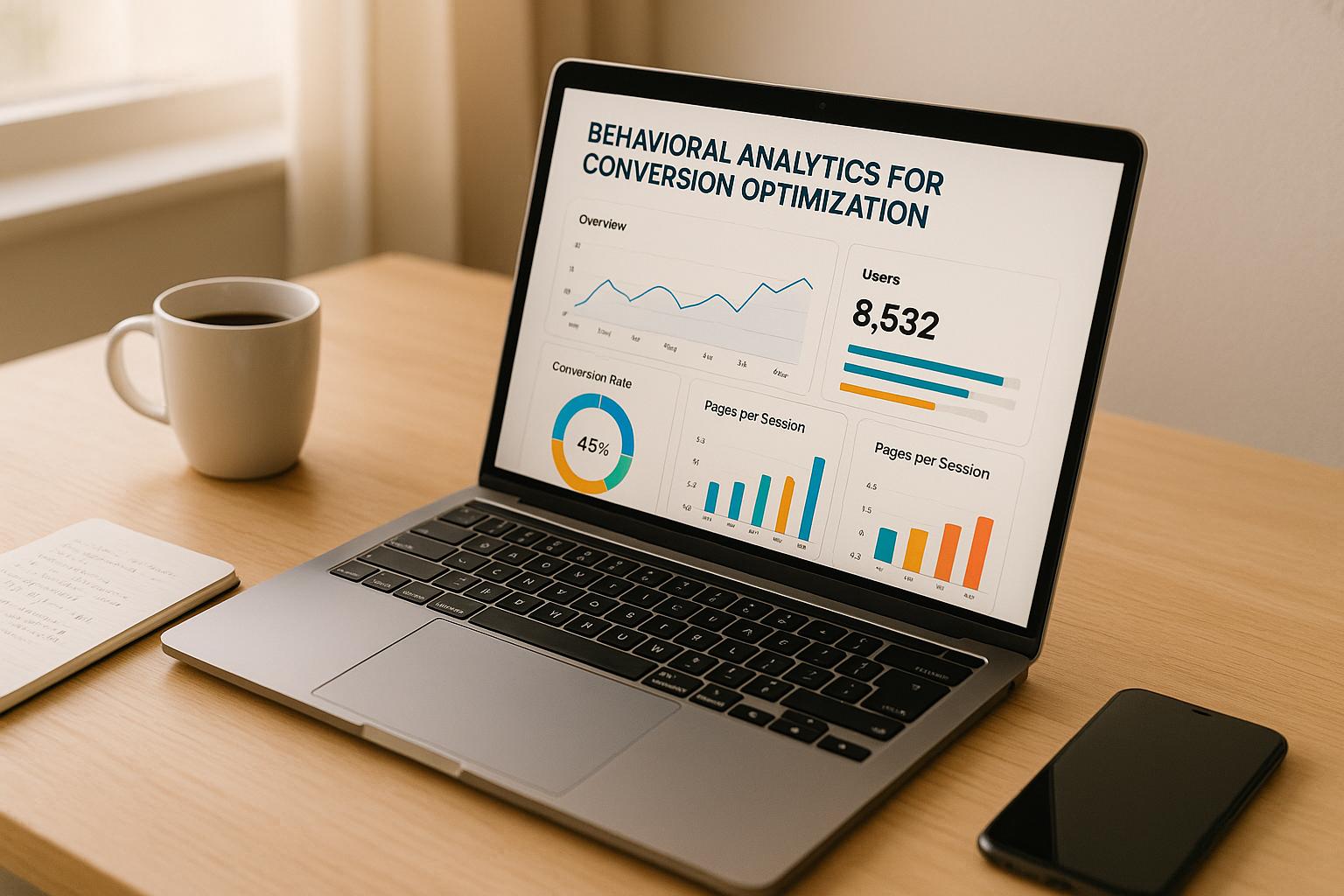
Want to boost your eCommerce conversions? Start with behavioral analytics. This method helps you understand why users act the way they do on your website, turning clicks, scrolls, and pauses into actionable strategies. Here's the quick rundown:
- What is Behavioral Analytics? It digs deeper than basic metrics (like page views) to uncover patterns behind user actions, such as cart abandonment or navigation behaviors.
- Why It Matters: Businesses using behavioral insights see up to 85% higher sales growth and can address challenges like the 26% cart abandonment rate caused by complicated checkouts.
- Key Metrics to Track: Conversion rate, cart abandonment rate, bounce rate, and scroll depth, among others.
- Tools to Use: Popular options like Google Analytics 4, Hotjar, Mixpanel, and Microsoft Clarity help track and analyze user behavior.
- Real-World Examples: Amazon’s behavioral-driven recommendations generate 35% of its revenue. Booking.com uses social proof to increase bookings.
Takeaway: Behavioral analytics helps you identify issues, personalize user experiences, and optimize for mobile and desktop users. Start analyzing today to improve conversions and grow your business.
Behavioral Analytics: Stop Guessing. Get Clarity - Priyanka Ved, Microsoft
Key Metrics and Tools for Behavioral Analytics
To turn behavioral data into meaningful insights, tracking the right metrics and using effective tools is essential. By focusing on precise measurements, businesses can uncover friction points, validate successful strategies, and make continuous improvements to the user experience. This approach ultimately leads to higher conversions and better performance.
Key Behavioral Metrics
Understanding and monitoring specific behavioral metrics can provide a clearer picture of user interactions and help identify areas for improvement:
- Conversion Rate: This metric tracks the percentage of visitors who complete a desired action, making it a cornerstone of eCommerce success.
- Average Order Value (AOV): Measures the average spending per transaction. For instance, BEAR, an American retailer, saw a 16% revenue increase by leveraging cross-selling strategies. Similarly, Paperstone boosted AOV by 18.94% and revenue by 16.8% through bulk discount deals [2].
- Revenue per Visitor (RPV): A combination of conversion rate and AOV, RPV provides a more comprehensive view of performance.
- Cart Abandonment Rate: This metric highlights potential friction during checkout. With nearly 70% of carts abandoned on average [2], addressing issues like complicated checkout processes - responsible for 26% of abandonments [1] - can significantly improve results.
- Add-to-Cart Rate: Indicates how effectively product pages convert visitors into buyers.
- Click-Through Rate (CTR): Measures the success of calls-to-action (CTAs).
- Bounce Rate: Reflects the relevance and engagement of your content.
- Exit Rate: Pinpoints the pages where users commonly leave, revealing potential design or content issues [3].
- Scroll Depth: Tracks how far users scroll on a page, helping determine if key content is being seen.
- Rage Clicks: These occur when users repeatedly click on non-responsive elements, signaling performance issues [3].
- U-Turns: Highlight instances where users quickly navigate back after landing on a page, often due to navigation problems or mismatched content [3].
Once these metrics are clearly defined, the next step is selecting tools to effectively capture and analyze the data.
Tools for Behavioral Tracking
A variety of tools can help businesses understand user behavior and optimize their platforms. Here’s a look at some of the most popular options:
- Google Analytics 4: A go-to for traffic analysis, conversion tracking, and audience insights. The free version offers robust features, while the enterprise-level Google Analytics 360 costs $50,000 annually [6].
- Hotjar: Provides heatmaps, session recordings, and user feedback. Plans start at $35 per month, with a free tier available. For example, a Dutch trampoline store moved a CTA button based on Hotjar data, resulting in a 50% increase in clicks [8][9].
- Mixpanel: Focused on event-based tracking, Mixpanel offers plans starting at $20 per month and has a 4.6/5 rating on G2 [7][9].
- Microsoft Clarity: A completely free tool offering session recordings and heatmaps [7].
- Crazy Egg: Specializes in heatmaps and A/B testing, with pricing starting at $29 per month. It holds a 4.2/5 rating on G2 [6][9].
- VWO (Visual Website Optimizer): Combines behavioral analytics with conversion optimization tools, starting at $393 per month. VWO helped a German retailer achieve a 29% increase in conversion rates and boosted leads by 23% for another client through A/B testing [2][9].
- Mouseflow: Offers session replay and heatmaps, with plans starting at $39 per month and a 4.6/5 G2 rating [5][9].
- Fullstory: Provides data capture and AI-driven insights, available through custom pricing [7].
- Contentsquare: Designed for enterprise clients, this platform delivers digital experience analytics with custom pricing [7].
Most eCommerce businesses start with Google Analytics 4 to establish a solid foundation for tracking. From there, tools like Hotjar can provide visual insights, while Mixpanel offers detailed funnel analysis. Combining quantitative data from traditional analytics with qualitative insights from behavioral tools creates a well-rounded understanding of user behavior [4]. These tools not only measure performance but also guide effective optimizations tailored to your goals and budget.
How to Use Behavioral Analytics to Boost Conversions
Behavioral analytics can help you identify and eliminate obstacles, create tailored experiences, and fine-tune interactions to increase sales. Let’s break down how analyzing user behavior can lead to targeted improvements, personalized experiences, and device-specific optimizations that drive better conversion rates.
Finding and Fixing Conversion Bottlenecks
Pinpointing where users get stuck is a powerful way to improve conversions. With over 65% of users abandoning their carts and eCommerce conversion rates averaging just 3% [12], addressing these roadblocks is critical for success.
Tools like session replays and heatmaps can uncover where visitors are struggling. Session replays allow you to watch real user sessions, showing moments of confusion, repeated clicks on broken elements, or sudden exits. As Matt Scaysbrook, founder of WeTeachCRO, explains:
"Nothing convinces stakeholders better than a video demonstration of users failing on your website." [10]
Heatmaps, on the other hand, reveal which parts of your pages get the most attention and which are ignored, helping you refine layouts and designs for better engagement [11].
Funnel analysis provides a broader perspective, showing where users drop off during their journey. For example, while 44% of users might reach product pages and 15% add items to their cart, most never complete their purchase [12]. Common fixes include offering multiple payment options, simplifying forms, and A/B testing call-to-action designs. A smoother checkout process can drastically reduce cart abandonment.
Personalizing the User Experience
Beyond fixing issues, personalization can make a significant impact on conversions. Behavioral data goes beyond basic demographics, allowing you to segment users based on actions like frequent purchases, cart abandonment, or browsing without buying [13].
Take ClearScore, for instance. By using Amplitude's Funnel Analysis to identify pain points for free users, they doubled their conversion rates to paid subscriptions [14]. Similarly, NBC Universal leveraged behavioral cohorts to deliver tailored viewer experiences, doubling retention rates [14].
Personalization can also enhance email campaigns, adjust website content dynamically, and improve retargeting efforts. For example, an eCommerce fashion retailer segmented customers by style preferences and pricing behavior, achieving a 70% increase in click-through rates and a 45% boost in conversions [13]. Behavioral triggers - like specific user actions - can also guide tailored responses. One SaaS company used product usage data to send personalized onboarding emails, cutting churn by 37% and increasing upsells. A retail chain employed geofencing and purchase history to send real-time SMS offers, leading to a 25% increase in foot traffic and an 18% rise in sales [13].
As Dorothea Gam, CMO at Mouseflow, highlights:
"With behavioral analytics, we move beyond guesswork and gain concrete insights into how users interact with our websites. As much as I love Google Analytics, it only tells part of the story. It's not just about the final numbers; it's about decoding the story behind those numbers, revealing user behavior, motivations, and experiences. This is where behavioral analytics truly shines." [14]
Optimizing Mobile and Desktop Experiences
Behavioral insights also help tailor strategies for mobile and desktop users, ensuring a seamless experience across devices. Mobile commerce is expected to hit $534.18 billion in the US by 2024, making up around 40% of total eCommerce sales [15]. But mobile and desktop users behave differently, requiring unique approaches.
Mobile sessions are shorter - averaging 3 minutes and 19 seconds compared to 13 minutes and 10 seconds on desktop. Mobile apps, however, convert better than mobile websites, with a 3.5% conversion rate compared to 2% [15][17]. Behavioral analytics can reveal mobile-specific challenges, like the fact that users scroll through only 76% of a page on average [15]. To address this, critical information and calls-to-action should be placed higher up. For example, apparel brand Hugo Boss used mobile analytics to identify confusion about their sub-brands. By adding a brand toggle button and testing visual cues, they improved user understanding from 10% to 92%.
Larger retailers report that mobile accounts for 52.8% of online sales, while smaller retailers see a 43% share [16]. In some categories, mobile shopping dominates - 77% of personal care sales and 68.2% of grocery sales happen on mobile devices [16]. As Vivek Pandya, lead analyst at Adobe Digital Insights, notes:
"Adobe Analytics data shows that consumers have embraced mobile shopping for purchases that are more frequent and lower in price, but we expect larger purchases will begin to shift towards smaller screens as well." [16]
Desktop users, in contrast, tend to spend more time researching. They value detailed product information and reviews, often juggling multiple tabs before completing a purchase. Balancing insights from both mobile and desktop behaviors is essential, especially since 85% of consumers expect mobile experiences to match or exceed desktop interfaces [18]. Behavioral analytics helps meet these varying needs, ensuring both user groups have an optimized journey.
sbb-itb-d7b5115
Connecting Behavioral Insights with Financial Planning
Behavioral analytics isn't just about improving user experiences - it also plays a critical role in shaping strategic financial decisions. By analyzing how customers engage with your website, you can uncover growth opportunities and decide when additional funding could help you scale faster. Let’s look at how specific user behaviors can highlight financial opportunities.
Behavioral Triggers for Financing Tools
Behavioral analytics can reveal patterns that indicate when your business might benefit from additional capital. For example, frequent clicks on a "show all" button might suggest users are struggling to navigate your site. Fixing this could lead to higher conversions. A great example comes from the Ukrainian fashion eCommerce store Intertop. The UX/UI agency Turum-burum used heatmaps to study category pages and found that most users clicked "show all" instead of browsing individual product listings. After A/B testing new filters to simplify navigation, they saw a 55% increase in conversions [19].
Behavioral data can also highlight seasonal trends, helping you prepare for spikes in demand. With studies showing that up to 78% of online purchases are impulse buys [21], having the right inventory during peak periods can significantly boost revenue.
The global behavioral analytics market is expected to hit $13,108.4 billion by 2034, with a CAGR of 27.5% [20]. This rapid growth reflects how businesses are increasingly relying on these insights for decision-making. Sudip Saha, managing director at Future Market Insights, emphasizes the value of these tools:
"The ability to predict customer actions and detect potential threats through data insights is invaluable, particularly in today's digital age. As AI and ML technologies mature, the market for behavioral analytics will only continue to grow, offering exciting opportunities for innovation." [20]
Using Data to Support Business Scaling
Behavioral data doesn’t just identify problems - it also shows where investments can have the biggest impact. For instance, session recordings can highlight where users face obstacles during onboarding, enabling you to prioritize fixes that directly improve revenue.
Take DashThis as an example. By using session replays, they identified onboarding challenges and introduced features like a search bar, pop-ups, and instructional videos. This led to a 140% increase in customer satisfaction [19].
Behavioral insights can also guide product development decisions. Gym-pass platform Hussle surveyed users to understand why they were canceling subscriptions. When 26% of respondents said they were switching to local gym memberships, Hussle added a feature allowing users to purchase memberships directly through their platform. This change reduced churn and improved retention [19].
Implementing these kinds of changes often requires upfront investments in technology, marketing, or inventory. Flexible financing options can help businesses act quickly on these insights, ensuring they capitalize on user behavior.
Onramp Funds as a Growth Partner
Pairing behavioral insights with flexible financing can drive immediate and meaningful growth. Onramp Funds specializes in revenue-based financing for eCommerce businesses, offering repayments that adjust based on your sales performance. This approach ensures funding aligns with actual business outcomes rather than projections.
Onramp Funds provides fast access to capital - often within 24 hours - and integrates seamlessly with platforms like Amazon, Shopify, BigCommerce, WooCommerce, Squarespace, Walmart Marketplace, and TikTok Shop. This integration offers real-time visibility into how your changes are impacting revenue.
For businesses generating at least $10,000 in monthly sales, Onramp Funds offers transparent fee structures with no hidden charges, allowing you to retain full ownership of your business while accessing the capital you need to grow.
For instance, if behavioral analytics reveal that customers are three times more likely to complete a purchase when faced with a 10-minute deadline [21], you might invest in features like countdown timers to create urgency. With the right financing, you can implement these changes quickly, ensuring your investments are backed by clear data and delivering measurable results. Together, behavioral analytics and flexible financing can form a powerful strategy for scaling your business effectively.
Best Practices for Implementing Behavioral Analytics
To make the most of behavioral analytics, it’s important to follow a structured approach. By focusing on effective data collection, respecting user privacy, and continuously refining strategies, you can improve user experiences and conversion rates.
Ensuring Privacy and Compliance
Transparency is key when it comes to data collection. Research highlights that non-compliance with GDPR can cost businesses in the EU up to €1.6 million, while 81% of consumers express concerns about how their data is handled. On the flip side, 70% of consumers are more likely to engage with brands that clearly outline their data practices, and 65% abandon their carts if they feel their information isn’t being handled properly [22].
To build trust, use clear and explicit consent mechanisms during account registration and checkout. For instance, include checkboxes that explain what data is being collected and why. Keep your privacy policy straightforward and easy to understand.
Empower customers by giving them simple tools to view, edit, or delete their personal data and withdraw consent whenever they choose. Collect only the data you absolutely need - this not only protects user privacy but also reduces the chance of breaches by 40%.
Strengthen your data security by using robust encryption for data in transit and at rest, implementing multi-factor authentication, and conducting regular vulnerability assessments. These measures can reduce breach risks by 27% and cut unauthorized access by up to 70%. Additionally, audit your third-party vendors regularly, as 59% of breaches in 2025 involved external partnerships [22]. A secure data environment not only safeguards user trust but also supports better conversion strategies.
Creating a Continuous Optimization Loop
Set clear objectives and track key metrics such as cart abandonment rates, checkout times, and overall engagement. Start collecting behavioral data as early as possible to gain actionable insights.
Mapping customer journeys is an effective way to pinpoint motivations and friction points. This helps you focus your analytics on areas that can have the greatest impact. For example, weekly heatmap reviews can uncover usage trends, while daily session recordings can highlight obstacles users face.
Use targeted micro-surveys to gather feedback, such as exit-intent surveys or questions triggered after users scroll through a significant portion of a page. Then, form hypotheses based on observed behaviors - small tweaks, like improving navigation, can make a big difference, boosting product findability by up to 72% [23].
Measure the impact of every change by comparing metrics like conversion rates, bounce rates, and engagement levels before and after implementation. The goal isn’t to collect endless amounts of data but to turn the data you have into actionable steps that lead to meaningful improvements.
Keep refining your approach by analyzing user behavior, running A/B tests, and collecting ongoing feedback. Engage your entire team - customer service, product development, and beyond - to ensure insights are shared and applied across the board. This creates a culture of continuous improvement, setting the stage for smarter decisions and consistent growth.
Conclusion: Growing Your Business with Behavioral Analytics
Behavioral analytics is reshaping how eCommerce businesses understand and serve their customers. Companies that use these insights are seeing impressive results - 85% higher sales growth and over 25% better gross margins compared to their competitors [24][14]. By turning raw user data into actionable strategies, businesses can achieve measurable growth and create meaningful customer experiences.
Key Takeaways
Traditional web analytics often fall short when it comes to understanding customer behavior. Behavioral analytics goes deeper, offering clear insights into how users interact with websites. It reveals the "why" behind the numbers, helping businesses uncover user motivations and refine their strategies.
The stats speak for themselves: 68% of shoppers expect tailored experiences, and 91% are more likely to shop with brands that provide personalized recommendations. Behavioral data also tackles major issues like cart abandonment - 26% of shoppers cite complicated checkout processes as a reason for leaving [25][26][1].
To get the most out of behavioral analytics, focus on three main areas: identifying what’s preventing conversions, personalizing the user experience, and aligning these insights with your financial planning. With the right data, these challenges transform into opportunities for growth.
Behavioral insights don't just boost immediate conversions - they also help with smarter inventory management, better marketing allocation, and even determining when to seek additional funding. This comprehensive understanding of your business lays the groundwork for sustainable growth.
Next Steps for eCommerce Businesses
Ready to dive in? Start by clearly defining your goals and mapping out your customer journeys. Gather data that directly impacts your bottom line - patterns in cart abandonment, checkout times, and how users discover products. The key is acting quickly on these insights rather than getting bogged down in endless data collection.
Behavioral triggers can also guide your financial decisions. For example, if you notice seasonal demand spikes or top-performing product categories, having access to flexible funding becomes essential. Onramp Funds offers revenue-based financing that aligns with your sales performance, making it easier to invest in inventory or marketing when your behavioral data highlights growth opportunities. Pairing precise analytics with smart financial tools strengthens your overall strategy and ensures you're optimizing every part of the customer journey.
As the eCommerce world evolves, so should your approach. With smartphones now driving nearly 70% of retail website visits and 73% of consumers open to trying new brands [24], your behavioral analytics strategy must adapt to these trends while staying laser-focused on what drives conversions for your audience.
Ultimately, success comes from ongoing optimization, not one-time fixes. Behavioral analytics gives you clear evidence of what’s stopping users from converting. Use this data to create a culture where every decision - whether it’s a website update or a funding choice - is rooted in user behavior. This approach positions your business to thrive in an increasingly competitive market.
FAQs
How can businesses use behavioral analytics to reduce cart abandonment and boost conversions?
Businesses can use behavioral analytics to tackle cart abandonment and boost conversions by pinpointing and addressing trouble spots in the customer journey. Tools like heatmaps and session recordings are invaluable for spotting areas where users struggle - whether it’s confusing navigation, unclear pricing details, or an overly complicated checkout process. Fixing these problem areas can lead to a smoother, more user-friendly shopping experience.
On top of that, providing real-time support through AI-powered chatbots or live agents can quickly answer customer questions, stopping potential drop-offs in their tracks. Personalized follow-ups, like targeted email reminders or exclusive discounts, can also help recover abandoned carts and re-engage shoppers. These tactics not only solve immediate problems but also improve the overall shopping experience, leading to better conversion rates and happier customers.
What are the best tools for understanding user behavior on eCommerce platforms, and how do they compare?
When it comes to understanding user behavior on eCommerce platforms, there’s no shortage of tools to choose from, each tailored to different goals. Google Analytics is a go-to option for tracking website traffic and user interactions, offering a detailed breakdown of customer journeys. If you’re looking to pinpoint friction points or improve your site’s usability, Hotjar is an excellent choice with its heatmaps and session recording capabilities. For those who want to dive deeper into user segmentation and engagement, Mixpanel is designed to track how users interact with your platform over time. Meanwhile, FullStory provides a comprehensive view of user activity through automatic data capture and session replay, requiring minimal setup.
Each tool brings something different to the table: Google Analytics focuses on traffic analysis, Hotjar shines in visualizing user behavior, Mixpanel digs into engagement metrics, and FullStory emphasizes a complete, hands-off approach to capturing interactions. Your choice should align with your specific business objectives and the kind of insights you need to refine your platform.
How does using behavioral analytics for personalization improve user experience and boost sales in eCommerce?
Behavioral analytics plays a key role in helping eCommerce businesses create tailored shopping experiences. By examining user interactions, companies can gain insights into individual preferences and behaviors. This knowledge allows them to fine-tune product recommendations, craft targeted marketing messages, and adjust website content to resonate with each customer, making the shopping journey more engaging and relevant.
Tailored experiences do more than just please customers - they deliver real business benefits. Research indicates that personalization can boost customer lifetime value by up to 20% and increase revenue by as much as 40%. By addressing specific customer needs, businesses can improve conversion rates, strengthen brand loyalty, and set the stage for consistent sales growth.
Related Blog Posts
Onramp Funds
Funding built around your sales
Connect your store and see what you qualify for. Repay as a percentage of sales, with no personal credit check.
Funding in as little as 24 hours.
