

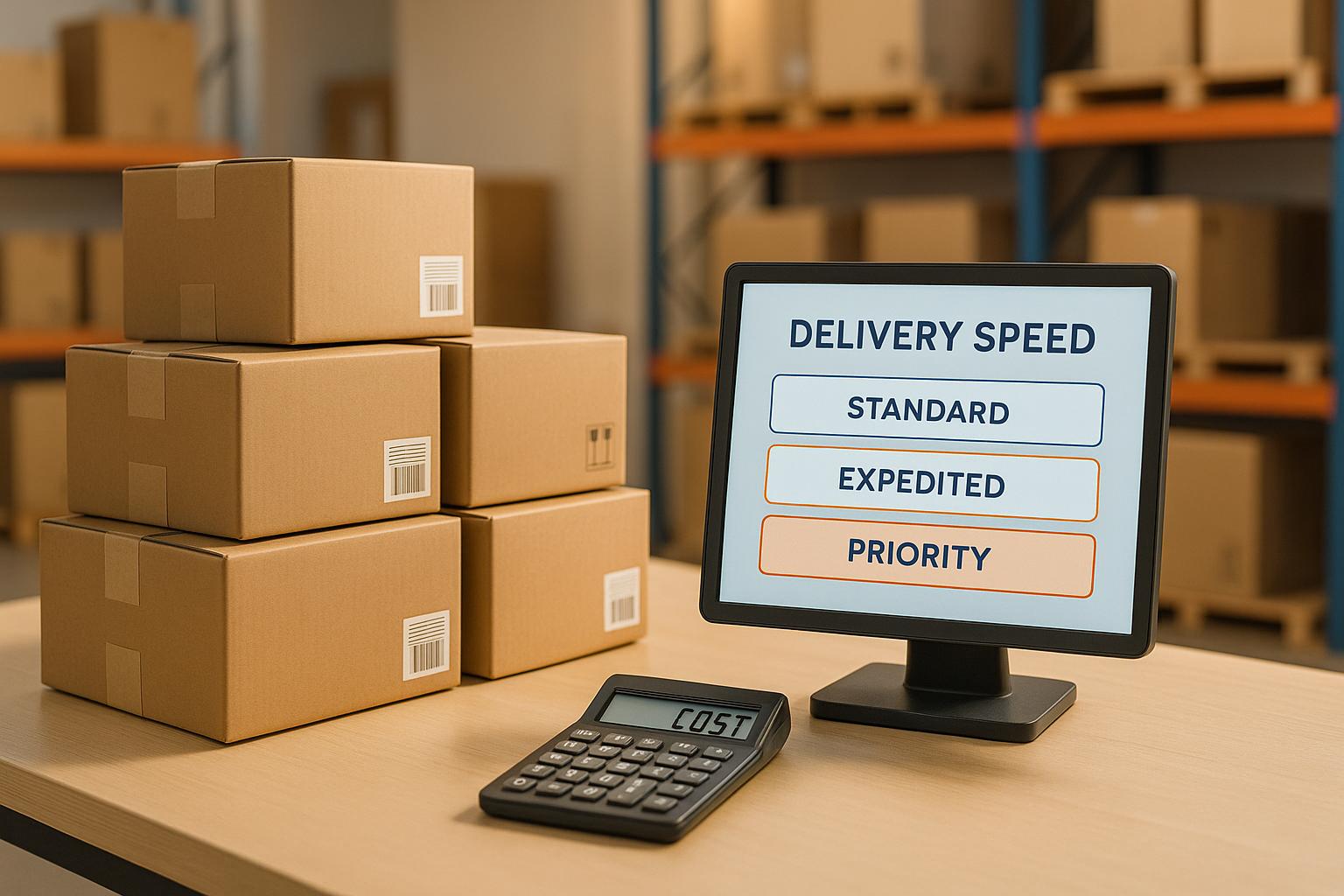
When it comes to shipping, finding the right balance between speed and cost is critical for eCommerce success. Customers demand fast delivery, but rising carrier costs make it challenging to meet expectations without cutting into profits. Here’s a quick summary of how to manage this balance effectively:
- Packaging Matters: Use custom-sized, lightweight materials to reduce dimensional weight fees and save up to 20% annually.
- Carrier Selection: Compare rates, negotiate discounts, and explore hybrid shipping options for better pricing.
- Inventory Placement: Store products closer to customers to reduce transit times and shipping zones.
- Flexible Shipping Options: Offer tiered choices like free standard shipping and paid expedited options to cater to different customer needs.
- Leverage Technology: Automate order processing and carrier selection to improve efficiency and reduce errors.
- Financial Planning: Use tools like Onramp Funds for flexible financing to invest in shipping improvements without straining cash flow.
How To Cut Shipping Costs and Delivery Times For Ecommerce
How to Reduce Shipping Costs Without Hurting Quality
Keeping shipping costs in check doesn’t have to mean sacrificing the customer experience. With carrier costs climbing by 6% globally [4], finding efficient ways to cut costs is crucial for staying competitive while still meeting customer expectations.
Smarter Packaging Strategies
The size and weight of your packaging can have a huge impact on shipping costs. Carriers often base their fees on dimensional weight, meaning you’re charged for the space your package takes up, not just its actual weight. Oversized boxes can lead to paying for air - not a smart move. The solution? Invest in custom packaging tailored to your product dimensions.
Switching to lightweight, biodegradable materials can also help lower weight-based charges while appealing to eco-conscious customers. For businesses shipping multiple items, "ships in own container" (SIOC) packaging - where the product’s packaging doubles as the shipping box - can be another cost-effective option.
Practical steps include using a postage scale to weigh packages accurately and training your team to select the right box size every time. Buying packaging supplies in bulk and reusing sturdy boxes for internal shipments can stretch your budget further. According to ShipSage, businesses that optimize their packaging setup can trim up to 20% off their annual shipping costs [7].
Choosing the Right Shipping Carriers
Not all carriers are created equal, so comparing their pricing, delivery speeds, reliability, and service areas is key. Negotiating with multiple carriers can work in your favor, as many offer discounts for higher shipping volumes or hybrid shipping options that combine services for better rates.
Start by analyzing your shipping volume and destination data to strengthen your bargaining power. Request volume-based discounts and explore economy shipping options, which may take a bit longer but often cost much less. Also, don’t overlook additional fees and customer service quality - sometimes a carrier with slightly higher upfront rates can save you money in the long run if they have fewer hidden fees and better support.
Using shipping rate comparison tools or software can simplify this process, helping you find the best deals quickly. And don’t forget to revisit your contracts regularly - carrier pricing and your shipping needs can change over time, so staying proactive can lead to better terms.
Optimizing Shipping Zones for Savings
Shipping zones, which carriers use to calculate rates, are another factor to consider. The farther a package travels, the more it costs. Focusing on closer delivery regions can significantly reduce your shipping expenses. If your customers are concentrated in specific areas, offering local promotions or incentives can further cut costs.
For a more advanced approach, consider distributing your inventory across multiple fulfillment centers. According to SaleHoo, using local suppliers and fulfillment centers can cut shipping times by 30–50% compared to sourcing from distant locations [8]. Even if you don’t have multiple warehouses, understanding your carrier’s zone maps can uncover opportunities to save. Different carriers may assign varying zones - and costs - to the same destination.
Data analytics can help identify customer clusters, making it easier to decide where to position your inventory. While setting up multi-warehouse fulfillment may require an initial investment, the long-term savings in shipping costs and faster delivery times often make it worthwhile. These strategies not only reduce costs but also lay the groundwork for improving delivery speed, which we’ll explore next.
Methods to Speed Up Your Shipping
Speeding up shipping isn't just about getting packages to customers faster - it's about boosting satisfaction and staying ahead of the competition. By using smart technology and refining operations, you can make fulfillment faster and more efficient.
Technology Tools That Speed Up Order Processing
Tech tools like Warehouse Management Systems (WMS) and Order Management Systems (OMS) can take the guesswork out of fulfillment. These systems automate inventory tracking and consolidate orders from multiple sales channels, which reduces errors like mispicks and ensures accurate orders. Fewer mistakes mean fewer delays caused by order corrections or reshipments [2].
Automation can also handle large volumes of orders at once. Features like batch processing and automation rules allow businesses to assign carriers automatically, create shipping labels, and send tracking updates in seconds [1]. For example, real-time rate comparison tools such as ShipAccel integrate with platforms like Shopify, BigCommerce, and WooCommerce to pull order data and query carrier APIs. What used to take 5–10 minutes can now be done in moments [1].
Other time-saving strategies include scheduling carrier pickups to streamline collections and using prepaid labels to skip the hassle of calculating postage or processing payments [4].
Working with Multiple Carriers
Once automation improves your processes, expanding your carrier options is the next step. Relying on a single carrier might limit your delivery flexibility. A multi-carrier approach allows you to compare rates and transit times across different zones, helping you secure faster and more cost-effective delivery options [2]. Choosing carriers with strong local networks can also reduce transit times and save on costs [5].
Hybrid shipping services take this a step further by letting you switch carriers depending on factors like cost, speed, package size, or weight. Automated shipping software can route each order to the fastest or most economical carrier, ensuring every package takes the quickest path to its destination [2][4].
Smart Inventory Placement
Where you store your inventory can make or break your shipping times. Strategically positioning inventory closer to your customers can drastically cut delivery times [5][4]. In the U.S., shipping zones typically range from Zone 1 to Zone 8, with Zone 1 being the fastest. By placing inventory in locations that allow most orders to ship from Zones 1 or 2, you can turn multi-day cross-country deliveries into quicker 1–2 day regional shipments.
For businesses with customers on both coasts, having fulfillment centers on the East and West Coasts can eliminate the need for long-distance transfers. You can also encourage pre-orders to ensure orders are ready to ship immediately.
This approach not only speeds up delivery but also reduces shipping costs, creating a win-win for both your business and your customers. Together, these strategies improve operations while keeping customers happy.
sbb-itb-d7b5115
How to Balance Speed and Cost Effectively
Finding the right balance between shipping speed and cost plays a key role in any shipping strategy. This balance ties directly into the packaging and carrier selection methods outlined earlier, ensuring a seamless approach to managing logistics.
Creating Multiple Shipping Options
Providing a variety of shipping choices can boost both conversion rates and customer satisfaction. One effective way to do this is by offering tiered options, such as standard economy shipping alongside expedited services.
For example, you could set a free shipping threshold - like offering free shipping for orders over $50.00 - while charging extra for faster delivery options. This kind of structure not only encourages larger purchases but also gives customers the flexibility to choose the service that fits their needs.
Using real-time rate calculators at checkout can further enhance the customer experience. These tools provide accurate pricing and delivery estimates instantly, eliminating surprises and building trust. They simplify the decision-making process for customers while ensuring transparency.
When structuring shipping options, it’s important to understand your audience. Business customers often prioritize speed, while budget-conscious shoppers might prefer economy options. Clearly outlining the delivery times and costs for each choice helps customers make informed decisions.
Flexible Pricing Based on Real Costs
Many eCommerce businesses are now adopting dynamic pricing models that reflect actual shipping costs. This approach ensures transparency while also aligning pricing with real-world carrier rates.
One way to implement this is by using shipping software that integrates with multiple carriers. Such tools can compare rates in real time and automatically select the most cost-effective option. Dynamic pricing adjusts based on factors like shipping zones, which can help avoid overcharging nearby customers or undercharging for distant deliveries. Zone-based pricing makes it possible to charge lower rates for local shipments and higher rates for those farther away.
Tracking key metrics - such as average shipping cost per order, delivery accuracy, and cart abandonment rates due to shipping options - can help identify which strategies are driving results and where adjustments may be needed.
Case Study: How One Business Found the Right Balance
A mid-sized home goods retailer faced rising shipping costs that were eating into its profits. To address this, the company adopted a multi-carrier strategy using automated software to select the most cost-effective carrier for each shipping zone. This change led to a 15% reduction in shipping expenses while maintaining delivery speed [2].
The retailer also restructured its shipping options based on customer behavior. They introduced three tiers: a standard option with a longer delivery window, a moderately priced expedited service, and a premium next-day delivery option. Customers responded positively, with many increasing their order sizes to qualify for free shipping. The clear communication of delivery expectations also improved overall satisfaction.
How Financial Planning Helps Shipping Optimization
Effective financial planning is the backbone of shipping optimization. Without proper cash flow or access to flexible funding, even the most well-thought-out strategies can falter. Businesses need capital not only to implement improvements but also to handle unexpected costs, making agile financial management just as important as strategic planning.
Managing Cash Flow for Shipping Costs
Shipping is one of the largest expenses for eCommerce businesses, making it essential to maintain steady cash flow to cover these recurring costs while still being able to invest in improvements. The challenge becomes particularly intense during peak seasons when a surge in orders can quickly deplete cash reserves. This creates a tricky situation: businesses need more capital to manage increased order volumes, but payments for those orders often come too late to cover immediate shipping and fulfillment expenses.
Tracking key financial metrics can help businesses navigate these challenges. Metrics such as average shipping cost per order, shipping expenses as a percentage of revenue, and seasonal patterns offer insights for better budgeting. For instance, if dimensional weight charges are driving up costs, a business may need immediate funds to invest in custom packaging that reduces box size and weight, ultimately lowering shipping expenses.
Analyzing historical data alongside real-time carrier information allows businesses to forecast shipping costs more accurately. This enables dynamic budgeting and quick adjustments to pricing or shipping policies when unexpected cost spikes occur.
Successful eCommerce businesses often maintain cash reserves or access flexible financing to absorb sudden cost increases, such as carrier rate hikes or fuel surcharges. Having this financial cushion also allows them to negotiate volume-based discounts with carriers or implement multi-carrier strategies without disrupting cash flow.
How Onramp Funds Supports Your Shipping Goals
Flexible funding options are crucial for overcoming these financial hurdles. Traditional loans, with their fixed repayment schedules, often clash with the seasonal nature of sales. Revenue-based financing offers a better fit, with repayments structured as a percentage of daily sales, allowing for greater flexibility.
Onramp Funds provides fast, equity-free financing within 24 hours, tailored specifically for eCommerce businesses looking to enhance their shipping operations. This quick access to capital is invaluable for negotiating carrier rates, investing in automation, or expanding fulfillment centers.
The platform integrates seamlessly with major eCommerce platforms like Amazon, Shopify, BigCommerce, WooCommerce, Squarespace, Walmart Marketplace, and TikTok Shop. With over 3,000 eCommerce loans issued, Onramp Funds understands the unique cash flow challenges that online sellers face when balancing shipping speed and cost.
Flexible repayment terms adjust automatically based on business performance. During slower periods, payments decrease, easing the financial strain that fixed loan payments can impose. This flexibility is particularly beneficial for businesses investing in shipping optimization, allowing them to scale operations in step with sales growth.
Funds can be allocated directly to shipping-related improvements, such as upgrading warehouse management systems, purchasing better packaging materials, expanding inventory across multiple fulfillment centers, or managing increased shipping volumes during peak seasons. For example, a Shopify store experiencing rapid growth could use Onramp Funds to finance eco-friendly packaging, negotiate better carrier rates through volume commitments, or expand into new fulfillment centers - improving both delivery speed and cost efficiency.
Transparent fees ranging from 2–8% ensure there are no hidden costs, making it easier for businesses to calculate the return on investment for their shipping improvements. This clarity helps prevent financing costs from eating into the benefits of optimization efforts.
Based in Austin, the Onramp Funds team provides personalized support to help businesses make quick decisions and access capital rapidly. Whether covering unexpected carrier surcharges or taking advantage of opportunities to secure better rates, having flexible financing ensures businesses can act decisively without compromising their shipping strategies.
Conclusion: Main Points for Balancing Shipping Speed and Cost
Summary of Key Methods
A well-thought-out shipping strategy is essential for thriving in the competitive world of eCommerce. This guide covered four critical methods to help businesses strike the right balance between shipping speed and cost: smart packaging, strategic carrier selection, efficient inventory placement, and tiered shipping options.
Packaging optimization is a key way to cut costs. By using packaging that fits products snugly, businesses can reduce dimensional weight charges. For smaller items, swapping boxes for poly mailers can significantly lower shipping expenses due to their lighter weight[3]. While custom packaging may require an upfront investment, it can lead to substantial long-term savings on each shipment.
Strategic carrier selection allows businesses to leverage multiple carriers for better flexibility and coverage. Negotiating service-level agreements ensures reliable delivery times[6]. For instance, USPS is often the best choice for lightweight domestic packages, but other carriers may offer better rates for specific zones or package types[3]. Comparing carrier options for each shipment is crucial to finding the most cost-effective solution[3].
Inventory placement plays a major role in reducing both transit time and shipping costs. Storing inventory in multiple fulfillment centers closer to key customer clusters shortens delivery distances[6]. Using data analytics to identify these clusters helps businesses position inventory strategically, cutting costs while improving delivery speed[8].
Tiered shipping options provide customers with choices, encouraging higher order values through free shipping thresholds while allowing businesses to recoup costs for expedited shipping[4]. This approach not only improves customer satisfaction but also enhances conversion rates by giving buyers more control over their delivery options.
Technology integration ties these strategies together. Automation tools streamline order processing and help businesses consistently choose the most cost-effective shipping options. Together, these methods equip businesses with the financial flexibility needed to refine and advance their shipping strategies.
Consider Financial Support for Growth
While operational improvements are essential, having access to financial resources is just as important for scaling these strategies. With 58% of merchants citing shipping costs as their top business challenge[3] and shipping expenses rising 10% from 2021 to 2022[3], flexible financing becomes a critical tool for staying competitive.
Traditional financing often falls short for eCommerce businesses, as it doesn’t align with the seasonal nature of their cash flow. Revenue-based financing, on the other hand, adjusts repayment schedules based on sales performance, providing much-needed flexibility. This approach offers breathing room during slower sales periods and supports growth during peak seasons.
Onramp Funds specializes in fast, equity-free financing tailored to the unique needs of eCommerce businesses. With over 3,000 loans issued, they understand the cash flow pressures online sellers face when balancing shipping speed and cost[9].
"Applied, got our offer, and had cash in our bank account within 24 hours. Their Austin, TX based team was very professional and helped me deploy the cash to effectively grow our business." - Nick James, CEO Rockless Table[9]
Their flexible repayment structure adapts to business performance, making it easier to invest in critical areas like packaging upgrades, carrier negotiations, inventory expansion, or technology adoption without disrupting daily operations.
"Onramp offered the perfect solution with revenue-based financing to secure the capital we needed to invest in inventory and pay it back at a reasonable time frame once we made sales. The process was quick, easy, and the support was great." - Jeremy, Founder and Owner of Kindfolk Yoga[9]
Whether it’s negotiating better shipping rates, implementing automation tools, or expanding fulfillment centers, having access to flexible capital ensures businesses can act decisively. The ultimate goal is to create a sustainable balance between speed and cost, meeting customer expectations while supporting long-term growth in an increasingly competitive market.
FAQs
What are the best strategies for eCommerce businesses to negotiate better shipping rates while balancing speed and cost?
To get better shipping rates, eCommerce businesses can implement a few smart strategies. First, compare rates from multiple carriers to find the best fit for your shipping needs. Use your shipping volume as leverage to negotiate discounts, and make sure your packaging is as efficient as possible to avoid extra dimensional weight charges. Building strong relationships with carriers and securing long-term contracts can also lead to more favorable terms.
For sellers aiming to improve cash flow and invest in critical areas like shipping, Onramp Funds provides fast, equity-free financing specifically designed for eCommerce businesses. With flexible repayment options, they help businesses manage growth and operational expenses with ease.
How can I strategically manage inventory placement to save on shipping costs and improve delivery times?
Getting inventory placement right can make a huge difference in balancing shipping speed and costs. By strategically housing products in multiple fulfillment centers closer to your customers, you can cut down on shipping distances and times. This approach doesn't just speed up deliveries - it also helps trim shipping expenses.
Leveraging tools like warehouse management systems or analytics platforms can pinpoint high-demand areas, guiding you on where to store inventory effectively. And by keeping a close eye on sales data, you can adjust stock levels to match seasonal patterns or changing customer preferences, ensuring you're always ready to meet demand without unnecessary delays or costs.
How can revenue-based financing help eCommerce businesses handle fluctuating shipping costs and optimize logistics?
Revenue-based financing from Onramp Funds offers eCommerce businesses a fast, equity-free way to handle fluctuating shipping costs and enhance logistics. This type of funding can help cover shipping expenses, upgrade logistics tools, or expand operations - all without putting unnecessary pressure on your cash flow.
What makes it stand out? Repayments are linked to a percentage of your sales, so during slower periods, payments adjust accordingly. This approach allows you to prioritize growth while keeping operational costs manageable.
Related Blog Posts
Onramp Funds
Funding built around your sales
Connect your store and see what you qualify for. Repay as a percentage of sales, with no personal credit check.
Funding in as little as 24 hours.
